


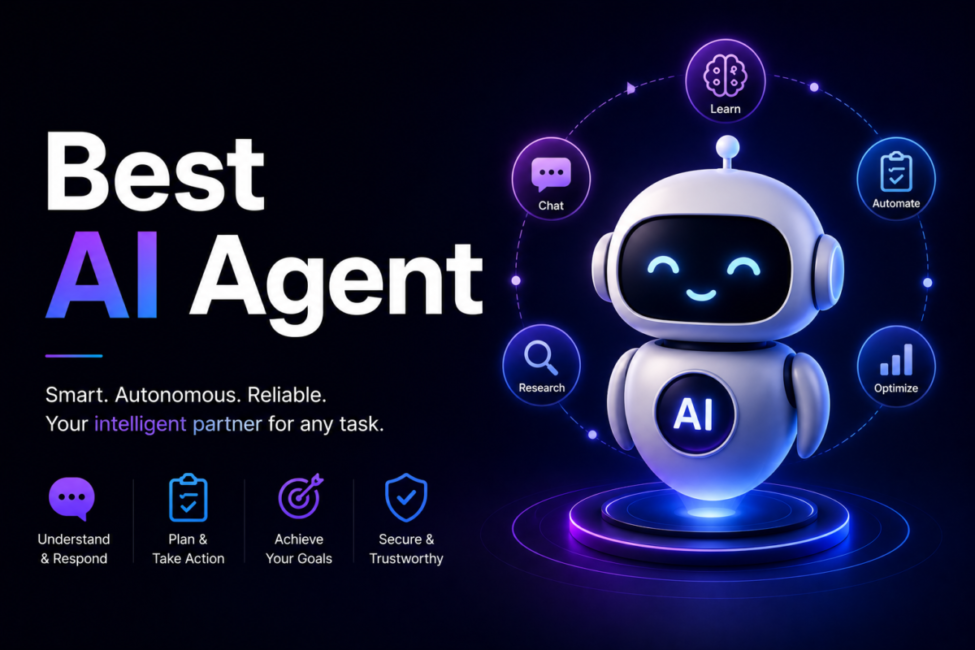
| Quick answer: There is no single best AI agent for everyone. In 2026, Salesforce Agentforce and Microsoft Copilot Studio lead for enterprises, Manus and Lindy win for no-code teams, and LangGraph is the safest developer framework. Pick on tool access, governance and how the agent fits the systems you already run, not on a slick demo. |
An AI agent is software you can delegate a goal to: it reasons, plans the steps, uses your real tools, and completes multi-step tasks with little supervision, going far beyond a chatbot that only answers questions.
Related: build your own with a low-code AI platform, or see the best agents for browser automation.
How we compare: our team runs each platform against a real, bounded workflow rather than a scripted demo, weighing tool access, governance controls, reliability and total cost of ownership. Pricing and adoption figures below are current as of July 2026 and link to primary sources.
Affiliate disclosure: some links in this guide may be affiliate links. We may earn a commission if you sign up, at no extra cost to you. It never changes our rankings or which tools we recommend.
Table of Contents
What is an AI agent, and why does it matter now?
The word “agent” gets stuck on everything, so a working definition helps. A true agent has three things a chatbot lacks: autonomy (it decides the next step instead of waiting for you), tool use (it can send an email, update a record, run a query or browse the web, not just talk about it), and persistence (it runs a multi-step task over time and recovers from problems). If a system only reads your data or only answers questions, it is an assistant. If you want the full conceptual background, our guide to what agentic AI is unpacks the paradigm, and AI agent vs AI assistant draws the line precisely.

How AI agents actually work
Almost every agent follows the same loop: perceive, reason, plan, act, observe, then repeat. It takes in a goal, the model reasons about what needs to happen, it plans a sequence, it calls a tool, it observes the result, and it loops back to decide the next move until the goal is met or it asks for help. Three components make that loop reliable: tools (the agent’s hands), memory (context across steps and sessions), and orchestration (the control logic that picks tools, handles errors and coordinates sub-agents). The frontier is moving toward multi-agent systems and open standards such as the Model Context Protocol (MCP) and agent-to-agent (A2A) communication, which let agents plug into tools and delegate to each other consistently.
Why is 2026 the year AI agents went mainstream?
The numbers moved fast. The global AI agents market reached roughly $10.9–12 billion in 2026, up from about $7.6 billion a year earlier, growing at a 44–46% CAGR and projected to pass $90 billion by 2032, according to aggregated 2026 agentic-AI statistics.
Three technical changes sit under those numbers. Models became reliable enough at tool use to call an API and handle the response without supervision. Long context stopped agents forgetting the middle of a task. And the major vendors shipped governed platforms — Agentforce, Copilot Studio — so an agent could inherit existing permissions instead of needing a bespoke security model. The demand was there in 2024; the plumbing arrived in 2026.
What does an AI agent look like in practice?
Consider Iris, a customer-success operations lead at a mid-size SaaS company. Every Monday she used to spend two hours pulling renewal dates from the CRM, cross-checking support tickets, and drafting outreach for at-risk accounts.
Now an agent does that pass before she logs in. It reads the renewal dates from the CRM, checks each account’s recent support tickets and product usage, ranks the accounts by risk, and leaves a drafted outreach email in her queue for each one it flags — with the reason it flagged them attached. What took two hours takes about ten minutes of review.
Crucially, Iris keeps a human in the loop. The agent never sends anything on its own; it prepares the work and waits for her approval, so a wrong judgment stays a wrong draft, not a wrong email to a customer.
This example is a composite of the agent deployments we see most often, not a single client account; the figures are typical rather than measured from one engagement.
Which is the best AI agent for your team right now?
Salesforce Agentforce — best enterprise CRM agent
Salesforce Agentforce is the strongest choice for autonomous work inside the systems where your customer data already lives. Its agents are “born with” context, and the Atlas Reasoning Engine plans and executes across sales, service and commerce with a dedicated trust layer for data masking and zero-retention controls. Pricing is usage-based: about $2 per customer-facing conversation, or Flex Credits at roughly $0.10 per action, with the Agentforce 1 tier starting near $550 per user per month.
Microsoft Copilot Studio — best for the Microsoft ecosystem
Microsoft Copilot Studio has grown from a chatbot builder into a full agentic orchestration platform wired into Microsoft 365, Teams, Outlook, SharePoint and Dynamics. It supports custom MCP servers, computer-use agents, agent-to-agent delegation and a persistent “Work IQ” memory layer. Pricing runs about $200 per 25,000 Copilot Credits per month, prepaid or pay-as-you-go, with agent messages drawing from the credit pool.
Manus & Lindy — best general and no-code agents
Manus is a general-purpose autonomous agent that decomposes a high-level goal into subtasks and executes them with built-in browsing, coding and data-analysis tools. It offers a free tier (300 daily credits) and paid plans at $20, $40 and $200 per month, though complex runs burn 500–900 credits each. Lindy and Gumloop (from about $37/month) let non-technical teams wire agents into Gmail, Slack, Drive and CRMs through a visual builder. For a wider tour of this tier, see our roundup of the best agentic AI tools.
LangGraph & developer frameworks — best for custom agents
When you need full control, frameworks give engineers the building blocks to define tools, memory and multi-agent coordination in code. LangGraph overtook CrewAI in GitHub stars in early 2026 thanks to a graph-based architecture that maps cleanly to production needs like audit trails and rollback points; CrewAI remains the fastest way to stand up a multi-agent prototype, and OpenAI’s Agents SDK is a strong production toolkit built around explicit handoffs. Our deep dive on the best AI agent frameworks compares them in detail, and if you want to ship your own, start with how to build an AI agent.
How should you choose an AI agent platform?
Four questions settle it, in this order. Most teams pick a platform on feature lists and regret it, because the constraint is almost never capability — it is where your data already lives and who is going to maintain the thing.
1. Where does the work already happen?
This decides more than anything else. If your revenue process lives in Salesforce, Agentforce inherits the objects, permissions and audit trail you already maintain. If your company runs on Microsoft 365, Copilot Studio does the same for Teams, Outlook and SharePoint. Choosing against your system of record means building and maintaining a data-sync layer forever.
2. Who maintains it after launch?
An agent is not a project, it is a running system that breaks when an API changes. If you have no engineering capacity, Manus or Lindy keep the maintenance inside the ops team. If you have engineers and genuinely custom logic, LangGraph and similar frameworks give you control — at the cost of owning the whole lifecycle.
3. What does a wrong action cost?
Decide this before you grant permissions, not after. Where a mistake means a bad draft, let the agent act freely. Where a mistake means a wrong email to a customer, a wrong refund or a wrong record, keep a human approval step in the path. The cost of review is almost always lower than the cost of the incident that removes your team’s trust in the system.
4. Can you start narrow enough to prove it?
Pick one repeatable, boring, well-documented task and ship that first. The agents that survive contact with a real team are the ones that did one thing reliably for a month before anyone asked them to do a second. Broad autonomous deployments are how pilots quietly die.
Frequently Asked Questions
What is the best AI agent?
There is no single winner. For enterprises, Salesforce Agentforce and Microsoft Copilot Studio lead because they embed agents where your data already lives. For no-code automation, Manus and Lindy deploy fastest, and for custom builds, frameworks like LangGraph offer the most control. The right pick depends on your team, tools and governance needs.
What are the limitations and risks?
A practical evaluation runs a real workflow, not a demo. Pick a task you genuinely need automated, build it on two or three shortlisted platforms, and judge reliability, observability and how gracefully each handles errors. Weigh total cost of ownership too: integration effort, maintenance, human review time and per-action or per-seat fees that scale with usage.
What is the difference between an AI agent and a chatbot?
A chatbot answers questions; an AI agent takes action. An agent reasons about a goal, plans the steps, uses real tools to do things across your systems, remembers context, and adapts as conditions change, completing multi-step tasks autonomously. The three defining differences are autonomy, tool use and persistence, which is exactly what turns a conversation into completed work.
How much do AI agents cost in 2026?
Pricing varies widely. General agents like Manus start free and scale from $20 per month, while no-code tools such as Gumloop begin around $37 per month. Enterprise platforms are usage-based: Agentforce runs about $2 per conversation, and Copilot Studio about $200 per 25,000 credits. Developer frameworks are free but carry engineering and infrastructure costs.
Are AI agents safe to use?
They can be, with governance. Because agents act, the safeguards matter more than with chatbots: human approval for high-risk steps, least-privilege access, audit trails for every action, and continuous monitoring. Choose a platform with a trust layer, access controls and compliance certifications such as SOC 2, then expand autonomy gradually as the agent proves itself on narrow tasks.
Do I need coding skills to build an AI agent?
No. No-code platforms like Lindy and Gumloop let non-technical teams build capable agents through a visual interface, and enterprise platforms offer low-code builders. Coding is only required for fully custom agents on frameworks like LangGraph or CrewAI. Most teams can deploy a genuinely useful agent for a bounded workflow without any engineering help at all.
Will AI agents replace jobs?
Agents automate tasks and workflows more than entire jobs, taking over repetitive multi-step work so people can focus on judgment, relationships and exceptions. Most organizations deploy them to augment teams and increase capacity rather than to cut headcount, though roles and workflows are clearly evolving as agents absorb more routine work across support, sales and operations.
Is there a free AI agent?
Free tiers exist; free production use largely does not. Lindy and Manus both offer limited free plans that are enough to build and test one workflow. Open-source frameworks like LangGraph are free to use but bill you for model tokens on every step, and an agent that loops burns tokens fast. Budget for the model calls rather than the platform — that is where the real cost sits.
How long does it take to deploy an AI agent?
Days for a no-code agent on one task, months for a governed enterprise rollout. A Lindy or Manus workflow over a documented process can be live in under a week. Agentforce or Copilot Studio deployments take longer not because of the build but because of permissions review, data mapping and approval design. The build is rarely the bottleneck; agreeing what the agent is allowed to do usually is.
Conclusion
AI agents are the leap from software that answers to software that acts, and in 2026 they are doing real work across support, sales, operations, development and finance. The best AI agent is not a single product but the right category for your team: enterprise platforms for governed, integrated deployments; no-code tools for fast wins; and frameworks for custom builds. Whatever you choose, the winning approach is the same, start narrow, govern tightly, and expand autonomy as trust grows.
For a regulated deployment example, see AI agents for cross-border loan servicing.

28 Comments
Pingback: Best AI Agents for Cross-Border Loan Servicing [2026]
Pingback: Best AI Agents for Security Questionnaires [2026]
Pingback: Best AI Phone Call Agents for Business Communication [2026]
Pingback: Best AI Phone Call Agents with Noise Cancellation [2026]
Pingback: Best AI Phone Call Agents for Business Communication [2026] - Techiehub
Pingback: What is Claude? Complete Guide to Anthropic's AI Assistant 2026
Pingback: 15 Best Agentic AI Tools & Platforms for Autonomous Agents 2026
Pingback: What is Answer Engine Optimization (AEO)? Complete Guide 2025
Pingback: Best AI Tools for Business 2026: Complete Guide
Pingback: Best AI Tools for Generating Images [2026 Guide]
Pingback: 5 Best Open Source AI Models 2026
Pingback: Agentic AI Applications – Top Use Cases & Examples
Pingback: Best Agentic AI Tools – Top Picks [Tested & Ranked]
Pingback: Best AI Agents for Security Questionnaires
Pingback: Best AI Chatbot for WordPress to Boost Engagement
Pingback: Best AI Models 2026: GPT-5.5 vs Claude vs Gemini vs DeepSeek
Pingback: Best AI Phone Call Agent to Automate Every Call
Pingback: Best AI Sales Tools - Techiehub
Pingback: Will AI Take Over Data Analytics – Truth Revealed
Pingback: Generative AI for Content Creation That Saves Hours
Pingback: Best AI Tools for Business to Scale Without Extra Staff
Pingback: Best Low Code AI Platforms to Build Apps Without Coding
Pingback: BI and AI: How AI Is Reshaping Business Intelligence
Pingback: Big Data AI – How It Works & Why Your Business Needs It
Pingback: How Does Generative AI Work – Simply Explained
Pingback: Best AI Agent for Browser Automation: Top Tools
Pingback: AI Agent vs AI Assistant: What's the Difference?
Pingback: Claude AI – What It Is, Features & How It Works