


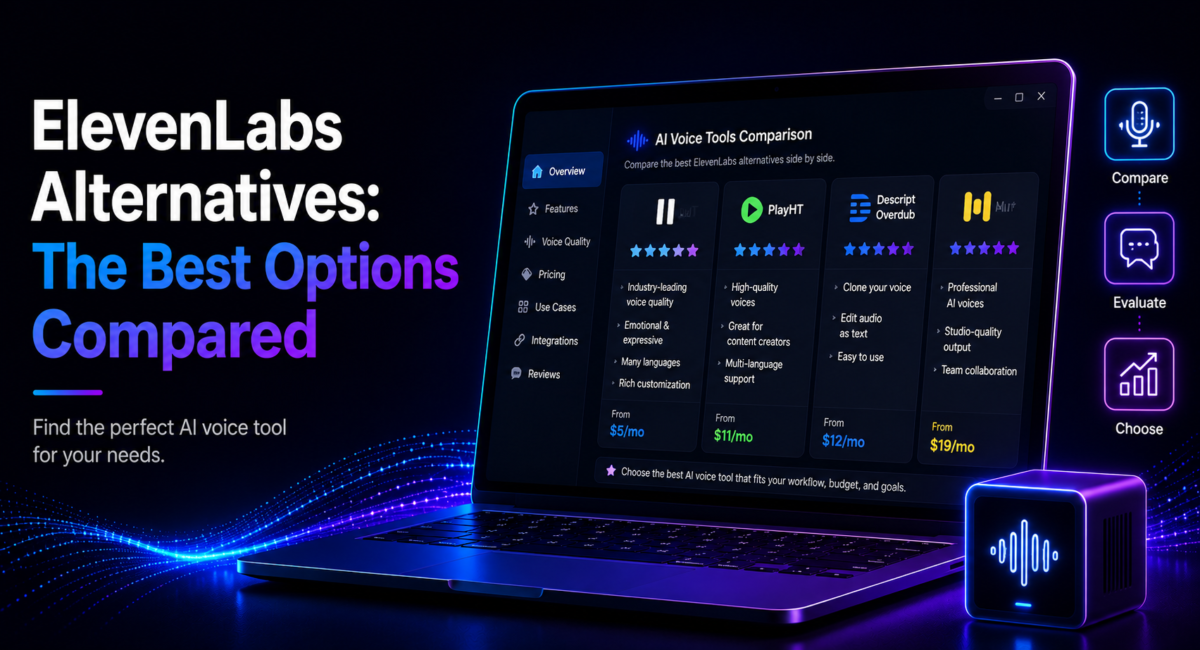
ElevenLabs is still the name most people reach for when they need synthetic speech, and in October 2026 it is still very good at it. What changed is everything around it. Real-time specialists now return audio in under a tenth of a second, open-weight models run on a single GPU with no per-character bill, and editing suites have quietly absorbed voice generation into the timeline. The useful question is no longer which engine sounds as good as ElevenLabs, because several now do. It is which specific problem you are paying ElevenLabs to keep having.
| Quick answer: Switch for a named reason, not on principle. Cartesia and Deepgram win real-time voice agents, Murf and Descript win creative workflow, Resemble AI wins cloning with on-premise control, and Fish Audio or Chatterbox win on raw cost. If none of those pressures apply to you, ElevenLabs remains the sensible default in 2026. |
How we compare: every tool here is judged on four independently verifiable things – published price per million characters, time to first audio, licensing and data-handling terms, and how much of the production workflow it covers. Figures were checked against vendor pricing and documentation pages on 2 October 2026 and move often. Two caveats we label in the text: Fish Audio publishes its rate in developer docs rather than a pricing page, and Resemble’s public plans now lead with its detection products.
Disclosure: some links below are affiliate links. If you subscribe through one, TechieHub may earn a commission at no extra cost to you. It never changes our rankings.

Table of Contents
Why do teams look for ElevenLabs alternatives in 2026?
Cost is the first and most common trigger. The published ElevenLabs pricing gives the free tier 10,000 credits a month with no commercial licence, Starter 30,000 credits for $6 with a commercial licence, and Creator 121,000 credits for $22 a month. That is generous for a newsletter and painful for a product. Once you are generating at volume through the API, flagship-quality output costs several times what a mid-tier engine charges for the same million characters.
The second trigger is control. Regulated teams, and agencies holding talent contracts, increasingly need audio generated inside their own network with a written answer to a simple question: where does the reference clip live, and who can delete it? A hosted-only vendor cannot give you that, however good the model sounds.
The third is workflow. ElevenLabs is a voice engine with a web front end. It is not a video editor, a slide tool or a learning-management system. If your bottleneck is assembling the finished asset rather than producing the waveform, a studio-shaped product will save you more hours than a marginally better voice ever will. Our wider guide to the best AI voice generator tools covers that split in more depth.
Which tools actually replace it, and for what?
Cartesia — best for real-time voice agents
Cartesia is the default for conversational agents. Its Sonic-3 model reports roughly 90 ms to first audio, built on a state-space architecture rather than a transformer stack, and its credit pricing stays predictable as concurrency climbs: a free tier of 20,000 credits, Pro at $5, Startup at $49 and Scale at $299 a month, with commercial use and instant cloning from Pro.
Deepgram — best when you need speech-to-text too
Deepgram suits teams that need both directions of the conversation. Aura-2 lists at $0.030 per 1,000 characters, or $30 per million, falling to $27 on the Growth plan, and it sits beside the speech-to-text stack most voice-agent builders already run, which removes a vendor from the architecture diagram. New accounts start with $200 in free credit.
Murf — best for business and e-learning
Murf is the strongest pick for business and e-learning: 200-plus voices across 30-plus languages, commercial rights on every paid plan, and integrations into the slide and video tools where corporate content is actually assembled.
Resemble AI — best for cloning, on-prem and compliance
Resemble AI owns the compliance corner, pairing synthesis with watermarking, deepfake detection and genuine on-premise or air-gapped deployment. Note what its published plans now lead with: a free Flex tier, Team at $350 a month ($280 billed annually) and Business at $1,000 ($800 annually), all built around the detection suite, with on-premise deployment and custom model training quoted on Enterprise.
Descript — best when voice lives inside editing
Descript is the odd one out, and that is exactly why it belongs here. Voice generation lives inside a transcript-based editor, so fixing a misspoken sentence becomes a typing job instead of a re-record.
Fish Audio — best value and self-hosting
Fish Audio is the value play: its developer pricing is $15 per million characters pay-as-you-go, and the OpenAudio S1 and S2 weights are published, so you can pull them down and run them on your own GPU instead.
| Tool | Best for | Voice cloning | Indicative 2026 price |
| Cartesia (Sonic-3) | Real-time voice agents | Yes, from short samples | Free tier up to about $299/mo |
| Deepgram (Aura-2) | Agents that also need speech-to-text | Preset voice library | About $30 per 1M characters |
| Murf | Business, e-learning, teams | Enterprise tier | From about $19/mo billed annually |
| Resemble AI | Cloning, on-prem, compliance | Yes, category leader | Flex free, Team $350/mo; on-prem on Enterprise |
| Descript | Podcast and video editing | Custom voice clones | Free tier; from $16/mo billed annually |
| Fish Audio | Best value and self-hosting | Yes | About $15 per 1M characters |
Prices are indicative and were current on 2 October 2026; verify on the vendor’s own page before committing budget.
Is speed still a real reason to leave?
Less than the internet thinks. The 2025 version of this argument said ElevenLabs was simply too slow for live conversation, and that claim has largely expired: its Flash v2.5 model is documented at under 75 ms model latency, putting it in the same bracket as Sonic-3’s 90 ms time to first audio. The expressive Eleven v3 model, which reached general availability in March 2026, is deliberately slower because it runs a larger network and a higher-fidelity codec.
So the honest 2026 comparison is not raw milliseconds. It is what happens at concurrency: how the price curve bends when 200 calls are live at once, whether streaming is first-class or bolted on afterwards, and whether you can colocate the model with your telephony. Those are the grounds on which Cartesia and Deepgram still take agent workloads, not an inability on ElevenLabs’ part to go fast.
What does self-hosted speech really cost?
Open weights are the biggest change since last year. Resemble’s Chatterbox is MIT-licensed, and in a blind evaluation run through Podonos, 63.75% of listeners preferred it to ElevenLabs on identical prompts with no prompt engineering or post-processing. Fish Audio’s OpenAudio line, Kokoro and Piper cover the rest of the quality-to-hardware spectrum, and community rankings such as the TTS Arena leaderboard let you sanity-check vendor claims by ear before provisioning anything.
The catch is that free describes the licence, not the bill. You are trading a per-character invoice for a GPU that has to stay warm, an engineer who owns the deployment, and monitoring you write yourself. Below roughly a few million characters a month, a hosted API is usually cheaper once engineering time is priced honestly. Above that line self-hosting starts to win, and it remains the only option that keeps voice data entirely inside your own network. If budget is the whole constraint, our roundup of the best free text to speech AI tools is a faster starting point than a GPU invoice.
How do you choose without burning a month on trials?
Name your binding constraint first and let it eliminate most of the market. If it is latency at concurrency, you are testing Cartesia and Deepgram. If it is data residency or a contracted talent voice, you are testing Resemble and self-hosted Chatterbox. If it is the hours your team spends assembling finished assets, you are testing Murf and Descript. If it is unit cost, you are testing Fish Audio.
Then run a two-tool bake-off with your worst script, not your best one: the paragraph stuffed with product names, acronyms and the second language your audience actually speaks. Voice quality diverges most on hard input, and demo reels hide it. Finish by reading the terms before the waveform. Confirm commercial rights on the exact plan you intend to buy, check the retention and deletion policy for reference audio, and confirm on-premise availability if you will ever need it. The same discipline applies across generative AI tools in general, whether the shortlist is voice engines or the soundtrack options in our guide to the best AI music generator platforms.

Case study: cutting a documentation team’s voice bill
Tamsin Clarke leads documentation at a 45-person B2B analytics company. Her team narrates around 40 short release-note videos a quarter plus a 90-minute onboarding course, and the voice bill had crept past what her tooling budget could absorb, largely because every renamed feature meant regenerating an entire script from scratch.
She ran the two-tool bake-off above with a deliberately ugly script: SQL keywords, three product names and a German localisation pass. Descript won the video work outright, because correcting a feature name in the transcript no longer meant regenerating five minutes of narration. For the onboarding course, where one voice had to carry 90 minutes across two languages, Murf’s studio and brand-voice presets beat both contenders.
After one quarter, voice spend was down by roughly three-quarters. Turnaround mattered more to Tamsin: the median time to ship a corrected video fell from two days to under an hour, because the fix no longer required a re-record slot. She kept one ElevenLabs seat for the job it still wins outright, the expressive marketing voiceover on the homepage.
This example is a composite of the voice-budget rebuilds we see most often, not a single client account; the figures are typical rather than measured from one engagement.
Frequently Asked Questions
What is the best alternative to ElevenLabs in 2026?
There is no single winner. Cartesia leads real-time voice agents, Murf leads business and e-learning, Resemble AI leads cloning with on-premise deployment, Descript leads editing workflows, and Fish Audio leads on price. Name your binding constraint first, then test only the two tools that genuinely address it.
Is there a genuinely free option?
Yes, but define free carefully. The ElevenLabs free tier grants 10,000 credits a month and no commercial licence. Open-weight models such as Chatterbox, Kokoro and Piper cost nothing per character under permissive licences, though you supply the GPU, the deployment work and the ongoing maintenance yourself.
Are open-source voice models really as good?
On perceived quality, often yes. In Resemble’s blind Podonos evaluation, 63.75% of listeners preferred Chatterbox to ElevenLabs on identical text. What you give up is the polished interface, the support contract and the integrations, which is precisely what non-technical teams are paying hosted vendors to provide.
What happened to PlayHT?
Meta acquihired the PlayAI team in July 2025, and the service shut down permanently on 31 December 2025, deleting accounts, saved audio and voice clones. Cartesia and Deepgram are the closest replacements for its streaming API, while Murf or LOVO suit teams that valued its multilingual library.
Does switching mean re-recording my cloned voice?
Yes. Clones are model artefacts rather than files, so they never transfer between providers. You re-clone on the new platform from your original reference audio. Keep that audio archived with documented consent, budget a day for re-cloning, and run both services in parallel until quality matches.
Is ElevenLabs still worth paying for?
For many teams, yes. It still leads on expressive prosody, Eleven v3 covers 70-plus languages, and Flash v2.5 answers the old latency complaint. Leave when a specific pressure, whether unit cost at volume, data residency or workflow friction, is measurably costing you more than the subscription does.
Which alternative is best for audiobooks and long-form narration?
Murf or Fish Audio, and the deciding factor is consistency rather than peak quality. Long-form work fails differently from short clips: a voice that sounds excellent for thirty seconds can drift in pace or emphasis across an hour, and pronunciation of names and technical terms has to hold chapter to chapter. Murf is the safer pick because its pronunciation controls and project structure are built for long scripts. Fish Audio wins on cost at volume — around $15 per million characters, with open weights if you want to keep everything in-house. The real-time specialists here, Cartesia and Deepgram, are optimised for latency you do not need when nobody is waiting on the other end.
Do you need permission to clone someone’s voice?
Yes, and every provider here requires it contractually. Professional voice cloning on the major platforms requires a recorded consent statement from the speaker, and cloning a voice you do not have rights to breaches their terms regardless of what the tool technically allows. The legal position has hardened too: Tennessee’s ELVIS Act extended likeness protection to voice in 2024, several other jurisdictions have followed, and the EU AI Act imposes transparency obligations on synthetic media. If you are cloning your own voice or a colleague’s with documented consent, you are fine. If the voice belongs to a client’s talent, get it in the contract before you generate anything — and if provenance matters, Resemble AI‘s watermarking is the reason it owns the compliance corner.
Conclusion
The honest summary for 2026 is that ElevenLabs no longer loses on any single axis by a wide margin. It loses on specific axes to specialists. Cartesia and Deepgram take the real-time work, Murf and Descript take the workflow, Resemble AI takes cloning under compliance, and Fish Audio and Chatterbox take the budget. None is a wholesale upgrade, which is why the right question is not which tool is best but which constraint is binding. Pin that constraint, bake off two candidates with your ugliest script, read the licence before the reviews, and re-check the decision in six months. PlayHT’s shutdown is a standing reminder of how quickly this market rewrites itself.
