



| Quick answer |
|---|
| The best AI tools for real-time action detection split by what you are detecting. For actions in video, use Ultralytics YOLO26 or Roboflow RF-DETR deployed through NVIDIA DeepStream. For actions taken by AI agents, use LangSmith at $39 a seat or Langfuse from $29. |
| How we compare |
|---|
| Rankings on this page come from vendor documentation and public pricing pages, all re-checked on 12 September 2026, plus each publisher’s own benchmark figures where they are cited. We did not run a head-to-head lab test: no latency was measured on our hardware and no video dataset was benchmarked here. No vendor paid for placement or reviewed this page before publication. |
Table of Contents
Two different things are called real-time action detection
The phrase covers two unrelated engineering problems, and buying the wrong one wastes a quarter. The first is computer vision: recognising human or object actions in a live video stream, which is a model plus a streaming pipeline plus GPU hardware. The second is LLM observability: detecting, tracing and scoring the actions an AI agent takes at runtime, such as which tool it called and whether the result was acceptable. For every category side by side, see our full AI tools list.
They share almost no vendors. This guide covers both, priced as of September 2026, because the same search returns both and no other round-up separates them. If what you actually need to watch is where your brand shows up inside AI answers, that is a third category again, covered in our guide to the best AI search monitoring tools.
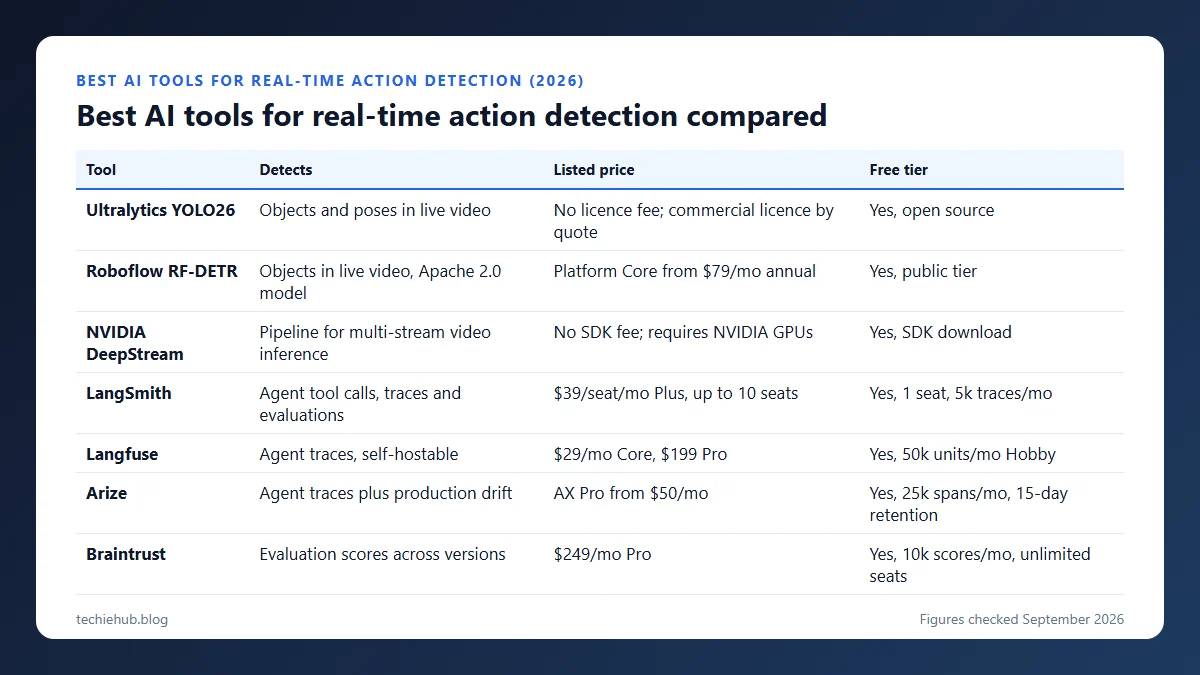
Best AI tools for real-time action detection compared
| Tool | Detects | Listed price | Free tier |
|---|---|---|---|
| Ultralytics YOLO26 | Objects and poses in live video | No licence fee; commercial licence by quote | Yes, open source |
| Roboflow RF-DETR | Objects in live video, Apache 2.0 model | Platform Core from $79/mo annual | Yes, public tier |
| NVIDIA DeepStream | Pipeline for multi-stream video inference | No SDK fee; requires NVIDIA GPUs | Yes, SDK download |
| LangSmith | Agent tool calls, traces and evaluations | $39/seat/mo Plus, up to 10 seats | Yes, 1 seat, 5k traces/mo |
| Langfuse | Agent traces, self-hostable | $29/mo Core, $199 Pro | Yes, 50k units/mo Hobby |
| Arize | Agent traces plus production drift | AX Pro from $50/mo | Yes, 25k spans/mo, 15-day retention |
| Braintrust | Evaluation scores across versions | $249/mo Pro | Yes, 10k scores/mo, unlimited seats |
| Weights and Biases Weave | Agent traces alongside model experiments | $60/mo Pro, $50/user Teams | Yes, personal use |
Detecting actions in video
The stack here is three layers: a detector, a tracker that keeps identities stable across frames, and a pipeline that feeds frames to the GPU fast enough to stay real time. Benchmark figures below are the publishers’ own; latency on your hardware will differ. Deployment is usually on the edge rather than in the cloud, and our walkthrough on running AI models offline covers those hardware trade-offs.
Ultralytics YOLO26
Released in October 2025 as an NMS-free, edge-optimised model. The official Ultralytics YOLO26 documentation reports roughly 43 percent faster CPU inference than its predecessor, and one pipeline covers detection, segmentation, pose, classification and oriented detection across five sizes. Open source, with a separate commercial licence from Ultralytics.
Roboflow RF-DETR
Transformer-based real-time detector released in March 2025 under Apache 2.0. The RF-DETR project documentation reports it as the first real-time model to exceed 60 AP on COCO, with a mid-size variant at 56.5 AP and 6.8 ms on an NVIDIA T4. The Roboflow platform has a free public tier; Core is listed from $79 per month on annual billing.
NVIDIA DeepStream
The pipeline layer rather than the model. NVIDIA’s DeepStream SDK page documents multi-stream video ingest, hardware decoding and TensorRT inference, with documented paths for running YOLO on Jetson hardware. There is no SDK fee, but it is tied to NVIDIA GPUs, so the cost sits in hardware rather than licence.
Detecting actions taken by AI agents
Here the unit is a span rather than a frame, and every vendor bills on volume. Instrumenting an agent this way is also the working end of the “Measure” function in NIST’s AI Risk Management Framework — you cannot govern behaviour you never recorded. The decision that matters is not which dashboard you prefer but whether you can afford your own trace volume at their metered rate. Our guides to AI agent frameworks and multi-agent AI systems cover what generates those spans in the first place, and our step-by-step guide to building an AI agent shows where the instrumentation hooks go.
LangSmith
Tracing and evaluation for LangChain and non-LangChain agents. LangChain’s published LangSmith pricing lists the Developer plan free for one seat with 5,000 base traces a month, and Plus at $39 per seat with 10,000 traces included. LangChain now meters overage through storage and compute units in a usage calculator rather than a flat per-trace rate; trackers put it at about $2.50 per 1,000 extra base traces and $5.00 per 1,000 extended ones.
Langfuse
Open source and self-hostable, which matters when the actions being logged contain regulated data. Langfuse’s published pricing lists a free Hobby tier at 50,000 units a month, Core at $29 with 100,000 units included and Pro at $199, with additional units on both paid plans at $8 per 100,000, falling to $7 per 100,000 above one million.
Arize
Pairs the open source Phoenix tracing library with the hosted AX platform. AX Free is listed at 25,000 spans a month with 15-day retention, AX Pro from $50 per month, and Enterprise by quote. The strongest option if drift and production monitoring matter as much as evaluation.
Braintrust
Evaluation-first, with unlimited seats even on the free tier. Braintrust’s pricing page lists Starter as free with 1 GB of processed data and 10,000 scores a month; Pro at $249 covers 5 GB and 50,000 scores on 30-day retention, with overage at $3 per GB and $1.50 per 1,000 scores.
Weights and Biases Weave
Extends an established experiment-tracking platform into LLM tracing. Free for personal use, Pro listed at $60 per month and Teams at $50 per user. Weave data ingestion is metered separately at a listed $0.10 per MB, which is the line that surprises teams at volume.
What 250,000 traces a month actually costs
Every vendor here quotes a headline price and meters the rest, so the sticker tells you very little. Below is a figure none of them publish: all-in cost per 1,000 traces at a fixed workload of 250,000 traces a month on a three-seat team, using each vendor’s own listed rates as shown above. The arithmetic is in the table so you can re-run it with your own volume.
| Tool | Listed rates used | Arithmetic at 250,000/month | All-in monthly | Cost per 1,000 |
|---|---|---|---|---|
| LangSmith Plus | $39/seat, 10,000 traces included, 0.005 LSU per extra trace at $1.00/LSU | (3 × $39) + (240,000 × $0.005) = $117 + $1,200 | $1,317 | $5.27 |
| Langfuse Core | $29/mo, 100,000 units included, $8 per extra 100,000 units | $29 + (1.5 × $8) = $29 + $12 | $41 | $0.16 |
| Braintrust Pro | $249/mo, 50,000 scores included, $1.50 per extra 1,000 scores | $249 + (200 × $1.50) = $249 + $300 | $549 | $2.20 |
The LangSmith row uses the $5.00 extended-trace rate, an upper bound; at the roughly $2.50 base rate it falls to $717, or $2.87 per 1,000. Two more caveats keep this honest. The three vendors meter different things — LangSmith bills traces, Langfuse bills units where traces, observations and scores all count, Braintrust bills scores — so the rows compare like for like only if your workload produces roughly one billable event per trace; a chatty agent logging ten observations per trace pushes the Langfuse figure up several times over. And the Braintrust row ignores processed data beyond the included 5 GB. Arize and Weights and Biases Weave are left out because neither publishes a per-unit overage rate on its public pricing page, so any figure we produced for them would be a guess.
The spread is the point. At this volume the metered line is 91 percent of the LangSmith bill ($1,200 of $1,317) but only 29 percent of the Langfuse bill ($12 of $41). Seat price ranks these tools in one order; cost per 1,000 traces ranks them in nearly the reverse.
Frequently Asked Questions
What are the best AI tools for real-time action detection?
For video, Ultralytics YOLO26 and Roboflow RF-DETR are the strongest real-time detectors, deployed through NVIDIA DeepStream. For detecting what an AI agent does in real time, LangSmith at $39 a seat, Langfuse from $29 and Braintrust at $249 are the leading evaluation and tracing tools.
What does evaluation tooling cost at production volume for real-time action detection?
Base subscriptions understate it, because every vendor meters volume. LangSmith lists additional traces at 0.005 LSU each with one LSU at $1.00, which works out at $5.00 per 1,000 traces beyond the included 10,000. Braintrust Pro at $249 includes 50,000 scores, then lists $1.50 per 1,000 after. Weave meters ingestion at a listed $0.10 per MB. At a few million spans a month, the metered line routinely exceeds the seat line, so model your own trace volume before signing.
Do you need a dedicated eval tool for real-time action detection if you already log traces?
Logging and evaluation answer different questions. Traces tell you what happened: which tool the agent called, in what order, how long it took. Evaluation tells you whether the output was acceptable, which needs scoring functions, a dataset of cases and a way to compare versions. If you already have traces and no way to say whether last week’s prompt change made things better, that gap is exactly what an eval tool fills.
How do you evaluate LLM output without ground-truth labels for real-time action detection?
Three approaches, in order of cost. Reference-free assertions: deterministic checks such as valid JSON, required fields present, no forbidden strings. Model-graded scoring: a second model judges against a rubric you write, calibrated against a small human-labelled sample so you know its error rate. Pairwise comparison: ask which of two versions is better, which is more reliable than absolute scoring. Every hosted platform listed above supports model-graded scoring.
How much do real-time action detection tools cost?
Listed prices in September 2026: YOLO26 and DeepStream carry no licence fee, Roboflow Core from $79 per month on annual billing, LangSmith Plus $39 per seat, Langfuse Core $29 with a free Hobby tier, Arize AX Pro from $50 with a free tier at 25,000 spans, Braintrust Pro $249 with a free Starter tier, and Weave Pro $60. Metered overage is the variable that decides the real bill.
Can YOLO26 detect actions, or only objects?
Out of the box it finds objects and body poses frame by frame; an action is a pattern across frames. Recognising a fall, a lift or a handover usually means pairing the detector with a tracker that keeps identities stable, then a rule set or a temporal model over the pose sequence. That extra layer is where most of the engineering time goes.
Conclusion
Decide which problem you actually have first. If the agent itself is still an open question, our comparison of the best AI agents is the place to start. For video, YOLO26 and RF-DETR are both free to start with, so the real budget line is GPU hardware and the engineer who tunes the pipeline, not a licence. For agent actions, start on a free tier, run a week of real traffic, and read the metered overage rates before you commit: at production volume the per-thousand-trace charge, not the per-seat price, is what appears on the invoice.
