

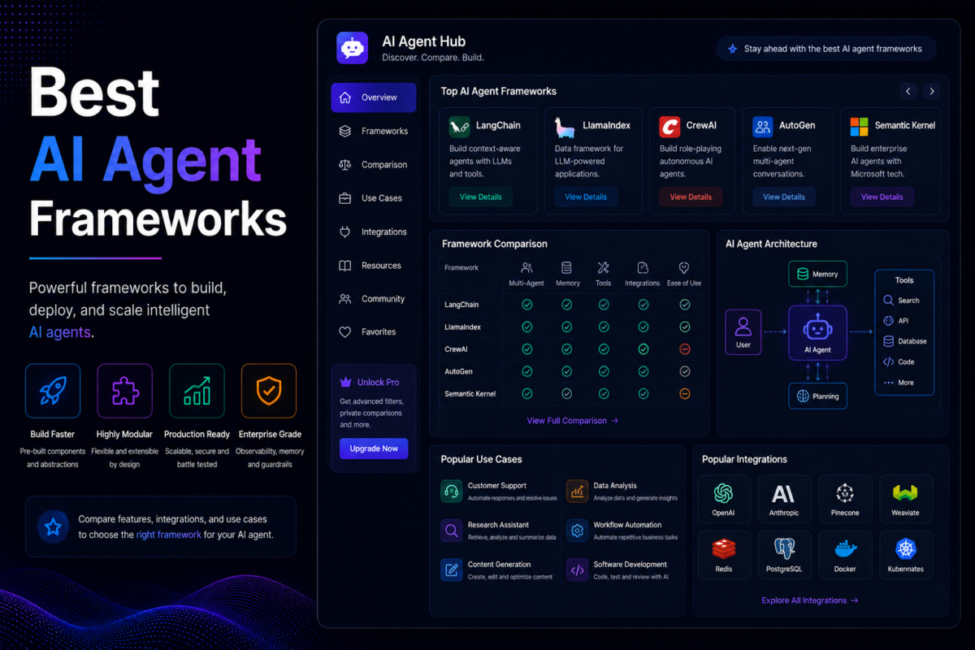
| Quick answer: The strongest AI agent frameworks in 2026 are LangGraph for stateful production, CrewAI for fast role-based prototypes, the OpenAI Agents SDK for GPT-native builds, Google ADK for multimodal and multi-language work, and the Claude Agent SDK for autonomous coding. All are free and open source, so your real cost is LLM API spend – choose on fit, not price. |

An AI agent framework is the scaffolding that wraps a language model with everything it needs to act: tool calling, memory, state, multi-agent coordination and failure recovery. Below we rank the leading options by what each does best, then give you a decision rule for your own stack.
Table of Contents
What an agent framework gives you
You can build an agent with raw API calls, but then you reimplement tool calling, state, retries, coordination and observability yourself – weeks of plumbing before any business logic. Frameworks hand you that plumbing. The trade-off is abstraction risk: each makes opinionated choices, and one whose model fights your problem slows you down more than raw code would. That tension is the lens for every option below. To ground the vocabulary, our explainer on what agentic AI means covers how planning, memory and tool use combine into autonomous behaviour.
The best AI agent frameworks, ranked by strength
1. LangGraph – stateful, production-grade control
LangGraph is the default for stateful workflows in regulated industries. It models an agent as a directed graph with shared state, offering persistent checkpointing, crash recovery and time-travel debugging – the one framework where “what happens when step 7 fails” has a first-class answer. It is also the most widely deployed: roughly 34.5 million monthly PyPI downloads and around 400 companies in production, including Klarna, Uber, LinkedIn, BlackRock and JPMorgan. Klarna’s LangGraph-backed support agent now handles two-thirds of customer inquiries.
2. CrewAI – fastest path to a multi-agent prototype
CrewAI is the quickest way to a working multi-agent system: define agents by role in natural language, connect tools, and ship in hours. With around 46,000 GitHub stars and native MCP and A2A support, it is the go-to for role-based crews. Details at crewai.com.
3. OpenAI Agents SDK – lowest friction for GPT-centric builds
Shipped in March 2025 as the production successor to the experimental Swarm project, the OpenAI Agents SDK maps cleanly to triage – specialist – escalation flows through its handoff model, with guardrails, built-in tracing and strong voice support. Later updates added sandboxing, sub-agents and first-class MCP. Docs at openai.github.io/openai-agents-python.
4. Google ADK – multimodal and multi-language
Google’s Agent Development Kit is the open-source framework behind Google’s own agent products, and its distinguishing feature is reach rather than any single primitive. It ships with first-class Python and Java support — still unusual in a field that assumes Python — which makes it the practical option for enterprise stacks where the JVM is not negotiable.
Its second differentiator is genuinely multimodal agents: ADK supports bidirectional streaming of audio and video, so an agent can hold a live conversation rather than exchange turns of text. It is built around Gemini but not locked to it, deploys onto Vertex AI Agent Engine for managed hosting, and supports both MCP and A2A — unsurprising, since Google authored A2A. Choose ADK when you are already on Google Cloud, need Java, or the agent has to see and hear rather than only read.
5. Claude Agent SDK – autonomous coding and computer use
The Claude Agent SDK is the framework extracted from Anthropic’s own Claude Code, and that origin is the point: it is the only entry here whose design assumptions come from a heavily used production agent rather than from a library author’s model of one. It is available for Python and TypeScript.
What sets it apart is the breadth of what the agent may touch. Rather than restricting the model to JSON tool calls, it gives an agent a working environment — reading and writing files, running shell commands, driving a browser and operating a computer directly. That makes it the strongest option for autonomous coding, research and any task defined as “work through this repository” rather than “answer this question”, and it supports MCP for connecting external tools.
The same breadth is the risk. An agent with filesystem and shell access needs a sandbox and a permission model before it needs better prompts, so budget for the isolation work as part of adopting it rather than as a hardening step afterwards.
Niche players worth knowing
- Pydantic AI – type-safe, composable agents for teams that value minimal abstraction.
- LlamaIndex and Haystack – RAG-heavy knowledge work over private data.
- Smolagents – Hugging Face’s code-first agents that write and run Python instead of JSON tool calls.
- Semantic Kernel – mixed-language enterprise stacks spanning Python, C# and Java.
- AG2 – the community fork continuing the AutoGen lineage after Microsoft folded AutoGen into its unified Agent Framework.

Framework comparison table
| Framework | Model / strength | Best for |
|---|---|---|
| LangGraph | Graph + durable state | Stateful, regulated production |
| CrewAI | Role-based crews | Fast multi-agent prototypes |
| OpenAI Agents SDK | Handoffs + guardrails | GPT-centric, voice agents |
| Google ADK | Multi-language, multimodal | GCP-native, Gemini agents |
| Claude Agent SDK | Computer use, OS access | Autonomous coding & research |
| Pydantic AI | Type-safe schemas | Reliable, composable agents |
Across independent reviews, the choice depends on deployment context, not feature count. Frameworks now converge on the basics – tool calling, streaming, MCP – so the differentiator is fit. Research shows the orchestration scaffold can move agent performance by up to 30 percentage points on identical models, so the framework is a genuine lever. This theme runs through our guide to real-world agentic AI applications.
Which framework fits which job?
For stateful production in regulated industries – anything needing rollback, audit trails or human-in-the-loop approval – choose LangGraph. For role-based workflows you want running quickly, choose CrewAI. For OpenAI-only deployments, the OpenAI Agents SDK is lowest-friction; for Claude-native autonomous coding, the Claude Agent SDK’s computer-use primitive is unmatched; for Google Cloud, multimodal or multi-language needs, Google ADK fits best. Pick Pydantic AI for type-safety, LlamaIndex or Haystack for RAG, and Semantic Kernel for mixed-language enterprise stacks.
Why do MCP and A2A matter more than features?
The biggest 2026 shift is the protocol layer consolidating. The Model Context Protocol (MCP) standardises how agents connect to tools and data; it has grown past 5,000 server implementations, making it the de-facto integration standard. A2A (Agent-to-Agent) is how agents from different frameworks discover and collaborate; the older ACP standard merged into A2A.
Protocols decouple your agents from any single framework’s lifespan. AutoGen’s shift into maintenance mode is the cautionary tale: teams wired to proprietary patterns faced a migration when its direction changed. Agents built around open protocols are far more portable, because the integration surface is a published standard rather than a vendor’s internal API. Understanding where agents differ from simpler tools also helps – see our breakdown of an AI agent versus an AI assistant.
AI agent frameworks in practice
Consider Naomi, a platform engineer at a mid-size fintech. Her task: automate first-pass triage of customer disputes without letting an agent move money unsupervised. She prototypes in CrewAI in an afternoon – a “classifier” agent and an “evidence-gatherer” agent – to prove the workflow with stakeholders. Once validated, she rebuilds it in LangGraph so every dispute becomes a durable graph run with a mandatory human-in-the-loop checkpoint before any refund node executes, each step checkpointed for audit.

This example is a composite of the framework deployments we see most often, not a single client account; the figures are typical rather than measured from one engagement.
The engineering that decides whether it works
Every framework here is capable enough to build the demo. What separates a system that survives production is the layer around it, and it is worth knowing what that layer is before you pick, because none of it is a framework feature you can shop for.
Evaluation, because agents fail silently
A traditional service throws an error when it breaks. An agent returns a confident, well-formatted, wrong answer, and nothing in your logs marks it as a failure. That is why teams that succeed build a fixed set of test cases with known-correct outcomes and re-run it on every prompt, model or tool change. Without it you have no way to tell an improvement from a regression — and model updates you do not control will move your results underneath you.
Observability, because a trace is the only explanation
When a multi-step agent produces the wrong result, the useful question is which step went wrong: the retrieval, the tool call, the reasoning, or the handoff. That is only answerable if every step is traced with its inputs, outputs and token cost. LangGraph’s durable checkpointing and the OpenAI SDK’s built-in tracing help here, but the discipline of actually reading traces is yours regardless of framework.
Failure recovery, because tools fail and loops run away
Assume every tool call can time out, return malformed data or succeed twice. Decide in advance what the agent does then — retry with backoff, fall back, or stop and ask a human. Two limits are worth setting on day one: a hard cap on steps per run so a reasoning loop cannot spiral, and a spend ceiling, since a runaway agent bills you for every iteration of its confusion.
How do you choose the right framework?
Choose along three axes. First, deployment context: which cloud, which model, how regulated. Second, complexity: simple linear flows favour the lighter SDKs and CrewAI, while complex, stateful, long-running workflows favour LangGraph. Third, interoperability: if agents must connect to many tools or other agents, weight MCP and A2A support heavily.
Frequently Asked Questions
What are the best AI agent frameworks in 2026?
The five that handle most production workloads are LangGraph (stateful, regulated production), CrewAI (fast role-based prototyping), the OpenAI Agents SDK (GPT-centric, lightweight), Google ADK (multimodal, multi-language) and the Claude Agent SDK (computer use, autonomous coding). Strong niche options include Pydantic AI, LlamaIndex and Semantic Kernel. Choose by deployment context.
Are AI agent frameworks free?
Yes. The major frameworks are all free and open source under MIT or Apache 2.0 licences, so the real cost of running an agent is the underlying LLM API spend, not the framework itself. Some vendors sell optional managed deployment, hosting or observability layers on top, but the core libraries carry no licence fee.
Which AI agent framework is best for production?
LangGraph is the default for stateful production, especially in regulated industries, thanks to durable checkpointing, crash recovery, time-travel debugging and human-in-the-loop primitives. Its verified enterprise users include Klarna, Uber, LinkedIn, BlackRock and JPMorgan. For provider-native stacks, the matching vendor SDK can be a strong choice depending on your cloud and model.
What is the difference between LangGraph and CrewAI?
LangGraph models agents as a directed graph with shared state, giving precise control, durability and human-in-the-loop steps – ideal for complex, stateful production. CrewAI models agents as a crew of role-playing specialists, which is faster and more intuitive for role-based workflows. LangGraph trades setup time for control; CrewAI trades control for speed.
Do I need to support MCP and A2A?
If your agents connect to many tools or must collaborate with agents from other teams, yes. Prioritise MCP (Model Context Protocol, now past 5,000 server implementations) for tool and data connectivity, and A2A for cross-framework collaboration. CrewAI and Google ADK ship native A2A, the Claude Agent SDK has the deepest MCP ecosystem, and the OpenAI SDK added first-class MCP.
Which framework is best for coding agents?
The Claude Agent SDK is purpose-built for autonomous coding and research, with computer use as a first-class primitive, deep OS access and built-in file and shell tools. No other framework makes giving the agent a real computer this easy, which is why it leads for agents that write, run and debug code end to end.
How do AI agent frameworks compare?
In a quick AI agent frameworks comparison, LangGraph leads stateful production work with durable checkpointing, CrewAI is the fastest route to role-based multi-agent prototypes, and the Claude Agent SDK is built for coding and research agents. The major frameworks are free and open source under MIT or Apache 2.0, so model API spend is the real cost.
Conclusion
The hard-won lesson from production teams is blunt: the framework matters less than the engineering around it. The gap between a good agent system and a bad one is almost never the framework; it is the evaluation pipeline, observability and failure-recovery logic. Pick a framework that stays out of your way, then invest there. For the full landscape, see our pillar on the best AI agent tools.
Affiliate disclosure: TechieHub may earn a commission from some links in this article at no extra cost to you. This never influences which frameworks we recommend – all five leaders here are free and open source.
Related: the A2A protocol explained covers how agents talk to each other.
