



| Quick answer |
|---|
| The best AI platforms with tools for healthcare analytics are AWS HealthLake at $0.27 per datastore hour for FHIR data, Google Cloud Healthcare API at about $0.05 per 1,000 FHIR operations for the cheapest entry, and Databricks or Snowflake when the workload is large-scale analysis. |
| How we compare |
|---|
| Ranked on published consumption pricing rather than quoted enterprise ranges, on HIPAA eligibility and the conditions attached to it, and on whether analysis runs where the data already sits. Vendor pricing and documentation pages were re-checked in September 2026, including Microsoft’s Fabric notice on Microsoft Learn. No vendor paid for placement. We did not run a head-to-head lab test of these platforms: every figure below is a published rate, not our own benchmark. |
Table of Contents
Two different products sold under one label
“Healthcare analytics platform” covers two jobs that price and behave very differently, and buying the wrong one is the expensive mistake in this category. For turning numbers into charts, see our guide to AI data visualization tools.
FHIR data platforms — AWS HealthLake, Google Cloud Healthcare API, Microsoft Fabric healthcare data solutions — exist to ingest, normalise and serve clinical records in a standard shape. Analytical platforms — Databricks and Snowflake — exist to run analysis and models over data you have already normalised. Most real deployments use one of each, which is why single-vendor comparison tables in this space mislead. For a clinical example of the same idea, see our guide to veterinary AI scribes.

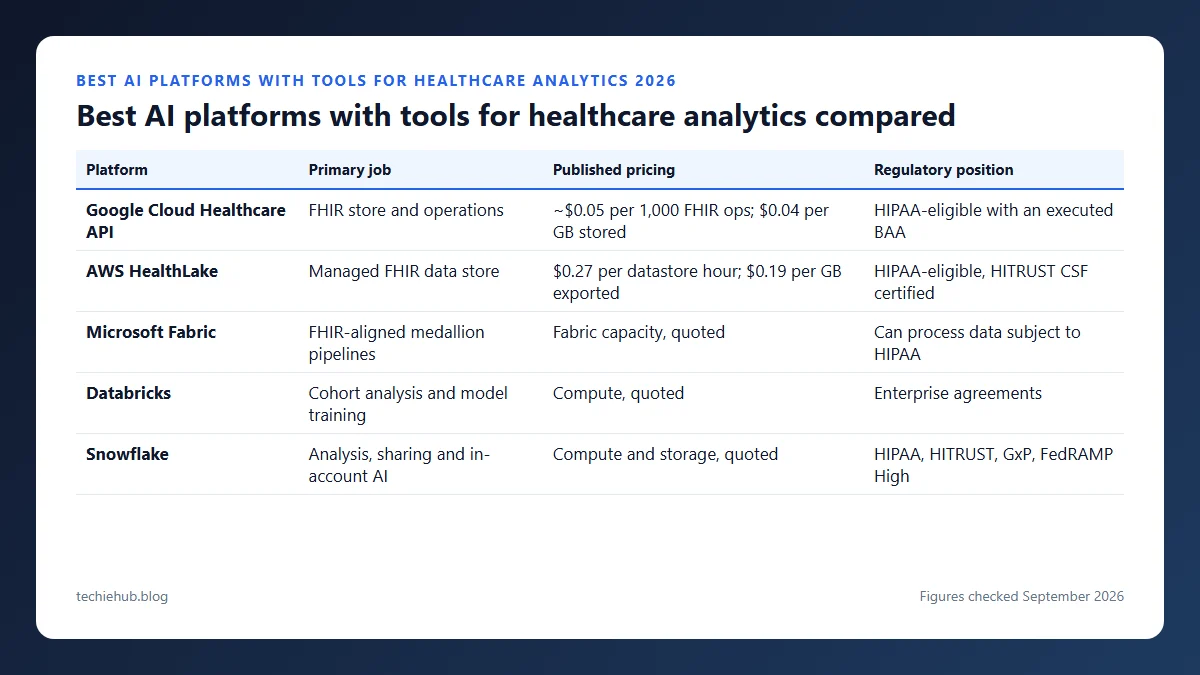
Best AI platforms with tools for healthcare analytics compared
| Platform | Primary job | Published pricing | Regulatory position |
|---|---|---|---|
| Google Cloud Healthcare API | FHIR store and operations | ~$0.05 per 1,000 FHIR ops; $0.04 per GB stored | HIPAA-eligible with an executed BAA |
| AWS HealthLake | Managed FHIR data store | $0.27 per datastore hour; $0.19 per GB exported | HIPAA-eligible, HITRUST CSF certified |
| Microsoft Fabric | FHIR-aligned medallion pipelines | Fabric capacity, quoted | Can process data subject to HIPAA |
| Databricks | Cohort analysis and model training | Compute, quoted | Enterprise agreements |
| Snowflake | Analysis, sharing and in-account AI | Compute and storage, quoted | HIPAA, HITRUST, GxP, FedRAMP High |
The Microsoft Fabric change you need to know about
If Microsoft Fabric is on your shortlist, the delivery model is moving and the dates matter more than the feature list.
- 3 August 2026: a downloadable source code and documentation package became available so customers can build customer-managed implementations.
- 1 October 2026: only existing customers can deploy the current managed healthcare data solutions.
- 31 December 2027: support for the current managed solution ends.
Read plainly, that shifts responsibility for the healthcare data pipelines from Microsoft to you. It is not a reason to rule Fabric out, but a customer-managed implementation needs engineering ownership that a managed solution did not, and that belongs in the business case rather than in a surprise a year from now.
The platforms in detail
AWS HealthLake
AWS HealthLake is a managed FHIR data store with the most legible published pricing in the category. Both Standard and Advanced are $0.27 per datastore hour, with data import and the first 10 GB of storage included; storage above that is $0.25 per GB per month on Standard or $0.37 on Advanced, and FHIR export or transformation for analytics is $0.19 per GB. Each data store includes 3,500 queries an hour, with extra queries at $0.015 per 10,000 on Standard and $0.048 on Advanced, and medical NLP is $0.0010 per 100 characters. HIPAA-eligible under a BAA and HITRUST CSF certified.
Google Cloud Healthcare API
Google Cloud Healthcare API is the cheapest entry point for FHIR storage and operations: about $0.05 per 1,000 FHIR operations and $0.04 per GB stored, with native export into BigQuery for analysis. Healthcare Data Engine sits above it for pipeline processing at a much higher per-GiB rate. HIPAA-eligible once you have an executed BAA and use only HIPAA-eligible services.
Microsoft Fabric healthcare data solutions
Microsoft Fabric healthcare data solutions provide FHIR-aligned data models and transformation pipelines in a medallion architecture and can process data subject to HIPAA requirements. Microsoft is moving it to a customer-managed delivery model on the timeline set out above.
Databricks
Databricks is a lakehouse platform for healthcare and life sciences, built on Delta Lake, handling structured and unstructured data with connectors for electronic medical records and genomics plus prebuilt solution accelerators. The strongest fit when the workload is model training and large-scale cohort analysis rather than FHIR interchange.
Snowflake
Snowflake is a healthcare and life sciences data cloud covering structured EHR data, genomic sequences, imaging and device feeds, with data sharing between organisations as a first-class feature. Supports compliance with HIPAA, HITRUST, GxP and FedRAMP High, and runs AI and LLM workloads inside the account rather than exporting data to reach them.
What 1 TB of FHIR data actually costs in month one
Per-hour and per-GB rates are hard to hold against a budget, so we did the arithmetic. AWS HealthLake is the only platform here that publishes every line of the round trip, so it is the one we can model honestly. The scenario: one Standard data store, running for a full 30-day month, holding 1 TB (1,000 GB) of FHIR data, exported once for downstream analysis.
| Line item | Published rate | Arithmetic | Month-one cost |
|---|---|---|---|
| Data store runtime | $0.27 per data store hour | 0.27 × 24 × 30 | $194.40 |
| Storage above the free 10 GB | $0.25 per GB per month (Standard) | (1,000 − 10) × 0.25 | $247.50 |
| One export or transform for analytics | $0.19 per GB | 1,000 × 0.19 | $190.00 |
| Total for 1 TB landed and exported once | — | 194.40 + 247.50 + 190.00 | $631.90 |
| Effective cost per GB | — | 631.90 ÷ 1,000 | $0.63 |
| Share of the bill that is the export line | — | 190.00 ÷ 631.90 | 30% |
Roughly a third of the first month goes on the line most buyers never budget: moving the data back out. Export twice instead of once and the same terabyte costs $821.90 rather than $631.90. Re-run it with your own volumes: (0.27 × 24 × days) + ((GB − 10) × 0.25) + (GB exported × 0.19). Query and medical NLP charges are excluded because they scale with your workload rather than your data volume.
We have not published an equivalent figure for the other four, because we cannot derive one honestly. Google Cloud Healthcare API lists per-operation and per-GB rates, but the operation count is a property of your sync design rather than your data size, and Databricks, Snowflake and Microsoft Fabric bill on quoted capacity. If avoiding that egress entirely is the point, the alternative is keeping inference inside your own environment, and our guide to the best local LLMs you can run yourself covers what that takes.
How to scope this without a surprise bill
- Price the export, not just the store. At a few terabytes, HealthLake’s $0.19 per GB egress line is larger than the datastore hours.
- Count FHIR operations, not records. Google’s per-1,000-operations pricing is cheap until a synchronisation job reads the same resources nightly.
- Get the BAA before the pilot. HIPAA eligibility applies to specific services, so an unlisted service in the pipeline invalidates the design, not just the paperwork.
- Validate the mapping before you buy the AI. Rebuild a cohort you already know and compare counts. Analytics on a bad FHIR mapping is confident and wrong.
For the analysis layer itself, our roundups of AI tools for data analysis and the best LLM for data analysis cover what runs on top of these platforms, and AI agents for healthcare covers the operational side. For the wider stack around them, see the AI tools businesses actually deploy, broken down by function.
Frequently Asked Questions
What are the best AI platforms with tools for healthcare analytics?
AWS HealthLake is the clearest starting point for FHIR data at $0.27 per datastore hour, and Google Cloud Healthcare API is the cheapest at about $0.05 per 1,000 FHIR operations. Databricks and Snowflake are stronger for large-scale analysis and model training, and Microsoft Fabric fits organisations already standardised on Fabric.
Can these tools work with your existing data warehouse?
Yes, and in two of the five cases the platform is the warehouse. Databricks and Snowflake are warehouse-native, so analysis happens where the data already sits. AWS HealthLake charges $0.19 per GB to export or transform FHIR data for analytics elsewhere. Google Cloud Healthcare API exports natively into BigQuery. Microsoft Fabric lands data in OneLake as a medallion architecture. The integration question is rarely whether it connects, and usually what the egress or transformation costs once volumes are real.
How accurate is AI-generated analysis on real datasets?
There is no credible published benchmark comparing these platforms on analytical accuracy, and any vendor quoting one is measuring its own test. In practice accuracy is decided upstream of the model, in the mapping layer: how consistently source records were normalised to FHIR, how duplicates were resolved, and how missing values were handled. If a rebuilt cohort’s counts differ from the ones you already know, the model is not the problem.
Do they handle sensitive or regulated data?
All five can, under conditions you have to meet. HIPAA eligibility is not a property of the platform but of the configuration, and NIST SP 800-66r2, the federal guide to implementing the HIPAA Security Rule, is the reference worth reading before you sign anything: you need an executed business associate agreement and you must use only the services covered by it. AWS HealthLake is HIPAA-eligible and HITRUST CSF certified. Google Cloud requires a signed BAA and HIPAA-eligible services only. Snowflake supports HIPAA, HITRUST, GxP and FedRAMP High. Microsoft Fabric healthcare data solutions can process data subject to HIPAA requirements. If any of your patients are in Europe, clinical decision support sits in the high-risk tier of the EU AI Act, which adds obligations HIPAA does not cover.
How much do AI healthcare analytics platforms cost?
Everything here is consumption-priced, so there is no per-seat figure to compare. Published September 2026 rates: AWS HealthLake $0.27 per datastore hour plus $0.25 (Standard) or $0.37 (Advanced) per GB per month of storage above the first 10 GB, and $0.19 per GB exported. Google Cloud Healthcare API is about $0.05 per 1,000 FHIR operations and $0.04 per GB stored. Databricks, Snowflake and Microsoft Fabric bill by compute capacity, which is quoted rather than listed.
Is Microsoft Fabric still a safe choice for healthcare analytics?
Yes, if you plan for owning the pipelines. Microsoft’s notice on Microsoft Learn says new customers must use a downloadable source-code package from 1 October 2026, and support for the current managed solution ends on 31 December 2027. Fabric itself continues; what changes is that the healthcare data pipelines become yours to run, so budget the engineering time before you commit.
Conclusion
Start from where your clinical data already lives. If it is arriving as FHIR and you need somewhere disciplined to put it, AWS HealthLake has the clearest published pricing and Google Cloud Healthcare API the lowest entry cost. If the hard part is analysis across genomics, imaging and claims, Databricks and Snowflake are the platforms built for that, and both expect you to have solved normalisation first.
Whatever the shortlist, treat HIPAA eligibility as a configuration you have to maintain rather than a badge the vendor holds, and validate the FHIR mapping before you evaluate a single model. In healthcare analytics the accuracy argument is almost always won or lost upstream of the AI.
