


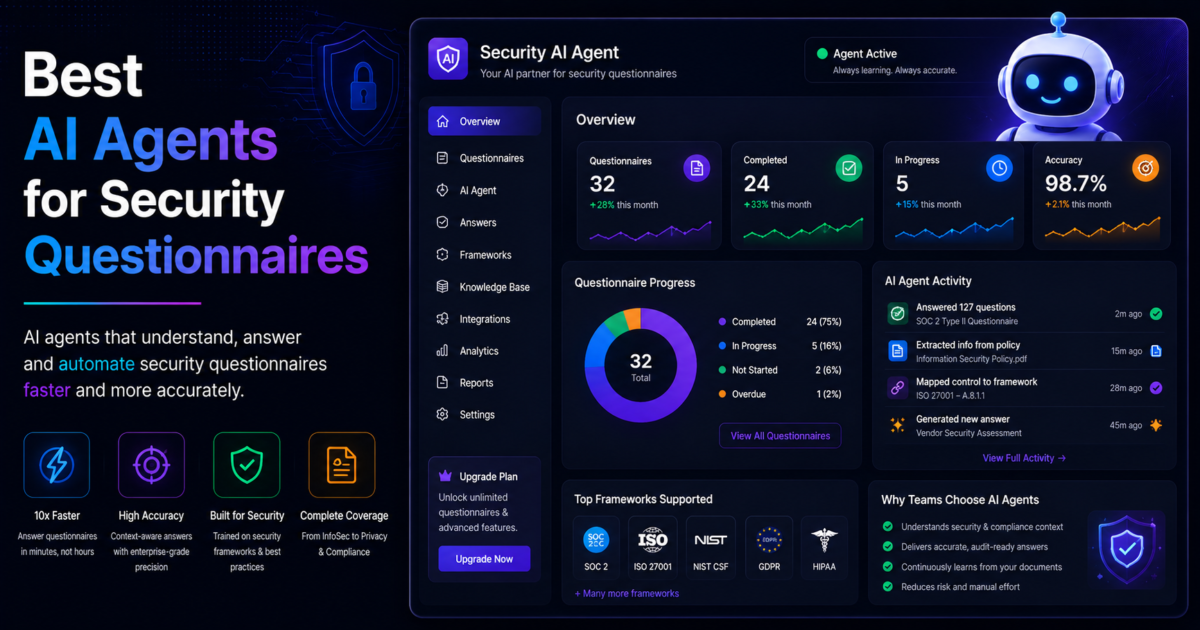
| Quick answer: The best AI agents for security questionnaires read vendor assessments (CAIQ, SIG and custom forms), draft accurate answers from your prior responses and compliance evidence, and route drafts through human review. Top picks for 2026 are Conveyor, Vanta, Drata, Arphie, SiftHub and SecurityPal — cutting response time up to 10x. |

Definition: An AI security-questionnaire agent is a domain-specific agentic AI tool that autonomously matches each incoming question to an approved, source-cited answer drawn from your compliance knowledge base.
Table of Contents
What is a security-questionnaire AI agent?
A security questionnaire is a buyer asking a vendor to prove how it protects data — and answering one is among the most repetitive tasks in any sales, security or GRC team. The two dominant standardized formats are the Consensus Assessment Initiative Questionnaire (CAIQ) from the Cloud Security Alliance and the Standardized Information Gathering (SIG) questionnaire from Shared Assessments, the latter now running past 800 questions across roughly 20 risk domains. Buyers also send countless custom spreadsheets and portal forms on top of those.
An AI agent for this job does three things: it reads each question, drafts a defensible answer by reusing your approved content and live compliance evidence, and manages the workflow across mixed file formats and third-party portals. Because the domain is bounded and document-heavy, leading tools report 95%+ first-pass accuracy with hallucination rates under 0.01% — the winning pattern is a narrowly scoped agent, not a general assistant asked to wing it. If you are weighing whether a full agent is overkill, our explainer on the difference between an AI agent and an AI assistant is a useful primer.
Why does automating security questionnaires matter?
The manual approach is slow and risky. Independent 2026 analysis found that completing a single vendor questionnaire takes 12–18 hours, and 88% of organizations need more than two weeks to finish assessments by hand — a serious problem when 78% of B2B buyers pick the vendor that responds first. Gartner projected that by 2026, 60% of organizations would treat third-party cybersecurity risk as a primary factor in business transactions, so these forms are only multiplying.
AI agents flip the equation. By centralizing knowledge and reusing approved content, teams respond up to 10x faster, compressing cycles from weeks to days or hours. Just as important, they fight drift: when answers live in scattered spreadsheets, different people answer the same question differently, and a stale response can misstate your posture and trigger red flags with a reviewer. A single, maintained source of truth keeps your hundredth questionnaire as accurate as your first, and a contradictory answer never reaches a buyer’s reviewer to raise a red flag. It is one of the clearest ROI stories among real-world agentic AI applications, because the payoff is both speed and trust: faster, consistent responses keep enterprise sales moving while reducing the compliance risk of outdated claims about your posture.

The best AI agents for security questionnaires, ranked
The leading tools sort into a few groups by who they fit best. The comparison table above summarizes them; the detail is below.
Conveyor — questionnaire-first
Conveyor is laser-focused on the customer security review: questionnaire responses, documentation sharing and a public Trust Center AI Agent that lets buyers self-serve answers without contacting your team. It claims 95%+ first-pass accuracy trained on your prior responses and uploaded docs, even without a pre-built library, at a predictable credit-based ~$9,600/year.
Vanta and Drata — compliance-suite modules
Vanta generates well-cited responses from continuously monitored controls and supports any format — spreadsheet, doc or portal. Drata keeps AI-drafted answers synced to real-time controls. If you already run your compliance program on one of them, their built-in module is the path of least resistance because it leans on evidence you are already collecting.
Arphie and SiftHub — transparency and workflow
Arphie attaches a source citation and confidence score to every answer, offers zero data retention, and connects to Google Drive, SharePoint and Confluence to eliminate library upkeep. SiftHub embeds its Answer Agent directly inside Excel, Word, Google Docs and Slack, auto-filling roughly 90% of responses on first pass across SIG, CAIQ, VSAQ and NIST 800-171 with every answer source-traced.
SecurityPal, Loopio and Responsive — volume and enterprise
SecurityPal pairs high-speed AI with certified human review and 24/7 support for enterprises fielding huge volumes. Loopio and Responsive suit teams consolidating RFPs and security responses into a governed answer library with mature tracking. Other strong options include Sprinto, Whistic, UpGuard (SMB trust portal), Skypher (~96% accuracy), and budget-friendly 1up.ai, AutoRFP.ai and VTTD for startups.

Who has the best AI agent for security questionnaires?
There is no single winner, because the question splits by how many questionnaires you field a year — and buying for the wrong volume is the expensive mistake in this category. If you answer a handful a year, the best AI agent for security questionnaires is a budget automation tool: 1up.ai from around $250 a month, or AutoRFP.ai in the $899–$1,299 range. If questionnaires are a steady part of the quarter, Conveyor is the questionnaire-first pick at roughly $9,600 a year on credits. If you already run a compliance platform, the Vanta or Drata module usually wins on integration even when it loses on raw answering quality, at $10,000–$25,000 a year with add-ons. And if you are fielding enterprise volume, SecurityPal, Loopio and Responsive are built for it.
The same answer covers the related searches. People look for this as “AI tools for security questionnaires”, “AI tools for vendor security questionnaires”, or “companies automating security questionnaires with AI”, and the shortlist does not change — only the framing does. One distinction is worth keeping straight, though: if you are the vendor answering questionnaires, everything above applies. If you are the one sending them to assess your suppliers, that is third-party risk management rather than response automation, and the same brands sell different products for it, so check which side of the exchange a demo is actually showing you.
What separates the leaders is not accuracy claims, it is what happens to a wrong answer. Every vendor here quotes a high first-pass accuracy figure against your own prior responses, and those numbers are not comparable because each measures against its own corpus. The questions that do discriminate: does it cite the source document for every answer so a reviewer can check it in seconds; does it flag low-confidence answers instead of filling them in confidently; and does it keep an audit trail showing who approved what, which is the artefact your customer’s security team will eventually ask for. A tool that answers 95% brilliantly and hides the 5% it guessed is worse than one that answers 85% and tells you which ones to read.
How much do these tools cost?
| Tool | Type | Pricing (2026) | Fits |
|---|---|---|---|
| 1up.ai | Budget automation | From ~$250/mo | A handful of questionnaires a year |
| AutoRFP.ai | Budget automation | ~$899–$1,299/mo | Growing volume, small team |
| Conveyor | Questionnaire-first | ~$9,600/yr, credit-based | Questionnaires as the core problem |
| Arphie | Questionnaire-first | ~$10,000–$25,000/yr | Teams wanting source transparency |
| Vanta | Compliance-suite module | ~$10,000–$25,000/yr with add-ons | Already on the compliance platform |
| Drata | Compliance-suite module | ~$25,000/yr median | Already on the compliance platform |
| Loopio, Responsive | Enterprise workflow | From ~$20,000/yr | High volume, formal RFP process |
Pricing spans a wide range, so match the tier to your real annual volume. At the accessible end, 1up.ai starts around $250/month and AutoRFP.ai runs roughly $899–$1,299/month, while VTTD offers flat pricing with unlimited users. In the mid-range, Conveyor uses credit-based pricing at about $9,600/year. Compliance-integrated platforms like Vanta typically land between $10,000 and $25,000/year with add-ons, Arphie sits in a similar $10,000–$25,000 band, and mature workflow platforms such as Loopio and Responsive start near $20,000/year, with Drata around a $25,000 median.
Frame the cost against the labor it replaces, not in isolation. A stalled enterprise deal costs far more than any subscription, and at 12–18 hours per questionnaire the recovered engineering time adds up fast. The mistake to avoid is over-buying: a startup answering a handful of questionnaires does not need a $25,000/year platform, and a budget tool with a clean review workflow will serve it well until volume genuinely demands more.
Security-questionnaire automation in practice
Consider Rhea, a security engineer at a Series B SaaS company selling into banks and healthcare. Before automation, each enterprise deal dropped a 400-question SIG on her desk that ate two full days and stalled the sales team while she chased down evidence she had already provided a dozen times. She deployed a questionnaire-first agent, pointed it at her SOC 2 evidence, security policies and a library of previously approved answers, and connected it to the company shared drive so nothing lived in a stale copy.
Now the agent drafts a full first pass in minutes, each answer carrying a citation to its source document and a confidence score that flags where judgment is needed. Rhea’s role shifts from author to reviewer: she verifies the AI’s drafts, corrects the handful of nuanced answers that genuinely require a human, and returns the completed questionnaire the same day instead of the following week. Her team reports the sales cycle no longer stalls on security review, answers stay consistent from one buyer to the next, and the security team spends its time on genuinely novel questions rather than copy-pasting boilerplate — an illustrative but representative outcome of the review-don’t-rewrite model these tools enable when they are fed a clean, current knowledge base.
A composite of the questionnaire rollouts we see most often, not one client account.
How do you choose the right tool?
Start with your situation, then weigh the capabilities that determine quality.
- Already on a compliance platform (Vanta, Drata): begin with their built-in module — it reuses evidence you already collect.
- High-volume sales org: a questionnaire-first tool (Conveyor) or a managed service (SecurityPal) pays off.
- Compliance-heavy and audit-focused: prioritize source attribution (Arphie, SiftHub).
- SMB: a trust portal (UpGuard) can let buyers self-serve instead of a full questionnaire.
Beyond fit, favor context-aware AI, a single source of truth for approved answers, structured review workflows, support for both files and third-party portals, CAIQ/SIG reuse, and full auditability. Accuracy and low hallucination rates matter most where a wrong answer could misrepresent your posture, so favor tools that cite their sources. Enterprise buyers should also confirm SOC 2 Type II, SSO and audit trails. This tool is one specialized member of a wider stack — see our pillar guide to the best AI agent tools for the broader landscape.
How should you deploy one safely?
The teams that get the most value follow a consistent pattern. First, clean your source content — the AI is only as good as the knowledge base it draws on. Second, define ownership so named experts approve answers in their domain. Third, integrate your core systems (drives, compliance platform, CRM) so the agent pulls from one source of truth rather than stale copies. Above all, review, don’t rewrite: never let an agent submit answers about your security controls without a qualified human verifying every response. A confidently wrong or outdated answer can misrepresent your posture, create contractual liability, or fail an audit — which is exactly why source-cited tools are worth the premium.
How we compare
Prices were re-checked on 3 October 2026; most vendors in this category quote through sales, and where that is the case it is stated rather than estimated. TechieHub independently researches every tool in this guide using official product documentation, public pricing, standards bodies (Cloud Security Alliance, Shared Assessments) and current 2026 industry analysis. We do not accept payment for placement or ranking. Affiliate disclosure: some outbound links may earn TechieHub a commission at no extra cost to you; this never affects which tools we recommend or how we rank them.
Security questionnaires are the tax on every enterprise deal — but they no longer have to slow you down. Feed an AI agent your approved answers, let it draft, review before you send, and watch a multi-week scramble become a same-day task.
Frequently Asked Questions
What are the best AI agents for security questionnaires?
Top 2026 tools include Conveyor (95%+ accuracy plus a trust center), Vanta and Drata (automation inside compliance suites), Arphie and SiftHub (source-cited answers), and SecurityPal (AI plus certified human review). Budget options like 1up.ai, AutoRFP.ai and VTTD suit startups. The best choice depends on your volume and existing stack.
How do AI security-questionnaire tools work?
They read each question, then draft an accurate answer by reusing your prior responses and compliance evidence, usually citing the source. The best tools train on your own documentation, support spreadsheets, documents and third-party portals, and route drafts through structured human review before submission, cutting response time up to 10x versus manual answering.
Is it safe to upload your security documentation to an AI tool?
It deserves the same scrutiny you are applying to your own vendors. There is a real irony in this category: to automate security reviews you hand a third party a consolidated map of your controls, architecture, audit evidence and known gaps — arguably a more sensitive package than any single questionnaire answer. Run your own diligence before you buy, and expect a serious vendor to welcome it.
Ask four things specifically. Where does your data live and is it segregated from other tenants? Is your content used to train shared models, and can you contractually opt out? What are the retention and deletion terms when you leave? And does the vendor hold the certifications it is helping you evidence — a SOC 2 report you can actually read, not a badge on a homepage.
Two practical guards. Scope what you connect: an agent indexing an entire drive will pull in material nobody intended to expose, so integrate specific sources rather than granting broad access. And check access control inside the tool itself — the knowledge base ends up containing your most sensitive internal documentation, so it should not be readable by every employee with a login.
How accurate are AI security-questionnaire agents?
Leading tools report high accuracy: Conveyor and SiftHub cite 95%+ first-pass accuracy with hallucination rates under 0.01%, and Skypher reports around 96%. Accuracy depends heavily on the quality of your source content, so always keep a human review step and favor tools that cite their sources on every answer.
Should I use my compliance platform or a dedicated tool?
If you already use Vanta or Drata, their built-in questionnaire module is the easiest start because it leverages evidence you are already collecting and keeps answers anchored to live controls. Move to a dedicated tool like Conveyor, Arphie or SiftHub if you need higher accuracy, source attribution, a public trust center, or more customization.
Can AI tools handle custom or non-standard questionnaires?
Yes, the best ones do. Tools trained on your own documentation can answer custom questions even without a pre-built library, and many support any format — spreadsheets, documents or buyer portals. Compliance-suite modules are strongest on standard frameworks like CAIQ and SIG and may be less flexible for unusual buyer requests than questionnaire-first tools.
Which companies handle security questionnaires best?
Two different offerings get compared under this question. Software vendors — Conveyor, Vanta, Drata, Arphie, SiftHub — sell automation that drafts answers from your own prior responses and evidence, keeping the work and the knowledge base in-house. Managed service providers instead absorb the questionnaire queue and return completed responses, which suits companies without a security team but puts your control evidence in someone else’s hands and costs considerably more per questionnaire. If you receive assessments regularly, owning the answer library is the cheaper long-run position.
Conclusion
Buy for the volume you actually have, not the volume you hope for. The pricing here spans a hundredfold, and over-buying is the common mistake: a startup fielding a few questionnaires a quarter gets what it needs from a budget tool with a clean review workflow, while a team losing 12–18 hours per questionnaire across dozens of deals is already paying for an enterprise platform in engineering time without receiving one.
After volume, the split is structural. If you already run Vanta or Drata, the module inherits your evidence and is usually the shorter path; if questionnaires are the bottleneck rather than compliance, a specialist like Conveyor or Arphie will answer better. Weight source citation heavily whichever way you go — an answer you cannot trace is one a human cannot verify, and this is the one workflow where an unverified answer becomes a contractual representation about your security posture. Keep a named expert approving every response, and see our guide to the best AI agent tools for how this fits the wider category.
