


How we compare: we test assistant and agent platforms hands-on, cross-check vendor documentation, and weigh independent benchmarks before we publish. Disclosure: TechieHub may earn a commission from some links on this page, at no extra cost to you.
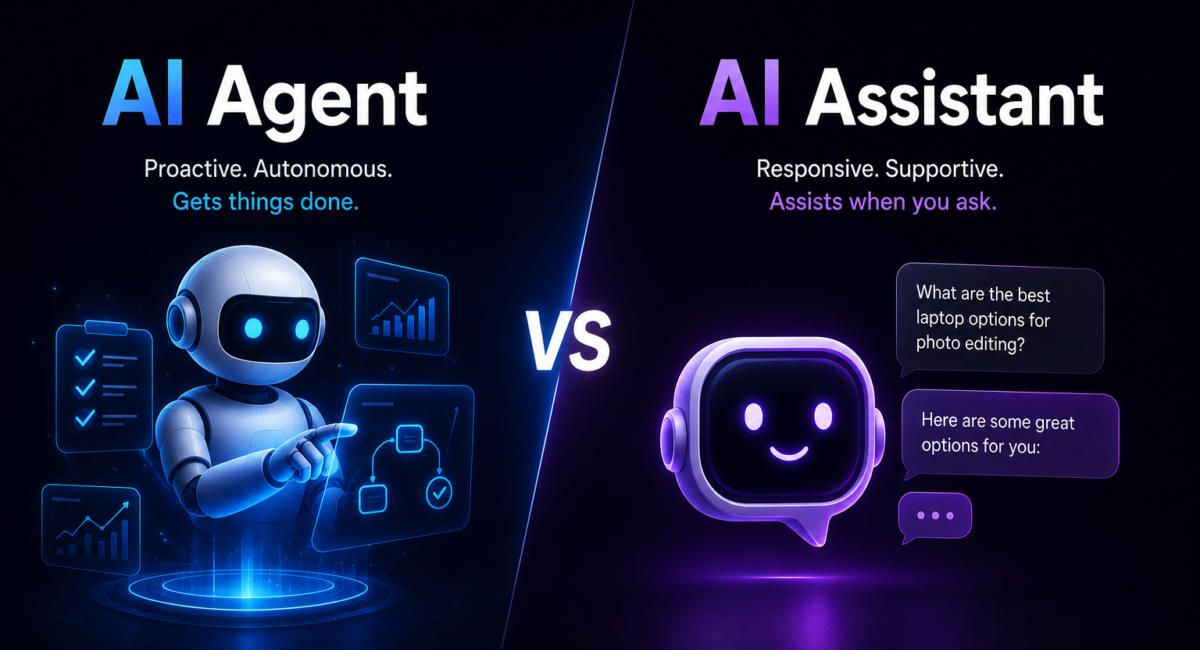
| Quick answer: An AI assistant is reactive — it responds to your prompt, completes one task, and waits. An AI agent is autonomous and goal-driven — you set an outcome, and it plans the steps, chooses and calls tools, self-corrects, and executes with minimal input. The real difference is who controls the next step: you, or the system. |

Definition: The ai agent vs ai assistant distinction is a difference in autonomy — an assistant answers questions on demand, while an agent independently pursues a goal from start to finish.
Table of Contents
AI agent vs AI assistant: the one difference that matters
The terms get used interchangeably, but they describe genuinely different systems.
A popular analogy captures it: tell an agent where you want to go and it books the flights, packs the bag, and fills in the customs form — you just show up at the airport. An assistant helps with each step only when you ask. As IBM defines it, an AI agent “autonomously performs tasks by designing its workflow and using available tools.” The distinction isn’t about which is smarter; it’s how far the system runs without a human.
What is an AI assistant?
An AI assistant is a reactive tool that processes user prompts and returns task-specific outputs under continuous human direction.
Assistants deliver value through simplicity and control, which is why most teams deploy one first.
In practice that means the assistant holds no goal of its own. It has no memory of what it was trying to achieve two prompts ago unless you supply it, it does not decide that a task is incomplete, and it never takes a second action without being asked. Every loop closes back to you — which is precisely why assistants are predictable enough to deploy quickly.
The category covers more than chat windows. A coding autocomplete suggesting the next line, a writing tool rewriting a paragraph you selected, a support widget answering from a help centre, and a meeting notetaker producing a summary are all assistants: each responds to a defined input and stops. Modern assistants can be sophisticated — calling tools, reading documents, searching the web — and still be assistants, because the human decides what happens next each time.
The trade-off is throughput. An assistant scales with your attention, so ten tasks need ten interactions. That ceiling is acceptable for work where judgement matters at each step and expensive for repetitive multi-step processes — which is the gap agents exist to fill.
What is an AI agent?
An AI agent is a goal-driven, autonomous system that designs and runs a workflow using the tools available to it.
- Autonomous tool use — it selects and invokes APIs, databases, browsers, and files on its own reasoning.
- Multi-step reasoning — it sequences dependent tasks and adapts the plan mid-workflow.
- Self-correction — it detects failed outputs and revises its strategy.
- Goal-directed execution — it works toward an outcome, not a single response.
Under the hood, an agent is a language model wrapped in a loop with tools and memory. That architecture now ships in vendor toolkits: Anthropic’s Claude Agent SDK and the OpenAI Agents SDK both expose an agent loop, tool calling, and guardrails. Autonomous coding agents such as Devin — which writes and tests code, chases bugs, and deploys builds with minimal hand-holding — show the leap from automating one task to running an end-to-end process. To go deeper, see what is agentic AI, and for where they earn their keep, our roundup of best agentic AI tools.
How do they compare across cost, control, and scope?
The two paradigms diverge on nearly every operational dimension — behavior, control, scope, cost, and the right kind of task.

| Dimension | AI assistant | AI agent |
| Behavior | Reactive — responds, then waits | Proactive — initiates and acts |
| Controls the next step | The human | The system |
| Scope of work | Single, defined task | Multi-step workflow toward a goal |
| Tool use | Within set boundaries | Selects and calls tools autonomously |
| Human involvement | Every interaction | Oversight at key checkpoints |
| Cost and setup | Fast, low cost | More setup, monitoring, and spend |
| Best for | Drafting, retrieval, scheduling | End-to-end operations |
Crucially, this is not a ranking.
The autonomy spectrum: bot, assistant, agent
These categories sit on a continuum of autonomy rather than in separate boxes.

The line between assistant and agent is blurring. Advanced platforms now hybridize: a tool answers questions conversationally like an assistant, then, handed a goal, switches into autonomous execution like an agent. So the sharper question is rarely “is this an agent or an assistant?” but “how much autonomy does this system have?” As IBM frames it, agentic AI is the overall framework of solving problems with limited supervision, and AI agents are the building blocks within it.
AI agents vs assistants in practice
Consider Maya, an operations lead at a mid-size online retailer preparing for a seasonal sale. For her marketing copy she uses an AI assistant: she pastes a product list, asks for five subject-line variants, tweaks the tone, and gets exactly what she requested in seconds — a fast, controlled, single-task exchange where she reviews every line.
For reconciling supplier invoices against purchase orders, she deploys an AI agent instead. She sets one goal — flag every mismatch over a threshold and draft correction emails — and the agent pulls records from two systems, cross-checks line items, compiles the exceptions, and prepares the drafts, pausing only for her approval before anything is sent. Same person, two tools, matched to two different jobs: the assistant amplifies a task she owns step by step, while the agent absorbs a multi-step process she’d rather hand off. That pairing mirrors the patterns in our guide to agentic AI applications.
What about copilots, chatbots and “agentic” tools?
Direct answer: those three words describe marketing positions more than technical categories, and all of them land somewhere on the same autonomy spectrum. Knowing where saves you from buying an assistant priced as an agent.
Chatbot
The oldest term and the least autonomous. Classic chatbots follow scripted decision trees and match intents; modern ones are language models with a chat interface. Either way the pattern is the same — one input, one response, no independent action. Every chatbot is an assistant; not every assistant is a chatbot.
Copilot
A positioning word rather than a capability. It signals “works alongside you inside an existing tool”, which is an assistant relationship: it suggests, you accept or reject. Some products branded copilot have added genuinely agentic modes that execute multi-step work, which is why the label alone tells you nothing. Ask what it does without you watching.
Agentic
Applied to anything from a two-step tool call to a system that runs for hours unsupervised. The useful test is not the label but the failure question: if this runs unattended and gets something wrong, how far does it get before anyone notices? If the answer is “one response”, it is an assistant regardless of branding. If it could complete several steps and act on the mistake, it is an agent and needs the oversight to match.
Which one should you choose?
Choose an AI assistant when the need is well-defined and human-supervised — drafting content, answering questions, retrieving data, scheduling — or any task where you want immediate output and full control. A rule of thumb: if you can describe the task as a single clear request, an assistant handles it faster and cheaper.
Choose an AI agent when the work is a multi-step process you’d rather delegate entirely — research spanning many sources, software tasks from code to deployment, or workflows that run end to end. The trade-off is real: agents demand setup, monitoring, approval gates, and tolerance for edge-case errors. The momentum is undeniable — Gartner predicts 40% of enterprise apps will feature task-specific AI agents by 2026, up from less than 5% in 2025 — yet the same analysts expect many agentic projects to be scrapped before they mature, a reminder to match autonomy to the task. For a curated shortlist, start with our pillar on the best AI agent tools.
Frequently Asked Questions
What is the difference between an AI agent and an AI assistant?
An AI assistant is reactive: it responds to your prompts with task-specific outputs and waits for your next instruction, keeping a human in control. An AI agent is autonomous and goal-driven: once given a goal, it plans the steps, uses tools, self-corrects, and executes on its own. The core difference is who controls the next step.
Is ChatGPT an AI agent or an AI assistant?
In its basic chat form, ChatGPT acts as an AI assistant — it responds and waits. Extended with tools, a goal-driven loop, or an agents framework, the same model can operate as an AI agent. This reflects hybridization: how a system behaves depends on how much autonomy it is configured to have, not on the underlying model alone.
Is Alexa an AI agent?
No, Alexa is an AI assistant. It executes predefined skills and routines in response to voice commands or user-set triggers, but it doesn’t autonomously plan, prioritize, or act toward a goal. It reacts within set boundaries rather than independently determining a sequence of actions to reach an outcome, which is what distinguishes a true agent.
Which is better, an AI agent or an AI assistant?
Neither is universally better; they suit different needs. Assistants win on speed, lower cost, predictability, and control, ideal for well-defined tasks. Agents win when you need autonomous, multi-step execution toward a goal, but they cost more and require oversight and clean data. The choice is about fit, and many teams deploy both.
What capabilities make something an AI agent?
Four capabilities define an agent: autonomous tool use (it selects and invokes APIs, databases, and browsers on its own), multi-step reasoning (it sequences dependent tasks and adapts mid-workflow), self-correction (it detects failures and revises its plan), and goal-directed execution (it works toward an outcome, not one response). An assistant lacks this autonomy.
Are AI agents more expensive than AI assistants?
Generally yes. Agents carry higher setup and ongoing costs because autonomous decision-making needs continuous monitoring, approval workflows for high-stakes actions, and good data quality. Assistants deploy faster, often in hours, with lower investment, because a human supervises each step. The extra cost of an agent is justified only when autonomous execution delivers enough value to outweigh it.
Going further: see where agentic AI is actually deployed by industry, compare platforms in our agentic AI tools guide, or look at agent frameworks if you are building rather than buying.
Conclusion
The difference between an AI agent and an AI assistant comes down to autonomy and initiative. An assistant is a reactive helper that responds and waits; an agent is an autonomous executor that, given a goal, plans and acts. Neither is inherently better — assistants offer speed, simplicity, and control, while agents offer end-to-end automation at the cost of oversight and complexity. Because they sit on a spectrum that keeps blurring, the smartest move is to stop asking which is better and start asking how much autonomy your task actually needs.

2 Comments
Hi, i think that i saw you visited my website so i came to “return the favor”.I’m
trying to find things to improve my website!I suppose its ok to use some of your ideas!!
Thank you for taking the time to share your thoughts! We truly appreciate the support and are glad you found value here. Stay connected—there’s more helpful content coming your way.