


Affiliate disclosure: some outbound links may earn TechieHub a commission at no extra cost to you. It never affects which tools appear here or their order.
The humanizer market is the strangest corner of the AI tools economy. Nearly every “top 10” list is published by a vendor selling one of the products it ranks, every homepage advertises a bypass rate in the high nineties, and almost none of those numbers can be checked from outside the company. Strip the marketing away and something useful remains, sitting right next to a promise the technology cannot keep.
| Quick answer: An AI humanizer rewrites machine-generated text so it reads with human rhythm and variation. Undetectable AI, WriteHuman, Phrasly and Humanize AI lead the category, while QuillBot and Grammarly are paraphrasers rather than true humanizers. Use one to polish drafts you already own — no tool can honestly promise to defeat an AI detector. |
Table of Contents
What does an AI humanizer actually change?
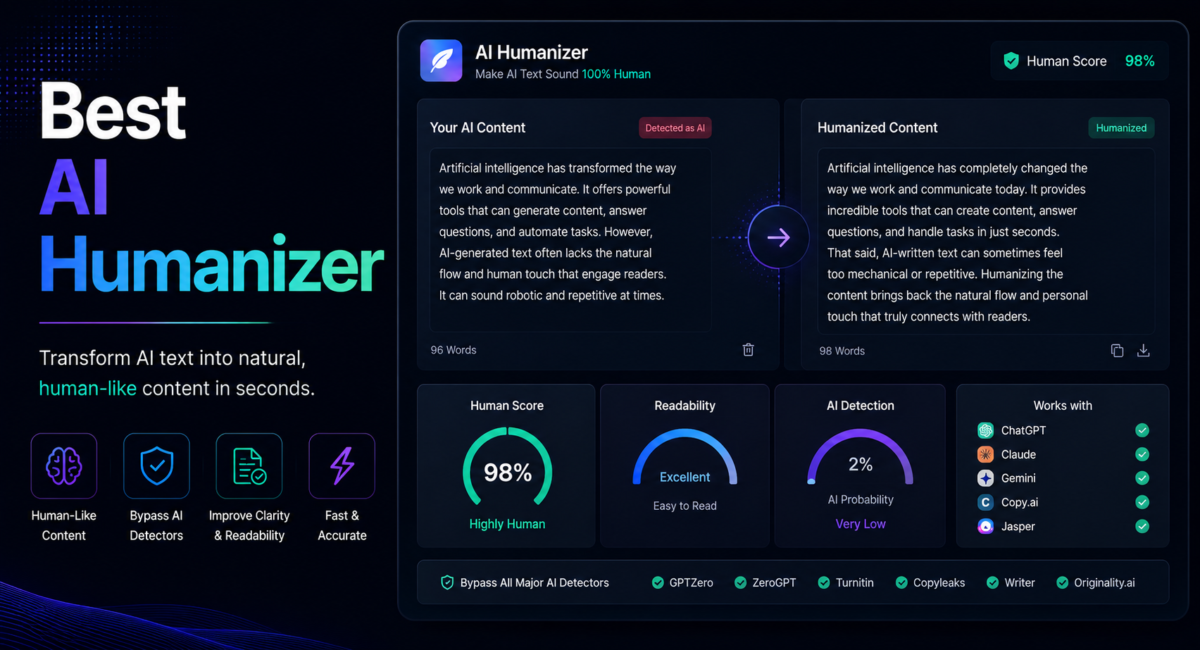
Language models produce text with an unusually even statistical texture. Sentences cluster around a similar length, transitions repeat, and word choice sits close to the most probable option at every step. Detectors are tuned to measure exactly that evenness. A humanizer works the other side of the same equation: it breaks sentences apart and recombines them, alternates short lines with longer ones, and replaces predictable connectives with less expected phrasing.
The distinction that matters is depth. Weak tools do synonym substitution, which is the easiest pattern for a detector to see through and which quietly damages meaning whenever the replacement is not a true synonym in context. Stronger tools restructure. Either way the tool only reshapes what you hand it — no facts, no argument, no expertise get added — so a thin draft comes back as thin prose with better cadence. That ceiling is worth understanding before you spend money anywhere in the wider generative AI tools stack.
Which is the best AI humanizer for your writing?
How we compare: we rank on output quality, meaning preservation and pricing transparency, with every price checked against the vendor’s own live pricing page in July 2026. We deliberately publish no bypass-rate column: those figures depend on which detector ran the test, on which day, against which model version, and no independent party can audit them.

| Tool | Best for | Approach | Entry cost (July 2026) |
| Undetectable AI | All-round rewriting | Structural rewrite, refund promise | 250 free words, then from $5/mo annually |
| WriteHuman | Minimalist, academic tone | Paste and rewrite, request-based | 3 free requests/mo, then from $12/mo annually |
| Phrasly | Academic all-in-one | Rewriter plus built-in detector | Limited free tier; verify current plan |
| Humanize AI | Readability, creative copy | Stylistic variation | Limited free words; verify current plan |
| QuillBot | Paraphrasing, weak humanizing | Word-level replacement | Free tier, paid upgrade |
| Grammarly | General writing aid, weak humanizing | Light rephrasing | Free tier, paid upgrade |
Undetectable AI is the most established option. Its published pricing lists a 250-word free trial and annual plans running from $5 per month for 10,000 words up to $21.25 per month for 50,000, plus an unusual commitment: if its output is flagged as not human, it refunds the cost of that humanization. WriteHuman is the minimalist alternative — three free requests a month at 250 words each, then $12 to $36 per month billed annually, tiered by request count and maximum length rather than a shared word pool. Phrasly bundles a detector alongside the rewriter, which suits academic users, and Humanize AI optimizes for natural-sounding prose rather than evasion. QuillBot and Grammarly are excellent at what they actually are — paraphrasing and general writing assistance — and weak at this specific job.
Do humanizers really beat AI detectors?
Sometimes, temporarily, and never in a way anyone can guarantee. The most useful evidence here is not vendor testing but the academic literature on detection itself. A multi-institution study that put 14 detection tools through a controlled test concluded that the available detectors are “neither accurate nor reliable”, that they lean toward classifying text as human-written, and that obfuscation techniques significantly worsen their performance. That finding cuts both ways: it explains why humanizers often succeed, and why a passing score proves very little about your text.
The failures run in the other direction too. Stanford researchers found that GPT detectors consistently misclassify non-native English writing as machine-generated, so a student who never opened a chatbot can still be accused. Scale makes that consequential: Turnitin reported reviewing more than 200 million papers in its detector’s first year, with roughly 11% showing at least 20% AI writing. Detectors also keep retraining on humanizer output, and now report AI-paraphrased passages as their own category. For the opposite side of this arms race, see our guide to the best AI content detector options.
How do you evaluate one before you pay?

Run the same 300-word passage of your own writing through every free tier on your shortlist, then judge four things in this order. First, meaning preservation: read the output against the original sentence by sentence and mark anything that changed a number, a qualifier or a technical term. Second, readability — does it sound like a person, or like a thesaurus having an argument with itself? Third, voice: can you still recognise your own register, or has everything flattened into the same mid-Atlantic blog tone? Fourth, and only fourth, price.
Notice what is missing from that list. Advertised detection scores belong at the bottom because they are unverifiable and unstable. A tool that preserves meaning while scoring mediocre against some detector beats the reverse: a low score can be fixed by rewriting, but a paragraph that now says something subtly false sails straight past you. Treat every humanized output as a draft to verify, never a finished file.
Do you still need a humanizer in 2026?
Less often than you did two years ago, and this is the shift the category’s marketing has not caught up with. When Anthropic released Claude Opus 5 in July 2026, it joined a generation of models that respond well to explicit style direction: paste three paragraphs of your own writing, ask for that cadence, name the phrasings you never want to see, and much of what a humanizer sells happens before the draft exists. The stronger AI writing tools now ship voice profiles as a first-class feature for the same reason.
That reframes the humanizer as a repair pass rather than a permanent pipeline stage. If you find yourself running every draft through one, the real problem is almost always upstream — a thin prompt, no style sample, no outline of your own.
When does using one cross a line?
The technical question and the ethical one get tangled together, and they should not be. Polishing a draft you wrote and are accountable for is ordinary editing; nobody objects to a spell-checker. Running AI-generated work through a rewriter so you can submit it as your own, somewhere AI use is prohibited or must be disclosed, is misrepresentation — and the tool has not changed that, because the humanizer supplied no thinking either.
In coursework this is straightforward misconduct whether or not detection catches it, and the consequences land on the student rather than the vendor. In professional work the risk is quieter: an undisclosed AI draft carrying a fabricated statistic is still your byline and your problem. Follow the policy that applies to you, disclose where required, and keep the humanizer on the editing side of that line.
A working editor’s humanizer workflow
Consider Esther Volkov, a freelance content lead running a B2B fintech blog — a composite drawn from the workflows we see from working editors rather than one named client. Her task last quarter was eight product-education articles, drafted quickly with a model and due in ten days. The client’s brand-voice reviewer returned the first two with a single note: “reads like software.”
Her instinct was to push all eight through a humanizer. Two came back damaged: one had turned “annual percentage rate” into “yearly interest cost”, which is not the same thing in a regulated market. So she split the pipeline. Compliance-sensitive sections she rewrote by hand. Marketing sections went through the humanizer, then a full read against the original to catch drift. Introductions she stopped generating altogether, writing them herself because they carry the voice. The remaining six shipped on time and cleared brand review, and the humanizer had earned its place in exactly one of the three roles she tried it in — the split we recommend to anyone assembling AI blog writing tools into a repeatable process.
Frequently Asked Questions
Which AI humanizer is best for most people?
There is no universal winner, and treat any list that names one with suspicion, since many are published by vendors ranking themselves. Undetectable AI is the most established all-rounder, WriteHuman the simplest, and Phrasly the strongest academic bundle. Test the free tiers on your own writing before paying anything.
Do AI humanizers actually work?
For readability, yes — good ones noticeably smooth robotic phrasing and vary rhythm. For guaranteed detector evasion, no. Independent testing repeatedly finds bypass claims inflated, results swing by detector and by week, and detection models retrain on humanizer output. Treat undetectability as marketing language, not a product feature.
Is using an AI humanizer cheating?
It depends entirely on what is being hidden. Polishing writing you produced and stand behind is editing. Disguising AI-generated work so you can submit it where AI use is prohibited or must be disclosed is misconduct, whether or not a detector catches it. The tool does not change that.
Can Turnitin detect humanized text?
Increasingly, yes. Turnitin now reports AI-paraphrased passages as a separate category from straight AI generation, specifically targeting rewriter output. Its accuracy is imperfect in both directions, and access is restricted to institutions, so any vendor claim of beating Turnitin is unverifiable by design rather than by accident.
Will a humanizer change my meaning?
It can, and that is the failure that costs you most. Aggressive rewriting strips qualifiers, swaps technical terms for near-synonyms and occasionally introduces outright errors. Always read the output against your original, line by line, before publishing anything factual, technical or legally sensitive.
Are there genuinely free AI humanizers?
Free tiers exist, but they are small. Undetectable AI offers a 250-word trial and WriteHuman three 250-word requests a month, both verified in July 2026. That is enough to test quality, not to run a workflow. Avoid unbranded free tools with unclear data-handling practices.
Conclusion
The honest summary of this category is much narrower than its advertising. A humanizer is a competent editing pass that varies rhythm and structure on text you already own, and the leading tools — Undetectable AI, WriteHuman, Phrasly and Humanize AI — do that reasonably well, while QuillBot and Grammarly are better understood as paraphrasers. What none can sell you is certainty: the research says the measurement layer itself is unreliable in both directions, which makes any guarantee a guess with a price tag. Prompt better first, humanize second, read every rewrite against the original, and keep the tool on the right side of whatever policy governs your work.
