


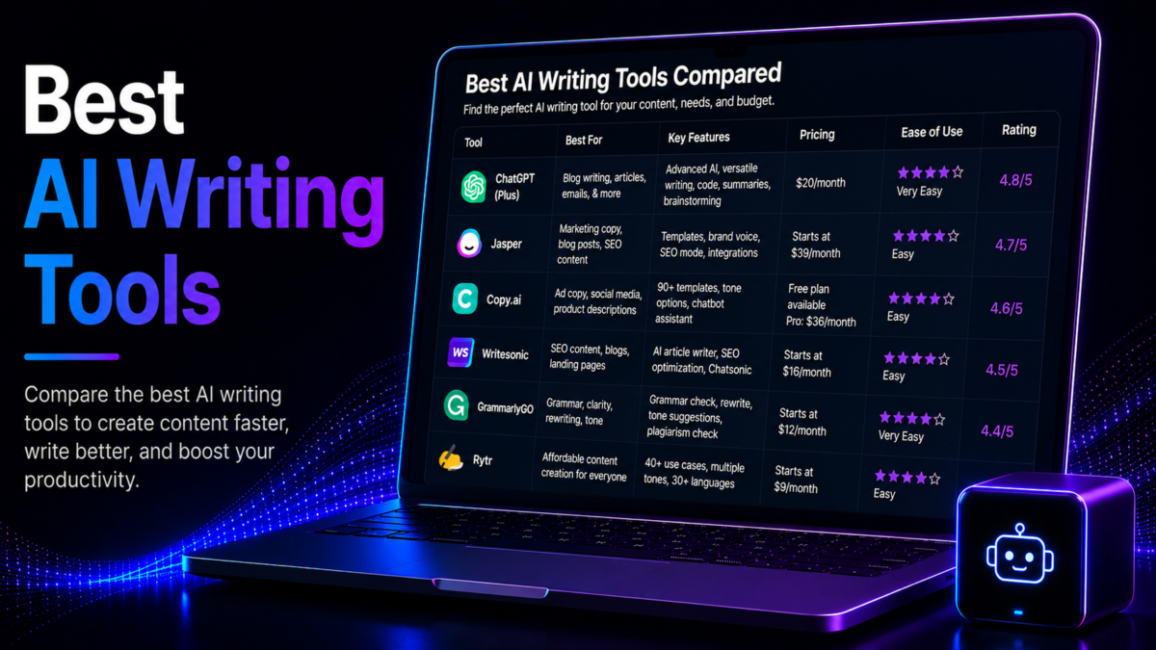
Most roundups rank writing software by how fast it produces words. That is the wrong number. The metric that decides whether a subscription pays for itself is how long you spend repairing the draft afterwards — call it the editing tax. A $10 tool that returns 900 confident, hollow words costs more than a $69 tool that returns a structured, sourced draft you can ship in twenty minutes. We timed that repair work, and it reorders the leaderboard considerably. Here is what the best AI writing tools look like in July 2026: honest pricing, honest limits, and a recommendation that starts with spending less rather than more.
| Quick answer: Begin with one general assistant — ChatGPT, Claude or Gemini, each about $20 a month — since it handles roughly four in five writing jobs. Buy a specialist only when a named gap appears: Jasper for team brand voice, Grammarly for editing, Surfer for SEO structure, Sudowrite for fiction. Every tool produces a first draft, never a finished piece. |
How we compare: we push the same three briefs — a 1,200-word explainer, a product landing page and a cold email — through each tool’s paid tier, then stopwatch the edit to publishable. Prices come from each vendor’s public pricing page in July 2026 and move often, so verify before you buy. Disclosure: some links here are affiliate links. If you subscribe we may earn a commission at no extra cost to you, and it never influences what we rank or what we criticise.

Table of Contents
What Are the Best AI Writing Tools in 2026?
How the category consolidated
The category has stopped expanding and started consolidating. Thin wrappers around a single model mostly died or pivoted — Copy.ai now sells itself as a go-to-market platform rather than a copy generator, and Grammarly’s parent company renamed itself Superhuman as it moved toward a full productivity suite. What survived built something the frontier models cannot replicate alone: proprietary search data, enforced brand voice, or a fiction-tuned model.
The three general assistants at the centre
That leaves three general assistants at the centre. ChatGPT has the widest app and plugin ecosystem. Claude — running Opus 5, released 24 July 2026 — is what editors reach for when the deliverable is 2,000 words of connected argument rather than a headline. Gemini wins on proximity if your drafts already live in Docs and Gmail. All three sit near $20 a month, and choosing between them is closer to a taste test than a spec comparison. (Claude is made by Anthropic, the maker of this assistant.)

| Tool | Best for | Price (July 2026) | The catch |
| ChatGPT Plus | General drafting, brainstorming | $20/mo | Generic without a detailed brief |
| Claude Pro | Long-form prose and reports | $20/mo ($17 annual) | No built-in SEO or SERP data |
| Google AI Pro (Gemini) | Writing inside Docs and Gmail | $19.99/mo | Best value only inside Workspace |
| Jasper Pro | Brand voice across a marketing team | $69/seat/mo ($59 annual) | Per-seat cost scales painfully |
| Grammarly Pro | Editing and polish layer | From $12/mo | Improves text, does not originate it |
| Surfer | SEO briefs and on-page scoring | From $89/mo | Optimises structure, not insight |
| Sudowrite | Fiction and narrative | $10–$44/mo | Little use for marketing copy |
What teams are actually spending
Context for the spending: McKinsey’s State of AI survey found 72% of organisations now use generative AI in at least one function, with marketing and sales among the most common. You are not early. You are choosing inside a mature market where workflow fit, not raw capability, is the differentiator.
Why Does the Sticker Price Mislead Almost Everyone?
Run the arithmetic. If you value your time at $50 an hour and a weak tool adds forty minutes of restructuring, fact-checking and de-clichéing per article, that is $33 of hidden cost on a single piece. Publish eight articles a month and the cheap option quietly costs $264 more than the one you rejected for being $40 dearer.
The editing tax is also uneven across tasks. A general assistant given a thin prompt does its worst work on exactly the pieces that matter most — thought leadership, technical explainers, anything where a wrong claim is expensive. Give the same model a role, an audience, three source links and an approved outline, and the tax collapses. Prompt quality is a bigger lever than tool choice, which is why we test on real briefs rather than vendor demos. Demos are selected to flatter.
One line item people forget: the drag of a stack that is too wide. Five tools means five logins, five brand-voice configurations, and five places where an unverified fact can slip through unnoticed.
Which Tool Fits Which Job?
Think in two axes: generation versus editing, and general versus specialist. Generation tools write from a prompt; editing tools improve text you already have. They are complements, not rivals, and the cheapest genuinely good stack is one strong generator plus one dedicated editor. Grammarly reports more than 40 million daily active users — less a quality claim than evidence that the editing layer is the piece nearly everyone keeps.
Specialists earn their price only against a named, recurring gap. Brand voice across six writers is a real gap, and Jasper solves it. Competitive page structure at volume is a real gap, and Surfer solves it. Fiction pacing is a real gap, and Sudowrite solves it. “Our content feels generic” is not a gap a specialist fixes — that is a briefing problem wearing a shopping list. If you publish articles specifically, our guide to the best AI blog writing tools breaks the long-form category down further, and the wider generative AI tools pillar covers the image, video and audio equivalents.

How Did One Freelancer Cut Her Stack From Five Tools to Two?
Odile Lambert writes B2B SaaS content from Lisbon for four retained clients. In January she was paying for ChatGPT Plus, Jasper, Surfer, Grammarly and Copy.ai — roughly $229 a month — and still rewriting most of what came out. Her assumption was that more specialised tools would mean less work.
She ran a two-month audit, logging edit time per deliverable alongside which tool produced the draft. The results were unflattering to her spending. Jasper’s brand voice added little, because each client already supplied a style guide she pasted into a prompt. Copy.ai duplicated work ChatGPT did just as well. Surfer earned its keep on exactly one client — the one competing for high-volume keywords.
She now runs ChatGPT Plus and Grammarly at $32 a month, keeps a per-client prompt file holding voice rules and three reference paragraphs, and bills Surfer to the single client who needs it. Average edit time per 1,500-word piece fell from 95 minutes to 55 — not because the tools improved, but because the briefs did.
This example is a composite of the writing workflows we see most often, not a single client account; the figures are typical rather than measured from one engagement.
What Do These Tools Still Get Wrong?
Hallucination is not solved. Every tool here will invent a statistic, misattribute a quote, or produce a plausible URL that resolves to nothing, and it does so in the same confident register it uses for correct facts. Names, numbers, dates and citations are the highest-risk fields; check all four before anything goes live.
Voice flattening is the subtler failure. Models converge on an agreeable middle register, so a page of unedited output reads like every other page of unedited output. Some writers reach for an AI humanizer to disguise that, and others test drafts against an AI content detector — but detectors carry a well-documented false-positive problem, and neither substitutes for an actual point of view.
On search, Google’s own documentation is unambiguous: AI assistance is fine, and generative AI is “particularly useful when researching a topic, and to add structure to original content” — but generating many pages without adding value can trip its scaled content abuse policy. The rule is outcome-based. Publish something worth reading and the production method stops being the issue.
Frequently Asked Questions
What is the best AI writing tool overall?
There is no single winner, and any list that names one is selling something. For general work, ChatGPT, Claude and Gemini are close enough that preference decides it. Reach for a specialist — Jasper, Surfer, Sudowrite — only after a general assistant has demonstrably failed at a specific, repeated task.
Are AI writing tools free?
Partly. ChatGPT, Claude and Gemini all run capable free tiers with usage caps, and Grammarly’s free plan covers basic corrections. Jasper and Surfer are paid only. Treat free tiers as a two-week trial against your genuine workload, not as a permanent production setup for client work.
Can AI writing tools replace human writers?
No, and the failure is structural rather than temporary. Models cannot supply first-hand experience, verified sources, accountability for errors, or an opinion worth disagreeing with. They compress drafting time substantially, which is real value. The judgement about what is true, relevant and worth saying stays with a person.
Will Google penalise content written with AI tools?
Not for using AI. Google’s guidance targets low-value pages produced at scale to manipulate rankings, regardless of how they were made. Original, accurate, genuinely useful content that happens to be AI-assisted is fine. Thin, unedited output published in bulk is what triggers the scaled content abuse policy.
Which AI writing tool is best for SEO content?
Surfer, Writesonic and Frase pair drafting with keyword and on-page scoring, which helps at volume. For a handful of articles a month, a general assistant plus a manually built brief usually matches them for far less money. Optimisation tools cannot supply the expertise that rankings actually reward.
How do I stop AI drafts sounding generic?
Give the model a role, a named audience, an approved outline and two paragraphs of your own writing as a voice sample. Then delete its opening line, which is almost always throat-clearing, and replace one section with something only you know: a number, a failure, or a client story.
What is the editing tax, and how do you measure it?
The editing tax is the time it takes to make a draft publishable, and it is the only number that actually ranks these tools. A subscription that costs $20 a month but needs 40 minutes of rewriting per piece is more expensive than one at $40 that needs 15, and the gap compounds with volume. Measure it the boring way: time yourself from the moment the draft lands to the moment you would publish it, across five real pieces rather than one. Count the whole edit — fact-checking, restructuring, stripping filler, fixing tone — not just the typing. Then divide the monthly cost by pieces produced and add the edit time at whatever your hour is worth. Most people discover the sticker price is the smaller half of the bill, which is why a cheap tool with a heavy tax is the most common expensive mistake in this category.
Conclusion
The honest recommendation is boring: one general assistant, one editing layer, roughly $32 a month, and a disciplined briefing habit. That stack beats most five-tool setups because the bottleneck was never generation capacity — it was the quality of instruction going in and the rigour of the edit coming out. Add a specialist the moment you can name the exact gap it closes and the hours it saves, and not before. Treat every output as raw material, verify anything carrying a number or a name, and put something in the piece no model could have produced. That last part is still the whole job.
