


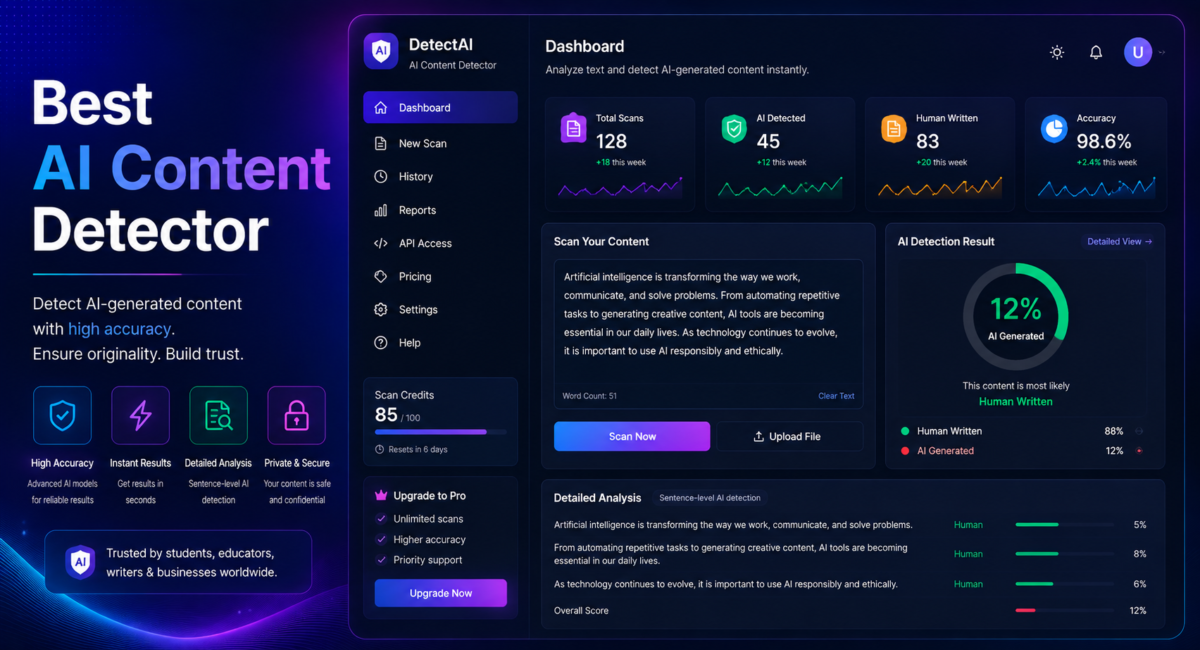
Running text through a classifier has become as routine as spellcheck for editors, instructors and marketplace moderators. What has not kept pace is the literacy around what those classifiers return. The 2026 generation is genuinely stronger than the 2023 generation — in places by an order of magnitude on false positives — but every one of them still outputs a likelihood, and treating a likelihood as evidence is how grades and contracts get damaged over statistics nobody in the room understands.
| Quick answer: In 2026 Pangram posts the strongest independent accuracy and the lowest false-positive rate, GPTZero is the best free entry point, Originality.ai suits publishers who want plagiarism in the same scan, Copyleaks covers multilingual volume, and Turnitin is whatever your institution already licenses. All of them return probability, never proof. |
Disclosure: TechieHub may earn a commission if you subscribe through links on this page. It costs you nothing extra, and it never affects which tools we recommend or how we order them.

How we compare: We weight independent, third-party evaluations above vendor marketing, and we treat a published false-positive rate as more important than a headline accuracy figure. Where a vendor’s own number is the only one available, we say so. Pricing is checked against official pages at the date above and changes often — verify at checkout.
Table of Contents
What Does an AI Content Detector Actually Measure?
Two generations of technology share the same label. First-generation tools scored statistical surface features: perplexity, or how predictable each word choice is given the ones before it, and burstiness, the variance in sentence length and rhythm. Machine text tends to be smoother on both. The heuristics were cheap and explainable, and they were also the source of the field’s worst reputational damage, because a great deal of honest human prose is predictable and evenly paced.
Second-generation detectors are supervised classifiers — transformer models fine-tuned on large labelled corpora of human and machine writing, frequently with hard-negative mining against paraphrased and deliberately “humanized” samples. Pangram’s published technical report describes exactly this training recipe. The practical difference is that a modern classifier learns the fingerprint of specific model families rather than scoring generic predictability, which is why it survives formal, technical and non-native writing far better.
None of it changes the epistemics. The output is a calibrated probability attached to a text, not a statement about a person. Vendors say so themselves: Turnitin’s documentation is explicit that its indicator is not a determination of misconduct. If you are producing the drafts rather than checking them, the same statistical logic drives the AI humanizer tools built to move a score in the other direction.
Which Is the Best AI Content Detector in 2026?
Pangram — the accuracy leader on independent evidence
Pangram is the accuracy leader on current evidence. In an August 2025 evaluation by the University of Chicago’s Becker Friedman Institute covering 1,992 human and 1,992 AI texts, it recorded a 0.001 false-positive rate against 0.002 for Originality.ai and 0.007 for GPTZero, and it was the only tool meeting the study’s policy cap of 0.005. A June 2026 Vrije Universiteit Brussel test of 160 academic papers reported 97.5% detection with zero false positives on ESL essays. The free tier allows a handful of checks per day; individual paid plans start around $20 per month.
GPTZero and Originality.ai — free checking and publisher workflows
GPTZero remains the sensible default for anyone who needs a credible answer without a purchase order. Its free tier covers roughly 10,000 words a month with sentence-level highlighting, and published paid plans start near $15 per month. Originality.ai is the publisher’s pick: its official pricing page lists $14.95 per month for 2,000 credits, where one credit scans 100 words for AI, or two credits per 100 words when you scan for AI and plagiarism together.
Copyleaks and Turnitin — multilingual volume and institutional reach
Copyleaks is the multilingual and enterprise option, covering AI detection in 30-plus languages with LMS integration; its 99.1% accuracy claim comes from internal testing, so treat it accordingly. Turnitin wins by distribution rather than merit — if your university licenses it, it is the score that counts.
| Tool | Best for | Entry price (verify) | Evidence base |
| Pangram | Highest-stakes decisions | Free daily checks; ~$20/mo | Independent university studies |
| GPTZero | Free, everyday checking | Free 10k words/mo; ~$15/mo | Third-party benchmarks |
| Originality.ai | Publishers and SEO teams | $14.95/mo, 2,000 credits | Third-party benchmarks |
| Copyleaks | Multilingual and enterprise | Limited trial, then paid | Vendor-reported |
| Turnitin | Institutions already using it | Institutional licence | Vendor-reported |
How Well Do Detectors Hold Up on Edited or Humanized Text?
This is where the field separates. Raw, unedited model output is close to a solved problem — most credible tools clear 90% on it. Add a paraphrasing pass and the picture changes completely. A 2025 University of Maryland comparison put Pangram at 98–99% overall and roughly 90% on humanized text, while GPTZero scored 85.3% overall but only 46.7% once the same text had been rewritten. Independent testing of Copyleaks has found humanized detection falling into the twenties.
The asymmetry matters for how you interpret a clean result. A high AI score on long-form text is informative. A “human” verdict is much weaker evidence, because the cheapest possible countermeasure — running a draft through a rewriter — defeats most detectors most of the time. Anyone auditing outsourced copy produced with AI writing tools should assume the negatives are unreliable and design the workflow around that, not around the flags.
Why Do Detectors Flag Honest Human Writing?
Because “sounds like a machine” and “was written by a machine” are different claims, and first-generation detectors could not tell them apart. The landmark evidence is a Stanford study published in Patterns, GPT detectors are biased against non-native English writers, which ran seven detectors over TOEFL essays written by humans and found an average false-positive rate of 61.3%, with roughly one in five essays misclassified unanimously by every tool tested. Rewriting the same essays in more idiomatic English dropped the false-positive rate to 11.8% — proof the detectors were scoring fluency, not authorship.
Vendors have responded with guardrails rather than denials. Turnitin’s official FAQ states a false-positive rate under 1% only for documents scoring above 20% AI, suppresses any score between 1% and 19% because that band produced more false alarms, and requires a minimum of 300 words of prose. Those constraints are the honest part of the product, and they tell you precisely where a score stops meaning anything.
What Should You Check Before You Pay for One?
Rank the false-positive rate above everything else, and insist on a source that is not the vendor. Then check three things: whether the tool reports sentence-level highlighting you can actually review, whether it has been tested against paraphrased text rather than raw output only, and whether the pricing model matches your volume — credit systems punish long documents, word allowances punish frequent small checks.
Finally, test any candidate on your own archive before you buy. Feed it twenty pieces you know were written by hand, ideally including work from non-native English speakers on your team, and count the flags. A tool that misfires on your own verified human writing will misfire on the writing you cannot verify. That single afternoon of testing is worth more than every accuracy claim on every marketing page, and it applies equally whether you are vetting freelancers or auditing drafts from AI blog writing tools.
Case Study: How a Managing Editor Rebuilt a Broken Review Process
Georgina Ashworth runs editorial at a fourteen-person B2B content studio in Austin that ships roughly forty freelance drafts a month. Her task in early 2026 was straightforward on paper: verify that contracted writers were not silently outsourcing to a model. Her first system was a single free detector and a 70% threshold, and within two months it had produced two wrongful accusations — both against the same Brazilian writer whose careful, formal English tripped the classifier repeatedly.
The rebuild had four rules. Nothing under 300 words gets scored at all. Every flag is confirmed by a second, independent detector before anyone is contacted. Sentence-level highlights must be read, not just the headline percentage. And a confirmed flag opens a conversation about drafting history — outlines, revision timestamps, source notes — rather than an accusation.
The outcome over the following quarter: zero wrongful accusations, one genuine case identified and resolved through the draft-history conversation rather than a score, and one writer retained who would otherwise have been dropped. The detector did not become more accurate. The process around it stopped pretending the detector was a verdict, which is the only reliable upgrade available in the current generative AI tools landscape.
This example is a composite of the detection reviews we see most often, not a single client account; the figures are typical rather than measured from one engagement.
Frequently Asked Questions
What is the most accurate AI content detector right now?
On independent evidence, Pangram leads. University of Chicago researchers measured a 0.001 false-positive rate against 0.002 for Originality.ai and 0.007 for GPTZero, and a 2026 Brussels study reported zero false positives on ESL essays. Accuracy still varies with text length, language and editing.
Is there a genuinely free AI content detector?
Yes. GPTZero’s free tier covers roughly 10,000 words a month with sentence-level highlighting, and Pangram allows a small number of free checks daily. Free tools without signup exist but publish no independent validation, so avoid them for anything with consequences attached.
Can detectors identify text from Claude Opus 5 or GPT models?
Mainstream detectors target output from all major model families, including Anthropic’s Claude Opus 5, released in July 2026. Detection typically lags a major release by weeks until classifiers retrain, so a clean result on very new model output deserves less confidence than usual.
Can an AI content detector be used as proof of cheating?
No, and vendors say so. Turnitin’s own documentation states its indicator is not a determination of misconduct. A score is grounds to open a conversation about drafting process, sources and revision history — never grounds for a penalty on its own.
Do paraphrasing tools defeat AI detection?
Often, yes. A University of Maryland comparison found GPTZero’s accuracy dropping from 85.3% to 46.7% on humanized text, and Copyleaks falling further. Pangram held near 90%. Treat a “human” verdict as weak evidence, since rewriting is the cheapest available countermeasure.
How much does a paid AI content detector cost?
Entry plans cluster around $15 to $20 per month. Originality.ai lists $14.95 monthly for 2,000 credits, where a single credit scans 100 words, rising to $179 monthly at enterprise scale. Word-allowance pricing suits frequent short checks, while credit systems suit occasional long documents.
What should you do if you are falsely accused of using AI?
Shift the conversation from the score to the evidence of how the draft was made. A detector output is a probability and cannot be rebutted directly — but authorship leaves a trail that a classifier does not. Google Docs and Word both keep version history showing the document being built over time; browser history, notes, outlines, reference PDFs and earlier drafts all corroborate it. Ask for the specific claim in writing, including which tool produced it, the exact score and the word count scanned.
Then cite the vendors’ own limits, because they are more conservative than the people quoting them. Turnitin suppresses any score between 1% and 19% and requires 300 words of prose, and its sub-1% false-positive claim applies only above 20% AI. If English is not your first language, the Stanford finding above is directly relevant: seven detectors averaged a 61.3% false-positive rate on TOEFL essays written by humans. Finally, offer a live demonstration — writing a comparable passage under observation settles it in a way no rebuttal document can.
Conclusion
The 2026 tools are meaningfully better than their predecessors, and the gap between them is now large enough to matter. Pangram is the tool to reach for when a decision has consequences, GPTZero when it does not, Originality.ai when you need plagiarism checking in the same pass. But the upgrade that changes outcomes is procedural, not technical: a word-count floor, a second opinion before anyone is contacted, sentence-level review instead of headline percentages, and an escalation path that examines how a draft was made rather than what a classifier guessed. Buy the most accurate detector you can justify — then build a process that would survive being wrong.
