


Affiliate disclosure: some links below are affiliate links. If you buy through one, TechieHub may earn a small commission at no extra cost to you. It never changes where a tool lands in this guide.
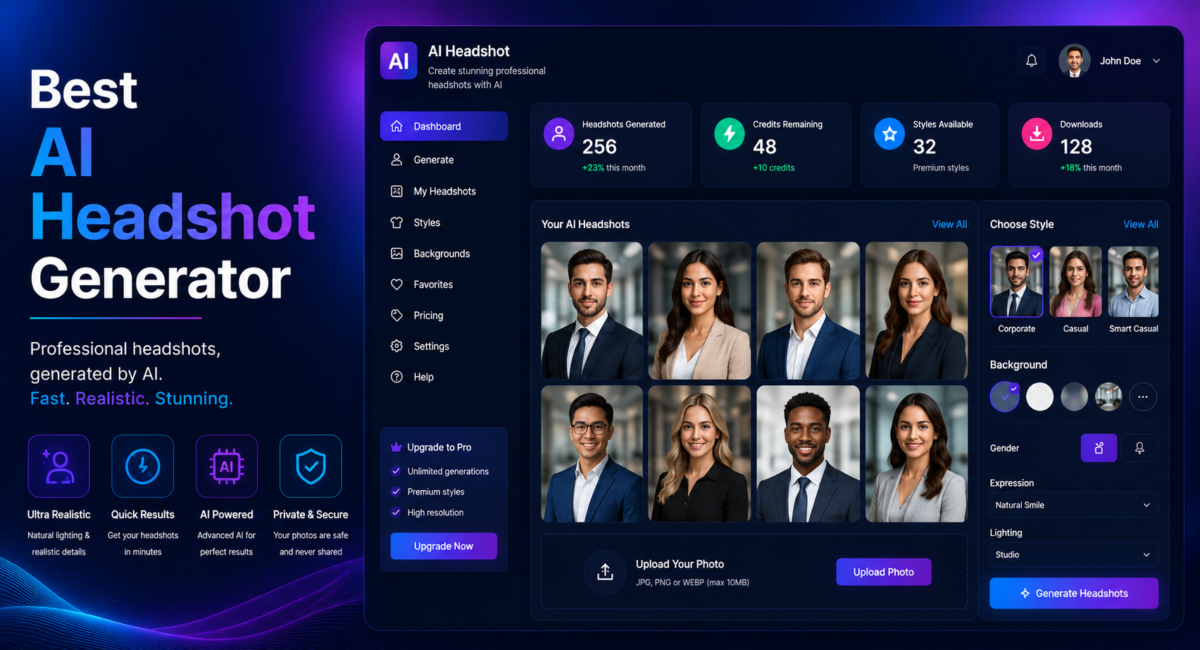
A studio headshot used to cost you a half day: book the photographer, find a shirt that photographs well, wait a week for proofs. In 2026 the same result starts with a folder of selfies and finishes before lunch. What changed this year is not the novelty but the accounting. Prices have settled into a narrow band, 4K has stopped being a premium upsell, and a layer of disclosure law has arrived that most ranked lists still ignore. This guide covers what these tools do to your face, what they cost per usable image, and what you agree to when you upload.
| Quick answer: Aragon AI is the strongest all-rounder for likeness, HeadshotPro is built for teams and bulk rollouts, and BetterPic ships 4K on every plan. Expect roughly $29 to $79 for 20 to 120 images, with turnaround between 15 minutes and two hours. Judge any tool on cost per usable photo, never on headline price. |
Table of Contents
How we compare: we weight likeness accuracy first, then artifact rate, then cost per usable photo, then privacy policy, and only then style count. Every price here was read off the vendor’s own pricing page in July 2026, not copied from another roundup. We take no payment for placement.
What these tools actually do to your photos
Every serious product in this category follows the same four beats. You upload a batch of selfies, the service fine-tunes a small personalised model on your face, it renders you into pre-built scenes with set attire, lighting and backgrounds, and you keep the frames that survive scrutiny. BetterPic is unusually specific about the input: eight images minimum for training, ideally six or seven chest-up shots plus one or two half-body frames.
Two consequences follow, and they explain nearly every complaint you will read. First, the model can only generalise from what you gave it, so ten near-identical bathroom-mirror selfies produce ten variations of the same slightly-off face. Second, nothing is retouched. Each frame is generated from scratch by the same machinery behind the best AI tools for generating images, which is why one image nails your jawline and the next quietly gives you somebody else’s ears. A keep rate of one in three to one in five is normal, not a defect.
The 2026 field, priced and compared
Three names do most of the work this year, and their published pricing is now specific enough to compare line by line.
Aragon AI — best overall likeness
Aragon AI stays the default pick for individuals who want one great photo with no fiddling. Its list tiers run $35, $45 and $75, with the middle tier taken by most buyers and the top tier promising the fastest turnaround and widest style range. Promotions run often enough that the list price is rarely what you actually pay.
HeadshotPro — the team and bulk rollout pick
HeadshotPro is the clearest team play. Its published plans are $29 for 30 headshots at roughly a two-hour turnaround, $39 for 50 headshots in about 30 minutes, and $59 for 70 headshots with 4K downloads and a 15-minute turnaround. Team pricing drops to about $25 per person for 40 headshots each, with an administrator locking the style so everyone on the about page matches.
BetterPic — 4K on every plan, for print
BetterPic differentiates on resolution: every plan renders at 4K, from the 20-image Basic tier through 60-image Pro to the 120-image Expert plan, which adds a human retoucher for the details generation still fumbles. Entry pricing starts around $35.
Below those, Secta AI sells one-time high-volume packs, ProfilePicture.ai anchors the budget end, and Canva’s free tier hands you a couple of frames for nothing. General image models are an option too, but they are weak at holding one specific real face across dozens of renders, which is exactly the job a headshot has to do.
| Tool | Best for | List price | Output | Turnaround |
|---|---|---|---|---|
| Aragon AI | Overall likeness | $35 / $45 / $75 | Tiered image packs | 15 min to 2 hr |
| HeadshotPro | Teams and bulk rollouts | $29 to $59 | 30 to 70 headshots | 15 min to 2 hr |
| BetterPic | Print and 4K output | From $35 | 20 to 120 shots, all 4K | 1 to 2 hr |
| Secta AI | Maximum volume | One-time packs | Hundreds of images | About 1 hr |
| ProfilePicture.ai | Lowest entry cost | Budget tier | Small packs | Under 1 hr |
| Canva AI | Trying it free | Free tier | A few frames daily | Minutes |

How to choose the best AI headshot generator for your situation
Skip the feature grid and answer one question: what is the photo for? A single LinkedIn and email-signature refresh is a $29 to $45 job, and the cheapest tier of any of the three leaders covers it. A conference programme, a printed banner or a press kit needs real pixels, which makes BetterPic’s blanket 4K the safe call. A company rolling out matching portraits across a people page wants HeadshotPro’s admin-locked team plan, because consistency is the deliverable, not variety.
Then run the only price maths that matters. At a realistic 30 percent keep rate, HeadshotPro’s $39 plan yields about 15 usable frames, or roughly $2.60 each; the $29 plan yields about nine, or roughly $3.20 each. The cheaper plan is the more expensive photo. That inversion holds across almost every vendor, which is why a money-back guarantee is worth more than ten extra style presets.
One shortcut is worth knowing: if you already own a decent photo taken in good light, a careful pass through the best AI image editor often beats a full generated session on cost and likeness, because you are correcting a real photograph rather than reconstructing one.
Why likeness beats resolution
LinkedIn’s own data is unambiguous about having a photo at all: members with one receive 21 times more profile views and 9 times more connection requests. What that figure does not say is that a more flattering photo performs better. The upside comes from being visible and credible, and credibility collapses the moment someone meets you and does a double take.
So audit the output like a picky photo editor. Zoom to 100 percent and check where generation still breaks: the hairline, the inner edges of glasses and their reflections, teeth, earrings, collar seams and any visible hands. Then run the harder test. Put three candidates beside a recent phone photo and ask whether a colleague would pick them as the same person without hesitating. Discard anything that looks younger, thinner or better-rested than you are, however tempting. A headshot that overpromises is worse than an average one.
The likeness failure nobody warns you about
Beyond age and weight, these tools have a documented habit of changing things people do not expect to be negotiable. Reported cases include lightened skin, narrowed noses, altered eye shape and straightened hair — features shifted toward whatever the training data over-represented. The problem is worst for users outside the demographic the model saw most of, which means the people most poorly served are the least likely to be warned.
It is rarely dramatic enough to notice in a thumbnail, which is exactly the danger. Check it deliberately: open a candidate beside a recent phone photo at the same size and compare skin tone, nose and jaw shape, eye shape and hair texture directly rather than judging the image on its own. If a tool cannot hold those across a batch, no amount of 4K fixes it — and that is a reason to pay for a service that keeps likeness under control rather than the cheapest pack of renders.
This is also the strongest practical argument for uploading a dozen varied, recent selfies rather than the minimum: the more the model sees of your actual face across different light and angles, the less it fills gaps with its own defaults.
Where your face data goes, and the new disclosure rules
You are uploading biometric data, so retention terms are a genuine comparison criterion. HeadshotPro states that uploaded selfies and generated results auto-delete after 30 days and that download links last seven, the kind of specificity you want in writing before you pay. Under Illinois’ Biometric Information Privacy Act, statutory damages run to $1,000 per negligent violation and $5,000 per intentional one, which is why the better-run vendors publish deletion windows at all.
The disclosure layer is new, and it is the part most roundups miss. Article 50 of the EU AI Act applies from 2 August 2026 and requires providers of systems generating synthetic image content to mark that output in a machine-readable, detectable format. In practice that means provenance metadata. The Content Authenticity Initiative behind the C2PA standard now counts more than 6,000 members, with hardware such as the Google Pixel 10 signing images natively at capture.
The practical upshot is modest but worth knowing. Your headshot may carry a credential identifying it as AI-made, many platforms strip metadata on upload anyway, and nothing here forbids using a synthetic portrait professionally. It simply means honest framing is becoming the default rather than the polite option, which is how generative AI tools should be used regardless.
Case study: one consultant, one afternoon
Nadia Farooq, a freelance data-privacy consultant in Manchester, had not had a decent photo taken since 2021. She was speaking at a September conference whose organisers needed a print-resolution portrait, and her only local studio quote ran to the low hundreds with a two-week lead time.
She shot twelve fresh selfies in one afternoon across three locations, deliberately varying angle, expression and background, then ran BetterPic’s Pro tier. Sixty 4K frames came back in about ninety minutes. Seven passed her likeness test; the rest went, including two she privately liked best because they had quietly slimmed her face. One frame went to LinkedIn, one to the conference at full resolution, one to her site.
She used Claude Opus 5 the same evening to tighten her LinkedIn headline against the new photo, then refreshed her CV with an AI resume builder so all three assets said the same thing. Total spend was under $50, the organisers accepted the file without a reshoot, and nobody at the conference mentioned the photo, which was the point.
Frequently Asked Questions
Is there a single best AI headshot generator?
No. Aragon AI wins on all-round likeness for individuals, HeadshotPro on team rollouts and admin control, and BetterPic on resolution because every plan outputs 4K. The right pick follows from your deliverable, so decide whether you need realism, consistency across people, or print-ready pixels first.
How much do AI headshots cost in 2026?
Mainstream plans run roughly $29 to $79 for a session returning 20 to 120 images. HeadshotPro starts at $29 for 30 headshots, Aragon lists $35, $45 and $75 tiers, and BetterPic starts around $35 with 4K throughout. A local studio session still costs several times that.
How many selfies should I upload?
Most tools want between eight and twenty. BetterPic asks for eight minimum and recommends six or seven chest-up shots plus one or two half-body frames. Variety matters more than volume: different days, angles, expressions and lighting. Skip group photos, sunglasses, hats and heavy filters entirely.
Are AI headshots acceptable on LinkedIn?
Yes, provided the result genuinely looks like you. Nothing in LinkedIn’s rules prohibits a generated portrait, and recruiters routinely see them. The failure mode is not the technology but the temptation to pick an idealised frame that undermines trust the first time you meet someone in person.
Do I have to disclose that my headshot is AI-generated?
You personally are not required to announce it. EU AI Act Article 50 obligations, applying from August 2026, fall on the systems generating the content and require machine-readable marking rather than a caption from you. Provenance metadata may travel with the file, though many platforms strip it on upload.
What happens to my uploaded photos afterwards?
It depends entirely on the vendor, so read the retention clause before paying. HeadshotPro auto-deletes uploads and results after 30 days, with download links expiring in seven. Check whether images train future models, how deletion is requested, and prefer vendors stating a specific window in writing.
Can I use an AI headshot commercially?
Usually yes on paid plans, but it is set by the vendor’s terms rather than by copyright, so read them before the photo goes anywhere that matters. Paid tiers on the major headshot services generally grant commercial use of the images you generate. Free tiers frequently do not, and that is the trap — the free frame that looks fine for LinkedIn may not be licensed for a company about page, a conference banner or a paid ad.
Two details are worth checking in the same pass: whether the licence survives cancelling your subscription, since some grants are tied to an active plan, and whether the vendor reserves the right to use your generated images in its own marketing. If the photo represents a business rather than a person, the disclosure rules covered above apply on top of the licence.
Conclusion
The category has matured past the point where the interesting question is whether AI headshots work. They do. The questions that matter in 2026 are what a usable frame really costs once you account for the keep rate, how long a vendor holds your biometric data, and whether you picked the photo that looks most like you rather than the one that flatters you most. Aragon for likeness, HeadshotPro for a team, BetterPic when the file has to print. Feed it a dozen varied, recent, well-lit selfies, audit at full zoom, and delete anything a colleague would hesitate over.
