

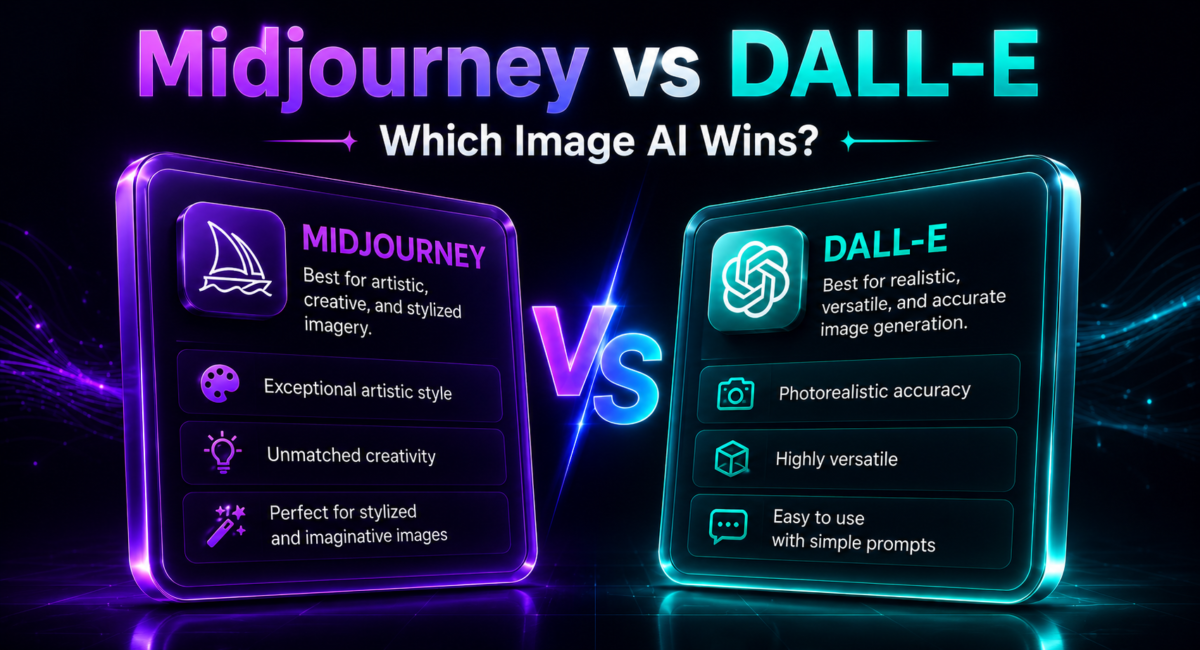
Ask this question in 2026 and you run into an awkward fact: one of the two contenders no longer exists as a shipping product. OpenAI switched DALL-E 2 and DALL-E 3 off in its API on 12 May 2026, and inside ChatGPT the DALL-E name was quietly replaced first by GPT Image 1.5 and then by GPT Image 2. Midjourney, meanwhile, has pushed out three model releases this year alone. So the honest matchup is Midjourney V8.2 against OpenAI’s GPT Image 2 – and the balance of power has shifted since the last time most guides were written.
| Quick answer: Midjourney V8.2 still makes the most striking, art-directed images and is the better buy when look and mood are the deliverable. OpenAI’s GPT Image 2 – the model that replaced DALL-E – wins on prompt accuracy, in-image text and sheer accessibility, and it currently sits at the top of the public image arenas. |
How we compare: we test both tools on the same prompt sets each quarter, weight the results against published benchmarks and official vendor documentation rather than vendor marketing, and re-check every price and model version before an update ships. Disclosure: some links on TechieHub are affiliate links. We earn a commission if you subscribe, at no extra cost to you, and it never changes which tool we recommend.
Table of Contents
Midjourney vs DALL-E: what actually changed in 2026?
The DALL-E brand is retired. OpenAI announced the deprecation in November 2025 and, per its own API deprecations page, shut both DALL-E 2 and DALL-E 3 down on 12 May 2026, pointing developers at gpt-image-2 instead. That consolidation is still running: gpt-image-1 retires on 23 October 2026, and gpt-image-1-mini, gpt-image-1.5 and chatgpt-image-latest all fold into gpt-image-2 on 1 December 2026. One model, one endpoint.
GPT Image 2 landed on 21 April 2026 and is the first of the line to apply reasoning to what it draws, which is why its typography is so much steadier than DALL-E 3’s ever was. Midjourney answered on its own cadence: V8 in alpha on 17 March, V8.1 on 14 April, and, per its own version documentation, V8.2 promoted to the default model on 24 July 2026 – an update aimed squarely at aesthetics and personalization. If you are mapping the wider field, our generative AI tools hub tracks how these releases fit together.
How do the two stack up head to head?

| Dimension | Midjourney V8.2 | OpenAI GPT Image 2 |
|---|---|---|
| Current model | V8.2, default since 24 July 2026 | GPT Image 2, released 21 April 2026 |
| Where you use it | Web app, Discord bot, mobile app | ChatGPT, Microsoft Copilot, OpenAI image API |
| Entry price | $10/month Basic, no free tier | Free tier, then $8 Go or $20 Plus |
| House character | Stylized, cinematic, opinionated | Literal, photoreal, spec-accurate |
| Text inside images | Still the weak spot | Reasoning-led, the category leader |
| Developer API | Effectively enterprise-only | Public, token-priced |
Read that table as two different products rather than two grades of the same one. Midjourney sells a look. OpenAI sells obedience plus distribution.
Which one produces better-looking images?
The benchmark picture is less flattering to Midjourney than its reputation suggests, but it needs a caveat. On the Artificial Analysis Text to Image Arena, where users blind-vote between two outputs from the same prompt, GPT Image 2 (high) leads with an Elo of 1340, roughly 40 points clear of Reve 2.1 at 1300. Midjourney’s best entry is v7 Alpha at 1069, ranked 89th.
That gap is real but partly an artefact: Midjourney does not submit its current models to the arena, so V8, V8.1 and V8.2 are simply absent from the ranking. What you are seeing is a year-old Midjourney model against a three-month-old OpenAI one.
In our own side-by-side runs the older verdict still holds for artistry. Midjourney V8.2 produces bolder, moodier, more confidently composed frames, and its personalization profiles now read your taste from a much larger image pool, so a well-trained profile gets you closer to a house style in fewer attempts. GPT Image 2 is cleaner, more photographic and less likely to surprise you. If you want a broader shortlist before committing, our roundup of the best AI tools for generating images covers the specialists too.
Which is more accurate with prompts and in-image text?
This is not close. GPT Image 2 uses an autoregressive architecture rather than diffusion, and it treats your prompt as a specification to satisfy instead of a mood to interpret. Ask for a red mug behind a blue notebook and you get that arrangement, not a prettier one. Compositions with several named objects, spatial relationships and counts survive the trip far more often.
In-image text is the decisive split. Applying reasoning to lettering closed the gap that made every earlier generator useless for posters, packaging, signage and social graphics with a headline. Midjourney V8.2 has improved but still garbles words often enough that you should plan on setting type yourself afterwards – which is a reasonable workflow if you already run outputs through an editor, and our guide to the best AI image editor options covers the tools for it.
GPT Image 2 is not flawless. It still struggles with scenes containing multiple faces and with non-Latin scripts including Chinese, Arabic and Hebrew, so verify anything multilingual before it ships. Midjourney also keeps a practical edge in control: some V7-era tools such as omni-reference still fall back to V7 under V8.x, but style references and seeds remain the better instruments for reproducing a look across a set.
What do they cost in 2026?
Midjourney is subscription-only with no free tier: Basic $10/month for about 3.3 fast GPU hours, Standard $30 which adds unlimited generations in the slower Relax mode, Pro $60 and Mega $120, each 20% cheaper billed annually. For high-volume work the Relax tiers make the per-image cost very hard to beat.
OpenAI’s route is bundled. The ChatGPT free tier allows a couple of images per day, Go is $8/month, Plus is $20 and includes everything else ChatGPT does, and Pro sits at $100 or $200 for much larger allowances. Developers pay by token on gpt-image-2 – $30 per million image output tokens and $8 per million image input tokens – which works out at roughly half a cent per low-quality image and around 17 cents at high quality.
The comparison people get wrong: Midjourney’s $10 buys a dedicated creative tool, while OpenAI’s $20 buys an assistant that happens to draw. Judge them on what else the subscription does for you.
Will anyone be able to tell the image is AI?
Increasingly, yes — and by design rather than by accident. Generated images now commonly carry C2PA content credentials: signed metadata recording which model made the file and when, part of an industry provenance standard that OpenAI has publicly committed to and documented for its image models. Social platforms and stock libraries read that metadata and use it to label uploads automatically.
The compliance angle changed this month. The EU AI Act’s transparency obligations for synthetic content began applying in August 2026, requiring AI-generated images to be marked in a machine-readable way where they are made available in the EU. In practice that pushes the burden onto whoever publishes the image, not only the model provider, so a marketing team shipping into the EU now needs to know what its generator embeds and to keep that marking intact.
What this changes about your choice
Two practical consequences. First, check what your tool writes before you build a workflow on it, because provenance support has been moving quickly on both sides and the answer today is not necessarily the answer six months ago — verify against each vendor’s current documentation rather than assuming. Second, expect platform-side labelling whether or not you want it: an “AI-generated” badge is applied by the platform reading the file, not by you declaring it.
None of this argues against using either tool. It argues for deciding your disclosure position deliberately — because if you do not, the metadata decides it for you, and a label appearing on a client’s campaign that nobody warned them about is a worse conversation than the one you could have had up front.
How one brand designer used both on a single launch
Yuki Tanaka is the sole in-house designer at a Bristol coffee-subscription startup. Her brief for their spring launch was three things at once: a campaign hero image, fourteen packaging mockups whose labels had to read correctly, and refreshed profile photos for a six-person founding team.
She split the work by strength. The hero went to Midjourney V8.2, where a personalization profile trained on the brand’s existing photography gave her a usable frame on the ninth attempt – warm, filmic and unmistakably theirs. The fourteen mockups went to GPT Image 2 inside ChatGPT, because every one needed a legible roast name, weight and origin on the label; she iterated conversationally, correcting copy in follow-up messages rather than re-prompting from scratch. The headshots went to a dedicated tool instead, for the reasons our best AI headshot generator comparison sets out.
The outcome: roughly two days of work instead of a quoted five-day shoot plus retouching, at about $30 of subscription spend. Her summary was blunt – Midjourney for the one image people would remember, GPT Image 2 for the thirteen they would only need to read.
This example is a composite of the launch design projects we see most often, not a single client account; the figures are typical rather than measured from one engagement.
Frequently Asked Questions
Is DALL-E discontinued?
Yes. OpenAI shut DALL-E 2 and DALL-E 3 down in the API on 12 May 2026 after announcing the deprecation in November 2025. Inside ChatGPT the model was replaced by GPT Image 1.5 in December 2025 and now by GPT Image 2, so “DALL-E” today is a colloquial name, not a product.
Which tool is better for text inside images?
GPT Image 2, by a wide margin. It applies reasoning to lettering, making it the clear pick for posters, packaging, signage, memes and any social graphic built around a headline. Midjourney V8.2 has improved but still misspells words often enough that you should plan to add type in an editor afterwards.
Does Midjourney have a free trial in 2026?
No. Midjourney remains subscription-only with no free tier, starting at $10 per month for the Basic plan and roughly 3.3 fast GPU hours. OpenAI’s free ChatGPT tier does allow a couple of GPT Image 2 generations per day, which makes trying that side genuinely risk-free before you commit.
Why does Midjourney rank so low on image leaderboards?
Because its current models are not entered. Midjourney does not submit V8, V8.1 or V8.2 to the Artificial Analysis arena, so the highest-placed entry is the year-old v7 Alpha at Elo 1069. Treat the ranking as incomplete rather than as evidence that V8.2 lost a fair fight.
Can I use images from either tool commercially?
Generally yes on paid plans, but check current terms. Neither vendor offers the commercial indemnification Adobe Firefly provides, and Midjourney is defending consolidated copyright suits from Disney, Universal and Warner Bros. Discovery. Avoid recreating copyrighted characters, brand logos or a named living artist’s signature style.
Do I need both, or is one enough?
One is enough if your work leans decisively one way – pure concept art, or pure utility graphics. If you produce both hero visuals and text-bearing assets, running Midjourney Basic alongside ChatGPT Plus costs about $30 a month and removes the compromise entirely. Most working designers land there.
Can you remove the AI metadata from a generated image?
Technically it is fragile — content credentials can be lost simply by screenshotting, re-encoding or running a file through a tool that strips metadata, and that happens routinely without anyone intending it. So the honest answer is that the marking is not tamper-proof and was never designed to be.
Deliberately stripping it is a different matter. Where a disclosure duty applies, removing the marking to hide that an image is synthetic is the thing the rule exists to prevent, and the obligation sits with the publisher regardless of what the file contains. The provenance standard is also designed so that absent credentials prove nothing either way — which is why the practical approach is to disclose deliberately rather than to rely on metadata surviving the trip.
Conclusion
The 2026 answer is not the 2024 answer. DALL-E is gone as a product, and its replacement is stronger than it was on exactly the axes that used to be excuses: prompt fidelity, typography, resolution and price of entry. GPT Image 2 leads the arenas, lives where you already work, and costs nothing to try.
Midjourney has not been beaten so much as narrowed. V8.2 remains the better instrument when the image itself is the point – when you need a frame with a distinctive look rather than a diagram that satisfies a brief – and its personalization and style-reference controls are still the best way to hold a consistent visual identity across a body of work. Pick GPT Image 2 for accuracy, access and anything with words in it. Pick Midjourney when someone will look at the result before they read it. Verify prices and model versions on each vendor’s own pages before you subscribe, because both are moving fast.
