


How we compare: our team tests agentic AI platforms hands-on and cross-checks every statistic against its original source before publishing. Affiliate disclosure: some links are affiliate links, and we may earn a commission at no extra cost to you — it never changes our verdict.

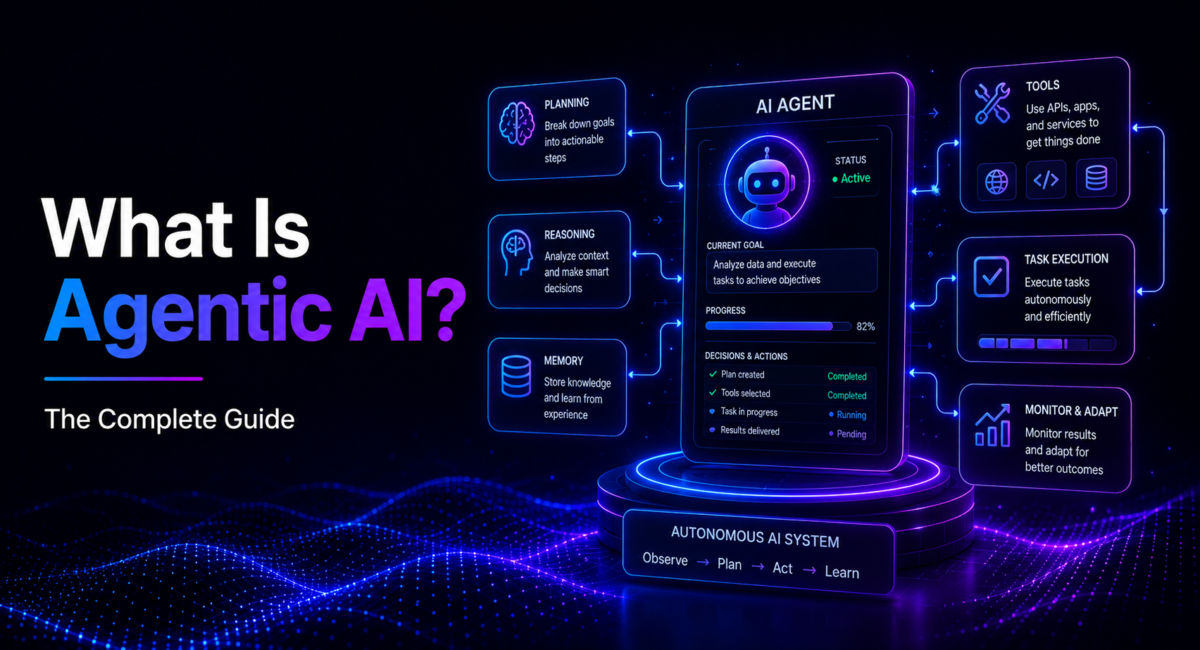
| Quick answer: Agentic AI is artificial intelligence that pursues a goal and completes multi-step tasks on its own, with limited human supervision. Unlike a chatbot that only answers a prompt, an agentic system plans, decides, uses tools such as APIs and apps, and takes real actions in a perceive-plan-act-observe loop. It builds on generative AI, using a large language model as its reasoning engine — the shift from “AI that produces” to “AI that does.” |
Table of Contents
What is agentic AI, exactly?
Agentic AI is an artificial-intelligence system that accomplishes a specific goal with limited supervision. Instead of waiting for a prompt and returning a single answer, it takes initiative: it sets sub-goals, breaks a task into ordered steps, makes decisions, calls external tools, and executes actions until the objective is met.
Its unit is the AI agent — a model that mimics human decision-making to solve problems in real time. One agent can handle a task alone, or several can cooperate in a multi-agent system coordinated through orchestration. What unites them is autonomy, goal-driven behavior and adaptability, which makes them behave less like a chatbot and more like a capable digital employee. These agents power the platforms in our guide to the best AI agent tools for teams.
How is agentic AI different from generative AI?
| Generative AI | Agentic AI | |
|---|---|---|
| What you get back | Content — text, code, an image | An outcome — the task is completed |
| How many steps | One turn: prompt in, answer out | Many, planned and revised as it goes |
| Does it use tools? | No — it produces output for you to use | Yes — it calls APIs, systems and other tools |
| Does it act? | No, you act on its output | Yes, within the permissions you grant |
| Who holds the loop | You, every turn | The system, until it needs approval |
| Typical failure | A wrong or invented answer | A wrong action already taken |
The terms get confused because agentic systems use generative AI as a component — but they differ. Generative AI produces content reactively in response to a prompt, then stops. Agentic AI autonomously manages a multi-step workflow, keeps memory across steps, calls external tools, and completes a whole task with minimal human intervention. The summary: generative AI produces; agentic AI does. For the granular contrast, see our breakdown of how AI agents differ from AI assistants.
An analogy helps. Generative AI is a brilliant consultant who answers any question but waits for you to act.

How does agentic AI work under the hood?
Agentic AI runs a continuous loop. A common five-step version is perceive (take in the goal and current state), plan (choose the next action), act (use a tool), observe (check the result), then loop back — repeating until the goal is met.
Making that loop work relies on four core components:
- Reasoning (the LLM): understands the goal and decides what to do next.
- Memory: retains context and prior steps across the whole task.
- Planning: breaks large goals into ordered sub-tasks.
- Tools and integrations: connect to apps, APIs, databases and the web so the system can act.
Together these turn a language model from a conversationalist into an operator. A crucial 2026 enabler is standardized tool access. The Model Context Protocol (MCP), introduced by Anthropic in late 2024 and donated to a Linux Foundation body in December 2025, has become the de facto way agents connect to external data and tools, with more than 10,000 public MCP servers now available — a big reason autonomous systems finally became reliable enough to deploy.
What can agentic AI actually do?
Because agentic AI completes whole workflows, its use cases span every function. Give a market-intelligence agent the goal “summarize competitor activity this week,” and it can query news APIs, pull structured data, summarize each source, and assemble a digest — with no step-by-step prompting.
Across industries it is applied to supply chain and inventory, customer support, software development, financial risk, healthcare support, and personalized employee assistance. A consistent 2026 finding is that domain-specific agents — built for a bounded area like email triage or code review — outperform general-purpose ones, because a narrow domain lets designers anticipate edge cases and test thoroughly. For deployments and the software that builds them, see our guides to real-world agentic AI applications and the leading agentic AI tools to build with.
Agentic AI in practice: a support-ops lead’s story
Consider Sofia Lindgren, a customer-support operations lead at a mid-sized SaaS company. Her team was drowning in repetitive tier-one tickets — password resets, billing questions, subscription changes — that delayed the genuinely hard cases.
She deployed a domain-specific agent connected through MCP to the help-desk and billing systems. The agent perceives each ticket, plans a resolution, drafts a reply, and — for low-stakes, reversible steps like tagging and routing — acts on its own. Anything consequential, such as issuing a refund, is queued for human approval.
An illustrative composite of the support-automation rollouts this pattern describes, not a single named customer.
What are the risks, and how do you deploy responsibly?
Autonomy is agentic AI’s strength and its risk. Where generative AI poses mainly informational risk (a wrong or biased answer), agentic AI introduces operational risk — it takes real actions on live systems, so a mistake can send a wrong email, make a bad trade, or delete a record. That is why governance must be built in from the start.
The responsible-use playbook centers on bounded autonomy: let the agent act freely on low-stakes, reversible steps while requiring human-in-the-loop approval for consequential actions like sending money or deleting data. Add strict tool-access controls so an agent can only touch what it needs, provenance logging so every action is traceable, and clear, measurable goals. The risk is real at scale: Gartner projects that 40% of agentic AI projects will be scrapped by the end of 2027, often because they were over-scoped or under-governed.
Why does agentic AI matter now?
Agentic AI became the defining AI topic of 2026 because the technology finally turned operationally practical. Capable reasoning models, reliable tool integrations via standards like MCP, and mature orchestration frameworks converged at once. The scale of the shift is concrete: Gartner predicts that 40% of enterprise applications will feature task-specific AI agents by the end of 2026, up from less than 5% in 2025.
Frequently Asked Questions
What is agentic AI in simple terms?
Agentic AI is software that pursues a goal and completes multi-step tasks on its own, with limited supervision. Unlike a chatbot that only answers a prompt, it plans, decides, uses tools, and takes real actions. It builds on generative AI, using a large language model as its reasoning engine plus memory and planning.
What is the difference between an AI agent and agentic AI?
An AI agent is a thing; agentic AI is a property. An agent is a specific system built to pursue a goal — the support agent in the example above is one. Agentic AI is the broader capability that makes such a system possible: perceiving state, planning, using tools and acting with some independence. So every AI agent is agentic, but “agentic AI” also covers agentic features inside products that are not standalone agents.
The distinction matters when buying. A vendor saying “agentic” may mean a fully autonomous system that completes work end to end, or a single agentic feature bolted onto a chat product. Ask what it does without a human turn — the answer separates the two immediately, and it is the same question that separates an agent from an assistant.
What does MCP have to do with agentic AI?
MCP is how an agent reaches the systems it needs to act on. An agent that can only talk is of limited use; the value appears when it can read a ticket, query a database and update a record. Historically every one of those connections was a bespoke integration, which is why agents were expensive to build and brittle to maintain.
The Model Context Protocol, introduced by Anthropic and now stewarded under the Linux Foundation, standardises that layer — one protocol between models and tools instead of one integration per pair. Practically, it means an agent can pick up a new capability by connecting to an MCP server rather than requiring custom code, which is a large part of why agentic systems became viable to deploy in 2026 rather than merely demonstrable.
What is an AI agent?
An AI agent is a system that mimics human decision-making to solve problems in real time, taking actions toward a goal rather than just responding. A single agent handles a task alone; in a multi-agent system, several agents each own a subtask, coordinated through orchestration. Agents are the building blocks of agentic AI.
Is agentic AI safe to deploy?
It can be, with the right controls. Because agentic AI takes real actions on live systems, it carries operational risk beyond a chatbot’s informational risk. Responsible deployment uses bounded autonomy, human approval for consequential actions, strict tool-access limits, and action logging, keeping a human accountable for anything that matters.
How much autonomy should you give an agent?
Grant autonomy by reversibility, not by confidence. The workable rule is that an agent may act alone where a mistake can be undone cheaply — tagging, routing, drafting, categorising — and must queue for approval where it cannot: money moving, data deleted, messages sent to customers, anything with a legal or financial consequence.
Set that boundary explicitly and in writing before deployment, because the default drifts. Teams typically start conservative, watch the agent perform well, and quietly widen its permissions without revisiting the reasoning — which is how the first expensive surprise happens. Review the boundary on a schedule, log every action the agent takes so the trail exists when something goes wrong, and treat a widening of scope as a decision requiring the same approval as the original deployment.
What are the main applications of agentic AI?
The main applications span customer service (resolving and escalating tickets), sales and marketing (lead qualification and outreach), finance (reconciliation and fraud detection), supply chain (forecasting, routing and inventory rebalancing) and IT and DevOps (infrastructure management and code generation), plus healthcare documentation and HR screening.
How is agentic AI used in healthcare?
Healthcare deployments concentrate on administration rather than clinical decisions, because that is where regulatory exposure is lowest and the manual burden highest: prior-authorisation processing, claims support, clinical documentation, scheduling and revenue-cycle follow-up. Clinical uses remain deliberately supervised by people.
How is agentic AI used in finance?
In finance, agents handle reconciliation, fraud detection, compliance monitoring and risk assessment. Because they reason across systems and evaluate risk thresholds, they allow faster decisions with an audit trail, which matters in regulated industries.
Which companies are using agentic AI?
Reported deployments include PayPal for transaction processing and fraud prevention, Walmart for inventory management and personalisation, Siemens for IoT monitoring and predictive maintenance, and TELUS, which reports saving hundreds of thousands of staff hours with Google Cloud.
Conclusion
The deeper significance is a change in what AI is — from a tool you query to a system that completes work on your behalf. That is why the vocabulary moved from “generative AI” to “agentic AI”: the frontier is no longer just producing content but taking action. Agentic AI pursues goals autonomously, builds on generative AI by adding memory, planning, tool use and a perceive-plan-act-observe loop, and demands bounded autonomy with human approval and strict tool access. Run that same loop through cameras and motors instead of APIs and you get physical AI, where the action space is joint angles rather than function calls. Understanding it now is how individuals and organizations position themselves for the next phase of work.
