


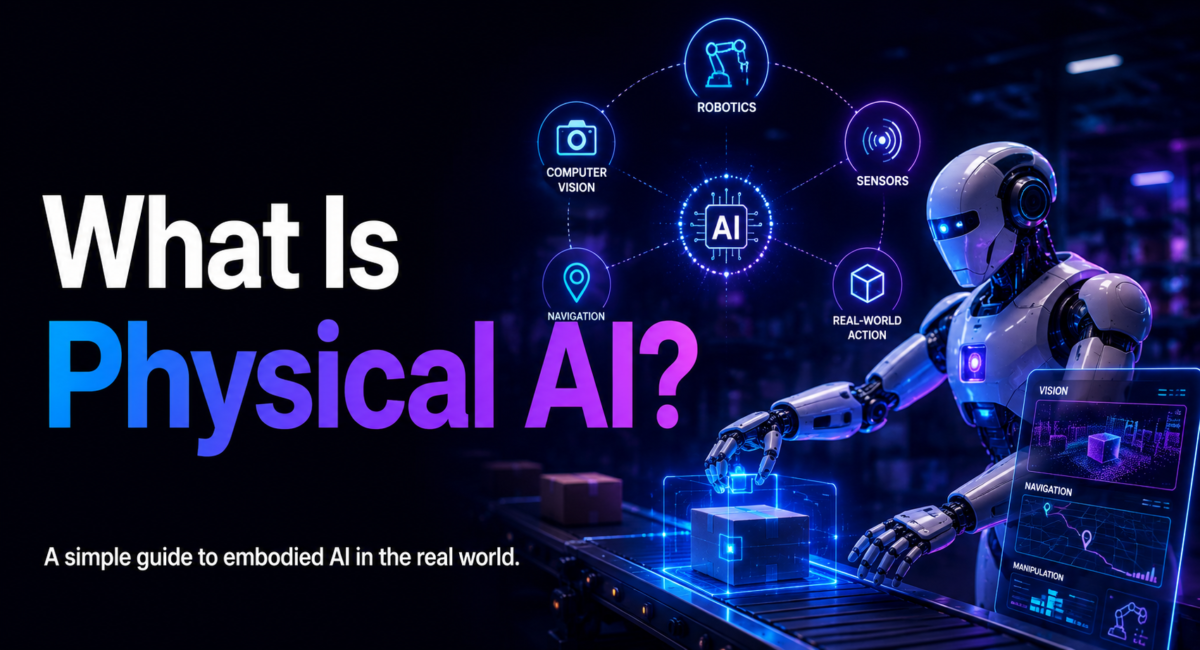
Most of the artificial intelligence you have used so far lives behind glass. You type a prompt, it returns text, an image or a block of code, and nothing in the room moves. Physical AI is the term the robotics and semiconductor industries have settled on for the next step: intelligence taken out of the browser tab and placed inside machines that have to obey gravity, friction and the clock.
That difference matters more than it sounds. A chatbot that gets an answer wrong produces a bad paragraph. A forklift that gets a decision wrong produces a broken pallet, or an injured worker. That single asymmetry shapes how physical AI is built, tested and deployed, and it explains why the field is moving more deliberately than generative AI did.
| Quick answer: Physical AI is artificial intelligence that perceives, reasons about and acts in the real world through machines with sensors and actuators, including robots, autonomous vehicles and factory equipment. Unlike generative AI, which produces digital content, physical AI produces motion, and it must satisfy physics, safety limits and real-time constraints. |
Table of Contents
What Is Physical AI?
Physical AI is artificial intelligence embodied in a machine that senses its surroundings, decides what to do and acts on the world through motors and actuators. NVIDIA, which did more than any other company to popularise the label, defines the underlying idea plainly: embodied AI is the integration of artificial intelligence into physical systems, enabling them to interact with the physical world.
Two terms circulate for the same shift. Embodied AI is the older academic phrase, used since the 1990s for systems that learn through a body. Physical AI is the newer industry framing, and it stretches slightly wider to cover any AI that reasons about or affects physical surroundings, including software that plans a factory line it never touches. In everyday use they are interchangeable, and this guide uses physical AI throughout.
The technology inherits its brains from the same foundation-model research that produced today’s large language models, but it inherits its constraints from mechanical engineering. A model that writes an essay can be rerun. A model that swings a robot arm through a shared workspace cannot take the swing back.
How Does a Physical AI System Actually Work?
Every physical AI system runs the same four-stage loop, thousands of times a minute.
Perceive. Cameras, depth sensors, lidar, force sensors and microphones convert the environment into a stream of data. Understand. The system builds an internal model of what is in front of it: which objects exist, where their surfaces are, which of them are moving and how fast. Plan. It reasons about a sequence of actions that would achieve the goal without colliding with anything. Act. Motors and actuators execute that plan, and the resulting change is immediately fed back into the perception stage.
The architectural leap of the last two years is the vision-language-action model, or VLA. Instead of hand-coding a separate module for each stage, a single neural network takes camera frames plus a natural-language instruction and emits motor commands directly. It is the same pattern as agentic AI planning a multi-step digital task, except the action space is joint angles rather than API calls.
Most of the learning happens in simulation first. Because a real robot can only perform one attempt at a time, developers train in physics engines where a task can be repeated thousands of times a minute, then transfer the resulting policy to hardware. This sim-to-real pipeline, increasingly seeded by generative world models that invent new scenarios automatically, is the only reason modern robots learn as fast as they do.
How Does It Differ From Generative AI?
Generative AI and physical AI share a family tree, but they solve different problems under different rules. The clearest way to see it is side by side.
| Dimension | Generative AI | Physical AI |
| Output | Text, images, audio, code | Motion, force, navigation |
| Environment | Digital and fully observable | Physical, noisy, partly hidden |
| Cost of an error | Deleting and regenerating | Damage, downtime or injury |
| Latency budget | Seconds are acceptable | Milliseconds, on-board |
| Training data | Abundant public web text | Scarce, physically recorded |
| Compute location | Data centre | Edge module on the machine |
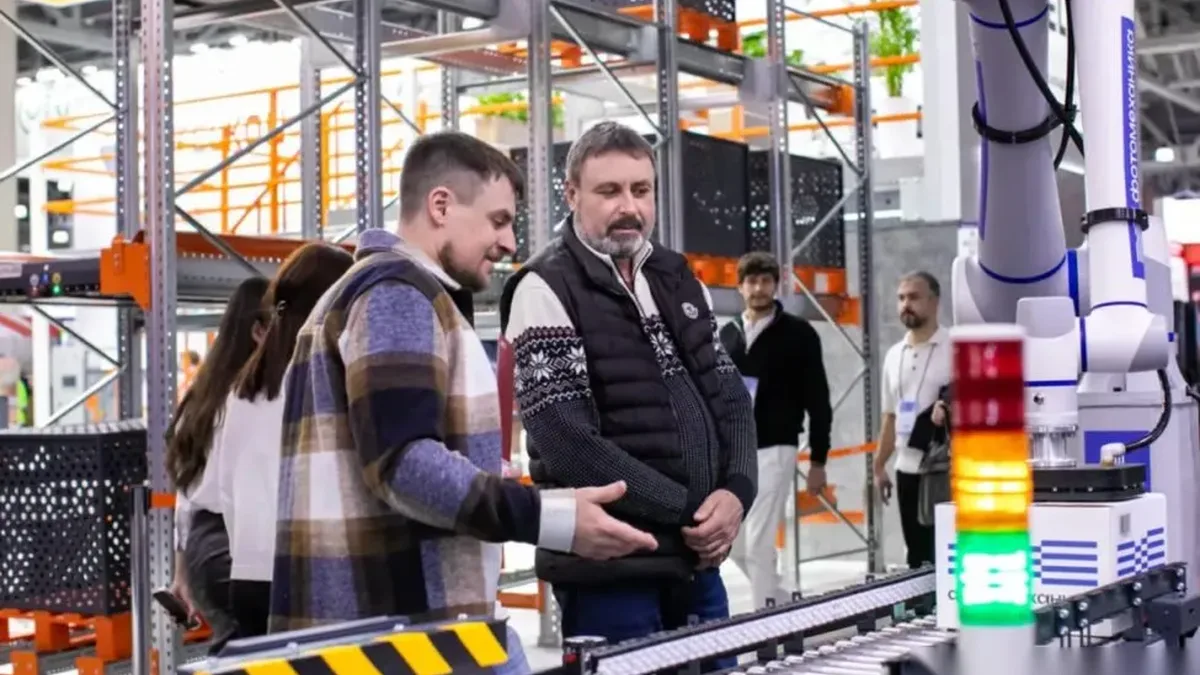
How we compare: we prioritise primary sources over vendor marketing. Deployment figures come from manufacturer newsrooms and operator statements, industry totals from the International Federation of Robotics, and definitions from the researchers who introduced the terminology. Contested numbers are labelled as estimates.
The connection runs deeper than analogy. The reasoning layer of a modern robot is often built on the transformer architecture that powers large language models, which is why robots can now follow instructions like “put the mug behind the cereal box” without anyone hard-coding either object.
Where Is It Being Used in 2026?
Physical AI is not a forecast. Industrial robots are already the largest deployed category: the International Federation of Robotics reports that 4,664,000 industrial robots were in operational use worldwide in 2024, a 9% year-on-year increase, with 542,000 units installed that year alone. Most of those machines were pre-programmed rather than intelligent, and it is precisely that installed base that physical AI is now upgrading.
Autonomous driving is the most visible consumer-facing example. Waymo states that its fleet now drives more than 4 million autonomous miles every week across more than ten cities where anyone can hail a fully driverless vehicle. Humanoids are further behind but past the demo stage: Agility Robotics reports that its Digit robot has moved more than 100,000 totes in a commercial deployment at a GXO facility under a robots-as-a-service contract.
The same stack is spreading into surgical robotics, crop-tending agricultural machines, autonomous excavators and last-mile delivery. The pattern holds: physical AI lands first where the task is repetitive and the labour is hard to hire.
What Does It Look Like on a Real Warehouse Floor?
Consider a continuous-improvement engineer at a mid-sized third-party logistics operator — an illustrative case, not a named company. The problem is not futuristic. The night shift runs short by three people twice a week, and the gap always appears at the same station: moving totes off autonomous mobile robots and onto a conveyor induction point. It is repetitive, it is unpopular, and it stalls the whole line when nobody is standing there.
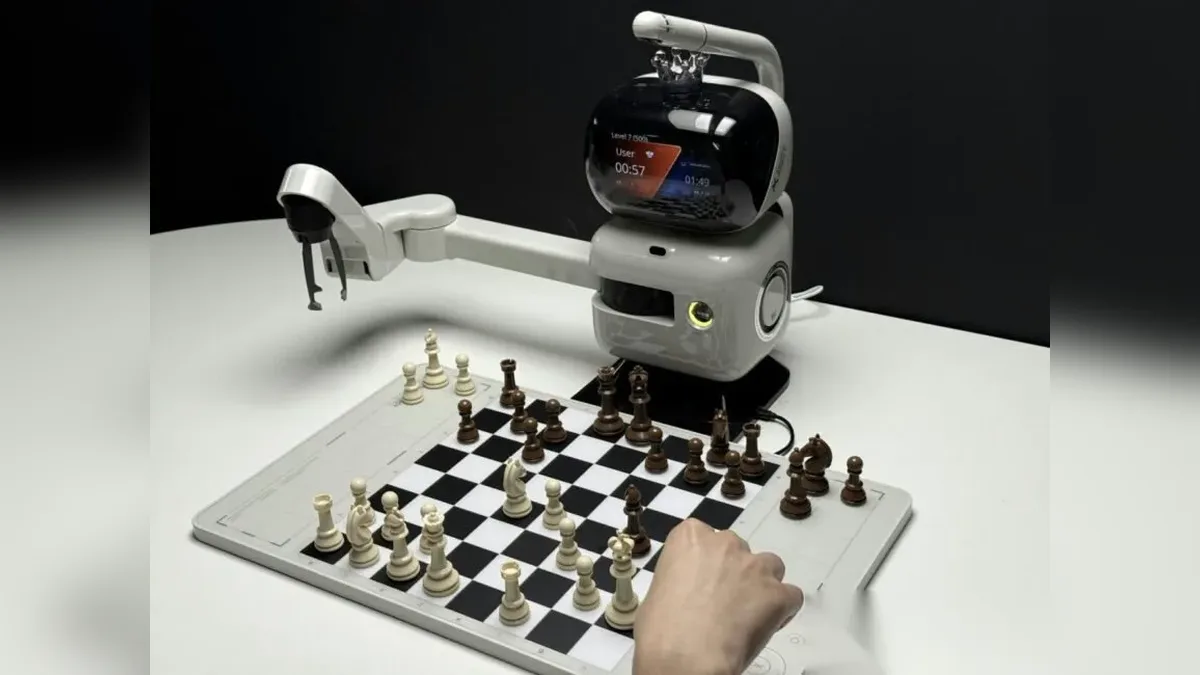
the engineer’s team pilots a humanoid on that single station rather than the whole building. The robot perceives each tote’s pose with onboard cameras, plans a grasp, lifts it and places it on the conveyor, then requests human help when a tote is torn or a label will not scan. Success is measured on three numbers the site already tracks: totes inducted per hour, unplanned line stoppages and overtime hours.
The outcome that matters is not the robot’s peak speed but its consistency across an eight-hour shift with no breaks and no drop in accuracy. That is the honest version of physical AI in 2026: one narrow, well-instrumented station at a time, expanding only after the numbers hold. The same staged approach applies to the digital side of the business, where agentic AI applications are typically piloted on one workflow before anyone touches the rest. This example is a composite drawn from publicly documented deployments rather than a single named customer.
What does physical AI actually cost to deploy?
The honest answer is that nobody sells you “physical AI” — you buy a robot, and the AI is why it works, which makes the pricing look nothing like software pricing. Where an LLM costs cents per thousand tokens, a warehouse robot is a capital purchase or a monthly rental against a wage it replaces. That is why adoption is decided by labour maths rather than by model benchmarks.
Three buying models dominate. Robots-as-a-service is now the common route in logistics: you pay a monthly fee per robot that bundles hardware, software updates, remote monitoring and maintenance, which keeps it on an operating budget and shifts downtime risk to the vendor. Outright purchase suits high-utilisation stations where the robot runs three shifts and the payback is short, but you own the spares, the integration and the obsolescence. Pilot programmes sit in front of both — a fixed-fee deployment of one or two units for a few months, which is where most organisations should start, because the integration work is almost always larger than the robot.
The costs that break pilots are not the robot. Integration into your warehouse management system, changes to the physical layout, network coverage on the floor, safety assessment and sign-off, and training the people who will work next to it routinely add up to as much as the hardware. Then there is the exception rate: a robot that handles 95% of totes still needs a human for the other 5%, and if that human has to stand there anyway, the labour saving evaporates. The question to ask a vendor is not what the robot can do but what happens in the 5% — how it asks for help, how long it waits, and whether one person can cover six robots or one.
What Is Still Holding the Field Back?
Data is the binding constraint. Language models trained on billions of freely available web pages. There is no equivalent archive of physical actions, because every example must be physically performed and recorded with synchronised vision, depth and motor streams. Companies are now paying people to record themselves doing household and industrial chores precisely because money alone cannot shortcut this.
Safety and certification take real time. A robot sharing space with people must be demonstrably predictable, not merely accurate on average, and the standards for certifying learned behaviour are still being written. Hardware economics remain unforgiving. Actuators, batteries and reliable hands have not fallen in price the way inference costs have. And the labour question is genuine, which is why most credible deployments start with roles employers already struggle to fill.
Frequently Asked Questions
What is physical AI in simple terms?
Physical AI is artificial intelligence that acts in the real world instead of only on a screen. It uses sensors to perceive its surroundings, models to decide what to do, and motors to move or manipulate objects. Robots, self-driving cars and warehouse machines are all examples of it.
Is physical AI the same thing as robotics?
No. Robotics is the engineering discipline that builds machines capable of movement and manipulation. Physical AI is the intelligence layer that lets such a machine perceive, reason and adapt to situations it was never explicitly programmed for. Modern robots combine both, but the two terms are not interchangeable.
How is physical AI different from generative AI?
Generative AI produces digital content such as text, images or code, and mistakes can simply be deleted. Physical AI produces action in a three-dimensional world where mistakes have physical consequences, latency is measured in milliseconds, and every behaviour must respect the laws of physics and workplace safety limits.
What are real examples of physical AI in 2026?
Current examples include driverless robotaxis operating commercially in multiple cities, humanoid robots moving totes in logistics facilities, robotic arms performing inspection and assembly in factories, surgical robots assisting with delicate procedures, and autonomous agricultural machinery that identifies and tends individual plants.
Why is training data the hardest problem in physical AI?
Because physical experience cannot be scraped. Every training example must be performed by a real body and captured as synchronised vision, depth and motor data, which is slow and expensive. Simulation and generative world models help enormously, but the gap between simulated and real physics still has to be crossed.
Is physical AI safe to work alongside?
In controlled industrial settings with speed limits, force limits and defined work zones, it is already deployed alongside people. Safety comes from constrained environments and verified behaviour rather than from model accuracy alone, and open, unstructured public spaces remain a substantially harder problem to certify.
Conclusion
Physical AI is the point where artificial intelligence stops being something you read and starts being something that moves. The perceive-understand-plan-act loop is conceptually simple, but making it reliable enough to run unattended next to people is one of the hardest engineering problems in the industry, which is why progress looks like one instrumented workstation at a time rather than a sudden arrival.
If you are evaluating it for your own operation, the useful question is not whether the technology works in a demo. It is whether your task is repetitive enough, your environment structured enough, and your metrics clear enough to prove the machine earned its place.
Disclosure: TechieHub is reader-supported. Some links on this site may be affiliate links, and we may earn a small commission at no additional cost to you. This never influences our research, testing or conclusions.
