


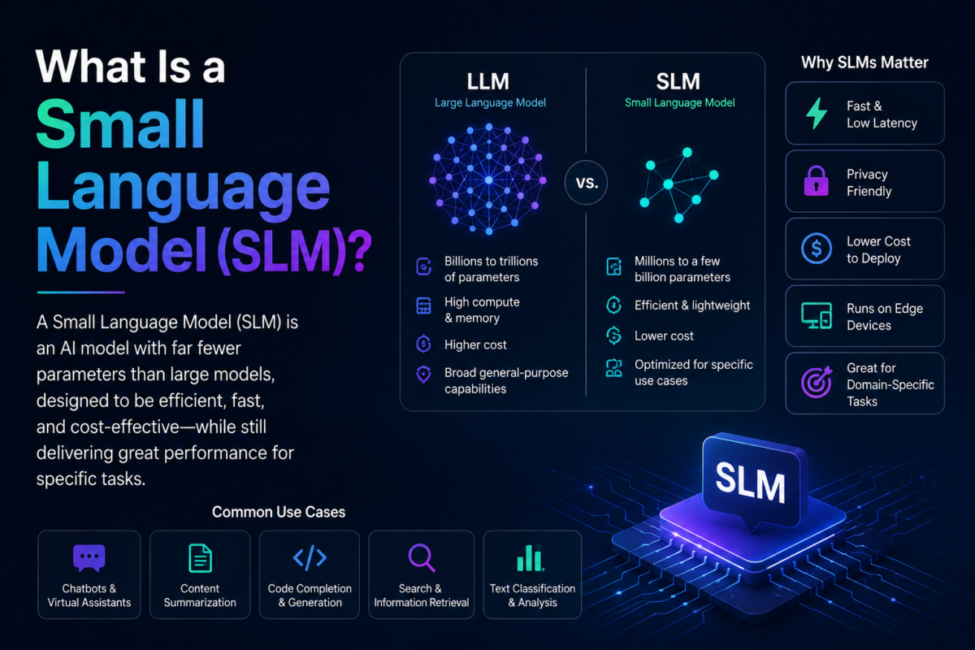
| Quick answer: A small language model (SLM) is a compact AI model, usually 1 to 15 billion parameters, built to run on a laptop, phone, or single GPU instead of a data center. SLMs trade some general breadth for big wins in speed, cost, privacy, and offline use, and often match larger models on narrow, well-defined tasks. |
In one sentence: an SLM is a language model small enough to run without the cloud, yet capable enough to handle the everyday tasks most AI systems actually spend their time on.

How we compare: our size ranges, capability claims, and model picks are drawn from vendor model cards, peer-reviewed research, and published benchmarks rather than marketing copy, and we favor sources you can verify yourself.
Affiliate disclosure: some links on TechieHub may earn us a commission at no extra cost to you. It never changes which models we recommend.
Table of Contents
What is a small language model, exactly?
A small language model is an AI system that reads and generates natural language, just like the giants behind chatbots, but at a far smaller scale. Where a frontier large language model may carry hundreds of billions or even trillions of parameters, an SLM’s parameter count typically lands between roughly 1 and 15 billion. Parameters are the internal weights a model tunes during training; fewer of them means a lighter model that fits on consumer hardware without a constant connection to the cloud.
The word “small” is relative and always moving. In 2018 a 110-million-parameter model felt large; today that same size is tiny, and the SLM ceiling keeps drifting upward as chips improve. As IBM notes, it is this reduced scale and scope, not a different underlying technology, that makes SLMs more compact and efficient than their larger cousins. So it is more useful to think of an SLM as “a model compact enough to run without the cloud” than to fixate on an exact parameter threshold. This guide is a companion to our pillar on the best AI models, zoomed in on the small end of the spectrum.
How do SLMs deliver big performance at a small size?
An SLM runs on the same foundation as any modern language model: the transformer, the neural-network architecture introduced in the 2017 paper “Attention Is All You Need”. It learns statistical patterns in text and uses them to predict what comes next. What makes small models punch above their weight is not simply shrinking a large one, but a handful of deliberate techniques.
The first is knowledge distillation, where a compact “student” model is trained to imitate the outputs of a larger “teacher” model, inheriting much of its behavior without the heavy architecture. Microsoft’s Phi family became famous for this, retaining a large share of its teacher’s capability at a fraction of the size.
The second is high-quality, curated training data. Instead of ingesting the entire noisy internet, many SLMs learn from carefully filtered, “textbook-quality” datasets, so every training token counts. And because a lot of SLMs are trained narrowly for one domain, they can be more accurate and less prone to hallucination on that domain than a sprawling general model. If you want to weigh these customization routes, our breakdown of the best local LLM options covers models that straddle the SLM line on real hardware.
Quantization: the third lever, and the one you will actually see
Distillation and pruning shape the model before you get it. Quantization shrinks it afterwards, by storing each weight at lower precision — 16-bit numbers reduced to 8-bit or 4-bit. It is the reason a model listed as “7B” can occupy about 4 GB rather than 14 GB, and it is why the same model appears on Hugging Face as Q4, Q5 and Q8 variants.
The trade is small but real: accuracy degrades slightly as precision drops, and the degradation is generally mild down to 4-bit and steeper below it. In practice 4-bit is the usual sweet spot — most of the quality at roughly a quarter of the memory. This matters when reading SLM claims, because a benchmark score published at full precision is not necessarily the score you get from the quantized file you downloaded.
SLM vs LLM: what actually changes?
The two families share a design but diverge on scale and where they live. SLMs win on cost, latency, privacy, and offline use; LLMs win on breadth of knowledge, long-context understanding, and deep multi-step reasoning. The table below captures the practical trade-offs.

| Factor | Small language model | Large language model |
|---|---|---|
| Parameters | ~1–15 billion | Tens of billions to trillions |
| Where it runs | Laptop, phone, edge, single GPU | Managed cloud, data-center GPUs |
| Cost | Very low, often free to self-host | High per-token or infrastructure cost |
| Latency | Fast, real-time, no network hop | Slower, network-dependent |
| Privacy | On-device, data stays local | Data sent to a provider |
| Best at | Narrow, high-volume tasks | Broad knowledge, hard reasoning |
That efficiency gap is not just theory. NVIDIA researchers argue in their 2025 position paper “Small Language Models are the Future of Agentic AI” that serving a 7-billion-parameter SLM can be roughly 10 to 30 times cheaper in latency, energy, and compute than a 70-to-175-billion-parameter LLM, which is exactly what makes real-time agents affordable at scale.
Which small language models matter in 2026?
The SLM field moved fast this year, and several families now anchor it. Independent 2026 comparisons suggest a good SLM can reach roughly 80 to 90% of top-tier model quality on focused tasks. Here are the names worth knowing:
- Microsoft Phi-4-Mini (about 3.8B) is a distillation-first model tuned for reasoning, math, and code in compute-constrained settings.
- Google Gemma ships in 1B to 4B variants built from the same research as Gemini; the Gemma 4 E2B and E4B edge models released in April 2026 target on-device use, and the 4B tier is notably RAM-frugal.
- Meta Llama 3.2 in 1B and 3B sizes remains the most-tested small workhorse with the broadest tool support.
- Alibaba Qwen3.5, released in March 2026, spans 0.8B to 9B under a permissive Apache 2.0 license, strong for multilingual work.
- Mistral covers the classic Mistral 7B plus the Ministral 3B and 8B line for edge deployment.
- IBM Granite 4.1 8B is a standout for coding and tool-calling, while DeepSeek-R1-Distill-Qwen-7B leads on math and logic among sub-10B models.
You can browse and download most of these from the Hugging Face model hub and run them locally in minutes. If your priority is generating code, our guide to the best AI model for coding weighs several of these small coders against the frontier options.

Small language models in practice
Consider Priya, a solo developer building a customer-support tool for a mid-size e-commerce brand. Her app fields thousands of routine tickets a day: order status, return policies, sizing questions. Routing every one of those to a frontier cloud model would burn through her budget and add a network delay to each reply.
Instead, Priya fine-tunes a 3-to-4-billion-parameter SLM on the company’s own help-center articles and past ticket resolutions, then runs it on a single modest GPU. The small model handles the high-volume, well-defined 80% of tickets instantly and privately, with no customer data leaving the company’s servers. For the genuinely hard 20%, ambiguous complaints or edge-case disputes, her code routes the request to a larger cloud model. The truthful upshot: her per-ticket cost drops sharply, replies feel instant, and sensitive order data stays in-house, while the tricky cases still get frontier-grade reasoning. That hybrid pattern, small model first and large model only when needed, is the same architecture NVIDIA’s researchers describe as a “smart manager leading efficient workers.”
When should you choose an SLM over an LLM?
Reach for a small language model when the task is narrow, repetitive, latency-sensitive, or privacy-critical, or when query volume is high enough that cloud API bills would spiral. If your data cannot leave the company perimeter, or the model must run locally or fully offline, an SLM (or a hybrid setup) is the safer bet. SLMs also shine in agentic systems that fire off many small, structured calls.
Choose a large model when you need broad world knowledge, very long context, or complex multi-step reasoning, the areas where scale still leads. The reliable rule is to evaluate both on your own workload: build a small test set from real examples and compare accuracy, latency, and cost side by side. A model that looks weaker on a generic leaderboard can be the better choice once you measure it on the exact job you need done. For heavier analytical work, our look at the best LLM for data analysis shows where a larger model still earns its keep.
Where small language models fall short
The case for SLMs is strong enough that it does not need overselling, and knowing the failure modes is what stops a pilot going badly.
Breadth is the real cost. A 3B model has genuinely less world knowledge than a frontier model, so it will be thinner on obscure facts and more likely to state something wrong with complete confidence. The “80 to 90% of top-tier quality” figure that gets quoted applies to focused tasks — on open-ended general questions the gap is much wider than those numbers suggest.
Multi-step reasoning degrades first. Anything requiring a long chain of dependent inferences is where compact models break down soonest, which is why they suit classification, extraction and summarisation far better than “work out what we should do about this”.
And the work moves rather than disappearing. An SLM that matches a large model on your task usually got there through fine-tuning, which means labelled data, someone to run the training, and re-running it when the domain shifts. You also own the hosting, the updates and the evaluation that an API provider would otherwise handle. That is often a good trade — but it is a trade, not a saving, and teams that budget only for the GPU are the ones caught out.
Frequently asked questions
Short, direct answers to the questions people ask most about small language models.
What is a small language model in simple terms?
A small language model is a compact AI that understands and writes text using the same technology as larger models, but with far fewer parameters, typically 1 to 15 billion. Being smaller, it runs on everyday laptops and phones, trading some breadth for speed, low cost, privacy, and offline use.
How many parameters does a small language model have?
There is no hard standard, but the 2026 consensus places SLMs at roughly 1 to 15 billion parameters, with some definitions starting from a few hundred million. Frontier LLMs run from tens of billions into the trillions. The threshold shifts over time, so “runs on consumer hardware” matters more than any exact number.
Are small language models as good as large ones?
It depends on the task. For narrow work like classification, extraction, routing, or summarization, a fine-tuned SLM can match or beat a much larger model while being faster and cheaper. For broad knowledge, long context, or deep reasoning, larger models still lead. Always test both on your real data.
What are some examples of small language models?
Leading small language model examples include Microsoft Phi-4-Mini, Google Gemma, Meta Llama 3.2 (1B and 3B), Alibaba Qwen3.5, Mistral 7B and Ministral, and IBM Granite 4.1 8B. Many ship with open weights, so you can download, run, and fine-tune them locally without relying on an external provider.
Can small language models run offline?
Yes, and that is a defining strength. Because SLMs fit on local hardware like laptops, phones, and edge devices, they need no internet connection to work. This enables true on-device AI where your data never leaves the device, which is why SLMs are popular for smart devices, IoT, and privacy-sensitive applications.
Why are small language models cheaper to run?
Their small size cuts the compute, memory, and energy each response needs, and a self-hosted SLM has no per-token API fees at all. NVIDIA research estimates serving a 7B SLM can be 10 to 30 times cheaper than a 70-to-175B LLM, so for high-volume workloads the savings often decide the choice.
Conclusion
A small language model is not a cut-down large one. It is a different bet: give up breadth you were probably not using, and get back speed, privacy, offline capability and a cost structure that does not scale with every request. For a narrow, high-volume, well-defined job, that bet usually pays.
The practical test is honest about scope. Write down the specific task, then ask whether it needs world knowledge or just competence at one thing. Ticket triage, extraction, classification, summarisation and on-device assistance sit firmly in SLM territory; open-ended research and hard multi-step reasoning still do not. And because the leading families are open-weight, testing the answer costs an afternoon rather than a procurement cycle — pull a Phi, Gemma, Llama or Qwen model, run it against real examples of your task, and let your own results settle it. See our guide to the best local LLM for running one on your own hardware, and best open source LLM for the wider open field.
