


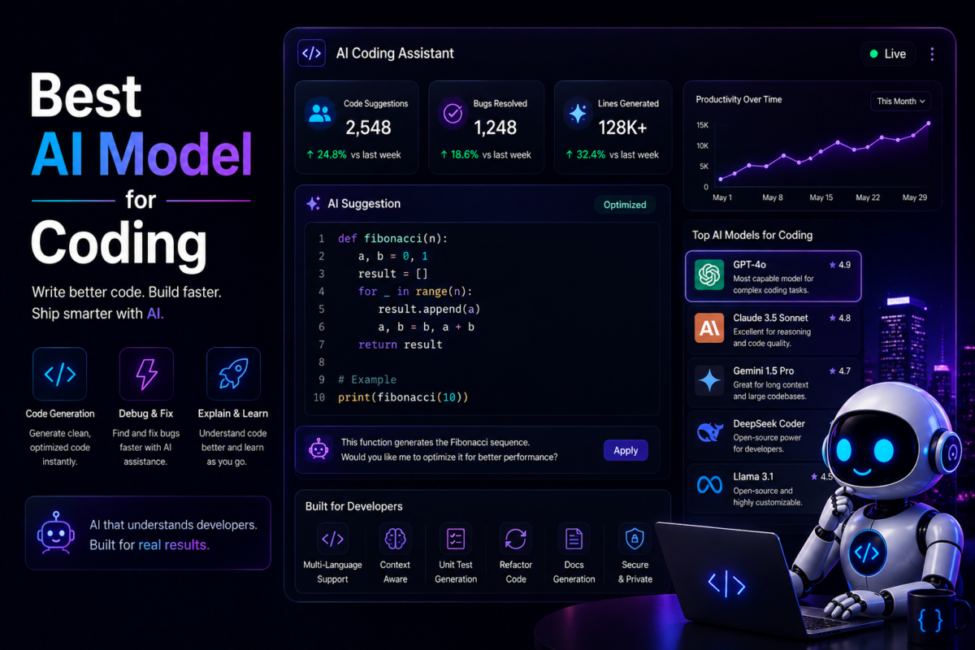
How we compare: our rankings draw on published SWE-bench Verified results, vendor documentation and hands-on testing across real refactors, bug fixes and feature work rather than a single leaderboard snapshot.
Affiliate disclosure: some links on TechieHub may earn us a commission at no extra cost to you. It never changes which model we rank first.
| Quick answer: There is no single best AI model for coding in 2026 because frontier quality has reached near-parity. Claude leads hard multi-file agentic refactoring, GPT via Codex leads terminal and DevOps automation, and Gemini gives frontier-class coding at the lowest closed-model price. Open models like Qwen3-Coder and DeepSeek are now genuinely viable. Match the model to the work. |

Table of Contents
What Is the Best AI Model for Coding Right Now?
An AI coding model is a large language model trained heavily on source code so it can read, write, refactor and debug software, usually inside an editor or an autonomous coding agent. The honest verdict is that the quality floor is high: the top models from Anthropic, OpenAI and Google all score strongly on the main coding benchmark, and even open-weight models have closed most of the gap. What separates them now is workflow fit, agentic reliability, speed, context size and price. The recurring advice from engineers who test these tools is to start from the work, not the leaderboard. One distinction worth making first: this guide ranks the models – the engines you call by API or select inside an editor. If what you need is the editor, agent or CLI wrapped around them, that is a different shortlist, covered in our comparison of the best AI coding tools. Most teams pick the tool first and silently inherit its default model, which is how people end up paying flagship rates for autocomplete. This guide sits under our pillar on the best AI models and helps you choose by task.
How Are AI Coding Models Actually Measured?
The benchmark that matters most is SWE-bench Verified, a human-validated set of real GitHub issues a model must resolve end to end with a working patch. It matters because it measures agentic, multi-step coding across a whole codebase rather than a single isolated snippet, making it the closest public proxy for performance inside a real coding agent. SWE-bench Pro raises the difficulty with harder, contamination-resistant tasks, and independent trackers like the SWE-rebench leaderboard refresh monthly to reduce benchmark gaming.
Two cautions apply. First, scores depend heavily on the test scaffolding, so vendor-reported numbers often run higher than standardized ones; compare from a consistent source. Second, benchmarks measure aggregate skill, not fit for your language, framework or code style. Because these are language models at heart, the fundamentals in what a small language model is also explain why smaller, specialized models can punch above their size on narrow coding tasks.

Which Top Models Lead for Coding in 2026?
Here is how the leading families compare, with standout strengths. Treat the numbers as a directional October 2026 snapshot. Every price below was re-checked against the vendor’s own pricing page on 2 October 2026; benchmark scores are the publishers’ own reported figures.
| Model family | Maker | Coding strength |
| Claude (Opus / Sonnet / Haiku) | Anthropic | Hard multi-file agentic refactors; precision and reliability |
| GPT / Codex | OpenAI | Terminal, CI and DevOps automation; fast interactive edits |
| Gemini (Pro / Flash) | Frontier quality at the lowest closed price; Google ecosystem | |
| Qwen3.6 / Qwen3-Coder-Next | Alibaba | Best open all-rounder; 77.2 SWE-bench Verified on a single GPU, Apache-2.0 |
| DeepSeek V4 (flash / pro) | DeepSeek | Lowest cost per token anywhere; open-weight and self-hostable |
| Kimi K2.6 / K2.7-Code / K3 | Moonshot | Highest reported open SWE-bench Verified score; long autonomous sessions |
Claude — hard multi-file agentic refactoring
Claude (see anthropic.com) is widely regarded as the strongest for the hardest coding work and is the default model in many popular coding tools. Anthropic’s flagship Opus line posts the top standardized SWE-bench Verified results, in the high-80s on the public leaderboard as of mid-2026. Its tiers suit different needs: a powerful flagship for hard problems, a balanced workhorse for all-day volume, and a fast lightweight model for quick edits.
GPT and Codex — terminal, CI and DevOps automation
GPT (see openai.com), through its Codex coding model, is neck and neck with Claude on the benchmark and excels when your agents live in the terminal and CI pipelines.
Gemini — frontier quality at the lowest closed price
Gemini 3.1 Pro delivers frontier-class quality at a notably lower per-token price than premium flagships, making it the closed-model value pick, and it shines on Google-ecosystem tasks. Google’s pricing page still lists it as a preview SKU at $2 per million input and $12 output below 200k tokens, so pin the model string rather than assuming it is stable. The sharper value story in late 2026 sits one tier down: Gemini 3.8 Flash runs $0.75 in and $3.75 out, half the rate of the 3.5 Flash it replaced, which makes it the model to route the boring 80% of coding calls to.
Are Open-Source and Local Models Good Enough?
The open-weight tier is now genuinely usable for coding, which matters enormously if your code cannot leave your infrastructure. Alibaba’s Qwen line is the standout open all-rounder, and it has moved fast: Qwen3.6-27B is a dense 27B model under Apache-2.0 that reports 77.2 on SWE-bench Verified with a 262k native context extensible past a million tokens, so flagship-adjacent coding now fits on a single high-end GPU. Qwen3-Coder-Next is the agent-tuned sibling, 80B total with 3B active, reported at 70.6 on SWE-bench Verified under the SWE-Agent scaffold. DeepSeek is now on the V4 line – deepseek-flash bills $0.15 in and $0.60 out per million off-peak, doubling at peak, with deepseek-v4-pro at $0.66 and $1.98 – still the lowest serious per-token rate anywhere. Kimi from Moonshot is the long-session specialist: K2.6 is reported at 80.2% on SWE-bench Verified, K2.7-Code is the coding-tuned build on top of it, and K3 pushed the open tier into the 2.8-trillion-parameter class in July 2026, which is well past what you will self-host but matters as a ceiling.
These models can run locally for complete privacy and zero per-token cost, distributed through hubs like Hugging Face. A popular pattern is to handle the routine 80% of coding locally and fall back to a cloud flagship for the hardest 20%. One caveat: choose a model built or tuned for code, since some general-purpose open models trail specialized ones significantly. For hardware-matched picks, see our guide to the best local LLM.
What Do These Models Cost?
Prices below were taken from each vendor’s own pricing page on 2 October 2026. The premium closed tier is cheaper than it was a year ago: Claude Opus 5.5 is $4 in and $20 out per million, down from Opus 5 at $5 and $25, while Anthropic’s top Fable 5.1 tier sits at $10 and $50, the same place OpenAI prices gpt-6-astra. The mid-tier is where the real work happens: Claude Sonnet 5.5 and gpt-6.1-sol are both $2 in and $10 out, and Claude Haiku 4.5 is $1 and $5. OpenAI’s dedicated coding model, gpt-5.3-codex, is $1.75 in and $14 out, priced for agents that run continuously, and the Codex CLI is still free with a sign-in – one of several genuinely free paths to capable AI coding.
| Tier | Indicative cost | When it makes sense |
|---|---|---|
| Premium closed flagships | $4–$10 per million in / $20–$50 out | Hard multi-file work where a wrong answer costs more than the tokens |
| Gemini 3.1 Pro (preview) | $2 in / $12 out under 200k | Frontier-class quality at the lowest closed-model price |
| OpenAI Codex (gpt-5.3-codex) | $1.75 in / $14 out; Codex CLI free with sign-in | Terminal and CI agents running continuously |
| Open-weight APIs (deepseek-flash) | $0.15 in / $0.60 out off-peak, double at peak | High volume where the task is well-defined |
| Self-hosted open weights | Hardware and electricity only | Code that cannot leave your infrastructure |
Treat the figures as ratios, not quotes
The figures move often, so treat them as ratios rather than quotes — the useful signal is that the gap between tiers is roughly an order of magnitude, which is what makes routing worth building.
Open-weight models and self-hosting
Open-weight models are cheapest of all: deepseek-flash is $0.15 in and $0.60 out per million off-peak, a fraction of any closed flagship, and self-hosting Qwen3.6-27B costs only hardware and electricity. For high-volume teams, the smart move is to mix tiers, routing the easy majority of calls to a cheap model and reserving the expensive flagship for genuinely hard problems. This same cost logic applies beyond coding, for example when picking the best LLM for data analysis, where token volume adds up fast.

Which Model Should You Choose?
Match the model to the work. For hard, multi-file agentic refactors where quality matters most and budget is secondary, Claude’s flagship is the safe default. For agents that live in the terminal and CI, GPT’s Codex is a strong pick. For frontier quality at the lowest closed price, Gemini Pro leads on value, and Claude’s balanced mid-tier is the best all-day workhorse. If your code cannot leave your infrastructure, the open tier is now viable: Kimi for long agentic runs, Qwen3-Coder for flexibility and fine-tuning, DeepSeek for the lowest cost.
For most individual developers, a single capable model plus a good editor covers nearly everything. For teams at scale, a tiered routing approach delivers the best balance of quality and cost. Whichever you choose, the model is only half the equation; the agent you run it in matters just as much.
AI Coding Models in Practice: A Backend Team’s Workflow
Take a senior backend engineer at a fintech startup with one recurring gnarly task: migrating a monolith’s payment service across dozens of files without breaking the test suite. The flagship goes inside the agent for that migration, because it can hold the whole change set in context and reason about cross-file dependencies. The routine parts of the day – unit tests, docstrings, small refactors – route to a cheaper mid-tier model to keep the token bill down.
Because the repository contains payment logic that cannot leave company infrastructure, anything touching regulated code paths runs on a self-hosted Qwen3.6-27B on an internal GPU box – a dense 27B model fits one high-end card, which is what makes this split practical rather than aspirational. The illustrative outcome is not a magic number but a pattern engineers will recognise: the hard migration that used to eat a full sprint gets a reviewed first draft in an afternoon, and the engineer’s time goes to verifying and hardening rather than typing boilerplate. Every line still gets reviewed and tested, because AI-generated code can look correct and still be subtly wrong.
Frequently Asked Questions
What is the best AI model for coding?
There is no single winner; it depends on your work. Claude tends to lead hard multi-file agentic refactoring, GPT via Codex leads terminal and DevOps automation, and Gemini gives frontier-class quality at the lowest closed price. Open models like Qwen3.6-27B and Kimi K2.6 are now level with the closed tier on SWE-bench Verified. Test the top options on your own codebase.
Is Claude or ChatGPT better for coding?
Claude generally edges ahead on complex multi-file refactors and is the default in several coding tools, while ChatGPT via Codex is close behind and excels at terminal and DevOps work. Both post near-identical SWE-bench Verified scores in 2026, so the gap is small. Test both on your actual tasks to decide.
What is SWE-bench and why does it matter?
SWE-bench Verified is the leading coding benchmark, a human-validated set of real GitHub issues a model must resolve end to end with a working patch. It matters because it measures agentic, multi-step coding across a codebase rather than isolated snippets. Top models now score in the high-80s; compare numbers from a consistent source.
Can open-source models code as well as Claude or GPT?
They have effectively caught up on the public benchmark. The best open-weight coders now report SWE-bench Verified scores in the high 70s and low 80s – Qwen3.6-27B at 77.2 and Kimi K2.6 at 80.2% on their publishers’ own numbers – which is no longer “within range” of closed frontier models but level with them on that test. They run locally for privacy and near-zero cost. The hardest agentic tasks still favor top closed models, but the gap has narrowed dramatically.
Which AI coding model is cheapest?
Open-weight models are cheapest. deepseek-flash runs $0.15 in and $0.60 out per million off-peak, and self-hosting Qwen3.6-27B costs only hardware and electricity with no per-token fees. Among closed models, Gemini 3.8 Flash at $0.75 in and $3.75 out is now the value floor, with Gemini 3.1 Pro the value pick at frontier quality. Free paths exist too, such as OpenAI’s Codex CLI with a sign-in for capable coding at no cost.
Do I need a coding-specific model or a general one?
For most cloud work, top general frontier models, Claude, GPT and Gemini, are excellent at code and need no special variant. Dedicated models like gpt-5.3-codex and specialised open models like Qwen3-Coder-Next are tuned for software and can excel in agentic workflows. Among open models especially, choosing one built for code matters most.
How do you test which coding model is best on your own codebase?
Build a small fixed set of tasks from work you have already done, then run every candidate against it. Pull eight to twelve real tickets your team closed recently — a bug fix, a refactor across several files, a migration, a test-writing job, something in your least fashionable language — and keep the merged diff as the reference answer. Real closed tickets beat invented prompts because they carry your conventions, your dependencies and your mess.
Then hold everything else constant. Same prompt, same repository state, same agent, one model swapped — otherwise you are benchmarking your scaffolding rather than the model, which is the exact caution this post makes about vendor-reported scores. Score on what you actually care about: did it pass the existing tests, how many correction rounds it needed, and whether a reviewer would approve the diff unchanged. Log token cost per task alongside the result, because the cheaper model losing narrowly is often the right production choice. Half a day of this tells you more than any public leaderboard, and it stays valid when the leaderboard changes next month.
Conclusion
The best AI model for coding is the one that fits your work, not the one atop this week’s leaderboard. Claude tends to lead on hard multi-file agentic coding, GPT’s Codex on terminal and DevOps, and Gemini on frontier-quality value, while open models like Qwen3.6-27B, DeepSeek V4 and Kimi K2.6 are now genuinely viable and run cheaply or locally. With the frontier near parity, the smart approach is to test the top options on your own codebase, route easy tasks to cheap models and hard ones to a flagship, and review everything the model writes before it ships.
