

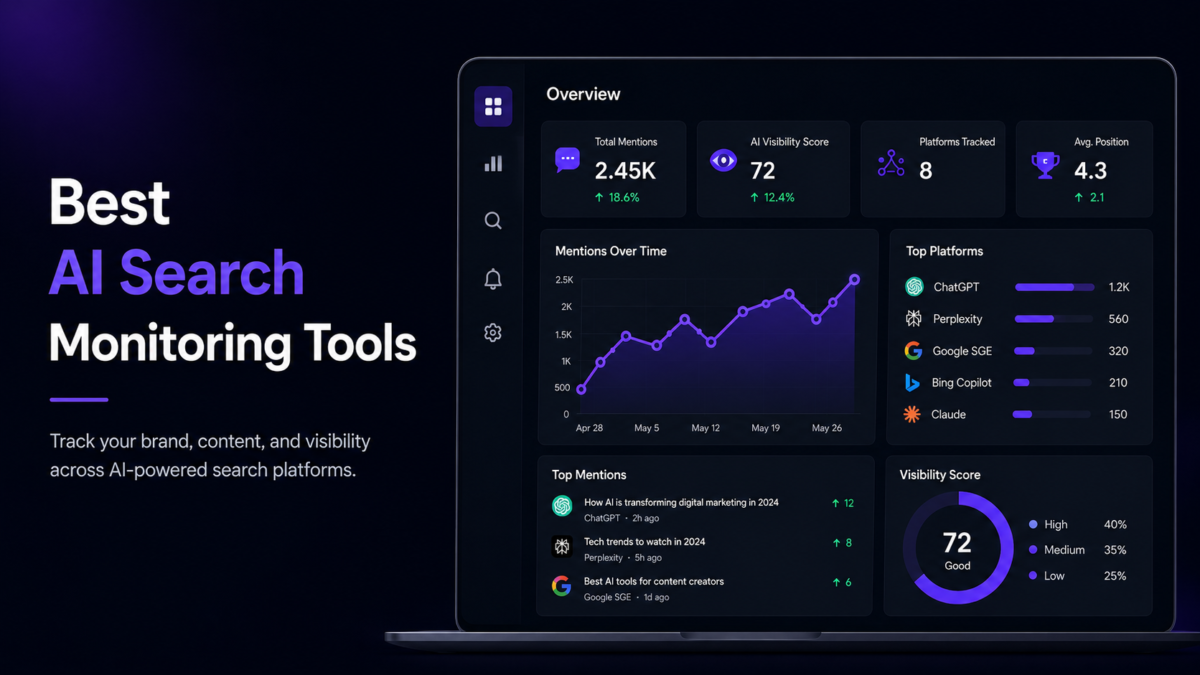
Your buyers are asking ChatGPT, Perplexity and Google’s AI Mode which product to choose, and your analytics stack cannot see a single one of those conversations. Rank trackers report blue-link positions. Analytics reports clicks that already happened. Neither tells you whether an assistant recommended you, named a competitor, or skipped your category entirely. AI search monitoring closes that blind spot, and there are now enough platforms doing it that picking one has become its own research project.
| Quick answer: Otterly.AI is the cheapest serious entry at $29 a month, Cairrot covers five engines for $99, and Profound now sells to brands through sales rather than a self-serve plan. All three track brand mentions and citations across ChatGPT, Perplexity and Google AI Overviews. Most teams bolt one dedicated tracker onto the SEO suite they already pay for. |
How we compare: we run identical prompt sets through each platform against live brands, then score engine coverage, citation depth, refresh cadence, actionability and cost per tracked prompt. Every price below was re-checked on the vendor’s own pricing page on 2 October 2026. Two exceptions are labelled in the text: Peec AI shows no prices to logged-out visitors, and Scrunch’s site did not respond on the day we checked. We publish the limitation we hit alongside the strength.
Disclosure: TechieHub is reader-supported. Some links below are affiliate links and we may earn a commission if you subscribe, at no extra cost to you. It never changes a ranking or softens a limitation.
Table of Contents
Why do you need AI search monitoring at all?
Scale is the short answer. ChatGPT serves roughly 900 million weekly users, and Google’s AI Overviews reach about two billion people a month across more than 200 countries, an audience that often never sees a ranked list of links at all. Investment is following the behaviour: Dimension Market Research sizes the generative engine optimization market at $1.09 billion in 2026, rising to $17.1 billion by 2034 at a 40.6% compound annual growth rate.
Fragmentation is the harder problem. A Writesonic study of 161,286 prompts found that ChatGPT, Gemini, Perplexity and Google AI Overviews share only around 17% of their cited sources for the same question. Winning inside one engine tells you almost nothing about the others. That is precisely why spot-checking prompts by hand fails, and why serious generative engine optimization now needs instrumentation rather than intuition.
Be clear about what you are buying, though. These platforms measure; they do not fix. Brand mentions churn week to week, so a tracker hands you a baseline and a trend line, not a growth lever. The lever is still content that earns citations on the sources the models already trust.
Which are the best AI search monitoring tools in 2026?
Eight platforms make up the realistic shortlist. Each entry below pairs the reason to buy with the reason people churn.
Profound — best for enterprise
The category leader, with roughly $155 million raised and a reported $1 billion valuation, pairs prompt-level tracking with agent analytics showing how AI crawlers consume your site. In September 2026 it withdrew the $99 and $399 self-serve brand plans that earlier write-ups quote. Its pricing page now lists a free trial of 50 prompts run daily for seven days across ChatGPT, Gemini and Google AI Overviews, a custom Enterprise package, and a self-serve agency plan carrying 400 credits per client workspace. Limitation: brands cannot buy it with a card any more, so budget for a sales conversation.
Peec AI — best for mid-market teams
Scrapes live answer interfaces instead of estimating through APIs, then layers competitor share of voice and citation-source analysis, with unlimited seats on every tier. Its pricing page names Starter, Pro, Advanced and Enterprise but shows no rates to a logged-out visitor; third-party trackers report Starter at about EUR 85 (about $96) a month, or EUR 70 (about $79) billed annually, for 50 prompts and three models. Limitation: you cannot price it without starting a sign-up, and extra engines are charged individually.
Otterly.AI — best cheap entry
Twenty-nine dollars buys 15 tracked prompts across ChatGPT, Google AI Overviews, Perplexity and Copilot, plus a GEO audit that bridges measurement and action. Standard is $189 for 100 prompts and Premium $489 for 400. Limitation: prompt volume is the only thing you are really buying, extra hundreds cost $99 each, and Gemini or Google AI Mode are paid add-ons.
Semrush AI Visibility Toolkit — best if you already use Semrush
A $99-per-domain add-on covering 25 prompts, prompt research, competitor research and an AI search site audit inside the suite your team already opens daily. Limitation: shallower than dedicated trackers, and multi-brand teams pay again per domain.
Ahrefs Brand Radar — best for share of voice
Ranks your AI impressions against named competitors using Ahrefs’ own index. Limitation: Brand Radar AI starts at $199 a month on top of a $129 Lite plan, so a realistic entry cost is about $328 before you add seats.
Writesonic GEO — best for monitor-plus-optimize
Combines visibility tracking with a mature content engine and Cloudflare-based crawler logs, so the fix happens where the data lives. Its Starter plan at $79 a month now tracks 50 prompts daily across ChatGPT, Gemini and Google AI Overviews, with Basic at $199 and Growth at $399. Limitation: the three-engine set holds until the custom Enterprise tier, and monitoring depth trails specialists.
Scrunch AI — best for crawler analytics
Goes deepest on how AI agents discover, fetch and render your pages, with enterprise coverage stretching to nine engines. Limitation: entry pricing around $250 to $300 a month is hard to justify below mid-market.
Cairrot — best budget multi-engine option
Thirty-nine dollars covers ChatGPT and Perplexity, while $99 adds Claude, Gemini and DeepSeek with no per-engine surcharge, plus free API access. Limitation: a newer, smaller product with lighter analytics than the leaders.

| Tool | Entry price | Engines at entry | Best for |
| Profound | Free trial, then Enterprise quote | ChatGPT, Gemini, AI Overviews on trial | Enterprise depth |
| Peec AI | No public price; about EUR 85 (about $96)/mo reported | 3 models on Starter | Mid-market teams |
| Otterly.AI | $29/mo | 4 engines | Small budgets |
| Semrush AI Visibility Toolkit | $99/mo per domain | Multi-engine | Existing Semrush users |
| Ahrefs Brand Radar | $129 base plus $199 Brand Radar AI | Multi-engine | Share of voice |
| Writesonic GEO | $79/mo Starter | 3 engines | Monitoring plus creation |
| Scrunch AI | Around $250/mo | Multi-engine | Crawler analytics |
| Cairrot | $39/mo Starter, $99 Pro | 2 engines, 5 on Pro | Budget coverage |
What do these platforms really cost?
Headline prices are the least reliable number in this category, because almost every vendor meters two things at once: how many prompts you track and how many engines you track them in. Otterly’s published pricing is the clearest example of the honest version, listing prompt counts and add-on engines line by line. Peec AI sits at the other end: it shows no rates at all until you start a sign-up, so every figure published about it, including ours, is second-hand.
Suite add-ons behave differently. The Semrush AI Visibility Toolkit is a flat $99 per domain for 25 prompts, with extra prompt packs and extra domains billed on top. Ahrefs charges per AI index, which is why a six-engine view runs several hundred dollars above the base subscription. Budget for the configuration you will actually run in month three, not the one on the sign-up page.
How do you pick the right tracker for your team?
There are only two buying paths. A dedicated tracker gives you prompt-level depth, sentiment, citation URLs and competitor share of voice, and it is the right call when AI visibility is somebody’s actual job. A suite add-on gives you directional signal inside a workflow you already run, and it is the right call when AI visibility is one line on a wider SEO dashboard.
Size is the deciding variable. Solo marketers and agencies testing the water should start at the $29 to $39 tier, track fifteen to twenty high-intent buying prompts, and resist the urge to monitor everything. Mid-market teams with a content programme want Otterly Standard at $189 or Cairrot Pro at $99, where citation-source data tells you which third-party pages to go and influence. Enterprises with procurement requirements need Profound or Scrunch, mostly for SOC 2, SSO and crawler-level telemetry, and both now route you through sales.
Whichever path you take, pick prompts that mirror real buying language rather than your own product vocabulary, and keep the competitor set fixed. The measurement layer only pays off when it feeds a plan, so read your dashboard alongside the tactics in how to rank in ChatGPT and the structural groundwork covered in LLMEO.
How did one SaaS team turn tracking into citations?
Sigrid Solberg leads content at a 45-person observability startup. Three deals in one quarter arrived with the same line on the discovery call: “we found you through ChatGPT.” Her attribution reporting showed none of it, so she bought Peec AI’s Starter plan, reported at about EUR 85 (about $96) a month, and tracked 40 buying-intent prompts, the kind beginning with “best” or “alternative to”.
The first fortnight of data was uncomfortable. Her brand appeared in 6% of ChatGPT answers for those prompts while the nearest competitor appeared in 41%. More usefully, the citation-source view showed that four of the five most-cited URLs were third-party roundups and review pages, not vendor sites. That reframed the task: this was not a content-volume problem, it was a third-party presence problem.
Sigrid pitched corrections and updated data to two roundup publishers, earned a listing on a comparison site that models cited constantly, and published one genuinely comparative page of her own. By week ten her share of voice on the tracked prompt set had climbed to 28%, and UTM-tagged AI referral sessions had roughly tripled from a small base. The tracker did not produce that result; it told her where to aim.
This example is a composite of the visibility-monitoring projects we see most often, not a single client account; the figures are typical rather than measured from one engagement.
Frequently Asked Questions
What are AI search monitoring tools?
They track how often and how favorably your brand appears inside AI-generated answers from engines such as ChatGPT, Perplexity and Google AI Overviews. Rather than reporting link positions, they parse the answer itself for mentions, cited source URLs, sentiment and competitive share of voice across a fixed prompt set.
What is the cheapest AI search monitoring tool?
Otterly.AI Lite at $29 a month is the cheapest credible option, covering 15 tracked prompts across four engines. Cairrot starts at $39 with two engines. Permanent free tiers are rare in this category, so most vendors offer a short trial or a sales demo instead of a free plan.
Which AI engines should I track first?
Start with ChatGPT, Perplexity and Google AI Overviews, which account for the bulk of AI search activity today. Add Gemini, Copilot or Claude only once your analytics or sales conversations show buyers actually using them, because nearly every platform charges extra for each additional engine.
Do these tools improve AI visibility or only measure it?
Most are measurement-first. The tools that go further are covered in our guide to answer optimization tools. A few add optimization layers: Writesonic bundles a content engine, Otterly ships a GEO audit, and Profound generates briefs on higher tiers. Real improvement still comes from earning citations on sources the models already trust, so treat the dashboard as a targeting system.
How is this different from traditional rank tracking?
A rank tracker records your position within a list of ten blue links. AI search monitoring reads a synthesized paragraph and determines whether you were named, cited or ignored entirely. Because there is no ranked list to scrape, the underlying measurement problem is fundamentally different and needs purpose-built tooling.
How often should I check AI visibility?
Weekly is enough for most teams. Answers are genuinely volatile, and day-to-day movement on individual prompts is normal, so a single snapshot proves very little. Read four-week trends instead, and always compare against the same competitor set so movement reflects your work rather than sampling noise.
What are AI search visibility tools?
AI search visibility tools measure how often a brand appears and gets cited inside AI-generated answers, rather than in the classic ten blue links. They run prompt sets against ChatGPT, Perplexity, Gemini and Google AI Overviews on a schedule, then report share of voice, citation counts and the source URLs each engine credited. The category is used interchangeably with AI search monitoring, AI search tracking and AI search analysis — the vendors differ more on engine coverage and refresh cadence than on what they measure.
Which AI search monitoring tools work best for ChatGPT specifically?
Every platform in this comparison tracks ChatGPT, but coverage depth differs. Profound and Peec AI both resolve which source URLs ChatGPT cited for a prompt, which is what you need to fix the underlying page. Otterly.AI reports mentions and position at $29 a month, and Cairrot tracks ChatGPT and Perplexity at $39, both with a shallower citation trail. If ChatGPT is your only priority, start with the cheapest tier that returns cited URLs rather than mention counts alone. Our guide to AI citation analysis tools compares the ones that name the source URL.
How do you track AI search performance over time?
Fix a prompt set that mirrors how buyers actually ask about your category, run it on a consistent schedule, and track three numbers per engine: whether you were mentioned, whether you were cited with a link, and which competitor was cited instead. Weekly cadence suits most teams — AI answers shift faster than classic rankings but not fast enough to justify daily checks. The trend line matters more than any single reading, because engine outputs vary between runs on identical prompts.
What tools monitor generative AI search results?
Three groups compete. If the question is specifically how rivals are being cited, our guide to competitor analysis tools for AI search compares the tools built for that. Dedicated AI-visibility platforms (Profound, Peec AI, Otterly.AI, Scrunch) were built for this and cover the most engines. Our guide to benchmarking competitors in AI answers covers the comparison angle specifically. Established SEO suites (Semrush, Ahrefs) have added AI-answer modules that are convenient if you already pay for them but cover fewer engines. Finally, DIY prompt logging via API gives complete control and costs only tokens, at the price of building and maintaining the pipeline yourself.
AI search monitoring, tracking, analysis or visibility — are these different things?
Mostly no, and the naming is a marketing artefact rather than a real product distinction. AI search monitoring tools, AI search tracking tools, AI search analysis tools, AI search checking tools and AI visibility platforms all describe software that runs prompt sets against answer engines and reports whether you were mentioned or cited. Vendors pick whichever label suits their positioning. The distinction worth caring about is depth: some report only that your brand appeared, while others resolve the exact source URL the engine cited — and only the second kind tells you which page to fix. Ask for a sample report before signing, not a category definition.
What are the best AI search trackers?
The best AI search trackers in 2026 are Profound for enterprise depth, Otterly.AI as the cheapest serious entry at $29 a month, and Cairrot at $99 for five engines on one bill. Each works as an AI search performance tracker: it runs a fixed prompt set on ChatGPT, Perplexity and Google AI Overviews and records whether your brand was named and cited.
Conclusion
AI search has become a discovery channel at the scale of traditional search, and you cannot improve a channel you cannot see. Profound suits enterprises that can run a procurement process, Peec AI suits mid-market marketing teams willing to request a quote, and Otterly.AI is the cheapest way to find out whether any of this matters for your brand. Choose on team size and engine coverage rather than feature-list length, verify pricing before you commit, and set your baseline this week. Then spend the real effort where returns actually come from: the generative engine optimization work that earns the citations your dashboard is counting. See also our guide to the the best tool for Google AI Mode.

6 Comments
Pingback: Answer Engine Optimization to Get Cited by AI First
Pingback: Generative Engine Optimization to Dominate AI Search
Pingback: LLMEO: Large Language Model Optimization Explained - Techiehub
Pingback: Best Answer Engine Optimization Tools That Actually Work
Pingback: Perplexity SEO Guide to Rank in AI Powered Search
Pingback: LLMEO Strategies: Complete Guide for AI SEO Success