


Ask an assistant which invoicing tool suits a freelance designer and you get three names, not ten blue links. Nobody scrolls past a shortlist they were handed. That single behavioural shift is why a discipline barely named two years ago now appears in quarterly plans — and why the advice around it turned noisy so fast. For every tactic backed by a controlled experiment there are five sold from a webinar slide. This guide separates them using 2026 evidence rather than 2024 folklore.
| Quick answer: LLMEO (large language model optimization) is the work of making your content retrievable, quotable and trustworthy enough that ChatGPT, Claude, Gemini and Perplexity name you in their answers. It rests on crawlable server-rendered HTML, evidence-dense writing, corroboration across independent sources, and freshness — measured by mention rate, never by rank. |
How we compare: Every claim below traces to a named, linked study rather than a vendor blog. Where the research is contested — as it is for file-based standards — we say so instead of picking the tidier answer.
Affiliate disclosure: Some links to monitoring and SEO platforms elsewhere on TechieHub are affiliate links, and we may earn a commission at no cost to you. No vendor paid for placement in this article or reviewed it before publication.
Table of Contents
What is LLMEO, and why did it get its own name?
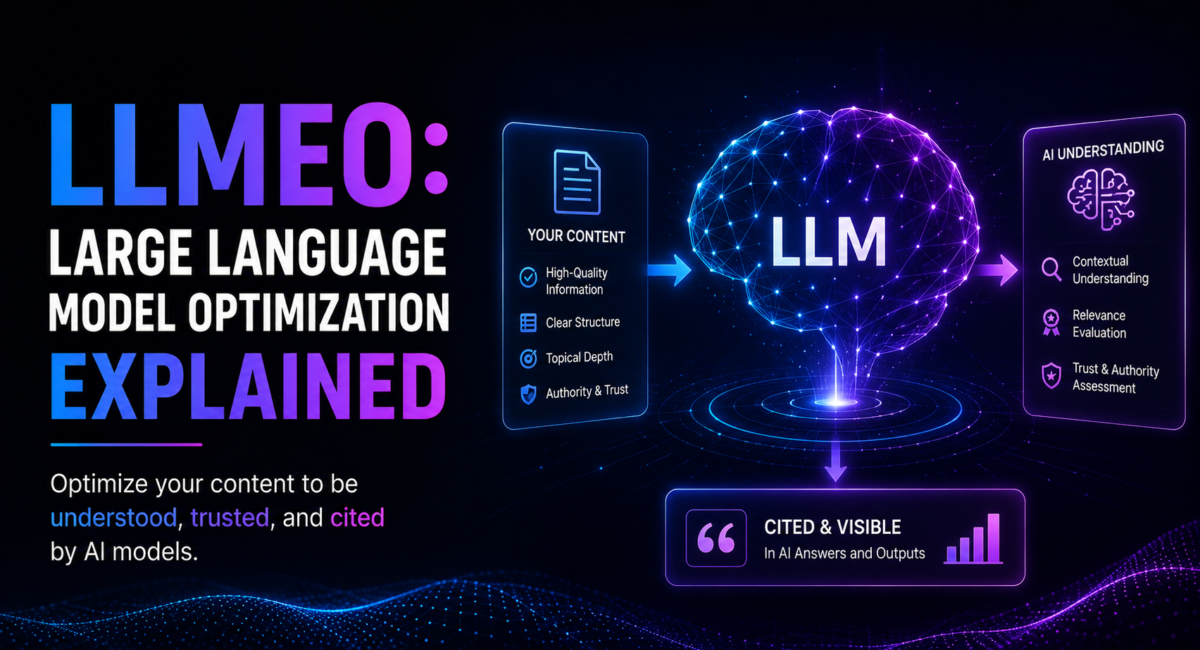
LLMEO — large language model optimization — is the practice of shaping your content, site architecture and off-site footprint so a language model retrieves you, trusts you, and names you when composing an answer. The unit of success is a mention, not a position.
It earned a separate label because the mechanics diverge from classic search in one decisive way: these systems are non-deterministic. Ask the same question twice and you may get different sources both times. There is no position one to defend, which quietly retires the whole vocabulary of ranking — climbing, holding, losing a spot. What replaces it is frequency: across the hundred questions your buyers actually ask, how often does your name appear?
LLMEO sits inside generative engine optimization as the retrieval-mechanics layer, and overlaps heavily with answer engine optimization, which concerns how cleanly a passage can be extracted. The distinction matters less than the sequence: you cannot be extracted from a page no crawler ever read.
How do language models decide whom to cite?
Three channels feed a model: training data, live retrieval, and vector similarity. Only the middle one is a realistic lever. Training corpora are frozen and enormous; the honest answer to “how do I get into the training data” is that you do not, at least not on purpose or on schedule.
Live retrieval is different. When an assistant browses, it issues a search, pulls a handful of documents, and synthesises from what it read. The concentration is severe: citation analyses in 2026 show models leaning on a narrow set of high-trust domains, with Wikipedia alone accounting for roughly a quarter of ChatGPT’s citations in Contently’s review of the most-cited sources. Two to seven domains typically carry an entire answer. You are not competing for a page of results; you are competing for a seat at a very small table.
Embeddings then govern which passages get pulled from the candidate set. They compare meaning, not strings, which is why comprehensive coverage of a concept and its neighbouring entities outperforms repeating a phrase.
Does llms.txt deserve a slot in your plan?
Here is the clearest case where popular practice and measured outcome have parted company. The proposal — a Markdown file at your root handing models a curated map of your site — is elegant, and it spread. SE Ranking crawled close to 300,000 domains and found 10.13% had the file in place, distributed evenly across traffic tiers rather than concentrated among sophisticated sites.
What the crawl logs show
The same study found no relationship between having the file and how often a domain gets cited. Removing the variable actually improved their model’s accuracy — a polite way of saying it added noise. Crawl-log observations point the same direction: the major bots overwhelmingly request HTML and skip the file, and no major lab has committed to reading it in production.
The practical verdict: adding one costs an hour and harms nothing, so treat it as cheap insurance against a future standard, not a visibility tactic. What you must not do is ship it, tick the AI-readiness box, and skip the unglamorous work — server-rendered HTML, an accurate sitemap, permissive rules for the bots you want, and pages that resolve without JavaScript executing first.
Which levers are proven, and which are theatre?
What the Princeton study actually measured
The strongest evidence in this field remains the Princeton-led study that coined GEO. Across roughly 10,000 queries the researchers tested content edits and measured visibility in generated answers; adding statistics, quoting credible authorities and citing sources produced relative gains of up to 30–40%. Not keywords. Not density. Evidence.
| Lever | What the evidence says |
| Cited statistics and named sources | Strongest measured lever; up to 30–40% relative visibility gain in the Princeton experiments. |
| Server-rendered HTML | Prerequisite. Crawlers that skip JavaScript cannot read script-injected content at all. |
| An llms.txt file | No measured correlation with citations across ~300,000 domains. Cheap, optional, not a strategy. |
| Keyword density | No mechanism. Retrieval compares embeddings, not string frequency. |
| Third-party corroboration | Hardest signal to fake, and the one models cross-check before trusting a claim. |
| Visible freshness | Update dates and current figures; assistants with live browsing weight recency heavily. |
AI crawlers take far more than they send back
One economic reality deserves a mention before you invest. Cloudflare’s network-wide measurement of crawl-to-referral ratios found AI crawlers taking vastly more than they return — Anthropic’s crawler made nearly 71,000 page requests per referral sent back in the sampled week. Treat AI mentions as brand and demand work, not a traffic channel with clean attribution.
How Signe rebuilt a 40-page blog into a cited source
Signe Aalto runs marketing alone at a nine-person company selling scheduling software to dental practices. Her blog had forty posts, respectable organic traffic, and zero mentions when she asked ChatGPT, Perplexity and Gemini the twenty questions her buyers ask. Competitors came up constantly.
She started with plumbing rather than prose. The blog rendered client-side behind a JavaScript framework, so she moved it to server-rendered pages — a two-week engineering ticket that made the archive legible to non-JavaScript crawlers for the first time. Then she took the six posts closest to purchase intent and rewrote them around evidence: dental-industry adoption figures with named sources, a quoted practice manager, a comparison table for every either/or decision, and a dated update line.
The third move mattered most and took longest. She got the product accurately described in two dental-trade publications, a software directory and a practitioner forum — four independent places a model could cross-check. By month five she appeared in roughly a third of her tracked prompts on Perplexity and about a fifth on ChatGPT, from nothing.
Nothing she did was clever. Crawlability, evidence, corroboration, in that order — the sequence our LLMEO strategies playbook expands tactic by tactic.
This example is a composite of the optimisation projects we see most often, not a single client account; the figures are typical rather than measured from one engagement.
How do you measure progress when there is no rank?
Build a prompt set before you change anything. Forty to sixty questions your buyers genuinely ask, phrased the way they would phrase them — not your keyword list rewritten with question marks. Run them across the assistants your audience uses, record which brands and URLs appear, and store the results with a date.

Two metrics follow. Mention rate is the share of your prompt set where your brand appears at all. Citation rate is the share where one of your URLs is actually linked. They move independently, and the gap is diagnostic: mentioned but never linked usually means your reputation travels through third-party sources while your own pages stay unreadable.
Re-run monthly, not weekly — non-determinism creates enough variance that short intervals show you noise and call it a trend. Sample each prompt a few times per run and average. Platform behaviour diverges more than most teams assume, so winning on one engine tells you little about another; ranking in ChatGPT deserves its own tracking line rather than a blended score.
Frequently Asked Questions
What does LLMEO stand for?
LLMEO stands for large language model optimization. It describes making your content retrievable and trustworthy enough that assistants such as ChatGPT, Claude, Gemini and Perplexity cite or recommend you inside generated answers, rather than merely ranking your page in a conventional list of blue links.
Is LLMEO different from GEO?
Barely, and the labels are used interchangeably in practice. Generative engine optimization is the umbrella covering every generative surface, while LLMEO emphasises language-model retrieval mechanics specifically — how a model selects, weighs and quotes sources. The tactics overlap almost completely, so pick one vocabulary and stay consistent.
Do I need an llms.txt file?
Not for visibility. A study of nearly 300,000 domains found no correlation between having the file and being cited, and major AI crawlers request HTML instead. Add one if you like — it takes an hour and costs nothing — but never in place of genuinely crawlable pages.
How long before this work shows results?
Expect three to six months. Technical fixes register within weeks once crawlers revisit, evidence-led rewrites take a couple of retrieval cycles, and third-party corroboration is slowest of all. Teams reporting overnight jumps are usually measuring one lucky sample rather than a durable change in mention rate.
Can I pay to appear in AI answers?
Not legitimately. Vendors promising to inject your brand into ChatGPT are selling something they cannot deliver, and models increasingly discount manipulated content. The reliable test is simple: if a tactic would embarrass you in front of a human reader, the model will eventually discount it too.
Does traditional SEO still matter here?
Very much. Several assistants browse through conventional search indexes, so pages that are indexed, fast and well-structured form the candidate pool retrieval draws from. Strong SEO no longer guarantees citation, but weak SEO reliably prevents it. Treat the two as layers, not alternatives.
Is LLMEO worth it if AI answers send almost no traffic?
Yes, but budget it as brand work rather than as a traffic channel. Cloudflare’s network-wide measurement found AI crawlers take vastly more than they return — Anthropic’s crawler made close to 71,000 page requests per referral sent back in the sampled week. If you judge this work by sessions in analytics it will look like a failure. The value is being the source an assistant repeats when a buyer asks who solves their problem, which shows up as branded search, direct visits and shorter sales conversations rather than as referral traffic. Fund it from brand budget, measure it with mention tracking, and do not expect clean attribution. Our LLMEO execution playbook covers the tactics once you have decided it is worth doing.
Conclusion
The uncomfortable truth in 2026 is that the winning work is unfashionable. No file dropped at your root will do it. What moves mention rate is a site a crawler can read without executing JavaScript, pages dense with sourced evidence rather than adjectives, a brand described accurately in places you do not control, and a habit of keeping figures current. The measured research supports exactly those levers and declines to support most of the rest.
Start with a prompt set and an honest baseline. Fix the plumbing, then the evidence, then the corroboration — each layer depends on the one beneath it. Then wait longer than feels comfortable before judging the result.

10 Comments
Pingback: Perplexity SEO: Complete Optimization Guide 2026
Pingback: 15 Best AI Sales Forecasting Tools 2026: Complete Guide
Pingback: 12 Best AI Tools for Academic Research 2026: Complete Guide
Pingback: Gong vs Chorus.ai 2026: Complete Comparison Guide
Pingback: 15 Best Answer Engine Optimization Tools 2026 Complete Guide
Pingback: LLMEO Strategies 2026: Complete Guide to LLM Optimization
Pingback: Best AI Chatbot for WordPress 2026 Tested
Pingback: Best Open Source AI Models 2026: DeepSeek vs Llama 4
Your 💫 passion for 🔥 helping others 🌟 shines through 💖 every single 🙏 post you share with us
Thank you for taking the time to share your thoughts! We truly appreciate the support and are glad you found value here. Stay connected—there’s more helpful content coming your way.