


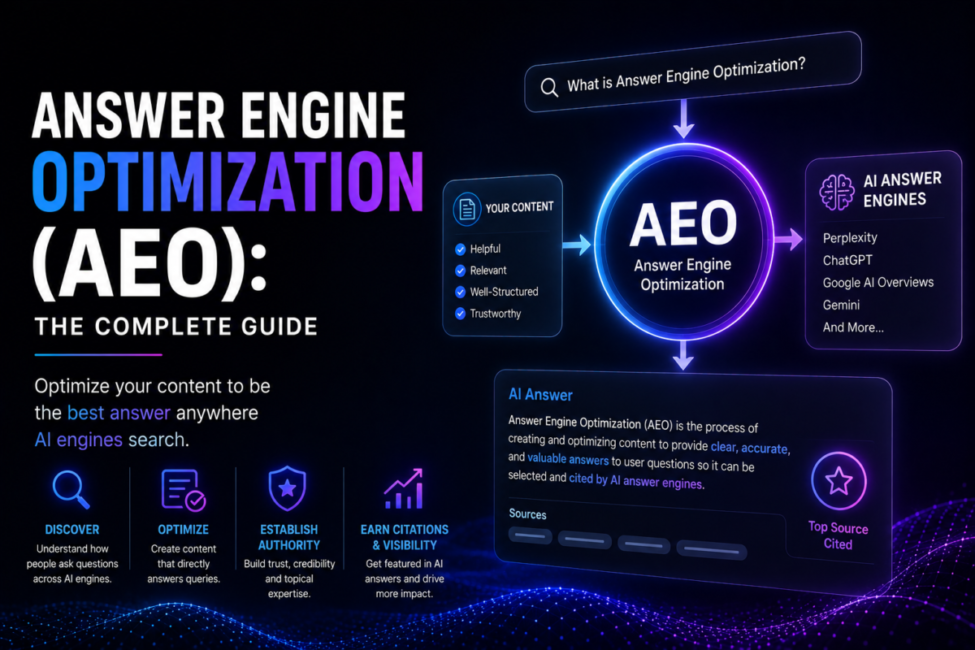
For two decades the job was to earn a blue link. In 2026 that job description quietly expired. SparkToro’s clickstream analysis of January through April 2026 found that 68.01% of U.S. Google searches ended without a click to any website, up from 60.45% in 2024. Google’s AI Mode passed a billion monthly users, and ChatGPT reached 900 million weekly users in February 2026. The answer itself has become the destination.
Related: pair this with our LLMEO strategies playbook for the step-by-step execution order.
Answer engine optimization is the discipline built for that reality — but the version circulating in most guides is already stale. May 2026 was the month Google both published its first official generative-AI optimization guidance and switched off the one rich result those guides told you to chase.
| Quick answer: Answer engine optimization (AEO) is the practice of structuring content so search engines, voice assistants and AI chatbots can lift it as a direct answer. In 2026 that means writing self-contained, question-shaped passages backed by original data and visible sourcing — not chasing schema-driven rich results, which Google has now retired. |
How we compare: every claim below traces to a primary source — Google’s own Search Central documentation, peer-reviewed research, or first-party clickstream data — rather than a vendor blog post. Where popular advice conflicts with Google’s stated position, we flag it and say which evidence we weight higher.
Affiliate disclosure: TechieHub may earn a commission when you buy through links to tools we mention. It never influences which tools we recommend or how we rank them.
Table of Contents
What is answer engine optimization, and what changed in 2026?
Answer engine optimization is the practice of preparing content so that an engine can extract a complete, correct answer from it and present that answer directly — in a featured snippet, a spoken voice result, or an AI-generated summary. Traditional SEO competes for a position in a list. AEO competes to be the passage that gets lifted out of the list entirely.
Three things shifted this year. Scale: AI Overviews now appear on more than a fifth of Google searches, and click-through falls by roughly 60% when they do. Guidance: Google published a dedicated generative-AI optimization guide in May 2026, ending years of guesswork. And least discussed, Google removed the FAQ rich result — the visible payoff a generation of AEO tutorials was built around.
The net effect is that AEO stopped being a formatting trick and became an editorial standard: you now write passages good enough that a machine reading ten competing sources decides yours is worth repeating.
How do answer engines decide which page becomes the answer?
Answer engines run on retrieval plus synthesis. A query is read for intent, candidate passages are retrieved, and a model assembles a response from whichever passages look most complete and trustworthy. Selection happens at the passage level, not the page level — which is why a strong page with a buried answer loses to a weaker page with a clean one.
Google’s own guidance is blunter than most agencies admit. It states that “the best practices for SEO continue to be relevant because our generative AI features on Google Search are rooted in our core Search ranking and quality systems”. It then dismantles several popular tactics directly: you don’t need new machine-readable files or markup to appear in Search, there’s no requirement to break content into tiny chunks for AI, and there’s no special writing style for generative search. Structured data, it says plainly, isn’t required.
The strategy simplifies accordingly. Retrieval favours pages that already rank, so the fundamentals of generative engine optimization still gate entry. Synthesis favours passages that stand alone, state a claim, and support it. Everything else is decoration.
Is FAQ schema still worth adding?
Here is where most AEO advice is now actively wrong. Google restricted FAQ rich results to authoritative government and health sites in August 2023, then finished the withdrawal in May 2026 — they no longer appear for anyone. How-To rich results were retired on a similar timeline. The screenshot-friendly payoff that justified bulk schema deployment is gone.
That does not make FAQ content worthless; it makes it honest. Google still uses FAQ structured data to understand pages, and unused markup causes no harm, so there is no reason to strip existing implementations. But the reason to keep an FAQ section is now the content itself: a tight question-and-answer block is the cleanest unit a model can retrieve and quote, with or without markup around it.

Schema that still earns visible results — Product, Review, Recipe, Event, Organization — remains worth implementing. Treat structured data as a comprehension aid, not as an AEO lever in its own right.
AEO vs SEO vs GEO: which one are you actually doing?
These three overlap enough that teams often buy the same work three times. The cleanest distinction is what each wins: SEO a ranking, AEO an extraction, GEO a citation inside a synthesized answer.
| Dimension | SEO | AEO | GEO |
| Goal | Rank in the link list | Be the extracted answer | Be named in the AI synthesis |
| Query shape | Short keywords | Natural questions | Multi-step prompts |
| Winning unit | The page | The passage | The brand entity |
| Surfaces | Organic results | Snippets, voice, AI Overviews | ChatGPT, Perplexity, Gemini, Claude |
| Primary metric | Rankings and clicks | Answer share | Citation frequency |
| 2026 pressure point | Falling CTR | Rich results retired | Attribution is opaque |
In practice you run them as one program. If you are specifically chasing Google’s summary panel, our guide to ranking in Google AI Overviews covers that surface in depth, while LLMEO handles the large-language-model side of the same problem.
Which tactics measurably increase AI citations?
The strongest available evidence is still the Princeton, Georgia Tech and IIT Delhi study presented at ACM SIGKDD in 2024, which tested optimization methods across roughly 10,000 queries. It found that generative engine optimization can lift visibility by up to 40%, with three interventions leading: adding relevant statistics, adding credible quotations, and citing sources.
That result maps neatly onto Google’s stance: both point at substance rather than syntax. The practical checklist:
- Answer in the first 40–60 words under a heading that mirrors the question. Engines lift openers.
- Make passages self-contained. If a paragraph only makes sense after reading the two above it, it cannot be extracted.
- Add a number and a source. A sentence with a dated figure and an attributable origin outcompetes a confident assertion.
- Quote a named expert. Attribution is a trust signal models reward.
- Match format to answer type — a list for a process, a table for a comparison, a paragraph for a definition.
- Publish something only you can publish. Google explicitly warns against recycled, commodity content that a model could generate itself.
Tooling helps you find the gaps rather than fix them; we cover the category in our roundup of answer engine optimization tools.
Case study: making a SaaS help center quotable
Vivienne Marchand runs content at a forty-person B2B scheduling SaaS. Her scenario is a composite of teams we’ve worked with, but the pattern is exact. Her help center ranked well and converted poorly: impressions climbed while sessions flattened, and prospects kept quoting a competitor’s answer to a question her own docs answered better.
The cause was the writing, not the markup. Every article opened with context — “Scheduling conflicts arise for many reasons…” — then delivered the real answer in paragraph four, wrapped in pronouns. Nothing could be lifted cleanly.
The rewrite changed three things. Headings became the literal questions from her support inbox. Each was followed by a fifty-word standalone answer naming the product instead of “the platform”. And each key claim gained a number with a source.
Within a quarter, manual prompt testing across ChatGPT and Google’s AI Mode returned her docs by name for six of eleven target questions, up from one. Clicks rose modestly; assisted conversions from branded search rose more.
This example is a composite of the help-centre rewrites we see most often, not a single client account; the figures are typical rather than measured from one engagement.
How do you measure AEO when nobody clicks?
Analytics cannot see an answer that never produced a session, so measurement moves upstream. Google now supplies the missing piece: its guidance points teams to the Generative AI performance report in Search Console. Start there, then layer on three habits.
Watch for high-impression, low-click question queries — the fingerprint of being summarized rather than visited. Run a fixed panel of target questions manually across Google, ChatGPT and a voice assistant monthly, logging whether you appear and how you’re described. And track brand-name searches, which rise when an audience keeps meeting your name inside answers they never clicked.
The trap is judging AEO by sessions alone. A strategy that increases your presence in answers often flattens informational traffic while improving the quality of what remains. Decide which number you’re optimizing before you start, or you will read a win as a loss.
What is a practical 90-day roadmap to start AEO and test what gets cited?
Ninety days is enough to establish a baseline, rewrite the pages that matter and read a real signal — but only if you measure before you change anything. The most common failure is rewriting fifty pages in week one, then having no way to tell which change moved anything. Work in three gated phases and re-run the same measurement at each gate.
Days 1–30: baseline and access
Nothing in this phase improves your citation rate. It exists so that the next sixty days produce evidence instead of anecdote.
- Build a fixed prompt set. Write 20–40 questions in the words buyers actually use, not your keyword list. Include comparison prompts (“X vs Y for Z”), selection prompts (“best tool for…”) and problem prompts (“how do I fix…”). This set must not change for 90 days, or your before-and-after is worthless.
- Run the baseline across engines. Put every prompt through ChatGPT, Perplexity, Google AI Mode and Gemini. For each result log three things: were you mentioned, were you cited with a link, and which competitor was cited instead. That third column is the one that tells you what to fix.
- Confirm crawler access. Check
robots.txtfor GPTBot, PerplexityBot, ClaudeBot, CCBot and Google-Extended. Blocking them is a legitimate business decision, but it is not compatible with wanting citations — make it deliberately, not by inheriting a default. - Verify your content is server-rendered. Fetch a key page with JavaScript disabled. If the answer text is not in the raw HTML, most retrieval pipelines will never see it.
- Audit your top 20 pages for extractability. For each, ask: does a self-contained 40–60 word answer exist directly under a question-shaped heading, or is the answer distributed across four paragraphs that only make sense in order?
Gate at day 30: you should be able to state your citation rate as a number — “we were cited in 6 of 40 prompts, mentioned without a link in 11, and Competitor A was cited in 22.” If you cannot say that sentence, do not proceed to phase two.
Days 31–60: rewrite for extraction
Now change things — but only on the pages your baseline showed are close, meaning you were mentioned but not cited, or a competitor was cited for a question you answer better.
- Lead every section with the answer. Put a self-contained 40–60 word response immediately under the question heading, then explain underneath. Retrieval systems lift passages, not pages, and a passage that depends on the paragraph above it cannot be lifted.
- Attach a source and a date to every claim that carries weight. “According to SparkToro’s January–April 2026 clickstream analysis” survives extraction intact; “studies show” does not, and a passage that cannot be verified is a passage a model has no reason to prefer.
- Publish at least one thing that exists nowhere else. A price you checked with the date you checked it, a benchmark you ran, a failure you hit. Synthesis of public information gives an engine no reason to cite you over the source you synthesised.
- Make your entity unambiguous. Consistent organisation name across the site, a real author with credentials, a substantive about page. Models resolve entities before they trust them.
- Keep schema in proportion.
Articlewith an honestdateModified,Organization,BreadcrumbListand product markup where you review products. Schema clarifies what a page is about; it does not persuade anything to cite you.
Gate at day 60: re-run the identical prompt set. Expect movement in mentions before citations — being named without a link is the normal first step, not a failure.
Days 61–90: corroboration and iteration
On-site work has a ceiling. Answer engines weight what other sources say about you, which is why the last phase happens mostly off your own domain.
- Earn third-party mentions where retrieval actually looks. Industry roundups, community discussions, comparison sites and anywhere your data can be referenced. A single citation of your original data in a well-indexed source moves more than another thousand words on your own page.
- Pitch the original asset from phase two. The data you published is the only thing on your site anyone has a reason to link to. Treat it as the outreach hook.
- Re-run the prompt set a third time and segment the result. Which engines moved, which pages moved, which prompts still return a competitor. Engines behave differently — improving in Perplexity while flat in ChatGPT is a normal and informative outcome.
- Decide what to stop. Pages that were not cited in three consecutive runs, despite rewriting, are usually competing above their authority. Consolidate them into the page that did get cited rather than maintaining both.
Gate at day 90: report the delta in citation rate against the day-one baseline, broken out by engine. A realistic first-quarter result for a mid-authority site is a citation rate moving from low single digits to the low teens, concentrated in the topics where you published something original.
| Phase | Primary work | What you measure at the gate |
|---|---|---|
| Days 1–30 | Fixed prompt set, baseline run, crawler access, extractability audit | Citation rate as a number, plus which competitor is cited instead |
| Days 31–60 | Passage-level rewrites, sourced claims, one original asset, entity clarity | Change in mentions and citations on rewritten pages only |
| Days 61–90 | Off-site corroboration, outreach on the original asset, consolidation | Delta versus baseline, segmented by engine and by page |
Two honest caveats. Engine outputs vary between runs on identical prompts, so treat any single reading as noise and the trend across three runs as signal. And ninety days is a diagnostic cycle, not a finish line — it tells you which of your topics can win citations, so the next quarter is spent going deeper there rather than wider everywhere. For the tracking side of this, see our comparison of AI search monitoring tools; for engine-specific tactics, our Perplexity SEO guide and guide to ranking in Google AI Overviews go deeper than this overview can.
Frequently Asked Questions
Is AEO just SEO with a new name?
Not quite, though they share a foundation. Google confirms its AI features run on core Search ranking systems, so ranking well remains a prerequisite. AEO adds a second requirement on top: your individual passages must be extractable and self-contained, because engines select passages rather than pages when building an answer.
Should I remove FAQ schema now that rich results are gone?
No. Google has said unused structured data causes no problems, and it still uses FAQ markup to understand page content. Removing it costs engineering time for no benefit. Just stop treating markup as the tactic — the extractable question-and-answer writing underneath it is what earns visibility now.
How long should an AEO answer be?
Roughly 40 to 60 words for the direct answer, placed immediately under a heading that mirrors the question. That length fits a featured snippet, reads naturally when spoken aloud by a voice assistant, and gives a language model a complete thought it can quote without needing surrounding paragraphs for context.
Does AEO work for small sites?
Yes, and often better than broad keyword strategies. Answer engines select the clearest response to a specific question, not the largest brand. Narrow, genuinely expert answers to long-tail and local questions are winnable ground where a small site’s firsthand experience outperforms a large competitor’s generic coverage.
Which content types get cited most often?
Research consistently favours content carrying statistics, quotations from named experts, and visible citations to original sources. Comparison tables, defined processes and direct definitions extract cleanly. Commodity explainers perform worst, since Google explicitly discourages content that recycles what already exists or that a model could generate unaided.
Can I optimize for ChatGPT and Google at the same time?
Largely yes. Both reward self-contained, well-sourced passages from pages that already rank or get retrieved. The differences are in surface and measurement rather than craft — Google exposes data in Search Console, while AI platforms require manual prompt testing or dedicated visibility tools to track mentions.
What is the difference between AEO, GEO and LLMEO?
They describe overlapping work under three labels that emerged from different corners of the industry. Answer engine optimization is the oldest and broadest — structuring content to be lifted as a direct answer, which predates generative AI and originally covered featured snippets and voice assistants. Generative engine optimization narrows that to generative systems specifically: AI Overviews, ChatGPT, Perplexity. LLMEO narrows further to large language models as the retrieval layer. In practice the tactics converge on the same short list — extractable passages, sourced claims, entity clarity, third-party corroboration — so choose whichever term your organisation already uses and do not spend budget on the distinction.
Do I need a specialised AEO platform, or does an enterprise SEO tool cover it now?
It depends on whether you need to know which source an engine cited. Established SEO suites have added AI-answer modules that report whether your brand appeared, which is enough for reporting to a board and is effectively free if you already pay for the suite. Dedicated platforms resolve the cited URL for each prompt, across more engines, at a higher refresh cadence — and that URL is the thing you act on, because it tells you which page to fix. Start with whatever your existing suite reports; add a specialist only when you have run out of things to fix that the free reporting can identify. Our AEO tools comparison covers the specific trade-offs.
How long does AEO take to show results?
Expect mentions within four to eight weeks of a passage-level rewrite and citations meaningfully later, because being named is a lower bar than being linked. Two factors dominate the timeline and neither is content quality: how often the engine refreshes its index for your topic, and whether anything off your own domain corroborates what you claim. Sites publishing genuinely original data tend to see movement in the first cycle; sites publishing well-written synthesis of public information often see none at all, at any timescale, because the engine can cite the original instead.
Conclusion
AEO in 2026 is a smaller, sharper discipline than the tutorials suggest. Google removed the rich results that made it look like a markup exercise, then published guidance saying the opposite: no special files, no chunking, no dedicated writing style, no required schema. What remains is the part that was always doing the work — clear questions as headings, complete answers underneath them, real numbers with real sources, and content that could not exist without you.
Start with your ten highest-intent question pages. Rewrite each opener as a standalone fifty-word answer, add one sourced statistic, and run the questions through Google and an AI assistant before and after. Then read the results as answer share, not sessions.

8 Comments
Pingback: Future of SEO: Key Trends to Watch in 2025 & 2026 - Techiehub
Pingback: Best AI Video Generator 2026: 15 Tools Tested & Compared
Pingback: Best Answer Engine Optimization Tools That Actually Work
Pingback: 10 Best AI Search Monitoring Tools 8 tools
Pingback: Generative Engine Optimization to Dominate AI Search
Pingback: LLMEO: Large Language Model Optimization Explained - Techiehub
Pingback: Perplexity SEO Guide to Rank in AI Powered Search
Pingback: LLMEO Strategies: Complete Guide for AI SEO Success