

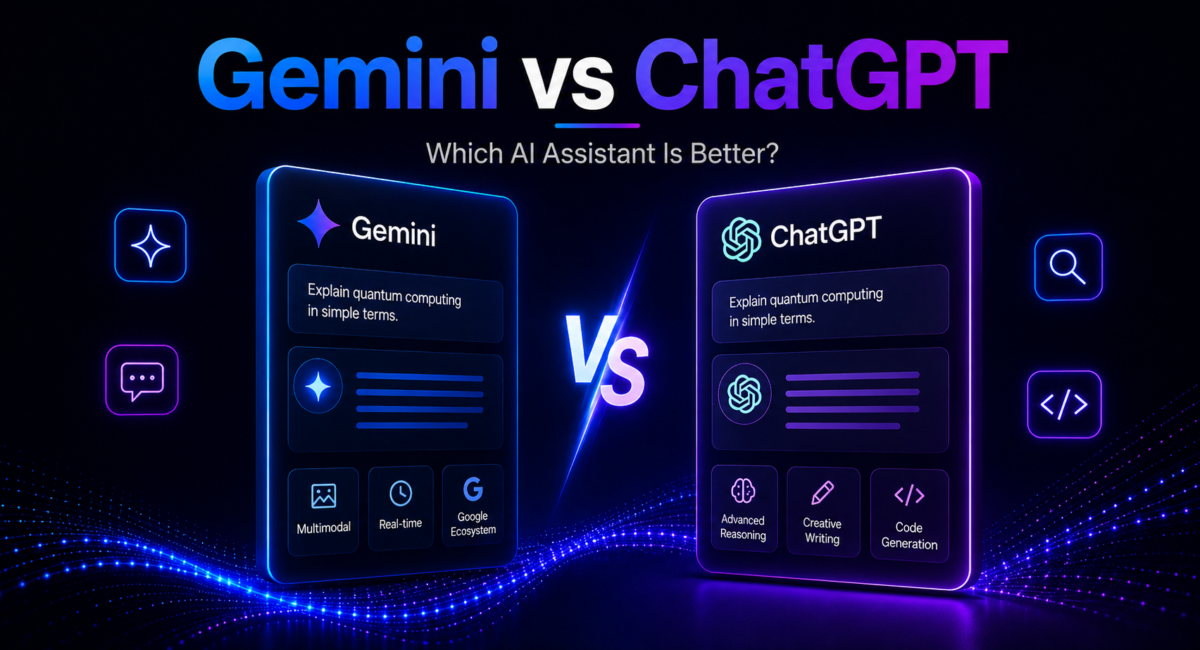
Gemini vs ChatGPT compared — multimodal abilities, context windows, writing quality, ecosystem integration and pricing — to help you pick the right AI assistant for how you work.
| Near-Tie Intelligence Index | $20/mon Both Standard Plans | Multimodal Gemini’s Edge | Writing ChatGPT’s Edge | 1M+ Token Context (Both) |
| Quick answer: Neither Gemini nor ChatGPT is universally better — the capability gap is the smallest it’s ever been, and the choice hinges on your ecosystem. Gemini (by Google) leads on native multimodal handling (it analyzes audio and video, not just images), the largest context windows, deep Google Workspace integration, real-time search and cheaper API pricing. ChatGPT (by OpenAI) leads on writing quality, complex reasoning, conversation consistency, and the broadest ecosystem of integrations and creative tools. Both have free tiers and ~$20/month plans. If you live in Google Workspace, Gemini is often the better default; otherwise ChatGPT is a safe pick. |
Key Takeaways
- Neither is universally better — they score nearly identically on overall intelligence, and the decision comes down to ecosystem and use case.
- Gemini leads on native multimodal (audio + video), the largest context windows, Google integration, live search and lower API prices.
- ChatGPT leads on writing quality, complex reasoning, conversation consistency, and the breadth of its tools and integrations.
- Both have free tiers and ~$20/month plans; pick Gemini if you live in Google’s ecosystem, ChatGPT for the broadest all-round toolkit.
Table of Contents
Gemini vs ChatGPT: The Quick Verdict
The honest headline is that neither Gemini nor ChatGPT is objectively better — and the gap between them is smaller than at any point since these assistants launched. On overall intelligence rankings, the two flagships score almost identically, both offer frontier-level coding, and both now include image and video generation. The days of one model clearly dominating are over; the decision now hinges on which ecosystem fits your work and which specific strengths you need. Gemini leads on multimodal range and context length, while ChatGPT leads on writing and reasoning polish. It pairs with our Claude vs ChatGPT comparison and our guide to tools like ChatGPT, and sits under our pillar on the best AI models.

Figure 2: Gemini vs ChatGPT at a glance
The Two Models
Gemini, built by Google (and formerly known as Bard), is a natively multimodal AI assistant powered by the Gemini 3.x model family, in tiers from a flagship Pro model down to fast, lightweight Flash variants. It features one of the largest context windows available (up to roughly a million tokens or more), native understanding of text, images, audio and video, and deep integration across Google’s ecosystem. See gemini.google.com.
ChatGPT, built by OpenAI, is the most widely used AI assistant in the world, with hundreds of millions of weekly users, powered by the GPT-5.x series in tiers from a flagship reasoning model down to lightweight ones, plus dedicated image and video models. It pairs strong text and reasoning with a broad creative toolkit and the largest ecosystem of third-party integrations. See openai.com. Both share the transformer foundation explained in what an LLM is, and both have evolved rapidly through several generational upgrades, which is why their capabilities now sit so close together.
Head-to-Head by Category
Here is how the two compare across the dimensions that matter most to everyday users.
| Category | Edge | Notes |
|---|---|---|
| Multimodal (audio/video) | Gemini | Natively analyzes audio and video, not just images |
| Context window | Gemini | Among the largest available; great for huge documents |
| Google ecosystem | Gemini | Deep Gmail, Docs, Sheets, Search, Maps integration |
| Real-time search | Gemini | Backed by Google Search for live data |
| API pricing | Gemini | Roughly 20–60% cheaper across tiers |
| Writing quality | ChatGPT | More polished, nuanced prose |
| Complex reasoning | ChatGPT | Handles multi-step logic with fewer errors |
| Ecosystem / tools | ChatGPT | Custom GPTs, Canvas, plugins, computer use, memory |
| Overall intelligence | Tie | Near-identical on the Intelligence Index |
Benchmark numbers and model versions change constantly, so treat the table as directional and verify the latest on neutral leaderboards like Chatbot Arena. The pattern, though, has held steady: complementary strengths shaped by each company’s priorities.
Where Each One Excels
Where Gemini wins
Gemini’s strengths cluster around multimodality, scale and Google integration. Its standout feature is native multimodal understanding — it processes text, images, audio and video together in a single prompt, and crucially it can analyze uploaded video and audio (meeting recordings, clips), something ChatGPT can’t do in the same way. It offers among the largest context windows available, making it excellent for analyzing massive documents in one pass, and it’s backed by Google Search for real-time data, which gives it an edge on research that needs up-to-the-minute information. For anyone who lives in Gmail, Docs, Sheets and Slides, its native Workspace integration is a genuine productivity multiplier — the AI sits right inside the apps and can draw on your files. Its API is meaningfully cheaper across every tier, which compounds at high volume, and many free users find it more capable out of the box.
Where ChatGPT wins
ChatGPT’s strengths cluster around polish, reasoning and ecosystem breadth. Professional users consistently find its prose more polished and its instruction-following more nuanced, and it handles complex multi-step reasoning chains with fewer errors. It tends to feel more reliable and consistent across a long conversation, holding context and tone steadily. Its ecosystem is the broadest available: a Custom GPTs marketplace where anyone can build and share specialized assistants, Canvas for collaborative editing, a coding tool, desktop computer-use agents that can operate your machine directly, persistent memory across chats, and polished voice and video-generation tools. As the most widely used assistant in the world, it also benefits from enormous community resources, tutorials and third-party integrations. For content creation, structured writing and a versatile all-round toolkit, ChatGPT remains a benchmark that the rest of the field is measured against.

Figure 3: Category-by-category comparison
Pricing Compared
At the consumer level, the two are very close: both offer a free tier and a ~$20/month standard plan (ChatGPT Plus and Google’s AI Pro / Gemini Advanced). Above that, OpenAI offers a $200/month Pro tier, while Google offers a higher Ultra tier (around $250/month) with its most advanced access and image generation. For business users, Google also offers a Workspace add-on that builds Gemini natively into the productivity apps for a modest per-user fee. Notably, Gemini’s free tier tends to feel more feature-rich out of the box, while ChatGPT’s free experience is often described as higher quality per message — a neat encapsulation of each platform’s broader philosophy.
On the API side, Gemini is the cheaper option across the board — roughly 20–60% less than the equivalent GPT tier. Its flagship Pro runs around $2/$12 per million input/output tokens versus GPT’s standard near $2.50/$15, and its lightweight Flash-Lite models drop to a fraction of that, well under a dollar per million tokens. For high-volume applications, that pricing advantage compounds significantly. ChatGPT’s API is competitive but generally pricier. Always verify current pricing on the official sites, since both change frequently. For local and open alternatives, see our guide to the Claude AI ecosystem and other models.
| 💡 Pro Tip Both free tiers are capable, so the cheapest way to decide is to run the same week of real tasks through each and notice which one disappears into your workflow rather than adding steps. For video or audio analysis specifically, Gemini is the clear pick. |
Which Should You Choose?
Choose based on your ecosystem and primary needs. Pick Gemini if you need native video or audio analysis, the largest context window, deep Google Workspace integration, real-time search-backed answers, or the most budget-friendly API. Pick ChatGPT if you prioritize writing quality and complex reasoning, want the broadest ecosystem of tools and integrations, need desktop computer-use agents or persistent memory, or want the most mature all-purpose creative toolkit.
For most general users, both are excellent and the ~$20/month plans are comparable. The deciding factor is usually which ecosystem you already live in — Google’s or OpenAI’s — much like choosing between Android and iPhone, where both phones are great and the real question is which world you’ve already invested in. It’s worth remembering that these two aren’t the only options: for coding specifically, Claude is widely regarded as the leader, as covered in our Claude vs ChatGPT comparison. Whichever you choose, both Gemini and ChatGPT sit at the frontier of AI assistants.

Figure 4: Which to choose
| ⚠️ Important AI capabilities, model versions and pricing change extremely fast — both Google and OpenAI ship new models frequently, and the lead in any given category can shift within weeks, so treat any specific figures, context-window sizes or prices here as directional and verify current details on the official sites before deciding. Benchmark results depend on the test setup and don’t always predict performance on your specific tasks. Both models can still make mistakes and hallucinate, so verify important outputs. |
Frequently Asked Questions
Is Gemini better than ChatGPT?
Neither is universally better — they excel at different things and score nearly identically on overall intelligence. Gemini leads on native multimodal handling (it analyzes audio and video), the largest context windows, Google Workspace integration, real-time search and cheaper API pricing. ChatGPT leads on writing quality, complex reasoning, conversation consistency and ecosystem breadth. The better choice depends on your use case and which ecosystem you already use. If you live in Google Workspace, Gemini is often the better default; otherwise ChatGPT is a reliable, versatile pick. Many people use both.
Which is better for writing, Gemini or ChatGPT?
ChatGPT generally has the edge for writing. Users consistently describe its prose as more polished and nuanced, and it follows detailed instructions more reliably while maintaining consistency across long pieces. It’s often the default for content creation and structured writing. Gemini writes well too and benefits from real-time information for research-heavy writing, but for pure writing quality and voice, ChatGPT is usually preferred. As always, the difference can be subtle, so testing both on your own writing style and subject matter is the best way to judge which suits you.
Which has the bigger context window?
Gemini has historically led on context window size, offering among the largest available — up to roughly a million tokens or more in its flagship model — which makes it excellent for analyzing very large documents, codebases or datasets in a single pass. ChatGPT has also moved to large context windows, reaching around a million tokens in its latest models, closing what used to be a significant gap. For most everyday use both are more than sufficient, but for the very largest document-analysis tasks, Gemini’s context capacity has been a notable advantage.
Can Gemini analyze video and audio?
Yes, and this is one of Gemini’s standout strengths. Because it’s natively multimodal, Gemini processes text, images, audio and video together, and can analyze uploaded video and audio content — such as meeting recordings or clips — directly. ChatGPT can generate video through its dedicated video model but cannot analyze uploaded video the same way Gemini can. If your work involves understanding video or audio content rather than just generating it, Gemini is the clear choice between the two. For pure image analysis, both perform well.
How much do Gemini and ChatGPT cost?
Both offer a free tier and a standard plan around $20/month — ChatGPT Plus and Google’s AI Pro (Gemini Advanced). Above that, OpenAI has a $200/month Pro tier, while Google offers a higher Ultra tier around $250/month with its most advanced access. On the API, Gemini is cheaper across the board — roughly 20–60% less than the equivalent GPT tier, with its flagship around $2/$12 per million tokens and lightweight models far cheaper. ChatGPT’s API is competitive but generally pricier. Always check the official sites, as pricing changes frequently.
Which is cheaper for API use?
Gemini is the more affordable option for API use, running roughly 20–60% cheaper than the equivalent ChatGPT tier across the board. Its flagship Pro model costs around $2 per million input tokens and $12 per million output, versus GPT’s standard pricing near $2.50/$15, and Gemini’s lightweight Flash-Lite models drop well under a dollar per million tokens. For high-volume applications, this difference compounds into significant savings. If API cost is a primary concern, Gemini has a clear advantage, though you should verify current rates on the official pricing pages since both update often.
Is Gemini good for Google Workspace users?
Yes — this is where Gemini shines. It integrates natively into Gmail, Docs, Sheets, Slides and Drive, surfacing AI assistance right where you already work and pulling context from your files automatically. For anyone who lives in Google Workspace, this removes friction that a separate tool like ChatGPT can’t match, making Gemini often the better default for those users. There’s typically a Workspace add-on for business accounts. If your daily work centers on Google’s productivity apps, Gemini’s integration is a genuine, practical advantage worth weighing heavily.
Which is better for coding, Gemini or ChatGPT?
Both are frontier-level for code and the gap is small. ChatGPT is generally stronger at multi-step debugging and holding detailed instructions across a long session, while Gemini’s much larger context window helps when the model needs an entire codebase in view at once. For coding specifically, though, Claude is widely regarded as the leader of the three — see our Claude vs ChatGPT comparison.
Is Gemini free, and which free tier is better?
Both have free tiers. Gemini’s tends to be more feature-rich out of the box, while ChatGPT’s free experience is often described as higher quality per message. If you need audio or video analysis without paying, Gemini is the only one of the two that offers it.
Conclusion & Key Takeaways
Neither wins outright. Gemini leads on audio and video analysis, context size, Workspace integration and API price; ChatGPT on writing quality, reasoning and ecosystem breadth. See our Claude vs ChatGPT comparison and the best AI models pillar.
- Neither is universally better; they score nearly identically on overall intelligence.
- Gemini edges multimodal (audio/video), context size, Google integration, live search and API price.
- ChatGPT edges writing quality, complex reasoning, consistency and ecosystem breadth.
- Both have free tiers and ~$20/month plans; the choice is largely about ecosystem.
- For coding specifically, Claude is widely regarded as the leader of the three.
