



| Quick answer |
|---|
| For US financial services, Semrush’s AI Visibility Toolkit at $99 a month per domain is the best measurement layer and Surfer SEO from $49 a month the best optimisation layer. Neither reviews content for compliance: FINRA Notice 24-09 makes the firm responsible for AI output, whoever generated it. |
| How we compare |
|---|
| Tools are split into a measurement layer and an optimisation layer, then judged on how each fits a supervised publishing workflow. Prices were taken from vendor pricing pages and re-checked on 12 September 2026 and again on 11 October 2026. Two things had changed by the second read: Profound no longer lists the self-serve tiers it showed in September, and Otterly now prices its Google AI Mode and Gemini add-ons at $9 each. Rankability’s page did not load on 11 October, so its figures are the September ones, and Semrush’s $99 per-domain rate is taken from its knowledge base because its main pricing page now leads with bundled plans. We did not run a head-to-head lab test and did not measure visibility gains ourselves. Every price was re-checked against the vendor’s own pricing page in September 2026, and figures available only from third-party trackers are marked as reported. No vendor paid for placement. Nothing here is legal advice. |
Table of Contents
The rules that actually constrain your tool choice
No tool on this list carries your regulatory obligation, and the recent guidance is explicit about it. FINRA issued Regulatory Notice 24-09 on 27 June 2024, reminding member firms that existing securities laws and FINRA rules apply to generative AI and large language models. The notice is deliberately technology-neutral: obligations attach to the communication, not to the software that produced it, and they apply whether the firm built the tool or licensed a third party’s — including AI features embedded inside products it already uses.
Under Rule 3110, a firm using generative AI within its supervisory system needs policies covering technology governance, model risk management, data privacy and the reliability and accuracy of the model.
The review step itself is in flux. On 9 July 2026 FINRA published Notice 26-14, seeking comment on modernising Rule 2210 (Communications with the Public), in a comment period that closed on 11 September 2026. The central proposal would replace the prescriptive requirement that a principal approve each retail communication before use with a risk-based framework, under which firms adopt written procedures defining which categories need pre-use approval.
Registered investment advisers face a parallel constraint. Under the SEC Marketing Rule, Rule 206(4)-1 as codified at 17 CFR 275.206(4)-1, with which advisers had to comply by 4 November 2022, an advertisement must not contain a material statement of fact the adviser lacks a reasonable basis for believing it can substantiate on demand. That is the exact point at which a fluent, unsourced AI draft becomes a liability rather than a shortcut.

Best AI search optimization tools for financial services compared
| Tool | Layer | Entry price | Unit you buy | Fit for a supervised workflow |
|---|---|---|---|---|
| Otterly.AI | Measurement | $29/mo | 15 prompts, 4 engines | Baseline before budget approval |
| Surfer SEO | Optimisation | $49/mo billed yearly | Content scoring | Good; scores structure, not claims |
| Frase | Both | $39/mo billed yearly | 10 articles per month | Best — article count maps to review capacity |
| Semrush AI Visibility Toolkit | Measurement | $99/mo per domain | 25 daily-tracked prompts | Good; per-domain suits multi-entity firms |
| Rankability | Both | $99/mo | 60 daily prompts; unlimited seats | Good for many advisor sites |
| Profound | Measurement | Free 7-day trial, then custom quote | 50 prompts on trial; custom after | Enterprise tier for SSO and SOC 2 |

The six tools in detail
Semrush AI Visibility Toolkit
The measurement layer. Semrush’s own pricing page lists it at $99 a month per domain billed annually for 25 daily-tracked prompts and mentions from ChatGPT, Google AI, Gemini and Perplexity, with extra users from $45 a month. For a regulated firm the useful output is evidence of what assistants currently say about you, which is also a reputational monitoring input.
Surfer SEO
The optimisation layer. Surfer scores a draft against the pages already ranking and publishes plans at $49, $99, $182 and $299 a month billed yearly, with Enterprise quoted individually, plus a separate AI Search Analytics product at $82 a month billed yearly for 50 prompts tracked daily. It scores structure and coverage; it does not evaluate whether a claim is substantiated.
Frase
The best fit for a workflow with a mandatory review gate, because it is the only platform here that prices in articles rather than opaque credits. Frase’s published tiers put Starter at $49 a month or $39 billed yearly for 10 articles, Professional $129 or $103 for 40, Scale $299 or $239 for 100. A predictable article count is easier to map onto a supervisory review capacity.
Otterly.AI
The cheapest way to establish a baseline before committing budget. Otterly’s pricing page lists Lite at $29 a month for 15 tracked prompts across ChatGPT, Google AI Overviews, Perplexity and Microsoft Copilot with daily tracking. Gemini, Claude and Google AI Mode are per-engine add-ons.
Rankability
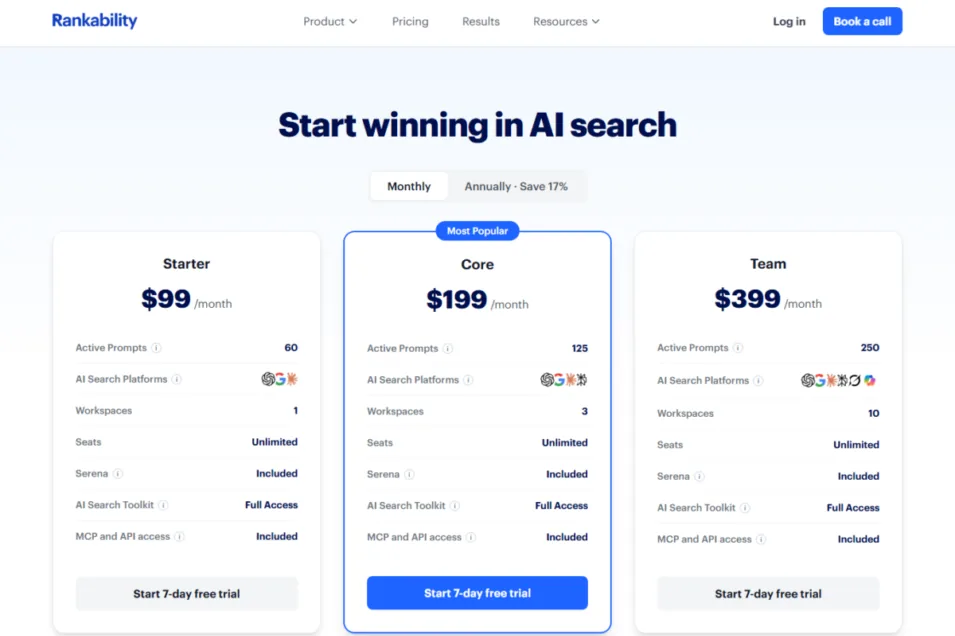
Built for multi-brand operations, which maps well onto firms running separate advisor or branch sites. Every tier includes unlimited seats, with plans at $99, $199 and $399 a month for 60, 125 and 250 daily-tracked prompts across one, three and ten workspaces.
Profound
The enterprise name most often shortlisted by large institutions. Its pricing page listed Starter at $99 a month and Growth at $399 in September 2026; by 11 October those self-serve tiers were gone, replaced by a free seven-day trial (50 preset prompts across ChatGPT, Gemini and Google AI Overviews) and a custom-quoted Enterprise plan. Enterprise, the tier large institutions need for SSO and security review, covers up to nine engines and is quoted individually.
What a tracked prompt actually costs
Every measurement vendor prices a bundle, so the headline figures are not comparable as published. Normalising them is: divide the listed monthly price by the prompts each entry tier tracks daily, then again by the engines included. Neither figure is published by any of these vendors; both come straight from their own listed numbers, and the arithmetic is shown so you can redo it on the tier you are actually quoted.
| Tool (entry tier) | Listed monthly | Prompts tracked daily | Engines included | Cost per prompt | Cost per prompt-engine pair |
|---|---|---|---|---|---|
| Otterly.AI Lite | $29 | 15 | 4 | $29 ÷ 15 = $1.93 | $29 ÷ 60 = $0.48 |
| Semrush AI Visibility Toolkit | $99 per domain | 25 | 4 | $99 ÷ 25 = $3.96 | $99 ÷ 100 = $0.99 |
| Surfer AI Search Analytics | $82 | 50 | 5 | $82 ÷ 50 = $1.64 | $82 ÷ 250 = $0.33 |
| Profound | Custom quote | Custom | Up to 9 | Not published | Not published |
Otterly monitors at roughly half Semrush’s cost per prompt-engine pair, and its add-ons barely narrow the gap: its pricing page lists Google AI Mode and Gemini at $9 a month each on Lite, so six engines cost $29 + $9 + $9 = $47, or $47 ÷ 90 = $0.52 a pair. Surfer’s AI Search Analytics is the cheapest per prompt at $1.64, yet it is a separate purchase from the $49 optimisation plan — a firm that wants both pays $82 + $49 = $131 a month. Profound cannot be placed in this table any more, because it no longer publishes a self-serve price.
The practical consequence for a regulated firm: prompt count, not seat count, is the variable that scales your bill, and prompt count is set by how many products, entities and advisor names you must monitor. Count those first, then price the tiers.

A publishing workflow that survives review
The tooling decision is the easy half. What separates firms that ship regulated content from firms that pilot it forever is the workflow around it:
- Separate generation from approval in the tool itself. An article allowance you can count, as Frase provides, is far easier to reconcile against review capacity than a credit balance.
- Require a source for every number. Substantiation on demand is the standard for advisers; an unsourced figure in a draft should fail review automatically.
- Keep disclosures next to the claim. Extraction lifts a passage away from the page, so a footer disclosure does not travel with it.
- Log which tool touched which draft. Technology governance under Rule 3110 is easier to evidence when the record already exists.
- Measure before and after. Baseline your visibility with the $29 tier before buying the $99 one, so the spend has a number attached.
Our guide to generative engine optimization covers the structural work these tools score, and answer engine optimization tools covers the wider measurement category. For the measurement layer on its own, across every engine rather than the finance-specific shortlist here, start with our comparison of the best AI search monitoring tools. For the operational side of financial services marketing, AI agents for finance and accounting covers the adjacent back-office use cases, alongside the AI tools accountants actually use for the finance function itself.
Frequently Asked Questions
What are the best AI search optimization tools for financial services US?
Semrush’s AI Visibility Toolkit at $99 a month per domain for measurement, and Surfer SEO from $49 a month for optimisation. Add Frase from $39 a month if you need a predictable article count to match a supervisory review capacity, and Otterly.AI at $29 to establish a baseline cheaply. None of them performs compliance review, which stays a firm obligation.
Does AI search optimisation hurt traditional rankings for US financial services firms?
No — the two objectives largely coincide. Both reward a page that answers the question directly near the top, uses honest headings, and delivers its content in server-rendered HTML. The one real tension is length, because classic SEO advice pushed towards comprehensive long-form while extraction rewards short self-contained passages. Structure resolves it: short, complete answers inside a longer page.
What content structure gets extracted by AI Overviews for US financial services firms?
Self-contained chunks, as our guide to ranking in Google AI Overviews sets out in detail. A passage that answers the question completely without depending on the paragraph above it can be quoted; one beginning “as noted above” cannot. In practice: a question-shaped heading, then a direct 40 to 60 word answer, then supporting detail. Tables and short lists extract well. Anything that only renders after JavaScript may never be seen.
Can AI-drafted financial content skip principal approval?
Not under the current rule. Rule 2210 still requires a registered principal to approve each retail communication before use, whoever or whatever drafted it. Notice 26-14 proposes a risk-based alternative, but its comment period only closed on 11 September 2026 and the rule has not changed. Keep the pre-use approval step in the workflow until it does.
How much do AI search tools for financial services cost?
Prices checked on vendor pricing pages on 12 September 2026 and again on 11 October 2026: Otterly.AI from $29 a month, Surfer SEO from $49 to $299 a month billed yearly, Frase $39 to $239 a month billed yearly, Semrush’s AI Visibility Toolkit $99 a month per domain, and Rankability $99 to $399 a month. Profound now offers a free seven-day trial and quotes everything else individually. Budget separately for the review workflow, which is usually the larger cost in a regulated firm. One caution on Rankability: its pricing page would not load for us on 11 and 12 October 2026, and recent third-party reviews disagree, some reporting that the $99 entry plan has gone and plans now start at $199 on a credit basis. Confirm the current plan before you budget on the figures here.
Conclusion
Buy in layers. Establish a baseline with Otterly at $29 a month, add Surfer at $49 for optimisation, and step up to Semrush’s toolkit at $99 per domain when the reporting has to be shared across a compliance and marketing team. Frase is the better all-in-one where a countable article allowance makes supervisory planning simpler.
The constraint that decides most of this is not the software. FINRA’s position is that the firm owns the communication whether a person or a model wrote it, and the SEC’s substantiation standard applies to the claim regardless of its author. Choose tools that make review easier, not tools that make output faster.
