


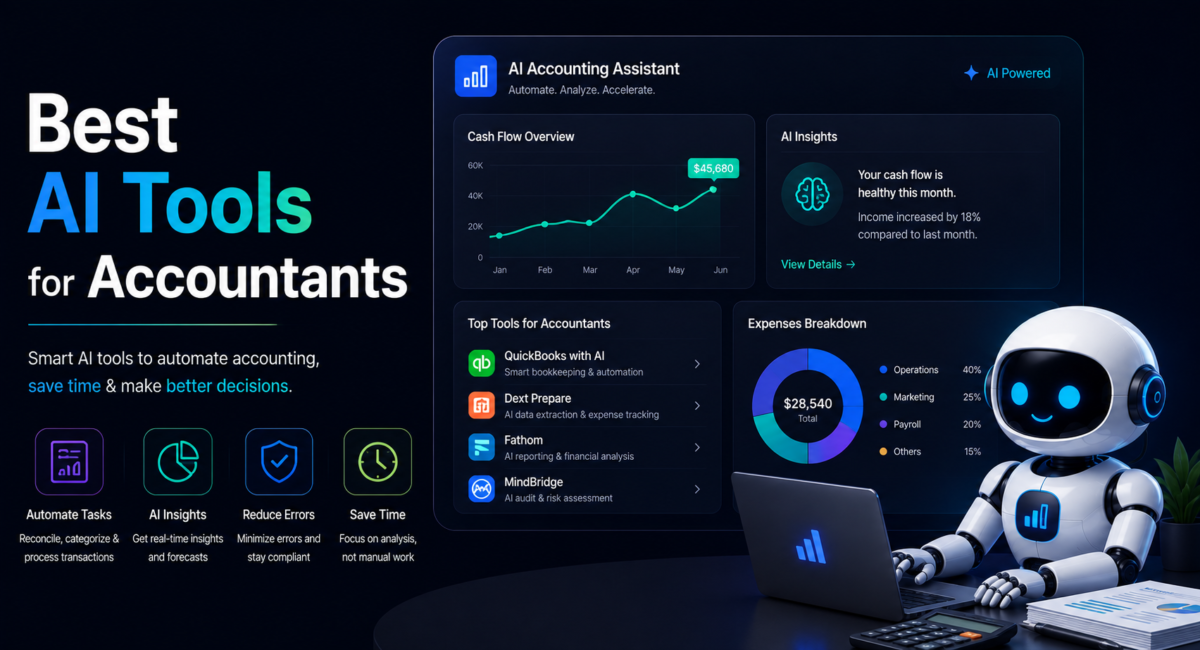
Accounting software crossed a line in the past eighteen months. Until recently, “AI” inside a ledger meant a suggestion chip beside an unmatched bank transaction. In 2026 it means agents that reconcile accounts, chase overdue invoices, risk-score an entire general ledger and draft the client commentary. The buying question changed with it: not whether to use AI, but which parts of your week you hand over, and what evidence you keep that a qualified human checked the result.
| Quick answer: The strongest options split by task. QuickBooks with Intuit Intelligence and Xero’s JAX handle bookkeeping and reconciliation, Dext handles document capture, MindBridge handles audit risk across the full ledger, Fathom handles reporting commentary, and Karbon’s Kai handles practice management. Every output still needs a qualified accountant’s review before it reaches a filing. |

How we compare: we assess tools on published capability, integration depth with the general ledger, audit-trail quality and security posture, and treat vendor efficiency claims as directional marketing, not measured results. Prices were checked in July 2026.
Disclosure: some links on TechieHub are affiliate links. If you buy through one we may earn a commission at no extra cost to you. It never changes which tools make this list.
Table of Contents
Where does AI actually fit in an accountant’s week?
Adoption is well ahead of measurement. The Thomson Reuters 2026 AI in Professional Services Report, covering more than 1,500 respondents across 27 countries, found organisation-wide AI use nearly doubled to 40% in 2026 from 22% a year earlier — while only 18% knew their organisation tracked any return on that investment. Agentic AI followed the same curve: 15% already using it, another 53% planning or considering it.
Most firms, in other words, are buying before they know what works. The pattern that holds up is narrow but dependable: AI earns its keep where work is high-volume, rule-shaped and checkable against a source document — categorising thousands of transactions, pulling line items off supplier invoices, matching a bank feed, scanning a ledger for outliers. It performs worst when asked to produce a figure or interpret a rule with nothing to verify against. Tax research is the classic trap: a fluent answer citing a provision amended two years ago looks identical to a correct one. The same split runs through the wider category of AI agents for finance and accounting, where autonomy is safest on tasks that leave a paper trail.
What are the best AI tools for accountants right now?
| Tool | Bottleneck it solves | Pricing model |
|---|---|---|
| QuickBooks + Intuit Intelligence | Bookkeeping, payments, payroll — agents inside the ledger | Tiered; stronger agents gated to higher tiers |
| Xero + JAX | Reconciliation and everyday queries in the ledger | Tiered by subscription |
| Dext | Document capture — line items from photos, PDFs and invoices | From ~$31.50/mo, metered by document volume |
| MindBridge | Audit risk scored across 100% of transactions, not a sample | Quote |
| Fathom | Management reporting, forecasting and narrative commentary | Per entity reported on |
| Karbon + Kai | Practice management — stopping work slipping between people | Per user |
QuickBooks with Intuit Intelligence — the agent suite
QuickBooks with Intuit Intelligence has moved from a single assistant to a set of agents — Accounting, Payments, Customer, Payroll and Sales Tax, with a Business Tax agent in beta. The accounting agent categorises transactions, generates its own follow-up questions when context is missing, and compares PDF bank statements against the ledger to surface anomalies. Two caveats: the stronger agents are tier-gated to Essentials and above, and QuickBooks Online raised prices roughly 15–25% from 1 May 2026.
Xero with JAX — reconciliation and the financial superagent
Xero rebuilt JAX — “Just Ask Xero” — into what it calls an AI financial superagent, developed with OpenAI. Beyond reconciliation and data entry, it predicts from payment history when a customer will actually pay, then runs the follow-up on overdue invoices and switches channel if nobody responds. A natural-language custom agent builder arrived in May 2026. Xero also ships a control layer called JAX Assure to reduce hallucinations — a candid admission that the underlying models need guardrails.
Dext — document capture and line-item extraction
Dext remains the reference point for document capture. It extracts line items, not just header totals, from photographed receipts, PDFs and emailed invoices, and syncs to Xero, QuickBooks and Sage. Business plans start around $31.50 per month for five users and 250 documents, cheaper annually — size the plan by document volume, not seats, because that is where the cost lands.
MindBridge — audit and risk across the full ledger
MindBridge is the audit and risk specialist. Rather than sampling, it analyses 100% of transactions — “no blind spots”, in its own phrasing — using an ensemble of statistical models, business rules and unsupervised machine learning to flag suspicious keywords, atypical amounts and unusual flows. Its June 2026 expansion focused on risk assessment and explainability — what matters when a reviewer asks why an entry was flagged.
Fathom — management reporting and forecasting
Fathom covers management reporting, forecasting and consolidation, and its Commentary Writer drafts the narrative that normally eats an afternoon per client pack. Karbon handles practice management: Kai launched on 3 June 2026 as an AI coworker sitting on the client history and workflows already in Karbon, alongside an AI notetaker, email triage and agentic period-close checks.
General assistants — where Claude and ChatGPT fit
General assistants still have a place. Anthropic released Claude Opus 5 on 24 July 2026 with stronger mathematical reasoning and an effort dial trading compute against cost; API pricing is $5 per million input tokens and $25 per million output. Useful for research, memo drafting and modelling — but a drafting tool, not a source of record. Never paste identifiable client data into an assistant your firm has not vetted.

How do you choose between built-in AI and specialist tools?
Start with the platform you already run. Intuit and Xero are absorbing AI into their core products, so much of what a bolt-on sold you in 2024 now ships in the subscription. Buy a specialist only where the built-in tool has a structural gap: full-population audit testing, high-volume line-item capture, client-ready commentary, or firm-wide workflow.
Four things separate a good fit from an expensive one. Extraction depth — a tool capturing totals only leaves you re-keying the lines reporting and audits depend on. Sync quality — real-time integration versus CSV exports that create their own reconciliation work. Security posture — SOC 2 attestation, GDPR handling, data residency, and a clear answer on whether your data trains models. Cost model — seats, documents and tiers price very differently at scale.
Firm size matters: a solo practitioner rarely needs audit analytics, while a five-partner firm doing outsourced controller work needs proper capture and reporting. If your analysis still lives in spreadsheets, pair your ledger with AI tools for Excel before buying a second platform, and if you are advising clients on their own stack, our guide to AI tools for small business fits better.

What are the real risks, and how do firms contain them?
Three risks deserve named owners. Accuracy and hallucination: AI misclassifies, miscalculates and states superseded tax rules with total fluency, and in accounting an unchecked error is not a typo but a misstatement that flows into a return. Confidentiality: client financial data is among the most sensitive a business holds, and it leaves your perimeter to reach a vendor’s servers. Documentation: if you cannot explain how a figure was derived, you cannot defend it.
Standards have moved to meet this. AU-C 500 recognises that audit procedures may be performed using automated tools and techniques, including artificial intelligence and machine learning — but obligations around professional skepticism and judgment do not shift, which makes human-in-the-loop review a governance requirement, not a nicety. The AICPA has also published introductory guidelines for responsible AI use in federal tax practice, worth reading before drafting your firm’s policy.
Containment looks unglamorous: a named reviewer for every automated workflow, verification against source records, a written policy covering which tools may touch client data, and retained evidence of the review. TechieHub is a technology publication, not an accounting firm — this article is informational and is not financial or tax advice.
How one practice cut month-end close from nine days to four
Niamh Gallagher leads outsourced-controller work at a five-partner firm in Leeds, handling monthly close for 42 clients. Her scenario is a composite of workflows firms in this bracket describe. Her close ran nine working days, and the bottleneck was never the accounting — it was receipts arriving as phone photos across three messaging apps, then two days of categorisation and a client report written the night before the meeting.
She changed four things over a quarter. Capture moved to Dext at source, so clients photograph a receipt once and line items land in Xero already coded. JAX cleared the routine bank matches and flagged the rest. Client narrative started as a Fathom Commentary Writer draft rather than a blank page. Karbon held the close checklist so nothing sat in one inbox.
Close came down to four days, and the character of her time changed more than the total: she reviews exceptions rather than keying data, and two clients moved onto advisory retainers. The sign-off did not change. In month two she rejected the system’s classification of a £14,000 equipment purchase as a repair — a plausible-looking error that would have understated fixed assets and overstated expenses. That catch is the argument for keeping the review step permanent.
Frequently Asked Questions
What are the best AI tools for accountants in 2026?
QuickBooks with Intuit Intelligence and Xero with JAX lead for bookkeeping and reconciliation, Dext for line-item document capture, MindBridge for full-population audit risk, Fathom for reporting commentary, and Karbon with Kai for practice management. The right pick depends on which task currently consumes most of your week.
Can AI replace accountants?
No. AI automates categorisation, reconciliation, extraction and drafting, but it cannot exercise professional judgment, interpret ambiguous tax law, sign off on financial statements or carry liability for an error. The realistic outcome is restructuring rather than replacement: less keying, more advisory work, and a permanent human review step.
Is it safe to put client financial data into AI tools?
It depends entirely on the tool. Accounting-specific platforms with SOC 2 attestation, documented GDPR handling and clear data-residency terms are a different proposition from a consumer chatbot. Check whether your data trains the vendor’s models, and never paste identifiable client information into an unvetted general assistant.
How accurate are AI accounting tools really?
Accurate enough to draft, not accurate enough to file. Vendor figures like 99.9% extraction accuracy describe optimal conditions, not your document mix. Treat every output as a first pass, reconcile it against source records, and expect failures to be plausible-looking coding errors rather than obvious nonsense.
Do AI accounting tools integrate with my existing software?
Most leading tools connect to QuickBooks, Xero, Sage and common ERP systems, and the ledger vendors are building AI into their core products directly. Confirm the integration is real-time rather than CSV export before committing, because manual file transfers quietly erase most of the promised time savings.
What does AI for accounting cost?
Budget on the pricing model, not the headline. Dext business plans start near $31.50 monthly but meter by document volume, QuickBooks gates its stronger agents to higher tiers and raised prices 15–25% in May 2026, and Karbon prices per user. Model your actual volumes before subscribing.
Can AI prepare and file tax returns?
It can do the preparation work around a return; it cannot be the authority behind one. AI is genuinely strong at the labour either side of the filing — extracting figures from source documents, reconciling ledgers, flagging inconsistencies between schedules, and reviewing a completed return for items that look out of pattern. Several practices use it as a second pair of eyes before sign-off and find it catches transposition and classification errors reliably.
Where it fails is authority. A general model will state a superseded rate or a repealed provision with complete confidence, and tax positions turn on specifics — jurisdiction, entity type, the year in question — that it routinely blurs. The compliance point is simply that signing a return transfers nothing: the preparer remains responsible for its accuracy regardless of what produced the numbers, so every AI-derived figure needs verification against source records and every AI-stated rule needs checking against current authority. Use it to find what to look at, never to decide what is correct.
Conclusion
The useful framing for 2026 is not a ranked list but a map of bottlenecks. If categorisation and bank matching eat your week, the AI already inside QuickBooks or Xero likely solves it without a new vendor. If documents arrive as photographs, Dext pays for itself. If you sample in audit, MindBridge changes what you see. Fathom drafts client reports; Karbon stops work slipping between people.
What holds it together is the part no vendor sells: a named human who verifies the numbers against source records and signs off. Adopt for the specific bottleneck, measure the hours you recover, and keep the review step permanent. That is how AI becomes capacity rather than risk. For the wider landscape, see our pillar guide to the best AI tools for business.
