

Affiliate disclosure: some links below are affiliate links. If you buy through them, TechieHub may earn a commission at no extra cost to you. It never affects which tools we include or how we rank them.
Ask three surveys how many small businesses use AI and you will get answers ranging from under 20% to nearly 90%. That spread is not a rounding error — it is the entire story. Most small firms have “adopted AI” in the sense that somebody opened a chatbot once during a slow week. Far fewer have wired a tool into a workflow that keeps running whether or not anyone remembers it exists. This guide is about the second kind: which tools earn a line item, what they genuinely cost in mid-2026 after a year of quiet price rises, and how to pick one that pays for itself before you buy a second.
| Quick answer: The best AI tools for small business in 2026 are ChatGPT or Claude for writing and thinking ($20/month), Canva for design ($15/month), HubSpot for CRM (free tier, paid from $20/seat), Zapier for automation ($29.99/month), and QuickBooks for bookkeeping ($38/month). Adopt one, aimed at your worst workflow, and prove it saves hours before adding a second. |

Table of Contents
Why do AI adoption numbers disagree so wildly?
The U.S. Chamber of Commerce reports that 58% of small businesses say they use generative AI, up from 40% in 2024 and more than double the 23% who said so in 2023. Meanwhile the U.S. Census Bureau’s Business Trends and Outlook Survey, measuring through May 2026, put AI use at under 20% among firms with four or fewer employees — against 37% for firms with 250 or more.
Both figures are honest; they measure different things. One asks owners whether they use AI at all, the other whether the business uses AI in producing its goods or services. The gap is exactly where most small businesses live: aware of AI, occasionally using it, not yet running on it.
The realistic payoff is also smaller than the marketing implies. Research from the Federal Reserve Bank of St. Louis found generative AI users saved an average of 5.4% of their work hours — roughly 2.2 hours a week on a 40-hour schedule. That is a genuine gain, but it is two hours, not ten. Budget accordingly: a $20 tool returning two hours a week is an outstanding trade, while a $300 stack assembled chasing the ten-hour claim is how small businesses waste money on software they never open.
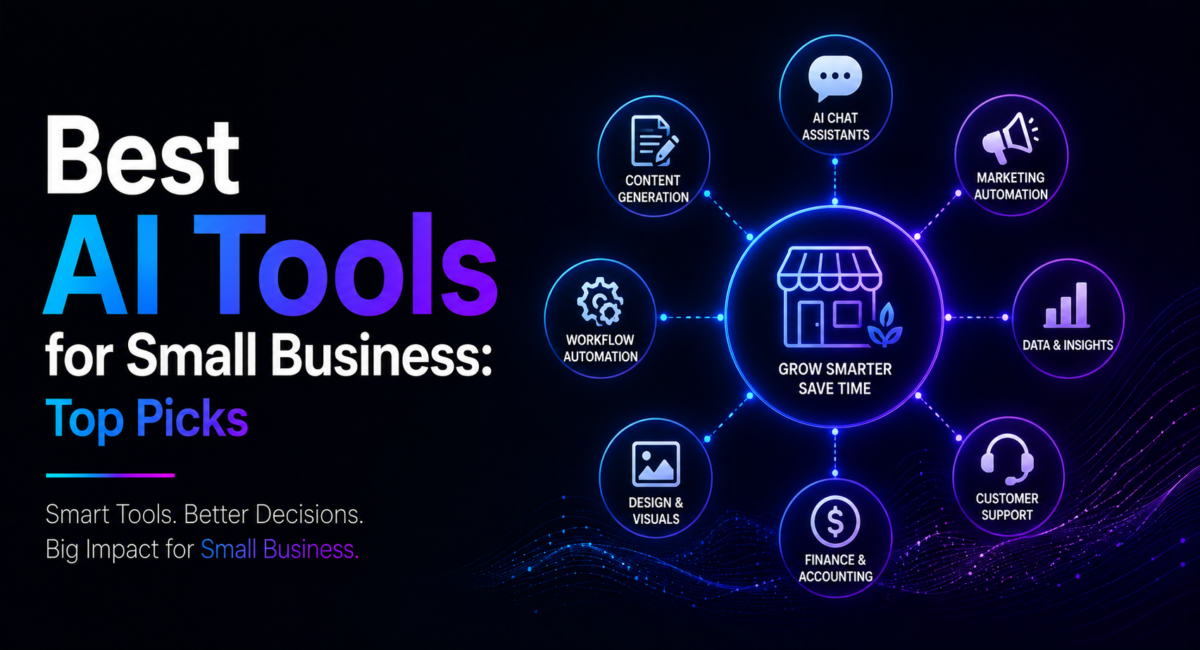
What are the best AI tools for small business in 2026?
A general assistant — ChatGPT or Claude, $20/month
This is the one tool nearly every small business should own, because it requires no setup and no workflow redesign. It drafts the quote email, rewrites the listing copy, summarises the supplier contract and explains the tax form. ChatGPT Plus and Claude Pro both sit at $20/month; Claude’s current model is Claude Opus 5, released 24 July 2026. Pick one and learn it properly rather than sampling both.
Design — Canva, free or about $15/month
Canva’s Magic Studio is why a two-person shop can produce a decent menu, a storefront sign and a month of social graphics in one afternoon. The free tier is genuinely usable; Pro buys brand kits, background removal and one-click resizing, which matter once you post regularly.
CRM — HubSpot, free, paid from $20/seat
The free CRM alone fixes the most common small-business leak: leads scattered across an inbox, a notebook and somebody’s phone. Paid Starter adds AI email drafting, lead scoring and follow-up sequences at roughly $20 per seat monthly, or $15 on annual billing. If selling is your bottleneck rather than admin, our guide to the best AI sales tools covers the deeper options.
Automation — Zapier, free or $29.99/month
Zapier is connective tissue: a form submission becomes a CRM contact, a task and a confirmation email without anyone retyping anything. The free tier handles simple two-step automations; Professional runs $29.99/month for 750 tasks. Our roundup of the best AI automation tools goes further here.
Bookkeeping — QuickBooks, from $38/month
Automatic transaction categorisation and receipt capture remove the monthly reconciliation slog and make tax season survivable. Watch the number: Simple Start moved from $35 to $38 in August 2026.
Support — Tidio with Lyro, from $39/month
Worth it only if repetitive customer questions genuinely eat your day. Read the pricing closely — Lyro is an add-on layered on top of a Tidio plan, starting near $39/month for 50 AI conversations, so it is rarely as cheap as the headline suggests.
What does a lean AI stack actually cost now?

Pricing drifted upward through 2026, and several vendors restructured what sits behind the headline figure. The table reflects list pricing checked in July 2026.
| Tool | Function | Price (July 2026) |
| ChatGPT / Claude | Writing and general assistant | Free tier; $20/month |
| Canva | Design and visuals | Free tier; Pro about $15/month |
| HubSpot | CRM and sales | Free CRM; from $20/seat/month |
| Zapier | Automation | Free tier; Pro $29.99/month |
| QuickBooks | Bookkeeping | Simple Start $38/month |
| Tidio + Lyro | Customer support | Lyro add-on from $39/month |
A realistic starter stack — one assistant, Canva Pro, free HubSpot and free Zapier — lands near $35/month. Add QuickBooks and paid Zapier and you are around $103. That is the honest range for a small business that wants AI doing real work.
How we compare: we score tools on setup time for a non-technical owner, whether the free tier is usable or merely a demo, integration with software small businesses already run, and whether pricing scales gently as a team grows. We verify list pricing on each vendor’s own page before publishing and re-check quarterly.
How did Henrietta Bloom claw back six hours a week at a three-person bakery?

Henrietta Bloom runs a three-person bakery with a small storefront and a growing wholesale side supplying four local cafés. Her bottleneck was never baking. It was the ninety minutes each evening spent answering the same emailed questions about custom-cake pricing, retyping wholesale orders from email into a spreadsheet, and building the following week’s social posts from scratch.
One tool at a time, over six weeks
She adopted one tool at a time over six weeks. First Claude, used to turn her scribbled pricing rules into a reusable quote template and to draft replies she edits before sending — about an hour a week back. Then Canva, where she built one brand kit and now resizes a single photo into a week of posts in twenty minutes instead of two hours. Last, a single Zapier automation on the free tier: wholesale order forms now land straight in a shared sheet and ping her phone, ending the retyping entirely.
What it added up to
Three tools, roughly $35/month, and about six hours a week returned across three people. That works out near the two-hours-per-person figure the St. Louis Fed data would predict — unglamorous, but it is the difference between closing at seven and closing at nine. The tools she skipped matter just as much: no CRM, because forty wholesale contacts fit in a spreadsheet, and no support chatbot, because her question volume never justified $39/month.
This example is a composite of the small-business rollouts we see most often, not a single client account; the figures are typical rather than measured from one engagement.
How do you pick a first tool without buying five?
Start by timing your week rather than browsing tool lists. For five working days, note where the hours actually go. Most owners are surprised: the drain is rarely what they complain about, and it is usually retyping or re-explaining something that already exists elsewhere. Buy for that.
Then apply three filters. Does the free tier prove the value? If a tool cannot demonstrate its worth without a card, be sceptical. Does it connect to what you already run? A tool that creates a new silo costs you time even while saving it. Does the price scale gently? Per-seat pricing that jumps at your next hire deserves a look before you commit.
Finally, resist the sprawl. The most expensive mistake in this category is not choosing the wrong tool — it is subscribing to six, mastering none, and paying for all of them for a year. One tool, one workflow, mastered, then reassess. The same discipline applies whether you are a solo operator, in which case the best AI tools for freelancers may fit better, or a growing team working through our pillar guide to the best AI tools for business.
Frequently Asked Questions
What are the best AI tools for a small business on a tight budget?
Start with a $20 assistant like ChatGPT or Claude, plus the free tiers of Canva, HubSpot CRM and Zapier. That combination covers writing, design, contact management and basic automation for the price of one subscription. Upgrade only the single tool where the free tier is actively blocking you.
How much should a small business spend on AI tools per month?
A lean, effective stack runs roughly $35 to $105 a month depending on whether you need paid bookkeeping and automation. Anchor the decision to hours: research suggests about two hours per person per week saved, so price each tool against what those hours are worth to you.
Is ChatGPT or Claude better for small business use?
Both cost $20/month and handle everyday small-business writing well. Claude, currently running Claude Opus 5 released in July 2026, tends to suit longer documents and careful editing; ChatGPT has broader third-party integrations. The genuine mistake is subscribing to both and learning neither properly.
Do I need a CRM if I only have a few dozen customers?
Probably not yet. A spreadsheet handles a few dozen contacts fine, and HubSpot’s free CRM costs nothing when you are ready. Adopt one when you start losing track of follow-ups or when a second person needs the same customer history you have been keeping in your inbox.
Are AI chatbots worth it for a small business website?
Only at real volume. Tidio’s Lyro add-on starts near $39/month for 50 AI conversations, so if you field a handful of enquiries a week, a good FAQ page and a contact form serve you better. Revisit the maths when repetitive questions consume more than a few hours weekly.
Can AI tools replace hiring an employee?
They delay certain hires rather than replace people. Saving two hours per person weekly is meaningful but is not a full role. Realistically, AI postpones your first admin hire and lets existing staff spend more time on customers, which is a genuine benefit without being a headcount substitute.
Will my business data be used to train the AI?
It depends entirely on which tier you are on, and the difference is not advertised. Free and consumer subscriptions frequently allow your conversations to be used for model improvement by default, while business, team and API tiers generally carry a contractual commitment not to train on your inputs. Same interface, same company, materially different terms — the split is by plan, not by product.
Two things to do before pasting anything sensitive. Check the training toggle in settings, because on several consumer plans it is on until you turn it off, and turning it off is free. Then apply a plain rule to what you paste: a supplier contract or a customer list is other people’s information, and if you handle EU or UK data your obligations follow it into the tool. Rewriting your own marketing copy carries no such issue. If your work routinely involves client data, the paid business tier is worth it for the terms alone, separately from the features.
Conclusion
The honest version of this category is less dramatic than the marketing. Small businesses are not being transformed overnight by AI; the ones getting value are picking one tool, aiming it at a specific weekly drain, and letting a modest saving compound. Two hours a week, sustained across a small team, is roughly a full working day recovered every month — and it costs less than a single hour of consultant time.
So resist the stack-building instinct. Time your week, find the retyping, buy one tool for it, and only look at the second once the first has genuinely proved itself. For the wider landscape beyond small business, start from our pillar guide to the best AI tools for business.
