


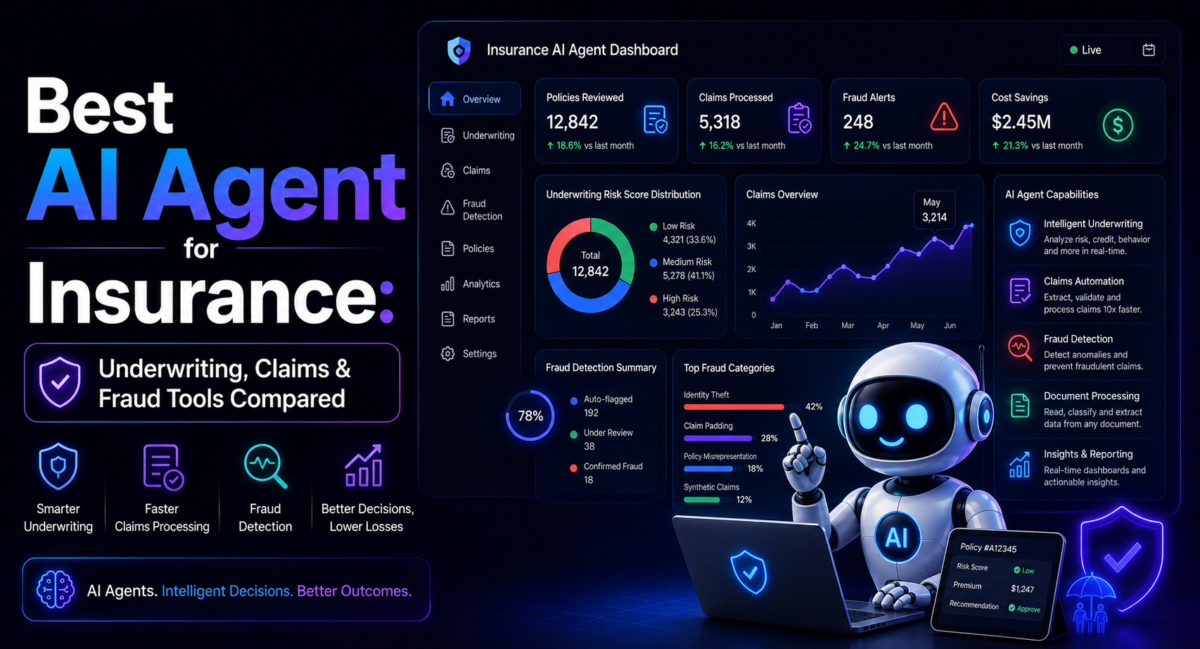
| Quick answer: There is no single best AI agent for insurance — the category splits by function. In 2026 the leaders are Shift Technology (fraud), Tractable (visual claims), Cytora and Federato (underwriting), Kognitos (end-to-end claims) and service platforms like Zowie. Match the specialist to your biggest bottleneck and integrate it with your core systems. |

What is an AI agent for insurance? It is software that autonomously handles a defined stage of the insurance value chain — intake, underwriting, claims triage, fraud scoring or customer service — using machine learning, computer vision and language models to decide and act with limited human input. Unlike a passive chatbot, an agent completes multi-step work, a distinction we unpack in AI agent versus AI assistant.
Table of Contents
How we compare
TechieHub evaluates insurance AI tools independently against four criteria: the specific value-chain function each one solves, its documented customer outcomes, how deeply it integrates with core and agency systems, and its compliance and auditability posture. We prioritize vendors with named enterprise deployments over marketing claims, and we verify facts against official product pages and reputable industry reporting.
Affiliate disclosure: some outbound links may be affiliate or partner links. This never changes our rankings, and we earn nothing from the vendors evaluated here. This article is informational and is not insurance, legal or financial advice — confirm pricing and compliance on each vendor’s official page.
Why insurance needs specialist agents, not one platform
Insurance is not one workflow but many. A fraud engine, a photo-appraisal model and an underwriting-submission platform solve genuinely different problems, so the strongest stacks combine specialists rather than betting on a single “do-everything” suite. This mirrors a broader pattern in agentic AI applications: the biggest wins come from narrow agents pointed at repetitive, rule-bound, high-volume tasks. The through-line across every deployment below is that AI augments underwriters and adjusters — it does not replace the judgment that regulation and good practice require.
There is a second reason specialists win: insurance data is messy, fragmented and heavily regulated. A commercial-submission platform must parse broker emails, loss runs and ACORD forms; a visual-appraisal model must reason about crumpled sheet metal from a phone photo; a fraud engine must connect entities across years of claims history. No single architecture is optimal for all three. Buyers who accept that reality — and who sequence adoption one bottleneck at a time — consistently outperform those chasing a monolithic “insurance AI” that promises everything and masters nothing.
The best AI agent for insurance, by function
Here are the leaders in 2026, each strongest in a different part of the chain.
| Function | Tool | What it does | Buyer |
|---|---|---|---|
| Fraud detection | Shift Technology | Fraud signals and anomaly detection across claims at portfolio scale | SIU and claims leadership |
| Visual claims | Tractable | Real-time damage assessment from photographs | Auto and property claims |
| Underwriting intake | Cytora | Digitises and triages commercial submissions on arrival | Commercial underwriting |
| Risk selection | Federato | Portfolio-aware guidance on which risks to write | Underwriting strategy |
| End-to-end claims | Kognitos | Auditable automation with traceable, deterministic steps | Regulated claims workflows |
| Front office | Zowie, EZLynx | Customer service and agency management | Agencies and service teams |
Shift Technology — fraud detection and claims signals
Shift remains the reference platform for AI fraud detection in property and casualty. Its models map the “social networks” of related entities across a carrier’s full data set, extract the most suspicious sub-networks, and deliver scored, prioritized alerts to claims handlers and SIU investigators. Its credibility was reinforced in 2026 when AXA extended its partnership with Shift for a further five years across claims, fraud and underwriting. Shift focuses on detection and investigative routing, so it pairs with an adjudication engine rather than running claims end to end.
Tractable — real-time visual damage assessment
Tractable is the industry standard for smartphone-based damage appraisal in auto and property. Policyholders photograph the damage, and Tractable’s computer vision classifies it, applies certainty scores and generates repair estimates in seconds. The company reports reviewing damage photos at roughly 95% accuracy and cutting estimate review from about 30 minutes to seconds; at Admiral Seguros, 70–75% of customers sent its web-app link complete their claim digitally. Tractable counts 25 of the world’s top 100 insurers as customers. See tractable.ai.
Cytora — commercial underwriting submissions
Cytora leads the front of the underwriting funnel: ingesting submissions in any format, extracting and structuring risk data, scoring against appetite and routing decision-ready risk into core systems. In March 2026 it launched Cytora Autopilot, an agentic capability that runs end-to-end risk workflows autonomously, and Zurich Insurance completed a 90-day rollout across five countries with plans to expand to more than 20 markets. Best for submission-heavy commercial and specialty lines.
Federato — portfolio-aware risk selection
Federato’s RiskOps platform gives underwriters a unified workbench, embeds real-time appetite guardrails and steers the whole book toward strategic targets. Investor confidence is notable: Federato has raised more than $180 million in total, including a $100 million Series D led by Goldman Sachs Alternatives in late 2025. Choose it when the goal is portfolio-level risk selection rather than a single workflow step.
Kognitos — auditable end-to-end claims
Kognitos orchestrates claims with neurosymbolic AI and an English-as-code interface, producing deterministic, traceable adjudication with full straight-through processing and strong compliance alignment, including the EU AI Act. It is the pick for insurers that want end-to-end automation without the hallucination and audit risks of purely generative systems.
Zowie, EZLynx and agency tools — the front office
On the service and agency layer, Zowie automates policyholder support across direct and broker channels, EZLynx remains the standard for independent agents comparing carrier rates instantly, and document tools like Chisel AI accelerate policy and regulatory analysis.

Where does AI deliver the most value in insurance?
The returns concentrate in a few areas. In claims, AI can automate up to 90% of simple cases — FNOL intake, coverage validation, document extraction and real-time fraud scoring. Carriers using AI claims automation report resolving claims about 75% faster with 30–40% lower cost per claim (roughly $40–60 down to $25–36), according to Deloitte’s 2025 financial-services AI outlook, which cites 20–35% operational cost reduction and 50% faster cycles within 12–18 months. Straight-through-processing rates have climbed from 10–15% to 70–90% on suitable workflows.
In underwriting, the payoff is better risk selection and faster decisions as intake tools remove manual triage. On the agency side, speed compounds: fast responders close far more business. What unites every high-value use case is that the work is repetitive, rule-bound and high in volume — exactly where automation is safe and savings are measurable — while pricing complex risk and adjudicating contested claims stays with experienced professionals.
Customer service is the fourth arena. Insurance chatbots and voice agents now resolve routine policy questions, first-notice-of-loss reporting and status checks around the clock, and industry analysts project billions in annual savings from automating these interactions. The strategic value is not only cost: fast, consistent responses raise retention, and every logged interaction feeds cleaner data back into the claims and fraud models upstream. The lesson repeated across all four arenas is that value scales with volume and repetition, so the smartest first deployment is wherever your team is drowning in identical, low-judgment tasks today.

AI insurance agents in practice
Consider Milena Popescu, a claims operations lead at a mid-size auto insurer handling a surge in minor-collision FNOL claims. Her team was drowning in month-long settlement cycles. She deploys Tractable for photo-based damage triage at first notice of loss and layers Shift Technology to score each claim for fraud signals before payment. Straightforward, low-fraud-risk claims now flow to same-day estimates, while flagged and complex cases route to human adjusters. The illustrative result: routine claims that once took weeks resolve in a day, adjusters spend their time on genuinely contested files, and every automated decision carries an audit trail. Milena did not replace her team — she pointed narrow agents at the highest-volume, lowest-judgment work and kept people on the decisions that matter.
How to choose the best AI agent for your insurance function
Start with your function and bottleneck, then map the specialist to it:
- Fraud: Shift Technology.
- Visual claims: Tractable.
- Commercial underwriting submissions: Cytora.
- Portfolio-aware risk selection: Federato.
- End-to-end auditable claims: Kognitos.
- Service and multi-carrier quoting: Zowie or EZLynx.
Then weigh practical fit. Integration is the single most important factor — favor insurance-specific tools that connect to your existing agency-management or core systems, and wrap new AI around legacy databases with middleware rather than ripping everything out. Confirm security and certifications given the sensitive data involved, and treat deployment as ongoing tuning, not set-and-forget. Building a bespoke workflow on top of these tools follows the wider pattern in our best AI agent pillar and the fundamentals in what is agentic AI.
Fairness, oversight and compliance
Insurance is heavily regulated, so a few principles are non-negotiable. Keep humans in consequential decisions: AI excels at intake, extraction, fraud signals and routine claims, but underwriting declines, coverage determinations and claim denials affect people’s lives and should be owned by qualified professionals. Guard against bias by training on clean, representative data and testing for unfair outcomes, since models trained on historical data can replicate discrimination. Maintain auditability, favoring deterministic, traceable tools. And treat compliance as mandatory — sensitive personal, health and financial data is governed by GDPR, CCPA, HIPAA and state insurance rules, so require SOC 2 Type II, encryption, role-based access, audit trails and data-residency controls, and confirm alignment with frameworks like the EU AI Act before any tool touches live data.
Governance is also a competitive advantage, not just a cost. Insurers that document their model inputs, decision logic and human-review checkpoints move faster through regulatory approval, respond more credibly to complaints and market-conduct exams, and build the customer trust that sustains renewals. Treat every agent as a member of the team that must show its work: log its decisions, review its edge cases, retrain it on fresh data, and retire or override it when performance drifts. Handled this way — AI for the repetitive load, professionals for judgment, with fairness and auditability baked in from day one — insurance AI agents deliver faster claims and sharper underwriting without sacrificing the trust the business runs on.
Frequently Asked Questions
What is the best AI agent for insurance?
It depends on your function. Shift Technology leads fraud detection, Tractable owns visual claims, Cytora is best for commercial underwriting submissions, Federato leads portfolio-aware risk selection, and Kognitos offers auditable end-to-end claims. Most insurers layer several specialists matched to their biggest bottlenecks rather than relying on one platform.
Can AI replace insurance agents or underwriters?
No. AI augments professionals rather than replacing them, automating intake, document processing, fraud signals and routine claims. Underwriting declines, coverage determinations and claim denials carry legal and ethical weight, so qualified humans should review and own those consequential decisions while AI handles the high-volume, repetitive work.
How much can AI improve claims processing?
Substantially. AI can automate up to 90% of simple claims, typically cutting cost per claim 30-40% and resolution time by around 75%, with straight-through-processing rates reaching 70-90% on suitable workflows. Deloitte reports most organizations see ROI within 12-18 months, though complex claims still need human adjusters.
Is AI underwriting fair and compliant?
It can be, but only with deliberate controls. Models trained on historical data can replicate discrimination, so train on clean, representative data and test for bias. Underwriting is regulated and drawing regulator scrutiny, so comply with anti-discrimination, state insurance and privacy rules, keep humans reviewing consequential decisions, and favor auditable tools.
How does AI detect insurance fraud?
Tools like Shift Technology analyze patterns across claims data, map the networks of related entities and flag suspicious sub-networks with scored alerts before payment. Customer-service AI adds consistent identity verification and audit trails. Insurers typically layer a dedicated fraud engine alongside claims and service systems rather than relying on one general platform.
Do insurance AI tools integrate with existing systems?
The best ones do, and integration is the most important selection factor. Choose insurance-specific tools that connect to your agency-management or core platforms rather than generic AI. You need not replace everything at once; middleware can wrap new AI around legacy databases. Always confirm integration depth and test with real data first.
What do insurance regulators require for AI use?
In the US the reference point is the NAIC Model Bulletin on the Use of Artificial Intelligence Systems by Insurers, adopted in late 2023 and since taken up by most states. It does not ban anything. It expects insurers to run a documented AI systems programme — written governance, risk controls proportionate to the decision’s impact, and oversight of third-party models you did not build — and to produce that documentation on request during a market conduct exam.
Two consequences matter when choosing a vendor. First, buying a model does not outsource the obligation: the regulator examines the insurer, so vendor due diligence and your own testing records are part of your programme. Second, some states go further for specific lines — Colorado’s insurance AI law requires quantitative testing for unfair discrimination where external consumer data feeds life underwriting. Ask vendors what they will hand over for an exam before you sign, because a tool that cannot explain a declination is a compliance liability whatever it does for your loss ratio.
Conclusion
Nobody buys “insurance AI” — they buy fraud detection, or claims triage, or submission intake. So start from the function that is costing you most, shortlist the two specialists that own it, and accept that a strong stack here is several tools rather than one platform stretched across underwriting, claims and service.
The deciding factor between finalists is rarely raw accuracy. It is whether the tool can explain a decision to someone who is entitled to an explanation — a regulator on a market conduct exam, or a policyholder whose claim was declined. Weight auditability and traceable logic accordingly, and pilot on a bounded workflow with real historical claims before it touches live decisions. See AI agents for cross-border loan servicing for the same high-risk classification questions in lending.
