


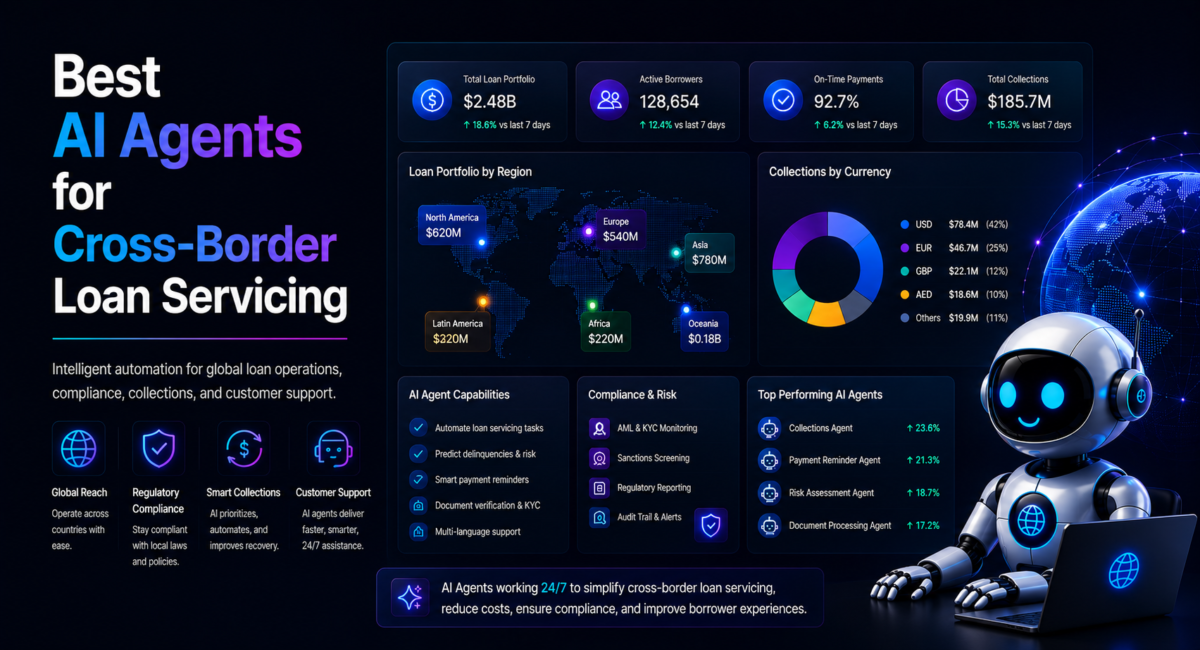

A loan book stops being one book the moment it crosses a border. It becomes a currency problem, a jurisdiction problem, a language problem and a calendar problem at once, each with a different regulator attached. AI agents for cross-border loan servicing are software agents that plan and execute multi-step servicing tasks — payment posting and reconciliation, KYC and AML re-screening, document extraction, borrower outreach and delinquency workflows — across more than one currency and more than one legal jurisdiction, under recorded human oversight. They are not underwriting robots. In the European Union, the moment one scores a person’s creditworthiness it lands in a category the law names explicitly.
Disclosure: TechieHub may earn a commission from some vendor links on this page. Commissions never influence which platforms we include or how we rank them.
| Quick answer: No single AI agent services a cross-border loan book end to end in 2026. Lenders assemble a stack: a servicing core with an agent gateway, a borrower-communication layer, and cross-border payout rails. Creditworthiness scoring of a natural person remains a high-risk use under the EU AI Act and requires documented human oversight. |
Table of Contents
What actually breaks when a loan book crosses a border?
Four things break, and they break in a predictable order.
Reconciliation breaks first
A payment leaves in one currency and arrives in another, minus correspondent-bank deductions nobody itemised in advance, with the remittance reference truncated somewhere in transit. It lands as an unapplied cash item. This is the largest source of manual servicing work in a multi-currency book and the task most amenable to automation — an agent reads the incoming message, matches it against expected instalments across an FX tolerance band, then posts or escalates. The matching discipline behind AI agents used for finance and accounting reconciliation applies here, except the tolerance band is a rate rather than a rounding error.
Message quality is about to move in the servicer’s favour. Swift has confirmed that from 14 November 2026, unstructured postal addresses will no longer be accepted in CBPR+ cross-border payment messages; town and country must appear in designated structured fields. Machine-parsable payment data is what a matching agent needs.
Compliance breaks second
A borrower who moves, or a beneficial owner who changes, triggers re-screening in every jurisdiction the loan touches, and sanctions lists update daily. Data-residency rules may forbid the servicing record from leaving the country it was created in, which constrains where an agent’s inference can physically run — a design question, not a procurement one.
Communication breaks third
Collections outreach that is legal at 8pm in one market is a violation in another, and a translated script is not a compliant script. Language coverage and regulatory coverage are separate capabilities, and vendors routinely market the first as the second.
Documents break last
Insurance certificates, security registrations and financial statements arrive in different formats, languages and accounting standards, and an extraction agent trained on one market’s templates degrades quietly on another’s.
Which AI agents for cross-border loan servicing lead in 2026?
There is no single product. The honest 2026 answer is a stack — servicing core, communication, money movement, compliance — with agents embedded at different maturity levels in each layer.

| Platform | Layer | Status and cross-border reality check |
| LoanPro AI Gateway (MCP) | Servicing and collections execution | Announced 28 October 2025 as a model-agnostic gateway. Guardrails are tested programmatically before an action executes, with a full audit trail across human and AI actions. Currency and jurisdiction logic is the lender’s to configure. |
| nCino Digital Partners | Origination through post-close servicing | Four role-based agents (Client, Analyst, Processor, Service), published April 2026. Strongest inside institutions already on nCino. |
| Finastra Mortgagebot agentic assistant | Origination and document handling | Announced March 2026 with a stated year-end 2026 launch target. Not generally available at the time of writing — treat claims as forward-looking. |
| Sagent Dara | Mortgage servicing workflow | Vendor-reported agentic workflow automation with auditability. US mortgage servicing focus rather than multi-jurisdiction lending. |
| Salesforce Agentforce for Financial Services | Borrower communication and collections | Vendor-reported prebuilt collections and digital loan officer agents. Inherits whatever multi-currency structure the CRM already holds. |
| Thunes, Nium, Wise Platform | Payout rails and FX | Vendor-reported corridor coverage and payout lifecycle tracking. These are the rails an agent instructs; none of them services the loan. |
Read that table as an assembly diagram, not a leaderboard. A servicing agent that cannot instruct a payout rail is a chatbot; a payout rail with no servicing context is a wire.
Which providers lead cross-border loan servicing with AI agents?
Direct answer: no single provider services a cross-border loan book end to end in 2026. The leaders are layer-specific: LoanPro for agent-executed servicing and collections through its model-agnostic AI Gateway, nCino for institutions already running its origination-to-servicing platform, Salesforce Agentforce for Financial Services for borrower communication and collections, and Thunes, Nium and Wise Platform for the payout and FX rails an agent instructs. Sagent leads in US mortgage servicing specifically, and Finastra has announced but not generally released its agentic assistant. Anyone claiming a single-provider answer is describing one layer and ignoring the other three.
How to choose a provider for each layer
The selection question differs by layer, which is why “who is best” has no single answer. For the servicing core, the deciding factor is whether agent actions pass through tested guardrails with an audit trail covering both human and AI actors — LoanPro’s gateway was built around exactly that, and it is the question to put to any competing provider. For borrower communication, the constraint is whatever multi-currency and multi-jurisdiction structure your CRM already holds, because the agent inherits it rather than fixing it. For money movement, corridor coverage and payout lifecycle visibility matter more than the agent layer on top. For compliance, the provider question is subordinate to your own oversight design, since the obligations under the EU AI Act sit with the deployer, not the vendor.
Which provider claims are worth verifying before you shortlist
Much of what circulates in this category is forward-looking. Finastra’s Mortgagebot agentic assistant was announced in March 2026 with a year-end target and was not generally available at the time of writing. Several capabilities across the table are vendor-reported rather than independently verified. Three questions separate a real deployment from a roadmap: can the provider name a live cross-border customer in your corridor, will they demonstrate the audit trail an examiner would ask for, and does currency and jurisdiction logic ship configured or is it left for you to build. The third question is where most cross-border projects overrun.
Where does the EU AI Act classify a servicing agent as high-risk?
At one specific point. Annex III, point 5(b) of the EU AI Act classifies as high-risk “AI systems intended to be used to evaluate the creditworthiness of natural persons or establish their credit score, with the exception of AI systems used for the purpose of detecting financial fraud.”
Three consequences follow from that wording. The trigger is creditworthiness evaluation of a natural person, so a re-underwriting agent or hardship-eligibility scorer is in scope while a pure cash-application agent generally is not. Fraud detection is carved out. Corporate borrowers sit outside point 5(b), which is why the boundary matters most in consumer and sole-trader books.

Timing has moved. The European Commission’s regulatory framework for AI confirms the Act became applicable on 2 August 2026, but the Digital Omnibus amendments deferred most obligations for standalone Annex III high-risk systems to 2 December 2027, and to 2 August 2028 for AI embedded in regulated products. That is breathing room, not an exemption — and Article 86 gives an affected person the right to a clear and meaningful explanation of the role an AI system played in a decision that adversely affects them. Penalties outside the prohibited-practices article reach €15 million or 3% of worldwide annual turnover, whichever is higher.
What human oversight does a regulated servicing agent need?
Article 14 of the EU AI Act requires high-risk systems to be designed so they “can be effectively overseen by natural persons.” In practice the named human must be able to understand the system’s capacities and limitations, stay alert to automation bias, correctly interpret its output, decide not to use it or to “disregard, override or reverse” that output, and interrupt operation through a stop mechanism. A dashboard that only displays what the agent already did does not satisfy this.
United States obligations run on a separate track and did not soften. The Consumer Financial Protection Bureau withdrew Circulars 2022-03 and 2023-03 in May 2025 in a broad guidance rollback, but withdrawing guidance does not amend a regulation: the Equal Credit Opportunity Act and Regulation B at 12 CFR 1002.9 still require a statement of the specific principal reasons for adverse action. A credit-related agent whose reasoning cannot be reduced to specific, accurate adverse-action reasons is unusable in a US consumer book however well it performs. Model risk governance — independent validation, ongoing monitoring, outcomes analysis — applies as it would to any other credit model, and the same explainability discipline appears in adjacent regulated domains such as AI agents used in insurance underwriting and AI agents used for legal document review.
What does multi-state compliance add in the United States?
Direct answer: in the US the binding constraint is usually licensing rather than AI regulation. Consumer loan servicing generally requires a licence in each state where borrowers reside, administered through the Nationwide Multistate Licensing System, with requirements varying by state and by loan type. Commercial lending faces a materially lighter surface than consumer lending. An AI agent does not change who must be licensed — but it does change how easily you can prove what the agent did in each state, which is what examinations turn on.
Three practical consequences for anyone deploying agents across a multi-state book. First, disclosure and communication rules differ by state, so a borrower-communication agent needs state-aware templates rather than one global script — this is the most common source of unintended violations. Second, collections practice is state-regulated, covering permitted contact hours, frequency and language, which means an autonomous collections agent needs those constraints encoded rather than inferred. Third, examination readiness is per-state, so the audit trail must be filterable by jurisdiction, not merely complete.
Combining a multi-state US book with cross-border exposure produces overlapping regimes rather than a single one: state licensing and consumer protection rules on one side, and where an EU borrower or EU-established deployer is involved, the EU AI Act obligations described below on the other. Neither substitutes for the other, and the honest position is that this is a question for licensed counsel in each jurisdiction rather than a vendor comparison.
Can credit decisioning run in real time across borders?
Direct answer: technically yes, and legally only with human oversight built in. Real-time credit decisioning — scoring an applicant and returning a decision in seconds rather than days — is mature technology, and decisioning engines routinely deliver it. The constraint is regulatory: evaluating the creditworthiness of a natural person is classified as high-risk under Annex III, point 5(b) of the EU AI Act, which means documented human oversight under Article 14. Real time and fully autonomous are not the same thing, and conflating them is the most common design error in this category.
Cross-border adds three problems real-time decisioning handles badly. Data availability is asymmetric — a thin-file applicant in one market may be well-documented in another, and a model trained on one bureau’s data degrades quietly when applied elsewhere. Identity and sanctions screening are not instant everywhere, so the honest architecture returns a provisional decision in real time and a confirmed one after screening completes. Explainability obligations differ by jurisdiction, and a decision you cannot explain in the borrower’s market is a decision you cannot defend there.
The workable pattern most cross-border lenders converge on: automate the clear approvals and clear declines in real time, route the ambiguous middle to a human with the model’s reasoning attached, and keep the reviewer’s override authority genuine rather than nominal. Oversight that cannot in practice change the outcome does not satisfy Article 14.
How we compared these platforms
We verified product existence, announcement dates and stated capabilities against primary sources: vendor newsrooms and official product pages, the AI Act text, the European Commission and Swift. Regulatory claims were checked against the instrument itself rather than secondary summaries, which is how we caught the Digital Omnibus deferral and the CFPB circular withdrawals.
What we could not verify: pricing, corridor-level performance, per-language compliance coverage, and any accuracy or straight-through-processing percentage. No audited figures are published for these, and we have not run the platforms against a controlled cross-border book. Capabilities appearing only in vendor materials are labelled vendor-reported.
Use case: servicing a euro-denominated SME book from Singapore
Wei Lin Tan is an illustrative composite persona, not a real customer. She heads servicing operations for a specialty lender with a Singapore hub and a €400 million book across Germany, Poland and Ireland.
The task: her team of eleven clears roughly 900 unapplied cash items a month, mostly from truncated remittance references and FX rounding on partial payments. The backlog peaks while Europe sleeps, so by the time a European analyst opens an exception the borrower has already called.
What she deployed: a matching agent on the servicing core with a defined FX tolerance band, permitted to post inside that band and required to escalate outside it. A separate outreach agent drafts correspondence in German, Polish and English; every draft touching a delinquent account is released by a named human. Creditworthiness re-assessment was deliberately excluded from agent scope.
The outcome: the exception queue is worked continuously rather than in an overnight batch, and analysts spend their time on genuinely ambiguous items. The gain came from closing a time-zone gap, not from replacing judgement.
Frequently Asked Questions
Can an AI agent approve a loan modification on its own?
Technically yes, legally it depends. If the modification decision evaluates a natural person’s creditworthiness, it falls under EU AI Act Annex III point 5(b) as high-risk and requires human oversight capable of overriding the output. In US consumer lending, any adverse outcome still needs specific principal reasons.
Does the EU AI Act ban AI in loan servicing?
No. The Act classifies AI that evaluates creditworthiness of natural persons or establishes their credit score as high-risk, which means obligations rather than prohibition. Payment reconciliation, document extraction and general borrower communication are not high-risk on that basis, and fraud detection is explicitly carved out.
Which AI agent handles multi-currency reconciliation best?
No independent benchmark exists for cross-border reconciliation accuracy. LoanPro’s AI Gateway and nCino’s Digital Partners are the two servicing-core options with verifiable agent execution and audit trails as of mid-2026. Matching quality depends far more on your payment data quality than on vendor choice.
What does data residency mean for a servicing agent?
It constrains where inference can physically run. If a jurisdiction requires borrower records to stay onshore, the agent must call a model hosted in that region or operate on de-identified data. This is an architecture decision made before procurement, not a configuration toggle afterwards.
Do collections agents work across languages and time zones?
They generate multilingual outreach reliably. They do not automatically encode each jurisdiction’s contact-time windows, frequency caps and disclosure requirements. Treat language coverage and regulatory coverage as two separate procurement questions, and require the vendor to show the rules engine, not just the translation.
What audit trail should a servicing agent produce?
At minimum: the input data, model and version used, the action taken or recommended, the guardrail checks that ran beforehand, and the human who approved or overrode it. Without a per-action record, explaining a decision to a regulator months later is impossible.
Who leads cross-border automated communications for lending platforms?
Salesforce Agentforce for Financial Services is the most widely deployed option for borrower communication and collections, largely because it inherits customer context from a CRM lenders already run. The important qualification is that it inherits the CRM’s structure including its weaknesses — if multi-currency and multi-jurisdiction data is not modelled cleanly in the CRM, the agent will surface that inconsistency to borrowers rather than resolve it. Specialist collections communication vendors compete on language coverage and contact-rule handling, which matters more than raw AI capability once a book spans time zones and regulatory regimes.
How does ISO 20022 affect cross-border loan servicing?
ISO 20022 is the structured message standard replacing free-text fields in cross-border payments, and it materially improves automated reconciliation. Swift has confirmed that from 14 November 2026 unstructured postal addresses will no longer be accepted in CBPR+ messages. For a servicing agent this is good news: structured remittance data means an incoming payment carries machine-readable references, so matching against expected instalments stops depending on parsing a truncated free-text field. Lenders whose reconciliation logic assumes unstructured input should treat that date as a migration deadline rather than a detail.
Should you buy one provider or assemble a stack?
Assemble, in almost every case, because no provider currently spans servicing core, communication, money movement and compliance with equal credibility. The realistic decision is which layer you standardise on first and which you treat as replaceable. Most lenders anchor on the servicing core, because migrating it is the hardest, and keep payout rails deliberately swappable since corridor economics change. The integration cost of an assembled stack is real, but it is smaller than the cost of a single-provider commitment in a layer where that provider is weakest.
Conclusion
The realistic 2026 position is that AI agents clear operational friction in cross-border loan servicing — reconciliation exceptions, document intake, multilingual outreach, screening refresh — while credit judgement about a natural person stays under named human control by law. Buy for the layer you actually need, insist on a per-action audit trail, and keep the creditworthiness boundary bright. If you are still mapping the wider landscape, our guide to the best AI agent platforms covers the general-purpose tooling these vertical systems are built on.
This article is for general information only. It is not financial, legal, tax or regulatory advice, and it does not create any advisory relationship. Regulatory requirements vary by jurisdiction and change frequently. Consult qualified legal and compliance counsel licensed in the relevant jurisdictions before deploying any AI system in a lending or servicing workflow.

4 Comments
Pingback: 15 Best Agentic AI Tools & Platforms for Autonomous Agents 2026
wish you best and best
AI xeberleri iqtisadi xeberler
Thank you for taking the time to share your thoughts! We truly appreciate the support and are glad you found value here. Stay connected—there’s more helpful content coming your way.