

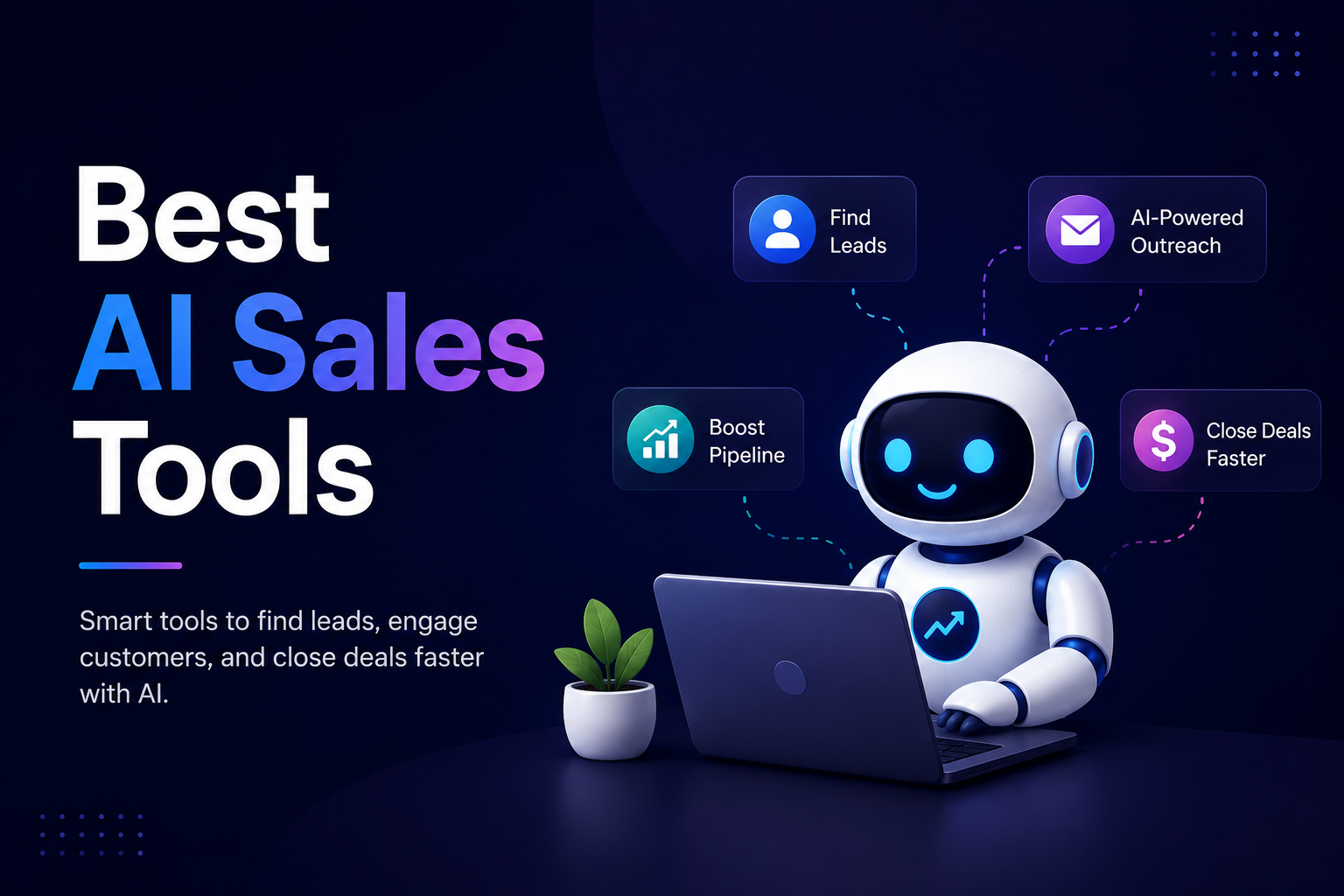
Sales software spent 2025 selling a story about autonomy and spent 2026 quietly walking it back. The tools that earned their renewal this year were not the ones promising to replace a sales development rep. They were the unglamorous ones that fixed data quality, tightened sequencing, and turned recorded calls into coaching. That gap between pitch and payback is where software budgets leak. What follows sorts the category by the job each product genuinely owns, prices it against current rate cards, and names the purchases teams most often regret.
| Quick answer: The strongest 2026 picks are Apollo or Clay for prospecting data, Outreach or Salesloft for sequencing, Lavender for email quality, and Gong or Clari for call and forecast intelligence. Buy one tool per job, fix your weakest link first, and treat fully autonomous AI SDR agents as an experiment rather than a headcount replacement. |
How we compare: We price every tool from its public rate card, or from consistent buyer-reported 2026 ranges where pricing is quote-only, and we rank by the job a product owns rather than by feature count. We accept no payment for placement.
Affiliate disclosure: some links on this page may earn TechieHub a commission at no extra cost to you. This never affects which tools we recommend or how we rank them.

Table of Contents
Why did the AI sales market reset in 2026?
Adoption is no longer the interesting question. Salesforce’s seventh-edition State of Sales report, drawn from 4,050 sales professionals, found that 87% of sales organizations now use AI somewhere in the cycle and 54% of sellers have worked with an agent. Nearly every team has bought something. The interesting question is which purchases survive a renewal.
Two figures explain the reset. Reps still spend roughly 60% of the week on non-selling work such as CRM hygiene, research and follow-up. That is better than the 72% number circulating in older buyer guides, but it remains the largest pool of recoverable time in any revenue org. Meanwhile Gartner expects more than 40% of agentic AI projects to be canceled by the end of 2027, mostly over unclear business value and escalating cost. Adoption went wide; value stayed narrow.
One quieter finding is worth holding onto. The productivity numbers vendors quote most often, a 34% cut in prospect research time and 36% off email drafting, are what sellers expect from fully implemented agents, not audited results. Treat them as a target to measure against, not a benchmark you have already hit. That distinction runs through the wider AI tools for business category too.
What are the best AI sales tools right now?
Seven products dominate serious 2026 shortlists, and each owns one job cleanly.
| Tool | Job it owns | 2026 entry price | Best for |
| Apollo | Contact data plus light sequencing | Free, then $49/user/mo annually | Teams wanting data and outreach in one place |
| Clay | Waterfall enrichment, research automation | Free, then from $167/mo | RevOps building custom lead lists |
| Outreach | Enterprise sequencing and execution | Quote only, roughly $100-$160/seat/mo | Outbound teams above 25 seats |
| Salesloft | Revenue orchestration and cadences | Quote only, roughly $75-$125/seat/mo | Mid-market alternative to Outreach |
| Lavender | Real-time email coaching | Free, then $29/mo | Reps sending 50+ cold emails daily |
| Gong | Call recording, analysis, coaching | Quote only, per seat plus platform fee | Managers coaching five or more reps |
| Clari | Forecasting and pipeline inspection | Quote only, roughly $100+/user/mo per module | Leaders whose forecast keeps missing |

On data, Apollo is still the best value entry point, with a contact database in the 210 to 230 million range plus enrichment and sequencing bundled, usable free before you commit. Clay solves a different problem: it orchestrates 150-plus providers in a waterfall so a lookup only falls through to expensive sources when cheap ones fail, and since its March 2026 pricing change it charges nothing for enrichments that return no result.
Apollo — best value entry for data and sequencing
Apollo is still the best value entry point, with a contact database in the 210 to 230 million range plus enrichment and sequencing bundled, usable free before you commit. Free, then $49 per user per month billed annually. It suits teams that want data and outreach in one place rather than stitching two vendors together — the trade-off is that specialists beat it on both halves individually.
Clay — best for waterfall enrichment and research automation
Clay solves a different problem: it orchestrates 150-plus providers in a waterfall so a lookup only falls through to expensive sources when cheap ones fail, and since its March 2026 pricing change it charges nothing for enrichments that return no result. Free, then from $167 a month. This is RevOps tooling — powerful for building custom lead lists, and genuinely hard to use well without someone who enjoys building the workflow.
Outreach — best for enterprise sequencing and execution
Outreach is the incumbent for large outbound teams, covering sequencing, task management and execution reporting at a depth smaller tools do not attempt. Pricing is quote-only and lands roughly between $100 and $160 per seat per month. It earns its cost above about 25 seats, where sequence governance and consistent execution across a large team start to matter more than per-seat price — below that, you are paying for coordination you do not need yet.
Salesloft — best mid-market alternative to Outreach
Salesloft covers the same revenue-orchestration ground at a lower typical price, roughly $75 to $125 per seat per month on quote. The honest distinction is less about features than fit: teams that find Outreach heavier than their process requires tend to land here. Evaluate both on the same live sequence rather than a feature matrix, because the differences show up in daily workflow rather than in capability lists.
Lavender — best for real-time email coaching
Lavender sits inside the inbox and scores emails as reps write them, which makes it the cheapest meaningful upgrade for a team whose problem is reply rate rather than volume. Free, then $29 a month. It pays back fastest for reps sending 50 or more cold emails daily — below that the coaching has too little volume to compound, and the fix is usually targeting rather than copy.
Gong — best for call recording, analysis and coaching
Gong remains the reference implementation for conversation intelligence, and the practical decision is usually between it and its closest rival — a matchup we break down in Gong vs Chorus. Pricing is quote-only, per seat plus a platform fee. It justifies itself when a manager is coaching five or more reps; with fewer, the recordings pile up unwatched and the spend is hard to defend.
Clari — best for forecasting and pipeline inspection
Clari sits a layer above the execution tools, converting activity into a forecast leadership can defend, at roughly $100 or more per user per month per module on quote. If a missed forecast is your actual pain, start with dedicated AI sales forecasting tools rather than buying a conversation platform and hoping the forecast improves as a side effect.
What do these tools really cost?
Headline seat prices understate the bill, and the three mechanisms that inflate it are predictable.
Platform fees.Gong states plainly that licenses are priced per user plus a platform fee scaled to the number of users supported. Buyer-reported figures put that fee between five and fifty thousand dollars a year, which lands hardest on small teams because it does not scale down. Salesloft carries a comparable charge. Budget it as a line item, not a rounding error.
Unbundling. Capabilities that shipped inside a base license two years ago are now separate modules, including forecasting and engagement at Gong and Copilot and Groove at Clari. A quoted seat price for the base product tells you very little about the configuration you actually need.
Credit consumption. Clay separates data credits from platform actions, and a five-provider waterfall consumes five lookups’ worth, not one. Apollo behaves similarly: the $49 annual seat is real, but heavy outbound teams routinely land far above it once credit top-ups are counted.
The cheapest layer is the one nobody sells you. Apollo’s free tier plus a $20 subscription to Claude Opus 5 or ChatGPT covers list building and first-draft emails for well under $25 a month, and it is the correct starting point below roughly five reps.
Are autonomous AI SDR agents worth buying yet?
This is the sharpest correction to make against guidance written even twelve months ago. The 2024 and 2025 pitch was that an AI SDR would run prospecting end to end, sourcing, writing, sending and booking, for a fraction of a human salary. Through 2026 buyers largely have not seen it. Teams that deployed these agents as headcount replacements have mostly reverted to hybrid setups where the agent researches and drafts while a human owns targeting, judgment and the reply.
The failure mode is rarely the model. It is deliverability and input quality. An agent that can send ten thousand emails a month against a mediocre list mostly produces ten thousand chances to burn a sending domain. Volume amplifies whatever strategy it is handed, including a bad one, and reply rates fall fastest for teams that scale first and think second.
That does not make the category worthless. Narrow agents handling inbound qualification, meeting scheduling, CRM enrichment or pre-call research briefs deliver reliably, because the task is bounded and failure is cheap. If you are evaluating this layer, scope it to one task and measure it in isolation. Our guide to the best AI agent for sales prospecting covers what to test before signing.
How did one 12-rep team rebuild its stack?
Danielle Moreau runs revenue at a 40-person compliance-software company with twelve reps. She is a composite of mid-market teams we speak with, but the shape of her problem is consistent. Pipeline coverage had slipped to 2.1x against a 3x target, and her stack had grown to six tools costing about $9,400 a month, including an AI SDR agent bought the previous year.
Her task was narrow: identify which layer was actually broken before renewing anything. She pulled 90 days of data and found reply rates were not the constraint, and connect-to-meeting conversion was fine. The constraint was list quality. Roughly a third of the contacts her team worked carried wrong titles or stale employers, so reps were personalizing carefully to the wrong people.
She cut the autonomous SDR agent, moved enrichment to a waterfall setup so bad records were caught before entering a sequence, kept call intelligence because manager coaching depended on it, and consolidated two overlapping sequencers into one. Net spend fell to roughly $6,800 a month. Within a quarter coverage recovered to 2.9x, not because she bought better AI, but because she stopped paying three tools to do one job badly.
How do you choose without over-buying?
Diagnose before you shop. Four rules hold up across almost every team we talk to.

Buy for your weakest link, not your loudest vendor. Thin pipeline is a data problem, poor win rates are a conversation problem, and a forecast that misses is an inspection problem. These need different purchases and are not interchangeable.
Let volume trigger the buy. Call intelligence pays back once a manager cannot listen to everything, realistically at five or more reps. Below that, listening yourself is cheaper and better.
Sequence purchases; never buy the whole stack at once. Fix one layer, prove payback over a quarter, then add the next. Teams that regret their spend almost always bought everything on day one.
Check the integration before the feature list. Over half of sales leaders using AI say disconnected systems are what slows their initiatives down. A tool that will not write cleanly back to your CRM creates the admin work you bought it to remove.
Frequently Asked Questions
What are the best AI sales tools for a small team?
Under five reps, Apollo’s free tier plus Lavender at $29 a month covers data, sequencing and email quality for very little, with a general assistant handling drafting. Skip call intelligence and forecasting platforms entirely until headcount and call volume justify their platform fees.
How much should I budget per rep?
Expect $100 to $250 per user monthly for an SMB stack and $300 to $600 for mid-market once sequencing and call intelligence are included. Enterprise configurations run higher. Add platform fees and credit overages, which commonly push real spend well above the quoted seat rate.
Does Gong replace Outreach?
No. Gong analyzes conversations that already happened, while Outreach schedules and sends the outreach that creates them. They sit at opposite ends of the cycle. Expecting either to cover the other’s job is the most common and most expensive mistake in sales tooling procurement.
Are AI SDR agents replacing human reps?
Not at meaningful scale. Most teams that bought them as replacements moved back to hybrid models where agents research and draft while humans own targeting and replies. Narrow agents handling inbound qualification or enrichment work well, but fully autonomous prospecting still disappoints on reply rates.
Which layer has the fastest payback?
Email coaching, typically. At roughly $29 to $69 per seat monthly it is the cheapest line in the stack, and it improves the asset every outbound team already sends daily. Data enrichment ranks second whenever list quality, rather than message quality, is the binding constraint.
Do I need a separate forecasting tool?
Only if the forecast is the thing that keeps missing. Many teams get adequate forecasting from their CRM plus a conversation-intelligence platform. Buy a dedicated forecasting product once pipeline inspection across multiple reps and stages has genuinely outgrown a spreadsheet review.
Conclusion
The 2026 market rewards restraint. Near-universal adoption means the edge no longer comes from having AI in your stack; it comes from having one right tool per job, integrated properly, with a payback you can point at during renewal. Start with the layer that is genuinely broken, prove it in a quarter, and add the next only when the first has earned it. That discipline, not the vendor roadmap, separates a stack that compounds from a line item nobody defends.

4 Comments
Pingback: Best AI Tools for Business to Scale Without Extra Staff
Pingback: Gong vs Chorus Comparison to Pick the Right One Fast
Guter Beitrag! Claude Fable 5 unter passt gut zu diesem Thema. Claude Fable 5
Pingback: Best AI Sales Forecasting Tools to Predict Revenue