


Disclosure: TechieHub may earn a commission if you sign up for a tool through links on this page. It never changes which tools we recommend or how we rank them.
A workflow automation platform is software that watches for an event in one app and automatically performs actions in others, with no integration code written by you. Zapier defined that category, and its official pricing page now advertises 9,000+ connected apps — the widest catalogue anyone offers. That reach is also why the invoice grows faster than the work: Zapier meters every task, so a team that doubles its customer count doubles its automation bill without shipping a single new workflow. This guide compares the platforms that fix that problem, and the newer ones solving a bigger one.
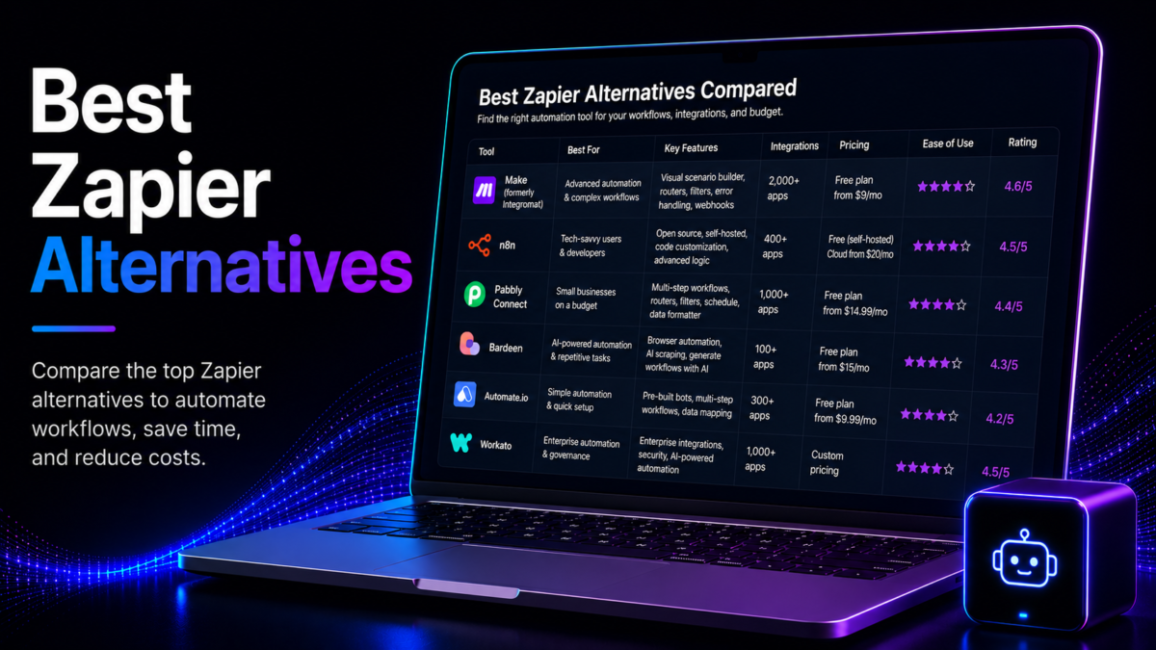
| Quick answer: The strongest Zapier alternatives in 2026 are Make (best overall, $9/month for 10,000 credits), n8n (best self-hosted, free to run yourself), Pabbly Connect (cheapest flat-rate), Activepieces (best open-source), Pipedream (best for developers) and Lindy (best AI-native). Pick by your reason for leaving: cost, data control, or AI capability. |

Table of Contents
Why do teams leave Zapier?
Four constraints account for almost every migration, and none is about reliability — Zapier is stable and easy to learn.
Per-task pricing. Zapier’s Professional plan starts at $29.99/month billed monthly, or $19.99/month billed annually, and that entry tier covers only 750 tasks. Each step in a multi-step Zap consumes a task, so cost scales with volume rather than with the number of automations you maintain.
A free tier that expires immediately. Zapier’s free plan allows 100 tasks per month. That is enough to test an idea and not enough to run one.
No self-hosting. Every Zap executes on Zapier’s infrastructure. Teams with data-residency, privacy or procurement requirements cannot keep records inside their own network, which rules the platform out before pricing is ever discussed.
The AI capability gap. Zapier has shipped AI agents and Model Context Protocol support, but its core model is still trigger-then-action. Newer platforms treat a large language model as the decision-maker inside the workflow, not a step within it — the shift we track across our guide to the best AI automation tools.
What are the best Zapier alternatives in 2026?
Six platforms cover the realistic decision space. Each is matched to a specific reason for switching.
Make — best overall
Make replaces Zapier’s linear step editor with a drag-and-drop scenario canvas that handles branching, iterators and error handlers natively. The Core plan is $9/month for 10,000 credits, Pro is $16/month and Teams is $29/month. One correction worth noting if you are reading older comparisons: Make renamed its billing unit from “operations” to credits in August 2025. The accounting is unchanged — one module call equals one credit — but the terminology in most guides is stale.
n8n — best self-hosted
n8n‘s Community Edition runs on your own server with unlimited workflows and executions, and it is one of the most-starred projects on GitHub with more than 198,000 stars. Its managed cloud starts at €20 (about $23)/month for 2,500 executions, with Pro at €50 (about $56)/month for 10,000. A second stale claim to correct: n8n is fair-code, not open source. It ships under the Sustainable Use License, which permits internal use and modification but not reselling n8n as a hosted service. For a node-by-node view of the trade-off, see our n8n vs Zapier comparison.
Pabbly Connect — cheapest managed option
Pabbly Connect’s Standard plan, last listed at $16/month in the US, covered 10,000 tasks a month when we read the page; it does not bill internal steps such as filters and routers, and sells multi-year and one-time lifetime plans that remove recurring cost entirely. The ecosystem is smaller and the builder less polished than Make’s, which is the honest trade.
Activepieces — best true open source
The Activepieces core is MIT-licensed and self-hosts cleanly, with enterprise directories held under a separate commercial licence. The cloud has a free plan with 1,000 credits a month, and the paid Plus plan is a flat $20/month for 10,000 credits and up to five users. It is easier to operate than n8n and has a smaller connector library.
Pipedream — best for developers
Pipedream mixes prebuilt connectors with arbitrary Node.js, Python, Go or Bash in a serverless runtime spanning roughly 3,000 apps. The free tier includes 100 credits a month and three active workflows.
Lindy — best AI-native
Lindy builds autonomous agents rather than linear flows: you describe the outcome and the agent decides which tools to call. Its Team plan starts at $49.99/month for 5,000 credits, billed per active user. The free plan is really a trial now: $50 of credits that expire after seven days. Relay.app ($27/month) and Gumloop are close competitors in the same category.
How do the leading options compare on cost?
How we compare: every price below was read directly from the vendor’s own pricing page, most recently on 10 October 2026, not from third-party roundups, and licence claims were checked against each project’s LICENSE file rather than its marketing copy. We compare entry paid tiers because that is where most switching teams actually land. Three exceptions that day: Pabbly showed us a localised, non-dollar price, and the Pipedream and Relay.app pricing pages did not load, so those three figures are last-known rather than freshly read.

| Platform | Best for | Entry price |
| Make | Most teams leaving on cost | $9/mo (10,000 credits) |
| n8n | Self-hosting and data control | Free self-hosted; €20 (about $23)/mo cloud |
| Pabbly Connect | Flat-rate and lifetime buyers | ~$16/mo last-known (10,000 tasks) |
| Activepieces | Open-source ownership | Free self-hosted; free cloud tier; $20/mo Plus |
| Pipedream | Developers writing code steps | Free tier (100 credits/mo) |
| Lindy | Autonomous AI agents | $49.99/mo |
| Zapier (baseline) | Widest app catalogue | $19.99/mo annual (750 tasks) |
Read that table by unit, not headline number. Make’s $9 buys 10,000 credits; Zapier’s $19.99 buys 750 tasks — roughly an order of magnitude in volume, and the gap widens as usage grows. Self-hosted n8n and Activepieces remove the software line item entirely, leaving a server bill of $5–$50/month — real money, but fixed rather than usage-linked. Larger deployments should also weigh governance features such as SSO and audit logs, which we cover in our roundup of the best AI workflow automation tools.
Which alternative wins for AI-driven automation?

Cost is the reason most teams start looking. Capability is usually the reason they stay away. Gartner forecasts that 40% of enterprise applications will include task-specific AI agents by the end of 2026, up from under 5% in 2025 — which reframes the question from “which tool moves my data” to “which tool can decide what to do with it”.
The plumbing for that shift standardised faster than most people expected. Anthropic donated the Model Context Protocol to the newly formed Agentic AI Foundation under the Linux Foundation in December 2025, giving agents a vendor-neutral way to discover and call tools. Zapier, Pipedream, n8n, Make and the agent-first platforms all now expose their catalogues through it.
Practically, that splits the field in two. If AI is one step inside a larger process — classify this ticket, summarise this transcript — n8n and Make both offer bring-your-own-key model nodes, so you can point a step at a frontier model such as Anthropic’s Claude Opus 5.5 and pay the model provider directly instead of paying an automation markup. Our walkthrough on using n8n with AI models covers that setup. If the AI is the workflow — reading an inbox, deciding which of nine actions applies, then executing it — Lindy, Relay.app and Gumloop are built for that shape and Zapier is not.
Real-world switch: a 40-client agency
An illustrative composite, not a client account: Bronwen Price runs a 12-person marketing agency in Bristol with about 40 retained clients. Each client onboarding fired the same eight-step Zap: intake form to CRM record, CRM record to project workspace, workspace to shared drive folder, then four notification steps. Eight tasks per onboarding, plus roughly 6,000 recurring reporting tasks a month across the client base.
Her Zapier bill had climbed past $200/month, and nothing about the workflows had changed — only the number of clients running through them. She rebuilt the onboarding scenario in Make over a weekend, keeping Zapier live in parallel for two weeks to confirm nothing silently failed.
The outcome: the same 6,000-plus monthly runs fit inside Make’s Core allowance at $9/month, and branching that had required three separate Zaps collapsed into one scenario with a router. The unexpected win was maintenance — one canvas to debug instead of three near-identical Zaps that had drifted out of sync. Her caveat: two niche connectors did not exist in Make, so those automations stayed on a Zapier free account.
This example is a composite of the agency migrations we see most often, not a single client account; the figures are typical rather than measured from one engagement.
How hard is it to migrate off Zapier?
There is no one-click importer between any of these platforms — distrust any guide that implies otherwise. What makes it manageable is that most Zaps are short: a ten-automation account is a few hours of rebuilding, not a project.
The sequence that works: inventory every live Zap and delete the dead ones first — most accounts carry 20–30% abandoned automations. Confirm your niche connectors exist on the target platform, since that is the only genuine blocker. Rebuild one representative workflow, run it in parallel with the Zapier version for a week, then move the rest in batches. Keep the Zapier free tier alive for anything with no equivalent connector.
Frequently Asked Questions
What is the best Zapier alternative in 2026?
Make is the best overall Zapier alternative for most teams, starting at $9/month for 10,000 credits with a visual canvas that handles branching natively. n8n is the strongest choice for self-hosting, Pabbly Connect for flat-rate budgets, Activepieces for open-source ownership and Lindy for AI agent workflows.
Is there a genuinely free alternative to Zapier?
Yes. n8n’s Community Edition and Activepieces both self-host at no licence cost with unlimited executions, so you pay only for a server. Make, Pipedream and Pabbly Connect also offer free managed tiers, all more usable than Zapier’s 100-task monthly free plan.
Is Make actually cheaper than Zapier?
For the same workload, yes, by a wide margin. Make’s $9/month Core plan includes 10,000 credits, while Zapier’s entry paid tier covers 750 tasks at $19.99/month billed annually. Because both meter per step, the gap grows as workflow volume increases rather than shrinking.
Can I self-host a Zapier alternative?
Yes. n8n and Activepieces both self-host via Docker with no licence fee, keeping every record inside your own infrastructure. n8n ships under the fair-code Sustainable Use License and Activepieces under MIT for its core. You take on updates, backups and monitoring in exchange.
Which Zapier alternative is best for AI agents?
Lindy leads for autonomous agents that decide which action to take, with Relay.app and Gumloop close behind. If you only need model steps inside a conventional workflow, n8n and Make both support bring-your-own-key AI nodes, which is cheaper than paying an automation platform’s AI markup.
How long does migrating from Zapier take?
Around ten automations typically takes a few hours of rebuilding, since no importer exists between platforms. Audit and delete dead Zaps first, verify your niche connectors exist on the target platform, then rebuild one workflow and run it in parallel for a week before moving the rest.
Will my apps actually be supported after switching?
This is the real switching risk, and the connector count is the wrong way to judge it. Zapier’s library is the largest by a wide margin, so any alternative will have fewer — but that only matters if the gap includes something you actually use. Do the specific test instead of the general one: list the five to ten apps your workflows genuinely touch, then check each against the alternative’s connector directory before you commit to anything.
Every platform here also has an escape hatch. A generic HTTP or webhook step means any app with a public API can be wired up manually, so a missing native connector is extra work rather than a blocker — perhaps an hour per integration, and one you have to maintain yourself when the API changes. The genuine dealbreaker is a niche SaaS tool with a native Zapier connector, no public API, and no equivalent elsewhere. That case is rare, but it is worth ten minutes of checking before you migrate forty workflows.
Conclusion
Zapier still wins on catalogue breadth and first-hour simplicity, and for a small team running a handful of automations it remains a defensible default. The moment your volume grows, though, its per-task meter turns growth into an expense, and that is what pushes teams to look elsewhere.
Match the tool to your actual reason for leaving. Choose Make if the bill is the problem, n8n or Activepieces if data control is, Pabbly Connect if you want a fixed number on the invoice, Pipedream if you would rather write a function than fight a connector, and Lindy if what you really need is an agent rather than a pipeline. Rebuild one workflow first, run it in parallel, and let the results decide the rest.
