


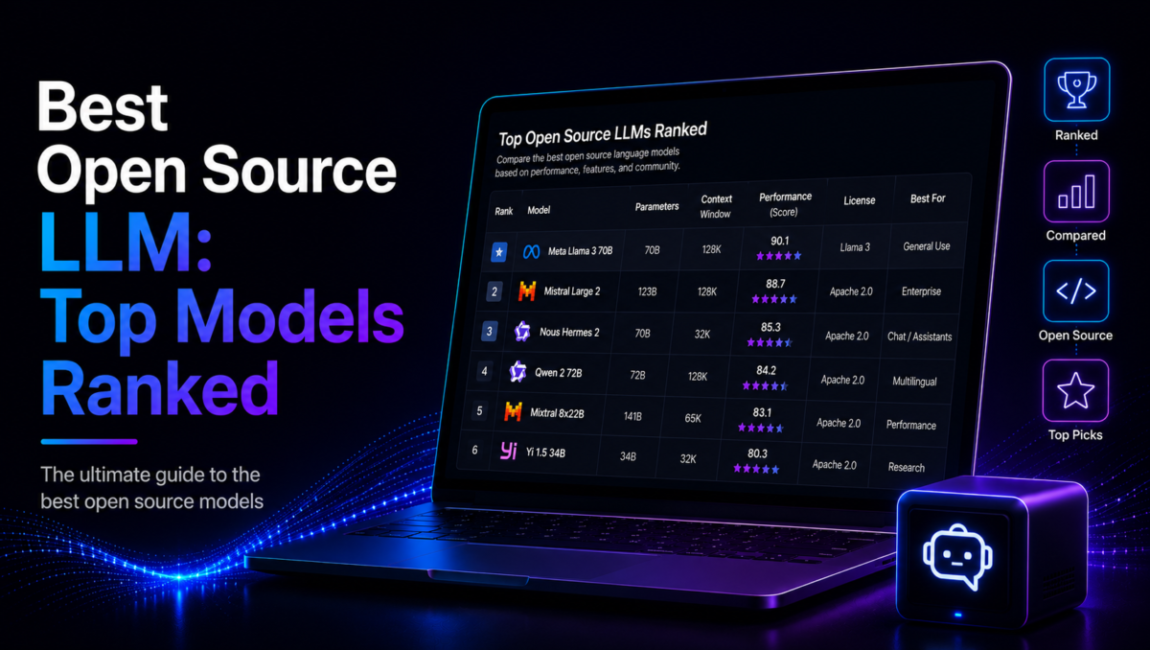
| Quick answer: The best open source LLM in 2026 depends on the job. Qwen is the strongest all-rounder and most multilingual, DeepSeek offers the best reasoning per dollar, GLM leads agentic coding, Llama has the widest ecosystem and Mistral the cleanest European licensing. On SWE-bench Verified the best open weights have effectively caught up; elsewhere they trail by roughly six to nine months. |
An open source LLM is a large language model whose weights are publicly released, so anyone can download, fine-tune and self-host it instead of renting it through a vendor’s API.

How we compare: TechieHub ranks these families by published benchmark results (SWE-bench Verified, GPQA Diamond, MATH-500), license terms read directly from each model card, and real deployment cost on commodity GPUs, then re-checks positions because the open-weight leaderboard genuinely moves that fast. Benchmark figures and licences on this page were re-verified against each model card and vendor pricing page on 3 October 2026.
Affiliate disclosure: some links on TechieHub may earn us a commission at no extra cost to you. Every model below is free, open-weight software; our rankings are based on independent testing, not partnerships.
Table of Contents
What counts as an open source LLM?
Two years ago, one American lab family dominated every leaderboard. In 2026 the map looks completely different: competitive open-weight flagships now ship from China, Europe, the United States, the UAE and beyond, and the distance between them and the closed frontier has collapsed to roughly six to nine months. For the everyday majority of production workloads, a well-chosen open model is genuinely competitive.
There is an important catch buried in the word “open,” though. Most models people call open source are technically open weight: you get the finished weights to run and fine-tune, but not necessarily the training data or code, and the license may attach conditions. In October 2024 the Open Source Initiative published its Open Source AI Definition (OSAID) v1.0, which requires access to training-data information, model architecture and training code before a model earns the “open source” label. By that strict bar, many household names fall short. If you are new to how model size shapes these trade-offs, our primer on what a small language model is is a useful companion.
How we ranked the best open source llm families
Rather than crown a single winner that will be stale in a month, it is more durable to rank by family strength in a given area. Here is the 2026 field.

Qwen (Alibaba) — best all-rounder
Qwen is the strongest general-purpose open family, pairing top-tier reasoning and coding with the broadest multilingual coverage of any open model. The line has moved twice since the Qwen3-Coder release that most comparisons still quote at 69.6% on SWE-bench Verified. Qwen3.6-27B is the one to look at now: a dense 27-billion-parameter model under Apache 2.0 that reports 77.2 on SWE-bench Verified with a 262,144-token native context extensible past a million, which means flagship-adjacent coding on a single high-end GPU rather than a multi-card rig. Qwen3-Coder-Next is the agent-tuned sibling at 80B total and 3B active, reported at 70.6 under the SWE-Agent scaffold. Apache 2.0 across the family keeps the licensing clean. That combination of breadth and clean licensing makes Qwen the safe default across workloads.
DeepSeek — best reasoning per dollar
DeepSeek delivers gold-medal-level math and step-by-step reasoning that rivals the closed frontier at a fraction of the cost. Its earlier R1 model hit a near-perfect 97.3% on MATH-500, and the line is now on V4: deepseek-flash (V4.1-Flash) and deepseek-v4-pro ship under the fully permissive MIT license, and the hosted API is the cheapest serious option anywhere at $0.15 in and $0.60 out per million tokens off-peak, doubling at peak, with v4-pro at $0.66 and $1.98. Distilled variants bring that reasoning down to consumer hardware, which is why DeepSeek is a favorite for math, logic and agentic coding.
GLM & Kimi — best agentic coding
The 2026 coding crown belongs to newer labs. Z.ai’s GLM-5.2, a 744-billion-parameter MoE, posts 91.2% on GPQA Diamond and 62.1% on the harder SWE-bench Pro at a fraction of frontier API pricing, while Moonshot AI’s Kimi now holds the highest reported open score of all: K2.6 is published at 80.2% on SWE-bench Verified and 58.6 on the harder SWE-bench Pro, K2.7-Code is the coding-tuned build on top of it, and K3 pushed the open tier into the 2.8-trillion-parameter class in July 2026 – far beyond what anyone self-hosts, but it sets the ceiling. Kimi remains the pick for long-horizon tasks where the model must plan, execute and iterate across hours rather than minutes. Both are strong picks for AI coding agents; see our deeper dive on the best AI model for coding.
Llama (Meta) — best ecosystem
Llama still wins on tooling, community support and integrations, with the widest ecosystem and countless fine-tunes, plus long-context variants reaching extraordinary window sizes. The catch is licensing: Llama ships under a custom Meta Community License, not a true open-source one, with a clause requiring a special license for companies above 700 million monthly active users.
Mistral — cleanest enterprise licensing
Mistral’s models, now shipping under Apache 2.0, are the go-to European option, attractive for data sovereignty and GDPR-conscious teams. Its Small model offers strong, low-latency performance on a single high-end GPU with function calling and configurable reasoning; see mistral.ai.
Gemma & Phi — best lightweight
Google’s Gemma (including tiny multimodal and function-calling variants) and Microsoft’s Phi (efficient reasoners that punch above their size) round out the field for edge, mobile and constrained hardware.
Which open source LLM is best for your use case?
Match the model to the job rather than the headline. A smaller model with excellent retrieval frequently beats a huge model with poor design, so the architecture around the model matters as much as the model itself.
| Use case | Top open picks |
| General / all-round | Qwen, Llama |
| Coding / agentic | GLM, Qwen3-Coder, DeepSeek, Kimi |
| Reasoning / math | DeepSeek, Gemma, Phi |
| Multilingual | Qwen, Mistral |
| Long context / RAG | Llama, DeepSeek |
| Edge / mobile | Gemma small, Phi-mini |
| Enterprise licensing | Mistral, Qwen (Apache 2.0), DeepSeek/GLM (MIT) |
If your work leans toward spreadsheets, dashboards and structured querying rather than freeform chat, the picture shifts again — our guide to the best LLM for data analysis covers which open models handle tabular reasoning and tool use most reliably.
Open source vs closed: how close is the gap really?

The headline story of 2026 is compression. In early 2025 proprietary models led on every benchmark; today open-weight flagships match the closed frontier from roughly two-thirds of a year earlier, and on specific tasks — coding, math, long context — the best open models match or exceed closed alternatives outright. Where closed frontier models still lead is the very hardest reasoning and the newest capabilities, and they remain easier to consume because there is no infrastructure to run.
But the calculus has flipped for many teams. The open advantages — data sovereignty, cost control, customization and freedom from vendor lock-in — now come with only a modest capability trade-off. For regulated industries like healthcare, finance and defense, keeping data on your own infrastructure is a compliance requirement, not a preference, which is exactly why open weights have become so compelling. For the wider landscape, including closed options, see our pillar on the best AI models.
Open-weight models in practice
Consider Ayaka, a lead engineer at a mid-sized health-tech company bound by strict patient-data rules. Protected records cannot go to a third-party API, so a closed frontier model is off the table for the core workflow. Ayaka self-hosts Qwen3-Coder under its Apache 2.0 license on two data-center GPUs, wiring it into an internal coding agent that drafts and reviews pull requests against the company’s private repositories.
Because the weights never leave her infrastructure, compliance sign-off is straightforward, and because the license carries no per-token fee, her only recurring cost is the GPUs she already owns. When a newer Qwen version ships, she swaps it in without changing her serving stack — a far smaller migration than jumping model families. The result is a frontier-class coding assistant the security team fully controls, illustrating why so many regulated teams now start their model search with open weights.
This example is a composite of the open-weight deployments we see most often, not a single client account; the figures are typical rather than measured from one engagement.
Licensing: open weight is not the same as open source
For commercial deployment, the license matters as much as the benchmark. The most permissive terms are Apache 2.0 and MIT, which impose no usage restrictions and often include patent grants: Qwen and Mistral use Apache 2.0, while DeepSeek and GLM use MIT. Llama and Gemma ship under custom community licenses with some conditions, and a handful of research models carry non-commercial terms that prohibit paid use entirely. A slightly weaker model with a clean license can be the safer choice than a stronger one with restrictive terms — always read the specific license before you build.
How do you choose and deploy an open model?
Decide along three axes. First, use case: Qwen or Llama for general work, DeepSeek for reasoning value, GLM or Kimi for agentic coding, Mistral for clean licensing, Gemma or Phi for edge. Second, license: prefer Apache 2.0 or MIT for commercial freedom. Third, hardware: models around 24B parameters and under run on a single high-end consumer GPU, while hundreds-of-billions-parameter flagships need multi-GPU or cloud instances with several A100- or H100-class GPUs; quantization helps fit larger models into less memory.
For deployment, one-command runtimes make local serving trivial, while high-throughput servers handle production traffic. Because the frontier moves monthly, do not memorize a fixed ranking. Hugging Face hosts virtually every open model alongside community leaderboards and download counts, making it the single best place to confirm what is current before you commit.
Bottom line: open source LLMs have come of age. Pick the family that leads your area, choose the largest version your budget supports, validate it on your own tasks, and verify the current best release on Hugging Face before you ship.
Open-source video models: the other half of local AI
An open-weight LLM will not generate video, and that trips up a lot of searches. Language models predict text; video needs a diffusion or video-transformer model with separate weights, a different runtime and far heavier VRAM demands. The two live on the same machine but they are not the same download.
The open-weight video models worth knowing in 2026 are Wan 2.7, which is Apache 2.0 and runs from roughly 8 GB of VRAM; LTX-2.3, which outputs 4K with audio and permits commercial use; and HunyuanVideo 1.5, whose 8.3B build renders a short clip in about 75 seconds on a single RTX 4090 and needs a quantised build on smaller cards. ComfyUI is the usual front end, and like the LLMs above they run with no network connection once the weights are on disk.
The licences matter here in the same way they do for text models. Apache 2.0 and MIT weights let you ship commercial output without asking anyone; some video checkpoints carry extra restrictions on commercial use or on generating real people. Read the model card before the first client render, not after.
For which video model fits which GPU, see our guide to the best local AI video generator.
Frequently Asked Questions
What is the best open source LLM in 2026?
It depends on your use case, and the leaderboard shifts monthly. Qwen is the best all-rounder and most multilingual, DeepSeek leads reasoning per dollar, GLM and Kimi lead agentic coding, Llama has the widest ecosystem, and Mistral offers the cleanest licensing. Choose by family strength, then verify the current version.
Are open source LLMs as good as ChatGPT or Claude?
They have gotten remarkably close. The gap has closed entirely on the public coding benchmark – Kimi K2.6 at 80.2% on SWE-bench Verified is level with the closed frontier, not approaching it – while on the hardest reasoning and newest capabilities open weights still trail by roughly six to nine months. Closed models still lead on the very hardest reasoning and are easier to run, but open weights are genuinely competitive for most workloads.
What is the difference between open source and open weight?
Open weight means the model’s weights are released so you can run and fine-tune it, but the license may impose conditions. True open source, per the OSI’s 2024 definition, also requires training-data information and code. Most models called open source are technically open weight; Qwen, Mistral, DeepSeek and GLM use permissive Apache 2.0 or MIT terms.
Which open source LLM is best for coding?
GLM and Qwen3-Coder lead open-weight coding in 2026. Kimi K2.6 reports the highest open figure at 80.2% on SWE-bench Verified, with Qwen3.6-27B at 77.2 under Apache 2.0 and Qwen3-Coder-Next at 70.6; GLM-5.2 still tops the harder SWE-bench Pro among open models. For a single-GPU setup, Qwen3.6-27B is the strongest practical choice because it is dense and fits one high-end card. Rankings update monthly, so check the date on any figure you read, including this one.
Can I run open source LLMs commercially for free?
Often yes, but it depends on the license. Models under Apache 2.0 (Qwen, Mistral) and MIT (DeepSeek, GLM) permit unrestricted commercial use with no per-token fees beyond hosting. Llama and Gemma allow commercial use with conditions, and a few research models forbid it. Always verify the specific model card before deploying.
What hardware do open source LLMs need?
It ranges widely. Models around 24B parameters and under, like Mistral Small or mid-sized Qwen and Gemma, run on a single high-end consumer GPU. Hundreds-of-billions-parameter flagships such as the largest Qwen, GLM and DeepSeek models need multi-GPU or cloud instances with A100- or H100-class GPUs; quantization helps fit them into less memory.
When does self-hosting an open source model cost less than an API?
The break-even is about utilisation, not volume. A GPU costs the same whether it processes a million tokens a day or none, so self-hosting wins when demand is steady and predictable and loses when it is spiky. Remember the engineering time needed to run the inference stack, which often costs more than the GPU.
Can I fine-tune open source models on my own data?
Yes. LoRA-style parameter-efficient tuning makes it practical on a single GPU, because you train a small adapter instead of every weight. Use retrieval-augmented generation for facts that change, and reserve fine-tuning for format, tone or domain-specific reasoning. Check the licence first, since some restrict how outputs can be used.
Do open source models handle non-English languages well?
Much better than two years ago. Qwen covers over 200 languages and is strong across Asian languages, while Mistral’s models handle 80-plus with particular strength in European languages. If multilingual output matters, benchmark on your actual target languages rather than trusting an aggregate score.
How do I deploy an open source model as an API?
vLLM is the standard for production serving and gives an OpenAI-compatible endpoint, so existing client code works unchanged. Ollama is simpler for single-machine and development use. Budget for the GPU sitting idle between requests, which is what makes the comparison with per-token APIs honest.
What is the best free LLM?
Open-weight models are free to download and run, so the best free LLM depends on your hardware and task. Qwen is the strongest all-rounder in our ranking, DeepSeek offers the best reasoning for the cost, and Gemma or Phi suit a single consumer GPU or laptop. Hosting them yourself is free apart from hardware and electricity.
What is the largest open source LLM?
Among widely used open-weight releases, mixture-of-experts models are the largest: Kimi K2 has about one trillion total parameters and DeepSeek-V3 has 671 billion, though only a fraction of those are active for each token. Size is not the same as quality, so pick on benchmarks for your task and on the hardware you can run.
Where can I download open source LLMs?
Hugging Face is the main hub for open-weight models, with model cards, licences and multiple quantised versions of most releases. For running models locally, Ollama’s library offers one-command downloads of popular models such as Qwen, Llama, Gemma and DeepSeek. Always read the licence on the model card before commercial use.
Conclusion
The open field has stopped being a fallback. Qwen and DeepSeek now trade blows with closed models on coding and reasoning, and for most production work the deciding factor is no longer capability — it is which licence your legal team will sign and which model fits the hardware you already have.
Choose in that order. Settle the licence first, because a model you cannot ship commercially is not a candidate however well it scores — Mistral under Apache 2.0 and Llama under Meta’s custom terms are not equivalent. Then size to your hardware. Only then compare benchmarks, and weight the ones that resemble your actual work over headline averages. See our open source AI models roundup for the wider field, and best local LLM if you are choosing by what your GPU can run.
