Close Menu

    Subscribe to Updates

    Get the latest creative news from FooBar about art, design and business.

    What's Hot

    Best AI Search Monitoring Tools 2026

    May 10, 2026

    Best AI APIs: Complete Developer Guide 2026

    April 29, 2026

    What Are AI Hallucinations? Complete Guide 2026

    April 27, 2026
    Facebook X (Twitter) Instagram
    Facebook X (Twitter) Instagram
    TechiehubTechiehub
    • Home
    • Featured
    • Latest Posts
    • Latest in Tech
    TechiehubTechiehub
    Home - Featured - Gong vs Chorus: Complete Comparison Guide 2026
    Latest in Tech

    Gong vs Chorus: Complete Comparison Guide 2026

    TechieHubBy TechieHubUpdated:May 25, 20263 Comments21 Mins Read
    Facebook Twitter Pinterest LinkedIn Tumblr Email
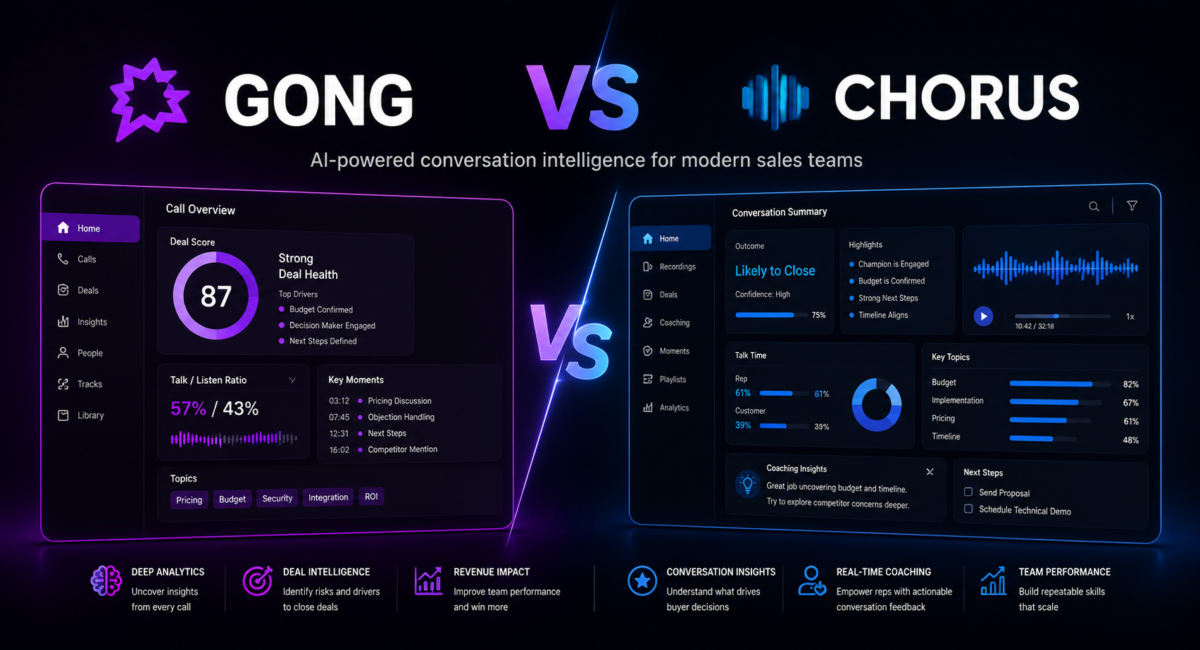
    Gong vs Chorus
    Gong vs Chorus
    Share
    Facebook Twitter LinkedIn Pinterest Email

    The definitive 2026 guide to Gong vs Chorus — covering features, real pricing, transcription accuracy, integrations, implementation timelines, and exactly which platform wins for your specific sales team size, budget, and workflow priorities.

    Gong vs Chorus by the Numbers 2026

    45%Gong CI Market Share4.7/5Gong G2 Rating (5,800+ reviews)4.5/5Chorus G2 Rating (2,280+ reviews)500-700%First-Year ROI Both Platforms25-30%Chorus Cost Saving vs Gong

    Table of Contents

    1. What Are Gong and Chorus?
    2. Gong vs Chorus — The Core Difference
    3. Feature Comparison: Gong vs Chorus Head to Head
      1. Revenue Intelligence and Deal Analytics
      2. Sales Coaching and Rep Development
      3. Forecasting Accuracy
      4. ZoomInfo Data Enrichment — Chorus’s Unique Advantage
    4. Gong vs Chorus Pricing — The Full Cost Breakdown
    5. Transcription Accuracy and AI Capabilities
    6. Integrations and Ecosystem
    7. Implementation, Adoption, and User Experience
    8. Who Should Choose Gong — and Who Should Choose Chorus
      1. Choose Gong If:
      2. Choose Chorus If:
      3. Consider Alternatives If:
    9. Frequently Asked Questions
      1. What is the main difference between Gong and Chorus?
      2. How much does Gong cost in 2026?
      3. How much does Chorus cost in 2026?
      4. Is Gong or Chorus better for small sales teams?
      5. Can Chorus be used without ZoomInfo?
      6. How long does it take to implement Gong vs Chorus?
      7. What are the best alternatives to Gong and Chorus in 2026?
    10. Conclusion and Verdict

    1. What Are Gong and Chorus?

    Gong and Chorus are the two dominant enterprise conversation intelligence platforms in 2026, together holding over 65% of the market. Both record, transcribe, and analyze sales calls using AI — but they approach revenue intelligence from fundamentally different angles, serve different primary use cases, and carry significantly different total costs of ownership.

    Gong, the market leader with approximately 45% share and 4,000 or more customers, positions itself as a full revenue intelligence platform. It connects conversation data to pipeline analytics, deal health scoring, and AI-powered forecasting — giving sales leaders a comprehensive view of revenue risk and opportunity across the entire deal lifecycle. Chorus, acquired by ZoomInfo in 2021 for 575 million dollars and now holding approximately 20% market share with 1,500 or more customers, positions itself as a conversation intelligence platform with a compelling differentiator: native integration with ZoomInfo’s B2B contact and company data. Every call analyzed by Chorus can be automatically enriched with ZoomInfo’s intelligence about who you spoke with, what technologies they use, their funding stage, and their team size.

    Pro Tip   Both Gong and Chorus deliver 500 to 700% first-year ROI according to independent research — meaning the investment in either platform is justified on financial grounds for mid-market and enterprise sales organizations. The question is not whether to invest in conversation intelligence in 2026. The question is which platform’s specific strengths align with your primary sales challenge: strategic revenue operations and forecasting precision, or coaching-focused rep development with rich contact data enrichment.

    2. Gong vs Chorus — The Core Difference

    Figure 2: Gong vs Chorus Full Feature Scorecard — Head-to-Head Across 9 Key Decision Factors

    The single most important sentence in this comparison: Gong is the Ferrari of revenue intelligence — expensive, powerful, and built for organizations that need deep pipeline analytics and deal health forecasting. Chorus is the practical coach — more affordable, ZoomInfo-integrated, and focused on helping reps improve their skills through conversation analysis. Understanding this distinction at the outset saves hours of evaluation time and prevents the most common purchasing mistake in this category: choosing the platform with the more impressive demo rather than the one that solves your actual primary problem.

    DimensionGONGCHORUS by ZoomInfo
    Primary PositioningRevenue Intelligence Platform — deals, pipeline, forecastingConversation Intelligence Platform — coaching, rep development, ZoomInfo data
    Best ForEnterprise organizations (100+ reps) needing forecast precisionMid-market teams (20-100 reps) using ZoomInfo, prioritizing coaching
    Core StrengthDeal health scoring, pipeline analytics, 94% forecast accuracyZoomInfo data enrichment, sentiment analysis, coaching libraries
    Market Share~45% — market leader with 4,000+ customers~20% — strong challenger with 1,500+ customers
    G2 Rating4.7/5 with 5,800+ reviews4.5/5 with 2,280+ reviews
    Transcription Accuracy93 to 96%90 to 93%
    Integrations162 native integrations45 native integrations
    Implementation2 to 3 months for full deployment2 to 4 weeks for core functionality
    Pricing Estimate~$200-$250/user/month (full bundle)~$100-$150/user/month

    Gong’s comprehensive feature set — revenue intelligence, deal analytics, AI forecasting, and 162 integrations — positions it as the clear choice when strategic visibility across the entire revenue operation is the primary requirement. Chorus’s ZoomInfo-native integration and more accessible price point position it as the stronger choice when coaching-focused rep development within an existing ZoomInfo ecosystem is the priority. Neither platform is universally superior — the right choice depends entirely on what problem you are actually trying to solve.

    3. Feature Comparison: Gong vs Chorus Head to Head

    3.1 Revenue Intelligence and Deal Analytics

    Gong’s core competitive advantage is its revenue intelligence layer — the ability to analyze conversation patterns across the entire deal lifecycle and predict outcomes with 94% accuracy. Gong’s AI engine processes calls through multiple models simultaneously, identifying deal risks, competitive mentions, pricing discussions, and stakeholder engagement patterns across all meetings in a deal. It synthesizes these signals into a deal health score that gives sales leaders an immediate assessment of which opportunities are on track, which are at risk, and which have gone dark. Chorus provides deal intelligence capabilities — including deal progression tracking — but the depth of predictive analytics and the breadth of signals analyzed are materially narrower than Gong’s platform.

    3.2 Sales Coaching and Rep Development

    Chorus has historically been the stronger coaching platform, with a focus on making it easy for managers to find, share, and review specific call moments relevant to skill development. Its coaching library organization and quick call review tools are consistently cited in user reviews as more intuitive and easier for managers new to conversation intelligence. Gong provides deeper coaching analytics — including keyword tracking, objection handling trend analysis across large call libraries, and customizable performance scorecards — but the interface complexity means a steeper learning curve for managers and reps who are not already comfortable navigating complex analytics dashboards.

    3.3 Forecasting Accuracy

    Gong Forecast is the most accurate AI-powered sales forecasting capability available in any commercial sales intelligence platform in 2026, achieving 93 to 96% forecast accuracy based on conversation signal analysis, pipeline movement patterns, and stakeholder engagement data. This level of accuracy is a genuine game-changer for VP-level sales leaders who need to commit to revenue forecasts with confidence. Chorus provides forecasting capabilities but achieves 78 to 85% accuracy — sufficient for many sales operations teams but materially less reliable than Gong for organizations where forecast precision directly affects business planning, investor communications, and resource allocation decisions.

    Pro Tip   Gong’s 94% deal outcome prediction accuracy is built on analyzing multiple signals simultaneously across every meeting in a deal: the ratio of talking to listening by each participant, competitor mentions and how they were handled, engagement of each stakeholder across the buying group, pricing discussion signals, and deal progression velocity. No human sales manager reviewing individual call recordings could synthesize these signals at the scale and speed Gong’s AI engine applies them across an entire pipeline.

    3.4 ZoomInfo Data Enrichment — Chorus’s Unique Advantage

    Chorus’s most compelling and differentiated capability in 2026 is its native ZoomInfo integration. When Chorus records and analyzes a call, it automatically enriches the call data object with ZoomInfo’s intelligence about every participant — company size, industry, technology stack, funding stage, recent news, job change signals, and intent data. This enriched context transforms a call transcript into a comprehensive intelligence asset that includes not just what was said but a full picture of who you were talking to and what their organizational situation was at the time of the conversation. For enterprise sales organizations where ZoomInfo is already a core piece of the go-to-market stack, this integration creates genuine unique value that Gong — or any standalone conversation intelligence tool — cannot replicate.

    4. Gong vs Chorus Pricing — The Full Cost Breakdown

    Figure 3: Gong vs Chorus Pricing Reality Check 2026 — True Total Cost of Ownership for a 50-Seat Sales Team

    Neither Gong nor Chorus publishes official pricing — both require custom quotes through their sales teams. However, extensive analysis of community-disclosed contract data, G2 reviews, and industry research provides a reliable picture of the pricing ranges both platforms operate within. The most important insight is that the sticker price per seat is only part of the total cost equation for both platforms.

    Cost ElementGONGCHORUS by ZoomInfo
    Seat Cost (per user/year)$1,200 to $3,000 depending on bundle$1,000 to $1,400 per seat per year
    Platform Fee$5,000 to $50,000 per year based on org sizeLower or bundled into ZoomInfo contract
    ZoomInfo Data SubscriptionNot required$15,000 to $40,000+ per year if not existing customer
    Implementation CostUp to $30,000 for enterprise professional servicesLower — simpler setup, minimal professional services
    Total for 50 Seats (estimated)$130,000 to $200,000+ per year$65,000 to $115,000+ per year
    Contract TermsAnnual only — no monthly optionsAnnual, typically bundled with ZoomInfo
    Price Trend 202656% increase reported on migration to bundled pricingLess transparent post-ZoomInfo acquisition

    The pricing comparison is deceptive in one critical direction: if your organization does not already use ZoomInfo, the effective cost of Chorus is dramatically higher than the seat price alone suggests. The ZoomInfo data subscription that makes Chorus genuinely differentiated costs 15,000 to 40,000 or more dollars per year depending on seat count and data tier. For teams without an existing ZoomInfo relationship, buying Chorus effectively means buying ZoomInfo at full price to unlock the integration that justifies the premium over cheaper conversation intelligence alternatives. For teams already using ZoomInfo, the incremental cost of adding Chorus within the ZoomInfo contract is often genuinely compelling.

    Pro Tip   Always get quotes from both Gong and Chorus in the same procurement cycle, even if you have a clear preference. The competitive pressure of a parallel evaluation consistently produces better pricing from both vendors. Users who reveal they are evaluating both platforms simultaneously have negotiated 15 to 25% better terms than those who approach either platform without a visible competitive alternative. The best leverage in any Gong or Chorus negotiation is a real, credible competing offer.

    5. Transcription Accuracy and AI Capabilities

    Transcription accuracy is the foundational capability that all other features of a conversation intelligence platform are built on. An insight generated from an inaccurate transcript is not just useless — it is potentially harmful, because it creates false confidence in a conclusion drawn from corrupted input data. Both Gong and Chorus achieve production-grade accuracy, but Gong leads on this dimension with a measurable advantage that compounds across large call libraries.

    •  Gong Transcription Accuracy: 93 to 96% accuracy across diverse acoustic environments, speaker accents, and industry-specific terminology. Gong’s models are trained on an extensive proprietary dataset of enterprise sales calls and continuously fine-tuned on new call data, improving accuracy over time as the platform ingests more conversations from your specific industry and deal type.

    •  Chorus Transcription Accuracy: 90 to 93% accuracy, with 14 proprietary patents covering audio processing innovations that deliver superior transcription performance in challenging environments — multiple speakers, background noise, and mixed audio quality conditions. Chorus’s centralized processing approach prioritizes audio quality and processing efficiency over breadth of language model training.

    •  AI Deal Risk Detection: Gong’s multi-model AI engine simultaneously analyzes talk-to-listen ratios, competitor mentions, pricing discussion signals, stakeholder engagement patterns, and deal progression velocity. Chorus focuses on sentiment analysis and conversation quality metrics, providing strong coaching signals but narrower deal-level risk detection.

    •  Real-Time Coaching: Gong provides live coaching cues during calls in 2026. Chorus also offers real-time guidance features. Neither platform provides the depth of real-time coaching capability that purpose-built tools like Nimitai or Cirrus Insight Copilot deliver — a genuine gap in both platforms that alternative tools are actively addressing.

    •  Language Support: Both platforms support major business languages including English, Spanish, French, German, and Portuguese. Gong’s broader integration footprint gives it an advantage for truly global enterprise deployments operating across more diverse language markets.

    6. Integrations and Ecosystem

    Integration breadth is one of Gong’s clearest quantitative advantages over Chorus. Gong offers 162 native integrations compared to Chorus’s 45 — a 3.6 times advantage in native connectivity that becomes practically significant for enterprise organizations running complex go-to-market tech stacks. However, the quality and strategic importance of specific integrations matter more than the total count for most purchasing decisions.

    Integration CategoryGONGCHORUS by ZoomInfo
    CRMSalesforce, HubSpot, Microsoft Dynamics, PipedriveSalesforce, HubSpot — tighter native Salesforce integration
    Sales EngagementOutreach, Salesloft, Apollo, XANTOutreach, Salesloft — solid core coverage
    B2B DataLimited native data enrichmentZoomInfo native — the defining differentiator
    Video ConferencingZoom, Teams, Google Meet, WebexZoom, Teams, Google Meet
    CommunicationSlack, Teams, email platformsSlack, Teams — standard coverage
    Total Native Integrations162 integrations45 integrations
    Custom APIREST API for custom integrationsREST API available
    Strategic AdvantageBroadest ecosystem coverage overallZoomInfo-native data enrichment unmatched

    The practical implication of Gong’s 162-integration advantage is most significant for large enterprise organizations running multi-tool revenue stacks where conversation data needs to flow into revenue operations platforms, customer success tools, marketing automation systems, and business intelligence dashboards simultaneously. For mid-market organizations running a more standard Salesforce or HubSpot plus video conferencing stack, Chorus’s 45 integrations cover the essential connectivity without the configuration overhead of Gong’s broader ecosystem.

    Pro Tip   The integration that makes Chorus genuinely unique is one that Gong cannot replicate: the ZoomInfo data enrichment layer. When your conversation intelligence platform automatically overlays who you spoke with, their technology stack, their funding signals, and their organizational hierarchy onto every call record — without your rep having to pull that from a separate tab — the quality of post-call follow-up and strategic account planning improves measurably. This is the integration that justifies Chorus for ZoomInfo customers and makes it difficult to justify for non-ZoomInfo customers.

    7. Implementation, Adoption, and User Experience

    Implementation timeline and user adoption are the two factors that most consistently determine whether a conversation intelligence platform delivers ROI — or becomes an expensive underutilized subscription. Both Gong and Chorus require meaningful organizational change management, but the scale of that investment differs significantly between the two platforms.

    •  Gong Implementation Timeline: 2 to 3 months for full implementation and team adoption. Gong’s comprehensive feature set requires extensive configuration — clean CRM data with consistent field hygiene is a prerequisite for Gong’s deal intelligence to function accurately. Dedicated RevOps or sales operations resources are required for setup and ongoing optimization. Organizations that shortcut the implementation process consistently report lower adoption rates and reduced ROI.

    •  Chorus Implementation Timeline: 2 to 4 weeks for core functionality. Chorus’s lighter setup process focused primarily on call recording and coaching workflows means teams are generating value significantly faster. However, the faster implementation also reflects Chorus’s more limited feature depth — the trade-off is genuine. Faster time-to-value with narrower capability versus more powerful platform that takes longer to configure.

    •  User Experience and Adoption Risk: Chorus consistently earns higher ratings for interface intuitiveness and ease of adoption across G2 reviews and independent comparisons. Gong’s power comes with complexity — reps describe it as a tool they have to actively manage rather than one that surfaces insights passively. The ‘destination tool’ problem is real: reps must log into a separate Gong dashboard to access insights, which creates adoption friction in organizations where the sales manager does not enforce consistent platform use.

    •  The Big Brother Problem: Gong’s comprehensive monitoring capability creates a documented adoption challenge. Some sales teams resist the platform because the visibility it provides to managers — every call recorded, analyzed, and scored — feels invasive rather than supportive. Organizations that successfully implement Gong address this proactively by framing the platform as a coaching resource rather than a surveillance tool and involving sales reps in the configuration of the metrics tracked.

    •  Post-Acquisition User Experience: Users report that transcription accuracy and support quality at Chorus declined following the ZoomInfo acquisition in 2022. The aggressive cross-selling of ZoomInfo products during the Chorus sales and renewal process is also frequently cited as a negative experience factor. Gong has maintained strong support quality and product development velocity as an independent company.

    Pro Tip   Before committing to either platform, run a structured 30-day pilot with a subset of your sales team — ideally your most data-savvy reps and your most coaching-focused manager. The pilot should include at minimum 50 recorded calls and a formal review of which platform-generated insights the team actually acted on versus which they ignored. Insight generation that does not drive rep behavior change delivers zero ROI regardless of how sophisticated the underlying AI is.

    8. Who Should Choose Gong — and Who Should Choose Chorus

    Figure 4: Gong vs Chorus Decision Guide 2026 — Answer 3 Questions to Find the Right Platform

    The choice between Gong and Chorus is not a close call when your situation clearly matches the profile each platform is built for. The confusion arises for organizations in the middle ground where both platforms could work — and where the pricing difference feels significant enough to justify Chorus but the feature gap feels significant enough to justify Gong. Here is the framework for making a clear decision.

    8.1 Choose Gong If:

    •  Your primary challenge is forecasting accuracy and pipeline visibility — Gong’s 94% deal outcome prediction and revenue intelligence layer are unmatched in the market for VP-level strategic decision making

    •  You have a sales team of 100 or more reps where the scale of conversation data makes Gong’s pattern recognition across thousands of calls genuinely powerful

    •  You have dedicated RevOps resources to manage a 2 to 3 month implementation and ongoing platform optimization

    •  Your CRM data hygiene is strong — Gong’s insights are only as good as the data it connects to, and poor CRM hygiene produces misleading deal health signals

    •  You need breadth of integrations across a complex multi-tool revenue stack — Gong’s 162 integrations cover virtually every enterprise GTM tool category

    •  Deal intelligence and competitive mention tracking across multi-stakeholder enterprise deals are core requirements — Gong’s multi-model analysis across deal lifecycle signals is significantly deeper than Chorus

    8.2 Choose Chorus If:

    •  Your organization is already a ZoomInfo customer and wants to unlock the native data enrichment integration that makes Chorus genuinely differentiated from all standalone conversation intelligence alternatives

    •  Your team size is 20 to 100 reps and you want full conversation intelligence capabilities without the enterprise price tag and implementation overhead of Gong

    •  Your primary use case is rep coaching and skill development rather than strategic revenue operations and forecast precision

    •  You need a faster time-to-value deployment — Chorus’s 2 to 4 week implementation gets your team generating coaching insights before Gong would even be fully configured

    •  Your budget for conversation intelligence is constrained and the 25 to 30% cost advantage Chorus provides over Gong makes a material difference to the business case

    •  Your sales managers are new to conversation intelligence tools and need a more intuitive, accessible interface to drive adoption without intensive training

    8.3 Consider Alternatives If:

    •  Your team has fewer than 20 sales reps — neither Gong nor Chorus is cost-effective at small team sizes. Fireflies.ai at 19 dollars per user per month provides solid meeting transcription and basic conversation intelligence at a fraction of the cost

    •  Real-time coaching during live calls is your primary requirement — neither Gong nor Chorus delivers deep real-time coaching capability. Purpose-built tools like Nimitai and Cirrus Insight Copilot are designed specifically for live call coaching

    •  You use Salesforce as your primary system of record and need a fully embedded intelligence tool that does not require reps to visit a separate dashboard — Cirrus Insight works inside Gmail, Outlook, and Salesforce natively

    •  Your budget is under 50,000 dollars per year for a team of 20 or more reps — at this price point, neither Gong nor Chorus delivers full functionality and the ROI case is difficult to make versus lower-cost alternatives

    9. Frequently Asked Questions

    What is the main difference between Gong and Chorus?

    Gong is a revenue intelligence platform — it connects conversation data to pipeline analytics, deal health scoring, and AI-powered forecasting across the entire sales cycle. Chorus is a conversation intelligence platform — it records, transcribes, and analyzes calls with a focus on coaching and rep development, differentiated by native ZoomInfo data enrichment. Gong is the stronger choice when strategic revenue operations and forecast precision are the primary requirements. Chorus is the stronger choice when coaching-focused rep development within an existing ZoomInfo ecosystem is the priority.

    How much does Gong cost in 2026?

    Gong does not publish official pricing. Based on community-disclosed contract data and industry research, Gong’s full bundle costs approximately 200 to 250 dollars per user per month, with an additional platform fee ranging from 5,000 to 50,000 dollars per year based on organization size. Implementation professional services can add up to 30,000 dollars for enterprise deployments. A 50-seat team should budget 130,000 to 200,000 dollars or more annually. All contracts are annual with no monthly payment option. Gong has moved toward bundled pricing in 2026, making it difficult to purchase only specific modules.

    How much does Chorus cost in 2026?

    Chorus by ZoomInfo seats run approximately 1,000 to 1,400 dollars per seat per year — roughly 25 to 30% less than Gong. However, the total cost of Chorus depends heavily on whether your organization already uses ZoomInfo. The ZoomInfo data subscription that makes Chorus genuinely differentiated costs 15,000 to 40,000 or more dollars per year. For teams without an existing ZoomInfo relationship, buying Chorus effectively requires purchasing ZoomInfo at full price, which can eliminate the apparent cost advantage over Gong. Chorus pricing has become less transparent following the ZoomInfo acquisition.

    Is Gong or Chorus better for small sales teams?

    Neither Gong nor Chorus is well-suited for small sales teams of fewer than 20 reps. Both require enterprise-level budgets, dedicated RevOps resources for implementation, and minimum contract commitments that make the ROI case difficult for smaller organizations. For teams under 20 reps, Fireflies.ai at 19 dollars per user per month or Nimitai at 149 dollars per seat per month provide conversation intelligence capabilities at a price point that delivers clear ROI at small team sizes. Both Gong and Chorus are best suited for mid-market and enterprise organizations with 20 or more sales reps.

    Can Chorus be used without ZoomInfo?

    Yes — Chorus functions as a standalone conversation intelligence tool without ZoomInfo. However, without the ZoomInfo integration, Chorus loses its primary differentiator over competing conversation intelligence platforms. You are paying for a capable but relatively expensive CI platform while missing the data enrichment layer that justifies the premium. For organizations not using ZoomInfo and not planning to adopt it, Gong typically delivers better standalone value despite its higher price — or lower-cost alternatives like Fireflies.ai or Nimitai provide better ROI at the conversation intelligence level without the enterprise overhead.

    How long does it take to implement Gong vs Chorus?

    Gong requires 2 to 3 months for full implementation and team adoption, including CRM data hygiene preparation, integration setup, scorecard configuration, and manager training. Chorus typically deploys core functionality in 2 to 4 weeks, with lighter configuration requirements focused on call recording and coaching workflows. The faster Chorus implementation reflects both its simpler setup process and its more limited feature depth relative to Gong’s comprehensive revenue intelligence platform.

    What are the best alternatives to Gong and Chorus in 2026?

    The strongest Gong and Chorus alternatives in 2026 are Fireflies.ai at 19 dollars per user per month for cost-effective meeting transcription and basic intelligence, Nimitai at 149 dollars per seat per month with no annual contract and the only real-time coaching capability during live calls, and Cirrus Insight for Salesforce-first teams that want conversation intelligence embedded directly inside Gmail, Outlook, and Salesforce without a separate dashboard. For organizations that specifically need real-time coaching during live calls — a gap that neither Gong nor Chorus adequately fills — Nimitai and Cirrus Insight Copilot are the purpose-built alternatives.

    10. Conclusion and Verdict

    The Gong vs Chorus decision in 2026 is clearer than it has ever been — because both platforms have become more distinctly positioned as the market has matured. Gong is the market-leading revenue intelligence platform for enterprise sales organizations that need forecast precision, deep deal analytics, and comprehensive pipeline visibility. If your VP of Sales is losing sleep over forecast accuracy and deal risk visibility, Gong is the answer. Chorus is the conversation intelligence platform for mid-market organizations that run ZoomInfo in their GTM stack and want coaching-focused rep development with automatic contact data enrichment at a significantly lower price point.

    The most important caution for buyers in 2026 is to reject the framing of this decision as a feature comparison and evaluate it instead as a problem-solution match. Both platforms generate dashboards full of insights. The question is which platform’s insights align with the specific decisions your sales leadership needs to make every week — and which platform your reps will actually use consistently enough to generate the data quality those insights require. Neither Gong nor Chorus delivers ROI when adoption is low. Choose the platform your team will actually use, and configure it relentlessly until every insight generates a consistent, measurable change in rep behavior.

    Share. Facebook Twitter Pinterest LinkedIn Tumblr Email
    Previous ArticleBest AI Sales Forecasting Tools 2026
    Next Article Best Low-Code AI Platforms 2026
    TechieHub

      Related Posts

      Best AI Search Monitoring Tools 2026

      May 10, 2026

      Best AI APIs: Complete Developer Guide 2026

      April 29, 2026

      What Are AI Hallucinations? Complete Guide 2026

      April 27, 2026
      View 3 Comments

      3 Comments

      1. BUY VALIUM ONLINE on March 6, 2026 1:50 am

        I have read so many posts regarding the blogger lovers however this
        paragraph is truly a nice paragraph, keep it up.

        Here is my blog … BUY VALIUM ONLINE

        Reply
        • TechieHub on March 8, 2026 6:57 pm

          Thank you for taking the time to share your thoughts! We truly appreciate the support and are glad you found value here. Stay connected there’s more helpful content coming your way.

          Reply
        • TechieHub on April 9, 2026 6:57 pm

          Thank you for taking the time to share your thoughts! We truly appreciate the support and are glad you found value here. Stay connected—there’s more helpful content coming your way.

          Reply
      Leave A Reply Cancel Reply

      Editors Picks

      Best AI Search Monitoring Tools 2026

      May 10, 2026

      Best AI APIs: Complete Developer Guide 2026

      April 29, 2026

      What Are AI Hallucinations? Complete Guide 2026

      April 27, 2026

      What is Prompt Engineering? Complete Guide 2026

      April 27, 2026
      Techiehub
      • Home
      • Featured
      • Latest Posts
      • Latest in Tech
      • Privacy Policy
      • Terms and Conditions
      Copyright © 2026 Tchiehub. All Right Reserved.

      Type above and press Enter to search. Press Esc to cancel.

      We use cookies to ensure that we give you the best experience on our website. If you continue to use this site we will assume that you are happy with it.