


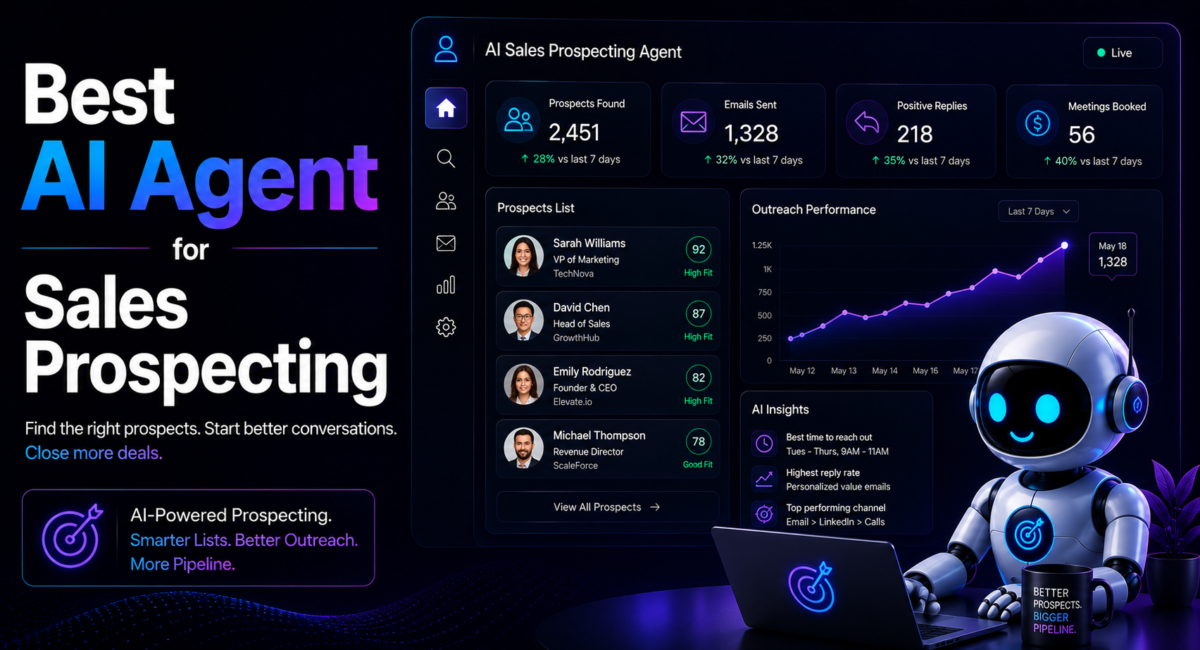
| Quick answer: The best AI agent for sales prospecting in 2026 depends on how much of the funnel you want to automate. Clay leads on research and enrichment, 11x on autonomous multi-channel outreach, AiSDR on end-to-end “hire an AI SDR” simplicity, Artisan on email and LinkedIn, and Apollo.io on accessible, operator-driven prospecting. Most winning teams run a hybrid model. |
An AI sales prospecting agent — usually marketed as an AI SDR — is software that autonomously finds prospects matching your ideal customer profile, researches decision-makers, drafts personalized outreach, and in some cases sends messages and books meetings with limited human input.

This guide keeps the facts from our earlier comparison and updates every number against 2026 sources. If you are new to the category, it helps to first understand what agentic AI actually is before you spend on an autonomous SDR. This spoke sits under our pillar on the best AI agent tools.
Table of Contents
How we compare
We weigh five things: autonomy (how much runs without a human clicking), data and enrichment quality, personalization depth, transparency of pricing, and — most importantly — whether the tool measurably improves reply quality rather than just send volume. We test claims against independent 2026 field data, not vendor marketing. Affiliate disclosure: some outbound links may earn TechieHub a commission at no cost to you; it never affects our rankings or the honest verdicts below.
What counts as an AI sales prospecting agent?
The category has split in two. Autonomous AI SDRs own the top of the funnel: they identify accounts, watch for buying signals, write and sometimes send outreach across email, LinkedIn and even voice, then escalate warm replies to a human. Separately, agentic deal-intelligence tools handle later-stage work like call analysis and forecasting. This article focuses on the prospecting layer — one of the most mature agentic AI applications in go-to-market today.
Adoption is real and fast: as of Q1 2026, 41% of enterprise B2B teams run at least one AI SDR in production, up from just 3% in early 2024, and the market is projected to reach $15.01 billion by 2030 from $4.12 billion in 2025 (a 29.5% CAGR). The demand is not in doubt — the question is which tool fits your motion.
The best AI agent for sales prospecting: five tools that earn their seat
Each of the leaders below wins a specific job. The mistake is buying one for a job it was never built to do.
Clay — the intelligence layer
Clay is the leading data-enrichment and prospecting-orchestration platform, powered by an AI research agent (Claygent). It pulls from 100+ data sources, enriches lead records, and chains AI research steps into programmable workflows, compressing roughly 60 minutes of account research into under five. Crucially, Clay does not send outreach — it builds the intelligence that feeds your execution tools or human team. Paid plans start around $149/month. See clay.com.
11x — the most complete autonomous platform
11x positions itself as a “digital worker” company. Its AI SDR (Alice) identifies prospects from a 400M+ contact database, researches decision-makers, runs multi-channel sequences across email, LinkedIn and SMS, responds to replies and escalates qualified opportunities, while a separate agent (Julian) adds autonomous voice. It is enterprise-priced — the Growth plan runs roughly $36,000/year — and best for teams scaling outbound across channels. See 11x.ai.
AiSDR — the clearest “hire an AI SDR”
AiSDR offers the most literal end-to-end autonomy: prospect, send, reply and book without operator clicks, with managed onboarding that gets most clients live within a week. Its Explore tier starts near $900/month with Grow around $2,500/month, priced by AI message volume with unlimited seats — roughly the cost of a fractional SDR, and a genuine autonomous agent.
Artisan — email and LinkedIn outbound
Artisan’s agent Ava scales personalized email and LinkedIn automation, positioned as an SDR-team augmenter. It is lighter than 11x, focused on those two channels rather than full multi-channel or voice, with pricing around $850/month — a good fit for teams wanting a named-agent product for email and LinkedIn.
Apollo.io — the accessible entry point
Apollo.io combines a large prospecting database with outreach sequences in one platform. It is operator-driven (AI assists rather than fully automates), with a free tier and paid plans from around $49/user, making it ideal for teams that want maximum control with AI help. Plan to spend several hours a week running it. See apollo.io.
Beyond the top five, Amplemarket’s Duo is a strong human-in-the-loop system with deep signal coverage, Regie.ai handles content-level personalization well, and augmentation stacks like Outreach and Salesloft add intelligence on top of tools you already run.
How do the top prospecting agents compare?

| Tool | Type & best for | Entry price (2026) |
|---|---|---|
| Clay | Enrichment + research — the intelligence layer that feeds everything else | From ~$149/mo |
| 11x | Autonomous multi-channel — scaling outbound plus voice | ~$36,000/yr (Growth) |
| AiSDR | End-to-end autonomous — “hire an AI SDR” simplicity | From ~$900/mo |
| Artisan | Email + LinkedIn agent — channel-focused outbound | ~$850/mo |
| Apollo.io | Operator-driven platform — control at an accessible price | Free tier; from ~$49/user |
| Amplemarket | Human-in-the-loop — signal-rich orchestration | Quote |
A useful split: Clay and the augmented stacks give you control and intelligence, while 11x, AiSDR and Artisan give you autonomy. Clay in particular often pairs with the others — it builds the data and research layer that feeds 11x, Artisan, Apollo or your human team.
Do autonomous AI SDRs actually work? The 2026 reality check

Here is the honest picture every buyer should know. The fully-autonomous AI SDR narrative peaked in 2024–2025, and by 2026 the field data is sobering. AI cold-email reply rates sit around 4.1% versus 5.2% for human-sent email, and the positive-reply gap is wider (1.4% AI vs 2.1% human). AI-written email also gets spam-flagged at 8% versus 3% for human, because filters have learned to spot the statistical fingerprint of generated text.
Retention tells the same story: AI SDR platforms see 50–70% annual churn, against 5–15% for typical SaaS in this segment, and most teams that try full replacement revert to a hybrid within six months. Three systemic problems drive it — quality degrades when AI sends at volume without review, underlying data is often poor, and hidden costs stack up.
But the same 2026 data points to what does work. In one large analysis, the hybrid model reached a 14.7% reply rate — about 3.6x AI-only (4.1%) and 1.4x human-only (10.4%). The lesson is not that the tools are useless; it is that framing matters. Give AI autonomy where it genuinely helps (research, enrichment, first-draft messaging) and keep humans where it counts (send decisions, account prioritization, relationships). This mirrors the broader AI agent versus AI assistant distinction playing out across every function.
AI sales prospecting in practice
Consider Josefina, a two-person RevOps team at a 40-seat B2B SaaS company with no dedicated SDRs. Her task: build repeatable outbound pipeline without hiring. She wires Clay to enrich a target list of 1,500 accounts — pulling headcount, tech stack and recent funding signals — so every record carries a real reason to reach out. Clay’s research feeds first-draft messaging into Apollo, where Josefina reviews a sample of sequences each morning before anything sends.
Rather than chasing maximum volume, she caps daily sends and reads the replies herself, tightening the ICP weekly. The illustrative outcome is exactly what the 2026 data predicts: fewer, sharper emails that reference specifics land far better than a blast of generic AI copy, and the human review step keeps her domain reputation intact. It is a hybrid motion — AI does the heavy research and drafting; Josefina owns the send decision and the strategy.
How do you choose the right prospecting agent?
Match the tool to your situation. If you have no SDR team and need to create outbound volume from scratch, an autonomous agent (11x, Artisan, AiSDR) can generate pipeline that would not otherwise exist — expect to tune aggressively for the first 90 days. If you have an established engagement stack and want to make it smarter, augmentation platforms (Outreach, Salesloft, Amplemarket) add intelligence with the least risk because you replace nothing.
The practical details to check
Watch the practical details. Autonomous pricing floors sit near $900/month and climb into five figures annually, so map cost against a fractional SDR. Check CRM compatibility — sync can be limited outside HubSpot or Salesforce. If budget is tight, Apollo’s free and $49/user tiers are the accessible on-ramp, at the cost of more operator time. For teams that mainly need research and enrichment to feed a human or another tool, Clay is the strongest standalone layer. Decide up front how much of the funnel you actually want to automate — it prevents paying for autonomy you will not use, or switching on autonomy you are not ready to supervise.
Treat the first 90 days as tuning
Whatever you buy, treat the first 90 days as a tuning period rather than a set-and-forget launch. Guard deliverability, because sending thousands of mediocre emails damages your domain and brand — volume without quality is a false economy. Invest in data quality, since poor data is a leading cause of failure and a strong enrichment layer makes every downstream step better. And set realistic expectations: an AI prospecting agent scales a good sales motion, but it will not fix a weak offer or a vague ICP. The single highest-leverage habit is keeping a human reviewing a sample of outbound and the replies, so generic or off-tone messages get caught before they burn your reputation.
Frequently Asked Questions
What is the best AI agent for sales prospecting?
It depends on your setup. Clay is best for research and enrichment, 11x for autonomous multi-channel outreach including voice, AiSDR for end-to-end ‘hire an AI SDR’ simplicity, Artisan for email and LinkedIn, and Apollo.io for accessible, operator-driven control. Most teams get the best results from a hybrid approach.
Do autonomous AI SDRs actually work?
Partially. By 2026, fully autonomous AI SDRs had not replaced human teams at scale; 50–70% of teams churn within a year, and AI reply rates (4.1%) trail humans (5.2%). They generate pipeline that would not otherwise exist, but the reliable model is hybrid — AI drafts, humans decide.
What is the difference between Clay and an AI SDR like 11x?
Clay is an intelligence layer: it finds, enriches and researches prospects but does not send outreach. AI SDRs like 11x are execution agents that prospect, write, send and respond across channels. They are complementary — many teams use Clay to build the data layer that feeds 11x, Artisan, Apollo or human reps.
How much do AI sales prospecting tools cost?
Widely. Apollo.io has a free tier and plans from around $49/user. Clay starts near $149/month. AiSDR’s floor is about $900/month, Artisan around $850/month, and 11x’s Growth plan runs roughly $36,000/year. Map any autonomous tool against a fractional SDR’s cost and confirm current pricing on each vendor’s page.
What is the best AI prospecting tool for a small team or budget?
Apollo.io is the strongest budget choice, with a free tier and a $49/user plan combining a prospecting database with sequences. It is operator-driven, so expect a few hours a week running it, but it delivers real capability without the $900+/month floor of autonomous agents. Clay is also accessible for research and enrichment.
How do I keep AI outreach from looking generic?
Quality control is everything. Use a strong enrichment layer like Clay so messages reference real, specific details, keep a human reviewing a sample of what the agent sends, and resist maximizing volume over relevance. Generic, templated AI messages are the top complaint and the main driver of churn.
Will an AI SDR hurt my email deliverability?
It can, and this is the failure that costs the most to undo. The spam-flagging gap above — 8% for AI-written email against 3% for human — compounds fast at agent volume, and a burned domain takes months to rehabilitate. Worse, the damage is not confined to outbound: your invoices and support replies ride the same reputation.
The standard protection is to never send cold outreach from your primary domain. Buy separate sending domains, warm them gradually, and cap volume per mailbox rather than letting the agent send at capacity. Authenticate properly with SPF, DKIM and DMARC — since the Google and Yahoo bulk-sender rules took effect, unauthenticated bulk mail is filtered rather than merely down-ranked. Then watch bounce and complaint rates weekly and treat a rising complaint rate as a signal to cut volume, not to buy more domains. Any vendor that cannot show you per-mailbox sending caps and deliverability reporting is asking you to gamble your domain on their defaults.
Conclusion
The honest conclusion is the one the 2026 data keeps pointing at: the hybrid model beat both extremes, reaching a 14.7% reply rate against 4.1% for AI-only and 10.4% for human-only. Buying an autonomous agent to replace an SDR is the configuration with the worst evidence behind it, and the 50–70% churn on those platforms is what that looks like in practice.
So buy for the layer you are actually missing. If the gap is research and list quality, Clay at ~$149/month fixes more than a $36,000/year autonomous platform will. If the gap is send capacity and you have someone to supervise it, AiSDR or Artisan earn their price. If you are not sure yet, start on Apollo.io and learn where your motion actually breaks before committing to a seat-priced agent. Protect the domain from day one, treat the first 90 days as tuning, and remember that no agent fixes a weak offer — it only sends it faster. For the wider revenue stack see our guides to AI sales forecasting tools and Gong vs Chorus for conversation intelligence on the calls this books.
