

| Quick answer |
|---|
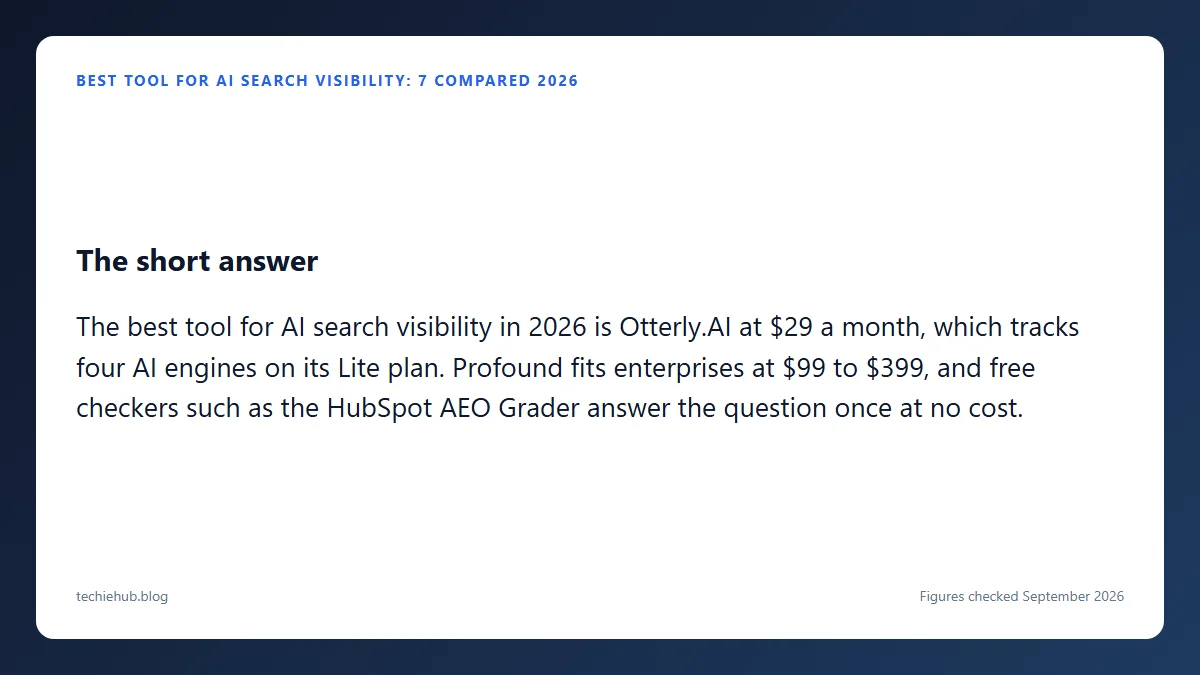
| The best tool for AI search visibility in 2026 is Otterly.AI at $29 a month, which tracks four AI engines on its Lite plan. Profound fits enterprises on a quoted plan, and free checkers such as the HubSpot AEO Grader answer the question once at no cost. |
How this comparison works: tools are judged on engines covered by the base plan, published price, prompt allowance and whether a free tier exists. Figures were checked against vendor pricing pages and independent pricing trackers in September 2026, and move often — confirm before you buy.
Table of Contents
What an AI search visibility tool actually measures
Asked as “what are the best AI search visibility tools”, the shortlist is Otterly.AI, Profound, Peec AI, AthenaHQ, Scrunch AI and the Semrush AI Visibility Toolkit — but almost nobody needs more than one, which is why this guide is written in the singular. The honest sequence is: run the free five-prompt check below first, and only buy a tool once you know which engines actually mention you and which ones you need tracked. Teams that buy before testing routinely pay for engine coverage they never look at. Prices here were re-checked on 4 October 2026.
These tools answer one question: when a buyer asks an AI assistant about your category, are you in the answer? The tool runs a fixed prompt set against engines such as ChatGPT, Perplexity, Gemini and Google AI Overviews, then records whether your brand is named, how often, and whether the answer links back to your site.
That is not rank tracking. A blue-link tracker asks “what position is this URL?” An AI visibility tool asks “was this brand named, and was it cited?” The two diverge constantly — you can hold position one organically and be absent from the AI answer above it. Our guide to AI search monitoring tools covers the wider category, and ranking in Google AI Overviews covers the page-side work.
Best tool for AI search visibility: 2026 comparison
| Tool | Entry price | Base-plan engines | Free tier or trial |
|---|---|---|---|
| Otterly.AI | $29/mo (Lite) | Four engines; AI Mode and Gemini are add-ons | 7-day trial, no card, 50 prompts |
| Semrush AI Visibility Toolkit | $99/mo per domain | ChatGPT, Gemini, AI Overviews; 25 prompts | Free AI visibility checker, no signup |
| Profound | Custom quote | Up to nine engines on Enterprise | Free 7-day trial |
| Peec AI | EUR 85 (about $96)/mo (Starter) | Core engines; extras from EUR 30 (about $34)/mo each | 7-day trial, no card |
| AthenaHQ | $245–295/mo | Broad coverage on a credit model | Free Essential tier, 300 credits |
| Scrunch AI | $250–300/mo (Starter) | 3 users, 350 custom prompts | Demo-led |
| Free graders | $0 | Usually two or three engines, one-off | Entire product is free |
More AI visibility tools: Superlines, SE Visible, Brand Radar and Frase
Several tools that appear in most 2026 comparisons are not covered above.
| Tool | Why buyers shortlist it |
|---|---|
| Superlines | Ranked first in several 2026 comparisons for multi-engine tracking |
| SE Visible (SE Ranking) | Competitor benchmarking and share of voice next to SEO data |
| Ahrefs Brand Radar | Visibility grounded in Ahrefs’ large query dataset; best for existing Ahrefs users |
| Frase | Monitoring plus content tools to fix the gaps it finds |
Five checks before you buy: which engines are covered on your plan, how many prompts are included, whether seats are limited (some tools include unlimited seats, which suits agencies), whether it connects to Google Search Console and GA4, and whether there is an API for your own reporting. Many teams end up with a hybrid stack: one tracker, one content-optimisation tool and their existing SEO suite.
The add-on trap in AI visibility pricing
The advertised price and the price you pay are rarely the same, because engines are billed separately. This is the single most useful thing to understand before buying, and vendor listicles — which is most of this SERP — leave it out.
- Profound withdrew its $99 and $399 self-serve plans in September 2026. Its pricing page, read on 11 October 2026, lists a free seven-day trial and a quoted Enterprise plan.
- Peec AI includes a core set and charges roughly EUR 30 (about $34) per extra model per month on Starter, EUR 70 (about $79) on Pro and EUR 140 (about $158) on Advanced.
- Otterly bundles four engines into every core plan but sells Google AI Mode and Gemini as add-ons.
- Semrush charges $99 per domain for 25 prompts, plus $60 a month for each extra 50 prompts, billed annually.
Work out which engines your buyers actually use, price only those, then compare totals. On that arithmetic Otterly’s $29 tier is genuinely the cheapest credible entry point, and Semrush’s $99 toolkit reaches $159 a month once you add one 50-prompt pack.
A test method and prompt set you can run yourself
Every tool here will sell you its own prompt set. Before you pay, run this five-prompt protocol by hand across ChatGPT, Google AI Overviews and Perplexity, then repeat it in seven days.
- Category prompt — “What are the best [category] tools?” Tests whether you exist in the broadest, highest-volume answer.
- Comparison prompt — “[Your brand] vs [competitor]: which is better?” Tests whether the engine has a defensible view of you.
- Problem prompt — “How do I [job your product does]?” Tests whether you are cited on intent rather than on brand name.
- Pricing prompt — “How much does [category] software cost?” The most commercially loaded prompt and the one most often answered by a competitor.
- Trust prompt — “Is [your brand] any good?” Surfaces sentiment and the third-party sources the engine leans on.
Score each run three ways — named or not, cited or not, and which competitor appeared first. If your presence swings wildly between the two rounds, you need daily refresh and should filter tools on that alone. If it barely moves, a monthly manual check may be enough and a subscription is premature.
The seven tools in detail
Otterly.AI
Lowest published paid entry at $29 a month for the Lite plan, which tracks 15 prompts across four AI engines. Google AI Mode and Gemini are sold as add-ons. A 7-day trial runs without a credit card.
Profound
Enterprise-leaning AI visibility platform. The $99 Starter plan tracks ChatGPT only; Perplexity and Google AI Overviews arrive on the $399 Growth tier.
Peec AI
European AI search analytics platform priced at EUR 85 (about $96) a month for Starter, EUR 205 (about $232) for Pro and EUR 425 (about $480) for Advanced. Extra engines cost EUR 30 (about $34) to EUR 140 (about $158) a month each depending on the plan.
AthenaHQ
Source-intelligence platform that identifies which URLs AI systems reference for your prompts. Listed at $295 a month for 3,600 credits on its Starter plan, with a free Essential tier of 300 credits and quoted Enterprise pricing.
Scrunch AI
Starter runs $300 a month, or $250 billed annually, covering 3 users and 350 custom prompts. Growth is $500 a month, or $417 annually, with 5 users and 700 prompts.
Semrush AI Visibility Toolkit
A $99 per month per-domain add-on covering 25 tracked prompts. It is sold standalone or inside Semrush’s SEO + AI Search plans from $199 a month, so price both routes before buying.
Free AI visibility checkers
One-off graders such as the HubSpot AEO Grader and the Semrush AI Search Visibility Checker return a snapshot score with no signup. They score you but do not track changes over time.
What none of these tools will do for you
This category measures; it does not fix. A tool will tell you a competitor is named in an answer where you are not. Closing that gap is content work — a clear, extractable answer high on a page that is indexed, renderable without JavaScript, and specific enough to quote.
That is the honest limit of AI visibility tools in 2026, and it is worth knowing before you spend. If your pages are not extractable, a subscription buys a very precise record of your absence. Our guides to answer engine optimization tooling and generative engine optimization cover the work that actually changes the answer.
Two narrower questions have their own guides: if the budget sits with brand or communications, see AI tools for brand visibility, and if you already track mentions and want to raise them, see tools for optimizing AI search visibility. If the worry is whether the numbers can be trusted at all, start with AI search optimization tools for data accuracy.
The three numbers a measurement tool has to give you
A tool that reports one blended “visibility score” is hiding the only distinction that matters. Insist on three separate figures: presence (were you named), share of voice (how often versus named competitors on the same prompts), and citation (was your URL linked). A brand can be named in eight answers out of ten and receive no clicks at all, and only the third number tells you that. For Google’s surfaces there is also a free fourth reading: since 31 August 2026 Search Console’s generative AI report shows AI Overviews and AI Mode impressions for every page, though not whether your brand was named or which prompt triggered it.
The second thing to insist on is a prompt set you control. If the vendor picks the prompts, the report flatters you. Our guide to AI search monitoring tools covers the wider category, and generative engine optimization covers what to do once the gaps are visible.
How to track brand visibility in AI search results without a subscription
Before you buy anything, run this manually for two weeks. It costs nothing, and it tells you whether a paid tracker would show you something you cannot already see. Every paid AI visibility tracker is an automated version of exactly this loop.
- Build a 15-prompt set. Five category prompts (“best X for Y”), five comparison prompts (“A vs B”), three problem prompts (“how do I fix Z”), two brand prompts (“is [your brand] any good”). Write them down once and never edit them mid-quarter — a changed prompt set destroys your trend line.
- Run each prompt in a fresh session. Signed out, no chat history, one engine at a time. Personalisation and memory will otherwise quietly flatter you.
- Record four columns per run: date, engine, brand named yes or no, and the domains actually cited. The cited-domains column is the one that pays for itself — it names the pages you have to outrank.
- Repeat every prompt three times. Answers vary between runs on identical input. One run tells you nothing; three runs tell you whether an absence is real or noise.
- Score weekly, on the same weekday. Presence rate is mentions divided by total runs. Share of voice is your mentions divided by mentions of you plus your two named competitors.
Two weeks of this produces a baseline no vendor dashboard can hand you, because it is built from your prompts rather than the vendor’s defaults. It also exposes the single biggest weakness of the category: run-to-run variance. If your presence rate swings ten points between identical runs, a tool reporting a single weekly number is smoothing over the thing you most need to see.
What an AI visibility tracker will not tell you
These brand monitoring platforms measure; almost none of them fix. A dashboard showing that a competitor is cited on a prompt where you are absent is useful exactly once — after that it is a recurring bill for the same bad news. Closing the gap is page work: a direct answer in the first 50 words, a heading phrased as the question, specifics that survive being quoted out of context, and markup a crawler can read.
Our guide to AI search monitoring tools covers the wider monitoring category, and ranking in Google AI Overviews covers the page-side work these trackers can only measure. If you are picking a first subscription, answer engine optimization tools compares the optimisation side rather than the monitoring side.
Frequently Asked Questions
What is the best tool for AI search visibility?
Otterly.AI is the best tool for AI search visibility for most teams, at $29 a month for the Lite plan. It tracks 15 prompts across four AI engines and runs a 7-day trial without a credit card. Profound suits enterprises, and free graders answer the question once.
Is a free AI visibility checker enough?
For a first look, yes. One-off graders such as the HubSpot AEO Grader and the Semrush AI Search Visibility Checker score you across a few engines at no cost, but they do not track change over time. Once you are changing pages and need to see the effect, you need a tracker.
What should you test before paying for an AI visibility tool?
Run the five-prompt protocol above — category, comparison, problem, pricing and trust prompts — across ChatGPT, AI Overviews and Perplexity, twice, a week apart. If your presence swings between rounds you need daily refresh; if it barely moves, a monthly manual check may be enough and a subscription can wait.
How much does AI search visibility tracking cost?
Entry plans run from about $29 to $300 a month. Otterly Lite is about $29 for 15 prompts, the Semrush toolkit $99, Peec Starter about €85 (about $96), Scrunch $250 to $300 and AthenaHQ $295. Engines and extra prompts are billed on top, so price the engines you need before comparing headline figures.
Which AI engines does each entry plan cover?
Otterly Lite covers ChatGPT, AI Overviews, Perplexity and Copilot. Profound covers up to nine engines, but only on a quoted Enterprise plan. Peec Starter includes three models of your choice, and the Semrush toolkit covers ChatGPT, Gemini and AI Overviews. AI Mode and Gemini are add-ons on several plans.
What should an AI search visibility tool integrate with?
Look for Google Search Console and GA4 integration so AI visibility sits next to search and traffic data, an API for custom reporting, and enough seats for your team. Agencies should check whether seats are unlimited and how many prompts and engines each plan covers.
Why does the same prompt give different AI answers?
Because answer engines sample: identical input can produce a different list of brands on each run, and location, personalisation and chat history shift it further. Run every prompt three times and report a presence rate rather than a single yes or no, or you will mistake noise for a trend.
Do AI trackers see personalised answers?
Mostly no. Trackers run clean, signed-out sessions so results stay comparable, which means they report the default answer rather than what a logged-in buyer with chat history sees. Treat tracker data as the baseline and your own signed-in spot checks as the personalised view.
What should a brand visibility report include?
Three numbers and one list: presence rate (mentions divided by runs), share of voice against your named competitors, citation rate (answers that link to you), and the domains each engine cited. The cited-domains list is the actionable part, because it names the pages you need to appear on or outrank.
Is AI brand tracking different from rank tracking?
Yes. A rank tracker asks what position a URL holds for a keyword, which is stable enough to chart daily. An AI brand tracker asks whether your brand was named in a generated answer, and the same prompt can return different text on consecutive runs. That is why prompt sets, not keywords, are the unit of measurement.
Conclusion
Buy on base-plan engine coverage, prompt allowance and refresh frequency — and ignore the headline price until you have priced the engines you actually need. On that basis Otterly.AI at $29 is the sensible first subscription, Semrush’s toolkit makes sense if you already pay for Semrush, Peec suits European mid-market teams, and Profound earns its cost only at enterprise scale.
Before any of them, run the five-prompt protocol above for two weeks. It is free, and it is the only way to know whether you are buying a monitoring product or a monthly reminder that you are absent.
