


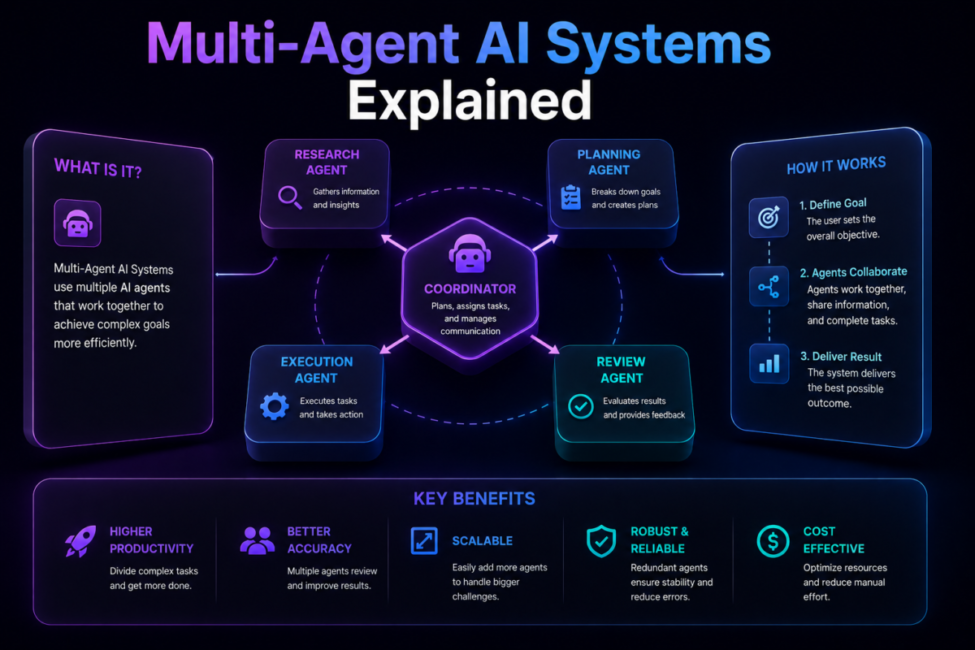
| Quick answer: A multi-agent AI system splits a hard problem across several specialized agents — usually a lead “orchestrator” that decomposes the task and delegates pieces to worker agents running in parallel, then merges their results. It beats a single agent when the work truly breaks into independent threads: Anthropic measured a 90.2% uplift, but at roughly 15x the token cost. |
Definition: A multi-agent AI system is an architecture in which multiple large-language-model agents, each with a narrow role, coordinate through a shared orchestration structure to solve a task that a single agent handles poorly.

Table of Contents
Multi-Agent AI Systems Explained: How the Pieces Fit
The idea is older than LLMs.
The dominant arrangement is the orchestrator-worker pattern: one lead agent owns the full task context, spawns specialist workers in fresh isolated contexts, and stitches their compressed results back together. This mirrors the core loop of agentic AI — plan, act, observe — but distributes it across a team rather than looping inside one model. If you are still deciding whether you even need autonomy, our explainer on the difference between an AI agent and an AI assistant is the right place to start before you scale to many of them.
When does splitting one agent into many actually pay off?
Single agents hit hard walls as tasks grow.
Anthropic’s internal research system is the reference proof point. A lead agent plans a strategy while subagents gather evidence in parallel; the design outperformed single-agent Claude Opus 4 by 90.2% on breadth-first research and cut wall-clock time on complex queries dramatically. You can read the full architecture in Anthropic’s engineering writeup.
But it is not a free upgrade. That same system burned roughly 15x the tokens of a single chat turn, and token usage alone explained about 80% of the performance variance — which tells you multi-agent mostly works by spending more compute, not by magic. The hard rule: architecture follows task structure. If the task is linear, sequential, or latency-sensitive, coordination overhead is pure cost. Before reaching for a team, make sure a single well-built agent from our best AI agent tools roundup genuinely cannot do the job.
The six orchestration patterns, ranked by how often they ship
Production multi-agent systems are assembled from six proven coordination patterns.
| Pattern | How it works & where it fits |
| Sequential chain | Agents run one after another, each feeding the next — linear, staged workflows. |
| Parallel fan-out | Many agents run the same step concurrently — breadth-first exploration. |
| Supervisor / worker | One orchestrator routes sub-tasks to specialists and merges results — ~70% of production systems. |
| Hierarchical delegation | Tiered supervisors manage sub-teams of workers — distinct domains of expertise. |
| Consensus / debate | Agents argue or vote toward a better answer — surfacing hidden failures. |
| Human-in-the-loop | A person approves or corrects at key steps — high-stakes decisions. |
The supervisor/worker pattern dominates — industry surveys and vendor reference designs put it at roughly 70% of production deployments in 2026, spanning builds at Stripe and Mercury and the public Anthropic and OpenAI blueprints. It wins the trade-off between flat coordination (none) and hierarchical (heavy): one level of routing, parallelism across workers, and observability you can actually reason about.
Why not just add more layers?
Hierarchy adds oversight and per-branch budgets but at a real latency cost — a three-level hierarchy with a two-second LLM call at each tier adds at least six seconds before a single worker starts, which rules it out for interactive UX. Consensus/debate, by contrast, is powerful for reliability: adding a reviewer or fact-checker agent to verify another’s output measurably reduces hallucinations on citations and code.
How do the agents actually talk to each other?
For a team of agents to cooperate, they need to reach tools and reach each other. Two open standards now handle this, and as of December 2025 both sit under the Linux Foundation’s new Agentic AI Foundation, with OpenAI, Google, Microsoft, and Anthropic all signed on.
- MCP (Model Context Protocol) is vertical — it standardizes how one agent connects to tools and data. Think of it as USB-C for tool connectivity. The spec lives at modelcontextprotocol.io.
- A2A (Agent-to-Agent) is horizontal — it standardizes how agents discover and message each other, even across frameworks and organizations. Think of it as HTTP for agent collaboration; details at the A2A protocol site.
The momentum is real: at its one-year mark in April 2026, the A2A project reported more than 150 supporting organizations, integration across Google, Microsoft, and AWS, and SDKs in five languages. Standardized communication matters most for multi-agent systems specifically because the coordination surface is where these systems break.
Which framework should you reach for?
You rarely build from raw API calls — frameworks provide lifecycle management, orchestration, observability, and resilience. The leading choices map to the patterns above. LangGraph models agents as a stateful graph with durable execution, ideal for supervisor and hierarchical patterns that need audit trails; its multi-agent docs are at langchain.com/langgraph.
| Framework | Model | Fits which pattern |
|---|---|---|
| LangGraph | Stateful graph with durable execution | Supervisor and hierarchical work needing audit trails |
| CrewAI | Role-based crews with declarative tasks | Sequential chains and role-split teams |
| AutoGen | Conversational agents exchanging messages | Consensus, debate and reviewer patterns |
| OpenAI Agents SDK | Lightweight handoffs between agents | Supervisor/worker without heavy infrastructure |
A caution from practitioners: the skills that matter most are not framework-specific. Engineers who understand state-machine design, fault-tolerant distributed systems, observability, and the failure characteristics of LLMs will succeed regardless of which orchestration library wins next year. For a fuller catalog of what you can wire together, see our guide to real-world agentic AI applications.
Multi-agent systems in practice
Consider Paloma, a solo market-research consultant who fields “map the competitive landscape for X” requests from startup clients. A single agent used to take one broad question, run one search thread, and hand back a shallow list.
The illustrative outcome is not a bigger number so much as a different shape of work: Paloma’s system explores four directions at once instead of one, and the reviewer step means she spends her time editing a sourced draft rather than fact-checking from scratch. The trade-off is exactly the one the research predicts — her token bill rose sharply, so she reserves the multi-agent path for genuinely broad briefs and keeps a single agent for quick, linear lookups.
Costs, failure modes, and how to keep them in check
Multi-agent systems introduce real challenges. Cost is the biggest — the 15x token multiplier can make a design an order of magnitude more expensive, so the task must justify it.
What actually drives the 15x token multiplier
The multiplier is not the agent count — it is context duplication. Every worker needs enough of the task, the shared state and the tool definitions to act sensibly, so the same preamble is re-sent on each branch. Then the orchestrator pays again to read every worker’s output and merge it. A five-worker fan-out therefore bills roughly seven full-context passes, not five, and each conversational turn re-sends the accumulated history. Retries multiply on top: a worker that fails twice and falls back to a stronger model can cost more than the entire single-agent baseline on its own.
The failure modes that actually bite in production
Error compounding is the one that surprises teams. Reliability multiplies rather than averages across handoffs — five sequential steps at 95% each land at roughly 77% end to end, and the system looks fine at every individual step while failing a quarter of the time overall. Alongside it: context loss, where a worker acts on a summary that dropped the constraint that mattered; coordination loops, where two agents hand work back and forth until a limit stops them; and debugging opacity, because a non-deterministic run across six agents is genuinely hard to reproduce from a bug report.
How to keep costs and failures in check
| Control | What it does |
|---|---|
| Hard turn and depth caps | Stops coordination loops before they bill. Every agent needs a maximum turn count and the graph a maximum depth. |
| Per-branch token budgets | Caps spend per worker rather than per run, so one pathological branch cannot consume the whole budget. |
| Model tiering | A capable model orchestrates; cheap fast models do the workers. This is the single biggest cost lever available. |
| Structured handoffs | Pass typed objects between agents, not prose summaries — this is what prevents context loss. |
| Prompt caching | The duplicated context is identical across workers, which is exactly what caching is for. |
| Tracing on every run | Per-agent spans with token counts. Without it you cannot tell which agent caused the bill or the bug. |
Set the caps and the tracing before the first production run, not after the first surprising invoice. A multi-agent system without per-agent token accounting is a system you cannot cost-optimise, because you cannot see where the money went.

Affiliate disclosure: TechieHub is reader-supported. Some outbound links may earn us a commission at no extra cost to you.
Frequently Asked Questions
What is a multi-agent AI system?
A multi-agent AI system uses several specialized AI agents that collaborate instead of one agent doing everything. The most common structure is the orchestrator-worker pattern: a lead agent decomposes the task, delegates pieces to worker subagents that often run in parallel, then merges their results into a final answer.
When is a multi-agent system better than a single agent?
Multi-agent wins when a task decomposes into independent, parallel threads, especially breadth-first research pursuing several directions at once. Anthropic’s system beat a single agent by 90.2% on such work. For linear, sequential, or latency-sensitive tasks, a single agent is usually cheaper and more reliable.
What is the orchestrator-worker pattern?
The orchestrator-worker (supervisor/worker) pattern uses one orchestrator agent that classifies a task, decomposes it, dispatches sub-tasks to specialist workers, and merges the results. It accounts for roughly 70% of production multi-agent deployments in 2026 because it balances flat coordination against heavy hierarchy.
How much more do multi-agent systems cost?
Significantly more. Anthropic’s multi-agent research system used roughly 15 times the tokens of a single chat interaction, and token usage alone explained about 80% of the performance variance. That order-of-magnitude cost is why you should reserve multi-agent designs for tasks that genuinely need them.
How do agents in a multi-agent system communicate?
Through two open standards now governed by the Linux Foundation. MCP (Model Context Protocol) is vertical and connects an agent to tools and data. A2A (Agent-to-Agent) is horizontal and connects one agent to another, even across frameworks. Most sophisticated systems use both together.
What frameworks are used to build multi-agent systems?
Common choices are LangGraph (stateful graphs, ideal for supervisor and hierarchical patterns), CrewAI (role-based crews mapping to specialist workers), and AutoGen/AG2 (conversational and debate patterns via GroupChat). The right pick depends on the pattern your task needs; underlying distributed-systems skills matter more than any one framework.
Conclusion
The decision this whole architecture turns on is narrower than it looks: does the work genuinely split into independent threads? Anthropic’s 90.2% uplift came from breadth-first research where sub-questions could be investigated in parallel without talking to each other. Work that is inherently sequential — where step three needs the actual output of step two — gets no benefit from parallelism and pays the coordination cost anyway.
So resist the architecture until the task demands it. Start with one capable agent and good tools; most work that looks multi-agent is a single agent with a retrieval problem. When you do split, take the supervisor/worker pattern first — it is roughly 70% of production systems for good reason — and treat hierarchy as a last resort, because each tier adds seconds before any real work begins. Then instrument it from day one: per-agent traces, hard turn caps and per-branch budgets, because at 15x tokens the failure that hurts is not the one that crashes but the one that quietly bills. For the wider context see what is agentic AI and agentic AI applications.
