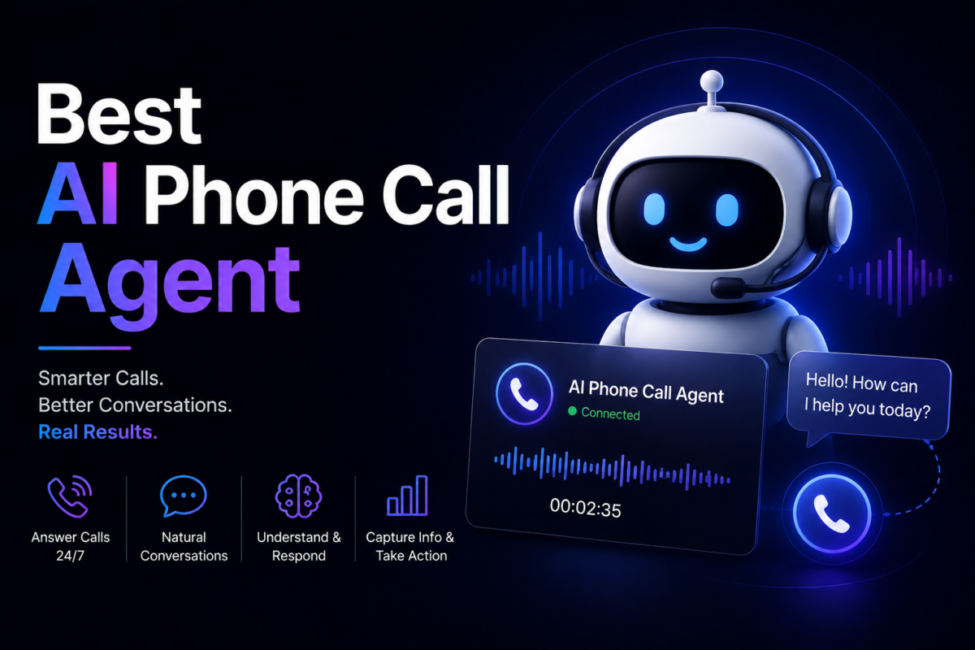
The complete guide for businesses and content creators: the top 10 best AI phone call agent platforms of 2026 — tested on real calls, ranked by latency, voice quality, pricing, and use case — from no-code SMB tools to enterprise-grade call center AI.
| $80B Contact center savings (Gartner) | 80% Routine calls resolved by AI | 600ms Best-in-class response latency | 68% Cost reduction reported | 100+ Languages (Vapi) |
Table of Contents
1. What Is an AI Phone Call Agent?
An AI phone call agent is software that uses speech recognition, large language models, and text-to-speech technology to conduct real phone conversations autonomously — answering inbound calls, making outbound calls, qualifying leads, booking appointments, resolving support queries, and routing complex issues to human agents, all without human involvement in the call itself.
The critical distinction from legacy IVR: Traditional interactive voice response (IVR) systems force callers through rigid menu trees — ‘Press 1 for sales, press 2 for support.’ AI phone call agents understand natural language. A caller can say ‘I need to reschedule my appointment for next Thursday afternoon instead’ and the agent understands, checks availability, updates the booking, and confirms — without any menu navigation or human intervention.
The technology stack behind an AI phone call agent combines four components: speech-to-text (STT) to transcribe the caller’s words in real time, a large language model (LLM) to understand intent and generate a contextually appropriate response, text-to-speech (TTS) to convert the response to natural-sounding voice, and a telephony layer to manage call routing, transfers, and connections. The quality of integration between these four layers determines the critical metric of call latency — the delay between when a caller stops speaking and when the AI responds. Latency above one second noticeably degrades conversation quality; platforms achieving under 600ms feel genuinely natural.
| 📌 Key InsightAI phone agents handle three types of calls in 2026: inbound call handling (answering calls, qualifying leads, booking appointments, answering FAQs), outbound call campaigns (sales prospecting, appointment reminders, follow-ups, collections), and hybrid routing (AI handles routine calls autonomously, escalates complex or emotional calls to human agents with full context). Most platforms in this guide support all three modes. |
2. Why Businesses Are Deploying AI Phone Agents in 2026
- $80 billion contact center savings: Gartner predicted that conversational AI would reduce contact center agent labor costs by $80 billion in 2026. This forecast reflects the operational reality: AI phone agents handle 80% of routine inquiries autonomously, allowing businesses to maintain or increase call capacity without proportional headcount growth.
- 68% cost reduction: Businesses report up to 68% reduction in customer service costs after implementing AI voice agents, while handling up to 3 times the ticket capacity with the same team size. AI agents do not take sick days, do not have shift limits, and handle simultaneous calls without degradation in quality.
- 24/7 availability without overtime: AI phone agents answer calls at 3 AM on Sunday with the same quality as during peak business hours. For businesses with after-hours call volume — appointment bookings, support queries, sales inquiries — this represents captured revenue and resolved issues that would otherwise result in missed calls and lost customers.
- Consistent call quality: Human agents have off days, script deviations, and variable call quality. AI agents deliver consistent messaging, consistent qualification questions, and consistent data capture every call — producing cleaner CRM data and more reliable customer experiences.
- Latency has crossed the naturalness threshold: Customers hang up 40% more frequently when an AI voice agent takes longer than 1 second to respond. In 2026, the best platforms achieve 400–600ms response latency — below the naturalness threshold where delays become perceptible. This technical milestone has made AI phone agents deployable in customer-facing contexts where they previously sounded robotic.
- Sales efficiency breakthrough: AI outbound calling at scale achieves cold call connect rates of 18% versus 6% for human SDRs making 30 calls per hour — because AI agents can make hundreds of simultaneous calls. Cost per booked meeting drops from over $200 on human SDR teams to approximately $58 with AI agents at scale.
3. The 3 Types of AI Phone Call Agents
| Type | What It Does | Best For | Top Examples |
|---|---|---|---|
| Autonomous AI Agents | Handle complete conversations independently from start to finish with no human involvement | High-volume routine calls: appointment booking, FAQs, lead qualification, outbound campaigns | Retell AI, Bland AI, Air AI, Ringly, Ringg AI |
| Agent-Assist Tools | Provide real-time guidance, suggested responses, and coaching to human agents during live calls | Complex sales, high-stakes support, calls where human judgment is required | Aircall, Aloware, CloudTalk Conversation Intelligence |
| Hybrid Models | AI handles routine portions of calls autonomously, seamlessly escalates complex issues to humans with full context | Businesses wanting both AI efficiency and human quality on complex queries | PolyAI, Synthflow, CloudTalk, Smith.ai |
4. Top 10 Best AI Phone Call Agents 2026 — Full Reviews
4.1 Retell AI — Best Overall AI Phone Call Platform
| Spec | Detail |
|---|---|
| Best For | Real-time phone calls and customer support teams — best overall production platform |
| Response Latency | ~600ms — near-naturalness threshold with proprietary voice AI orchestration |
| Free Plan | Yes — trial available |
| Paid Plans | Usage-based — pay per minute |
| LLM Flexibility | GPT-5.4, Claude, Gemini — choose model per agent |
| Key Features | Visual drag-and-drop builder, API access, simulation testing, analytics, HubSpot/Twilio/n8n integration |
| Call Modes | Inbound, outbound, omnichannel (voice + chat + SMS from single agent config) |
| Key Differentiator | Built-in simulation testing to validate agent behavior before going live — reduces production failures |
Retell AI is the strongest overall AI phone call platform for production deployment in 2026. Its ~600ms response latency — achieved through proprietary voice AI orchestration — sits at the threshold where conversations feel genuinely natural to callers. Unlike competitors that force a choice between no-code simplicity and developer flexibility, Retell offers both: a visual drag-and-drop builder for non-technical users and deep API access for engineering teams customizing complex workflows. The LLM flexibility is a genuine differentiator — you can run the same agent on GPT-5.4, Claude, or Gemini and compare output quality on your specific use case. Built-in simulation testing lets you validate agent behavior across edge cases before any live call goes out — a critical feature that most competitors lack, and whose absence is why many AI phone deployments fail in production.
Why Retell leads for production teams: Comprehensive analytics dashboards, native integrations with HubSpot, Twilio, and n8n, and omnichannel deployment from a single agent configuration mean that one Retell agent can handle voice, chat, and SMS from the same trained knowledge base — reducing the maintenance overhead of separate channel deployments.
4.2 Vapi AI — Best for Developers & Custom Workflows
| Spec | Detail |
|---|---|
| Best For | Engineering teams wanting full API control over AI phone call infrastructure |
| Architecture | API-first framework — infrastructure layer, not a finished product |
| Free Plan | $10 free credits on signup |
| Pricing | Usage-based — approximately $0.05/minute |
| Languages | 100+ languages — broadest multilingual support in the category |
| LLM Support | Any LLM — integrate your own or use platform defaults |
| Key Differentiator | Most flexible platform — deep customization across LLMs, voices, telephony providers, and backend systems |
| Limitation | Requires significant engineering effort — not suitable for non-technical teams |
Vapi AI is the developer’s AI phone platform — a flexible infrastructure layer that gives engineering teams full control over how voice agents are built and deployed. Rather than offering a pre-built system with fixed options, Vapi provides the building blocks: connect any LLM, integrate any telephony provider, route to any backend system, build any conversation flow. The result is a platform limited only by the engineering team’s implementation quality rather than by platform constraints. Its 100+ language support is the broadest in the category — critical for global deployments requiring native language quality across diverse markets. The clear limitation: without significant engineering resources, Vapi’s flexibility becomes complexity. Non-technical teams should choose Synthflow, Retell’s visual builder, or CloudTalk instead.
| 💡 Pro TipFor development teams evaluating Vapi, start with the $10 free credit allocation to test your specific use case before committing to production infrastructure. Build your most complex conversation scenario first — if Vapi handles your edge case, it handles everything. If it struggles on complex multi-turn conversations, evaluate Retell AI’s more opinionated architecture instead. |
4.3 Bland AI — Best for Outbound Calling at Scale
| Spec | Detail |
|---|---|
| Best For | High-volume outbound calling campaigns — sales, lead qualification, appointment reminders |
| Pricing | $0.09/minute — usage-based, no platform fee |
| Free Plan | Trial available |
| Latency | Fastest in category — optimized for outbound cold calling scenarios |
| Key Features | Voice cloning, API-based customization, programmable workflows, multilingual |
| Technical Level | Developer-first — API-based, limited visual builder |
| Key Differentiator | Most cost-effective for high-volume outbound at $0.09/minute with voice cloning capability |
Bland AI’s positioning is clear: the most cost-effective, fastest-latency platform for high-volume outbound calling. At $0.09 per minute, it is significantly cheaper than platform-fee competitors for teams making thousands of calls per month. Its voice cloning capability allows businesses to train a custom AI voice — matching a brand’s existing spokesperson voice or creating a distinct persona — producing outbound calls that sound consistent and brand-aligned rather than generic. Cold call AI deployments on Bland AI achieve 18% connect rates on outbound campaigns versus 6% for human SDRs, at a cost per booked meeting of approximately $58 versus $200+ for human SDR teams. Best for sales teams, appointment reminder campaigns, collections, and any high-volume outbound use case where cost per call matters.
4.4 CloudTalk — Best for SMB Sales & Support Teams
| Spec | Detail |
|---|---|
| Best For | Growing SMBs wanting an all-in-one cloud phone system with native AI voice agents |
| Users | 4,000+ teams globally |
| Free Plan | 14-day free trial |
| Paid Plans | Starter $25/user/mo · Essential $30/user/mo · Expert $50/user/mo |
| AI Voice Agent (CeTe) | Add-on from $350/month — 1,000 minutes included |
| Languages | 60+ languages and accents |
| Key Features | AI Voice Agent, AI Dialer (80+ conversations/day), Conversation Intelligence, CRM sync |
| CRM Integrations | Salesforce, HubSpot, Pipedrive, Zendesk — native bidirectional sync |
CloudTalk is the most complete SMB AI phone system in 2026 — combining an AI Voice Agent (CeTe), AI Dialer, Conversation Intelligence, and deep CRM integrations in a single platform. CeTe handles inbound calls 24/7: qualifies leads, confirms meetings, collects feedback, and escalates to human agents when needed — all with automatic CRM sync so no call data requires manual entry. The AI Dialer enables parallel dialing with 1.5-second voicemail detection and instant connection, helping sales reps reach 80+ live conversations per day versus the 20–30 typical of manual dialing. Conversation Intelligence adds automatic transcription, AI summaries, sentiment analysis, and real-time insights on every call. For SMBs that want AI phone capability without building custom infrastructure, CloudTalk is the lowest-friction path to production.
4.5 Synthflow AI — Best No-Code AI Phone Agent
| Spec | Detail |
|---|---|
| Best For | Non-technical teams wanting fast deployment without engineering resources |
| Free Plan | Yes — free plan available |
| Paid Plans | $50–$450/month depending on usage and features |
| Setup Time | Hours to days — no code required |
| Languages | 50+ languages |
| Key Features | No-code visual builder, pre-built templates, scheduled calls, CRM integrations |
| Best For | SMBs, early-stage startups, solopreneurs, agencies deploying for clients |
| Limitation | Struggles with complex multi-turn conversations — best for structured, predictable call flows |
Synthflow AI is the most accessible AI phone agent platform for teams without engineering resources. Its no-code visual builder allows non-technical users to design complete voice agent workflows in hours, not weeks — selecting from pre-built templates for appointment booking, lead qualification, customer support, and outbound campaigns, then customizing without writing a line of code. The accessible pricing at $50/month entry makes it one of the few platforms genuinely usable for small businesses and solopreneurs. The honest limitation: Synthflow performs best on structured, predictable call flows. Complex or emotionally nuanced multi-turn conversations degrade its performance more than API-first platforms. For businesses with well-defined, repeatable call scenarios, Synthflow delivers strong ROI. For businesses needing sophisticated conversation handling, Retell AI or Bland AI are more appropriate.
4.6 PolyAI — Best Enterprise AI Phone Agent
| Spec | Detail |
|---|---|
| Best For | Enterprise organizations with high call volumes and complex multilingual requirements |
| Pricing | Custom — typically six figures annually |
| Containment Rate | 80–87% for enterprise clients — highest documented rate in the category |
| Languages | 30+ languages with enterprise-grade multilingual complexity |
| Implementation | Weeks to months with dedicated support team |
| Key Features | Custom AI personas, enterprise security certifications, multilingual agents, advanced analytics |
| Typical Clients | Large retail chains, financial services, hospitality, utilities |
| Limitation | Enterprise pricing excludes SMBs; longer implementation timeline |
PolyAI is the enterprise gold standard for AI phone call agents in 2026. Its 80–87% call containment rate for enterprise clients — meaning 80–87% of calls are fully resolved by the AI without human escalation — is the highest documented rate in the category and reflects both the sophistication of its conversational AI and the depth of its implementation support. PolyAI builds custom AI personas for each enterprise client: voice, personality, and conversation approach are tailored to match the brand’s existing customer experience standards. For multinational enterprises handling calls in multiple languages with complex business logic, PolyAI’s specialization in high-stakes multilingual deployments provides a level of accuracy and naturalness that self-service platforms cannot match. The six-figure annual pricing reflects this — PolyAI is enterprise infrastructure, not a software subscription.
4.7 Air AI — Best for Natural Long-Form Conversations
| Spec | Detail |
|---|---|
| Best For | Use cases requiring extended, naturally flowing conversations — sales, relationship building |
| Key Feature | Extended natural conversations with context awareness across long call durations |
| Voice Quality | Premium voice synthesis — most natural-sounding voice in the category |
| Custom Personas | Custom voice personalities per deployment |
| Pricing | Usage-based — contact for pricing |
| Best For | Cold calling, B2B sales, longer consultative conversations |
| Key Differentiator | Best voice naturalness on cold calls where skeptical prospects are more sensitive to AI detection |
Air AI focuses on the dimension most critical for cold outbound calling: voice naturalness. When a prospect receives an AI cold call and detects the robotic quality of a lesser platform, they disconnect immediately. Air AI’s premium voice synthesis produces the most human-sounding conversations in the category — context awareness across extended call durations maintains coherent, natural dialogue that does not degrade over longer conversations the way some platforms do. For B2B outbound sales teams where the quality of a cold call’s first 15 seconds determines whether the prospect stays engaged, Air AI’s voice quality advantage translates directly to higher connect rates and more conversations that reach the qualification stage. Best fit for premium outbound campaigns where voice quality matters more than per-minute cost.
4.8 Ringly.io — Best for E-Commerce & Shopify
| Spec | Detail |
|---|---|
| Best For | E-commerce stores — especially Shopify — handling customer service calls at scale |
| Resolution Rate | 73% of e-commerce calls resolved autonomously |
| Languages | 40 languages |
| Key Feature | Deep Shopify integration — order lookup, tracking, returns, product questions in real-time |
| Guarantee | 65% call resolution guarantee for Shopify stores |
| Pricing | Usage-based — contact for pricing |
| Best For | DTC brands, Shopify merchants, e-commerce customer service automation |
| Key Differentiator | Only platform with a documented resolution rate guarantee for e-commerce deployments |
Ringly.io is purpose-built for e-commerce customer service — specifically Shopify stores — and its 73% autonomous call resolution rate for e-commerce queries reflects the depth of its integration with e-commerce data. Where a general AI phone agent might answer product questions generically, Ringly connects directly to your Shopify store: it can look up a specific order by name or email, check real-time inventory status, process return requests, provide accurate shipping ETAs, and answer product-specific questions — all live on the call without a human agent. For Shopify merchants handling hundreds of ‘where is my order?’ and ‘can I return this?’ calls per week, Ringly transforms the most repetitive customer service calls into a fully automated workflow. The 65% resolution guarantee is unique in the market — no other AI phone platform guarantees a specific autonomous resolution rate.
4.9 Smith.ai — Best Human-AI Hybrid Answering Service
| Spec | Detail |
|---|---|
| Best For | Businesses not ready for fully autonomous AI calls — want human backup on all calls |
| Model | Hybrid: AI handles routine, human agents handle complex and emotional calls |
| Free Trial | 14-day trial |
| Pricing | Starter $292/mo (20 calls) · Basic $492/mo (40 calls) · Pro $1,012/mo (80 calls) |
| Best For | Law firms, medical practices, high-stakes professional services |
| Key Feature | 24/7 human + AI hybrid — every call has human oversight |
| Key Differentiator | Only service guaranteeing a human backup on every call — maximum quality assurance |
Smith.ai occupies a unique position in this guide: it is not a fully autonomous AI platform but a human-AI hybrid service where AI handles the structured portions of calls and human agents take over for complex, sensitive, or emotionally charged situations. For businesses in high-stakes professional services — law firms, medical practices, financial advisors — where a mishandled call can have serious consequences, Smith.ai’s human oversight on every call provides quality assurance that pure AI platforms cannot match. The higher per-call cost versus pure AI platforms reflects the human labor involved, but for businesses where call quality is non-negotiable and the volume is moderate, Smith.ai is the appropriate choice over fully autonomous alternatives.
4.10 Goodcall — Best for Small Businesses & HIPAA Compliance
| Spec | Detail |
|---|---|
| Best For | Small businesses wanting deep customization and HIPAA-compliant AI phone answering |
| Free Plan | Trial available |
| Pricing | Starter $79/mo (100 unique customers) · Growth $129/mo · Scale $249/mo |
| HIPAA Compliance | Yes — HIPAA certified, suitable for healthcare and privacy-sensitive sectors |
| Key Features | Custom call flow configuration, lead capture during calls, Google Voice + Zapier integration |
| Best For | Healthcare practices, professional services, any business with privacy compliance requirements |
| Key Differentiator | Most configurable small business option with HIPAA compliance at accessible pricing |
Goodcall fills the specific gap of HIPAA-compliant AI phone answering for small businesses and healthcare practices that need regulatory compliance alongside AI automation. Its deep customization — defining exactly which questions callers must answer, routing logic at each call stage, lead capture requirements — gives it more configuration flexibility than simpler tools like Rosie or IsOn24 while remaining accessible to non-technical users. The per-agent pricing model (where an agent is a phone number, not a user) makes cost predictable for businesses with a defined number of phone lines. Google Voice integration and Zapier connectivity cover most small business CRM and workflow automation needs without requiring dedicated integration work. For healthcare practices, dental offices, or any privacy-sensitive small business, Goodcall is the most complete HIPAA-ready option in the accessible pricing tier.
5. Head-to-Head Comparison Table
| Platform | Category | Latency | Free Plan | Best Resolution Rate | Languages | Technical Level |
|---|---|---|---|---|---|---|
| Retell AI | Full platform | ~600ms | Trial | 60–70% routine | Multi | Low–High |
| Vapi AI | Developer API | Very low | $10 credits | Depends on build | 100+ | High |
| Bland AI | Outbound-focused | Fastest | Trial | High on outbound | Multi | Medium |
| CloudTalk | SMB all-in-one | Good | 14-day trial | Standard | 60+ | Low |
| Synthflow AI | No-code | Good | Yes | 60–70% structured | 50+ | Low |
| PolyAI | Enterprise | Very low | No | 80–87% enterprise | 30+ | Managed |
| Air AI | Voice quality | Low | Contact sales | High on outbound | Multi | Medium |
| Ringly.io | E-commerce | Good | Contact sales | 73% e-commerce | 40 | Low |
| Smith.ai | Human-AI hybrid | N/A | 14-day trial | Near-100% (human) | English | Low |
| Goodcall | SMB / HIPAA | Good | Trial | Good for SMB | English | Low |
6. Pricing Comparison
| Platform | Pricing Model | Entry Cost | Best For Budget |
|---|---|---|---|
| Synthflow AI | Monthly plans | $50/month | Best entry price for no-code AI calls |
| Goodcall | Per agent/month | $79/month | Best for HIPAA-compliant small business |
| Bland AI | Per minute | $0.09/min (usage-based) | Best for high-volume outbound — pay per use |
| Vapi AI | Per minute | ~$0.05/min | Cheapest per-minute for developer builds |
| Retell AI | Per minute | Usage-based | Best value for production at scale |
| CloudTalk | Per user/month | $25/user/mo + $350 AI add-on | Best all-in-one for growing SMB teams |
| Ringly.io | Usage-based | Contact sales | Best for Shopify merchants by resolution guarantee |
| Air AI | Usage-based | Contact sales | Best for premium outbound voice quality |
| Smith.ai | Per call | $292/month (20 calls) | Best for human-hybrid professional services |
| PolyAI | Enterprise custom | Six figures/year | Enterprise only — best containment rate |
| 📌 Key InsightFor budget-conscious deployment, the most cost-effective path is: Synthflow AI ($50/month) for structured inbound call flows, or Bland AI / Vapi AI (usage-based at $0.05–$0.09/minute) for outbound campaigns. A business making 500 outbound calls per month at 3 minutes average = 1,500 minutes = $75–$135/month on usage-based pricing — often cheaper than any platform-fee alternative at that volume. Always calculate your actual usage before choosing between flat-rate and usage-based pricing. |
7. Which AI Phone Agent Is Right for Your Business?
| Your Situation | Best Platform | Why |
|---|---|---|
| All-round production deployment | Retell AI | Best latency, simulation testing, LLM flexibility, omnichannel from one agent |
| Developer building custom workflows | Vapi AI | API-first framework, 100+ languages, any LLM, full infrastructure control |
| High-volume outbound at low cost | Bland AI | $0.09/min, fastest latency, voice cloning, best cost per booked meeting |
| SMB all-in-one phone system | CloudTalk | AI Voice Agent + AI Dialer + analytics + deep CRM sync in one platform |
| No-code fast deployment | Synthflow AI | No engineering required, $50/month entry, hours to live |
| Enterprise high-volume complex calls | PolyAI | 80–87% containment, custom AI personas, enterprise security, multilingual |
| Premium outbound voice quality | Air AI | Most natural voice, best for cold calls where voice quality drives connect rate |
| Shopify / e-commerce customer service | Ringly.io | Deep Shopify integration, 73% resolution rate, 65% resolution guarantee |
| Human oversight on every call | Smith.ai | Human-AI hybrid, maximum quality assurance for high-stakes professional calls |
| Small business with HIPAA needs | Goodcall | HIPAA compliant, $79/month, deep customization, Google Voice integration |
8. Implementation Best Practices
AI phone agent deployments fail most often not because of platform limitations but because of implementation mistakes. Here are the practices that separate successful deployments from costly failures:
- Define your call scope precisely before building: The most common deployment failure is building an AI agent that tries to handle too many different call types simultaneously. Define a narrow, specific scope for your first agent: ‘answer inbound appointment booking calls for our dental practice.’ Once that works reliably, expand scope. Trying to handle appointment booking, billing disputes, and clinical questions with one agent before any of them work well is the most consistent failure pattern.
- Test latency on your actual phone infrastructure: Platform-claimed latency figures are measured under ideal conditions. Test response latency on your actual call setup — VoIP connection quality, geographic routing, and network conditions all affect real-world latency. If your phone infrastructure introduces 300ms of additional latency on top of a platform’s 600ms response time, you are at 900ms — above the naturalness threshold. Test before committing.
- Build explicit escalation triggers from day one: Configure clear escalation triggers before your agent goes live: escalate when confidence is below a threshold, escalate when a caller expresses frustration three times, escalate when specific keywords appear (complaint, lawyer, cancel, emergency). AI agents that have no escalation path create hostile caller experiences when they inevitably encounter scenarios outside their training. Human escalation with full call context transferred is the safety net that makes autonomous AI phone deployment responsible.
- Train on your actual call recordings: The fastest path to high resolution rates is training your AI agent on recordings of your best human agents handling the same call types. Your human agents have already learned which phrases de-escalate frustrated callers, which questions qualify leads most efficiently, and which information callers need most. This institutional knowledge transfers to AI training — use it.
- Disclose AI where required — and where it builds trust: Legal disclosure requirements for AI phone interactions vary by jurisdiction. In several US states and the EU, AI calls must be disclosed at the start of the conversation. Beyond compliance, proactive disclosure often improves caller satisfaction — ‘I’m an AI assistant and I can help you book an appointment right now’ sets appropriate expectations and prevents the frustration of a caller believing they have deceived a human agent. Check your jurisdiction’s requirements and err toward disclosure.
- Monitor and optimize weekly for the first three months: AI phone agents improve with monitoring and iteration. Review call recordings weekly for the first 90 days: identify calls where the agent failed to understand intent, where callers expressed frustration, where escalations happened unnecessarily. Each failure mode reveals a training or configuration improvement. Teams that monitor and iterate weekly see resolution rates climb from 50–60% at launch to 70–80%+ by month three.
| ⚠️ Watch OutNever deploy an AI phone agent to customer-facing calls without first running extensive simulation testing on edge cases. Most platforms that fail in production perform well on expected inputs and fail on unexpected ones — the frustrated caller who does not follow the anticipated conversation flow, the caller with an unusual accent, the caller who asks an off-topic question. Test your most difficult expected scenarios before going live, and build explicit handling for failure modes rather than discovering them on live customer calls. |
9. Frequently Asked Questions
What is the best AI phone call agent in 2026?
For most businesses wanting production-ready AI phone call capability, Retell AI is the strongest overall platform in 2026 — offering ~600ms latency, a visual builder for non-technical users, deep API access for developers, simulation testing before live deployment, and omnichannel support from a single agent configuration. For enterprise organizations needing 80–87% call containment, PolyAI leads. For high-volume outbound at the lowest cost, Bland AI at $0.09/minute is the best value. For Shopify e-commerce, Ringly.io’s 73% resolution rate and Shopify-specific integration make it the specialist choice.
How much does an AI phone call agent cost?
Pricing varies significantly by platform and model. No-code platforms like Synthflow start at $50/month. Usage-based platforms like Vapi AI and Bland AI charge $0.05–$0.09 per minute of call time. SMB platforms like CloudTalk start at $25/user/month with the AI Voice Agent available as a $350/month add-on. Human-hybrid services like Smith.ai start at $292/month for 20 calls. Enterprise platforms like PolyAI typically cost six figures annually. For most small businesses, the realistic range is $50–$350/month depending on call volume and the sophistication of the deployment.
Can AI phone agents replace human customer service agents?
AI phone agents handle 60–87% of routine calls autonomously in well-configured deployments, but human agents remain essential for complex, emotionally sensitive, or high-stakes interactions. The most successful deployments use a hybrid model: AI handles the high-volume routine calls (appointment booking, order status, FAQ, lead qualification) while human agents handle escalations, complaints, and nuanced situations that require empathy and judgment. This model increases the per-agent capacity of human teams by 3x or more, since humans handle only the calls that genuinely require them.
How long does it take to deploy an AI phone agent?
Deployment time varies significantly by platform and complexity. No-code platforms like Synthflow can go live in hours for simple call flows with pre-built templates. Retell AI’s visual builder enables deployment in 1–3 days for standard use cases. Developer-first platforms like Vapi require 1–4 weeks of engineering time for custom implementations. Enterprise platforms like PolyAI involve weeks to months of implementation with dedicated support teams. The fastest path to a working AI phone agent is starting with a no-code platform on a simple, well-defined call scenario — then expanding complexity as you validate that the core workflow performs correctly.
What response latency is required for AI phone calls to feel natural?
Customers hang up 40% more frequently when an AI voice agent takes longer than 1 second to respond. Industry consensus places the naturalness threshold at under 700–800ms — response times in this range feel like a normal human pause. The best platforms in 2026 achieve 400–600ms: Ringg AI at under 400ms, Retell AI at approximately 600ms, and Bland AI achieving the fastest latency in the outbound category. Avoid platforms with consistent latency above 800ms for customer-facing deployments — the conversation degradation at these latencies noticeably affects caller satisfaction and resolution rates.
Do AI phone agents support multiple languages?
Yes — multilingual support is a standard feature on most 2026 platforms, though depth varies significantly. Vapi AI supports 100+ languages. Synthflow supports 50+. CloudTalk supports 60+ languages and accents. Ringly supports 40. PolyAI specializes in complex enterprise multilingual deployments. Language support quality matters as much as language count — test with native speakers for your critical markets before deploying, as accuracy, pronunciation, and cultural nuance vary significantly between languages on the same platform.
10. Conclusion & Key Takeaways
AI phone call agents have crossed the deployment threshold in 2026. $80 billion in projected contact center savings, 80% autonomous resolution rates, and sub-600ms latency that passes the naturalness test have made AI phone agents operational infrastructure rather than experimental technology. The question for businesses in 2026 is not whether to deploy AI phone agents — it is which platform matches their use case, technical resources, and call volume.
For most businesses, Retell AI is the strongest starting point: production-grade latency, both no-code and API access, simulation testing, and omnichannel support. Add Bland AI for high-volume outbound campaigns where per-minute cost matters. Use Synthflow for the fastest no-code deployment on simple, structured call flows. Choose PolyAI when enterprise scale and 80–87% containment rates are required. And deploy Ringly.io for Shopify e-commerce customer service where the Shopify integration produces the industry’s documented resolution guarantee.
Key Takeaways
- Gartner projected $80 billion in contact center labor savings from AI in 2026 — AI phone agents are now operational infrastructure, not experiments
- Retell AI is the best overall production AI phone platform — 600ms latency, visual builder, simulation testing, LLM flexibility
- Vapi AI is the best for developers — API-first, 100+ languages, any LLM, full customization but requires engineering resources
- Bland AI is the best for outbound cost efficiency — $0.09/minute, fastest latency, voice cloning, $58 cost per booked meeting
- PolyAI leads enterprise containment rates at 80–87% — six-figure investment, dedicated implementation, multilingual enterprise capability
- Ringly.io is the Shopify specialist — 73% resolution rate and a 65% resolution guarantee for e-commerce customer service
- Synthflow at $50/month is the most accessible no-code entry point — hours to live on structured call flows
- Latency under 700ms is the naturalness threshold — customers hang up 40% more when AI takes over 1 second to respond
- Always deploy with explicit human escalation triggers — AI agents that cannot escalate create hostile caller experiences
- Monitor weekly for the first 90 days — resolution rates climb from 50–60% at launch to 70–80%+ with iteration
Quick Recommendations
Best by Use Case
- Best overall production deployment: Retell AI — best latency, testing, flexibility
- Best for developers / custom builds: Vapi AI — API-first, 100+ languages, any LLM
- Best for high-volume outbound: Bland AI — $0.09/min, voice cloning, fastest latency
- Best SMB all-in-one: CloudTalk — AI Voice Agent + Dialer + Intelligence + CRM
- Best no-code fastest deployment: Synthflow AI — $50/month, hours to live
- Best enterprise containment: PolyAI — 80–87% resolution, custom personas, multilingual
- Best for premium outbound voice: Air AI — most natural voice, best cold call connect rate
- Best for Shopify e-commerce: Ringly.io — 73% resolution, Shopify-native, 40 languages
- Best human-AI hybrid: Smith.ai — human backup on every call, high-stakes professional services
- Best SMB HIPAA compliance: Goodcall — $79/month, HIPAA certified, deep customization
🚀 Getting Started Action Plan
- TODAY: Identify your single highest-volume, most repetitive call type. Count how many of these calls your team handles per week. Calculate: calls × average duration × hourly staff cost. This is your AI phone agent ROI baseline — the labor cost you are replacing.
- DAY 2: Sign up for Retell AI’s trial or Synthflow’s free plan. Build a simple version of your target call flow using the visual builder. Test it yourself by calling in and evaluating the response latency, conversation naturalness, and accuracy of the AI’s handling of your most common queries.
- WEEK 1: Configure your escalation triggers. Define the 5 most common scenarios where a caller should be transferred to a human agent, and build these triggers into your agent before any live calls. Test each escalation scenario to confirm the transfer works correctly with context preserved.
- WEEK 2: Go live with a single phone number handling your target call type. Monitor every call recording for the first week. Identify the three most common failure modes and fix them before expanding volume.
- MONTH 1: Measure your resolution rate, average handle time, and customer satisfaction scores. Compare against pre-deployment baseline. Use this data to build your business case for expanded deployment and additional phone lines or use cases.
- ONGOING: Follow TechieHub.blog for AI phone platform updates, new feature releases, and implementation guides as the conversational AI market evolves rapidly through 2026 and beyond.
Every missed call is a missed opportunity. AI phone agents in 2026 answer every call, every time, in any language — at a fraction of the cost of growing your human team. Start with one use case, measure the ROI, and scale what works.


1 Comment
Pingback: Best AI Agent: Ultimate Buyer's Guide [2026] - %sitenameBest AI Agent: Ultimate Buyer's Guide [2026]