


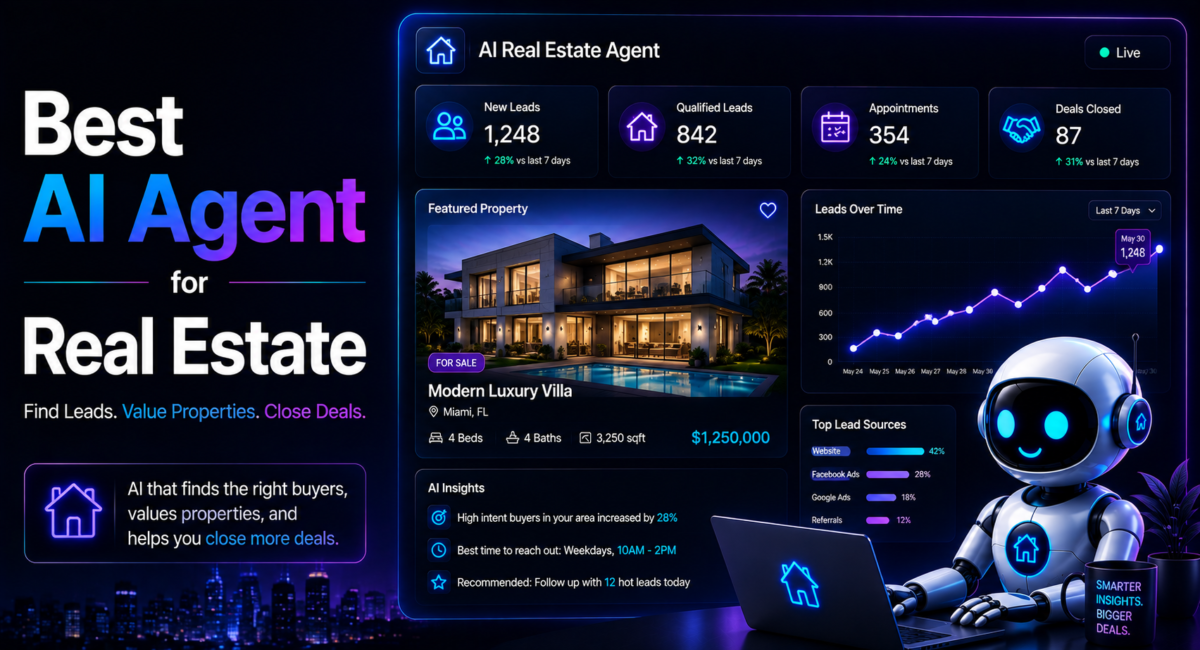
| Quick answer: There is no single best AI agent for real estate — the category splits into lanes, so top performers stack a specialist per lane. In 2026 the strongest picks are Structurely for instant lead response, Ylopo for scale, Lofty as an all-in-one, Follow Up Boss for CRM and REimagineHome for virtual staging. |
How we compare: we weigh each tool on lead-response speed, CRM depth, listing and staging output, pricing transparency and compliance support, drawing on vendor documentation and independent 2026 industry data rather than marketing claims. Disclosure: some links below are affiliate links. If you buy through them TechieHub may earn a commission at no extra cost to you, and it never changes our rankings.

An AI agent for real estate is software that autonomously handles a repetitive part of the sales cycle — answering a new lead, qualifying it, drafting a listing, or scheduling a showing — without a human triggering each step.
Table of Contents
What is an AI agent for real estate?
It is not a robot that replaces the agent. Real estate stays relationship-driven and local: reading a nervous seller, negotiating a counter, walking a family through a home. What an AI agent removes is the administrative drag around that work. If you are new to the underlying idea, our primer on what agentic AI actually is explains how these systems plan and act on goals instead of waiting for prompts, and the broader applications of agentic AI show why property is one of its fastest-adopting verticals.
The market divides cleanly into five lanes: conversational capture and qualification, AI-enhanced CRM, listing copy and staging, transaction coordination, and long-cycle nurture. Adoption is now mainstream — the National Association of Realtors’ 2025 technology survey found roughly two-thirds of agents using AI, and a February 2026 Realtors Property Resource poll put adoption at 82% (NAR). The agents seeing results, though, are not the ones running the most tools; they are the ones running the right tool in each lane.
Why does response speed decide the deal?
Speed is the single biggest reason to bring AI into a real estate business. The average human agent takes over 15 hours to respond to a new online lead, while an AI text agent replies in under 60 seconds and a voice agent answers in about a second. That gap is decisive: leads contacted within five minutes are roughly 21x more likely to convert than those reached after 30 minutes, and 78% of buyers work with the first agent who responds. One 2026 analysis found leads engaged inside 60 seconds converting at 23.4% versus 4.8% after half an hour — nearly a fivefold swing from timing alone.
Because most buyers are not ready to transact for 6–12 months, the same speed advantage compounds across the long nurture cycle: AI keeps texting and calling at sensible intervals long after a human would have given up at follow-up number three. This is the same instant-engagement logic that drives modern lead tooling generally — it just matters more in a business where the buying window is measured in seasons.
Which is the best AI agent for real estate?
Here are the leaders, each strongest in a different lane. Confirm live pricing on each vendor’s page, because plans change often.
Structurely — instant lead response
Structurely (its Aisa Holmes assistant) is the category leader for AI inside sales agents. It holds realistic text and voice conversations, replies in under a minute, qualifies on timeline, budget and motivation, and hands off only when a lead clears the bar. Pricing starts around $179/month for a smaller lead volume and rises toward $500/month for fuller team deployments. Best for solo agents and small teams who need instant response without hiring an ISA.
Ylopo — engagement at scale
Ylopo pairs AI-generated video ads on Facebook and Google with its Raiya text-and-voice assistant and behavioral IDX remarketing. Pricing is demo-locked; teams report $1,000–$3,000+ per month once managed ad spend is included. Best for brokerages running paid acquisition at volume.
Lofty — the all-in-one suite
Lofty (formerly Chime) bundles lead gen, CRM, IDX websites and an AI ISA that qualifies via SMS and email and books showings automatically. Plans start near $499/month per office plus per-seat fees. Best for teams that want one connected ecosystem over a stack.
Follow Up Boss — the AI CRM
Follow Up Boss analyzes lead activity — site visits, listing views, email opens — and surfaces a prioritized “hot lead” list each morning with AI conversation summaries and talking points. Advertised from about $69/month, with real-world calling plans closer to $108/user/month. It turns a CRM from a rolodex into a deal-finding engine.
REimagineHome — virtual staging
Buyers judge a listing by its photos. REimagineHome restages empty or dated rooms photorealistically in 30–90 seconds with no design skill, from a free tier up through roughly $14–$99/month by image volume. It helps buyers connect emotionally and drives faster sales and more listing appointments.
HouseCanary & SmartZip — the data lane
HouseCanary and RealScout deliver instant comps and market intelligence, while SmartZip and Top Producer lead predictive seller identification — surfacing homeowners likely to list — replacing hours of manual analysis with property data on demand.

How do the top tools compare?
| Tool | Lane | Pricing (2026) | Best for |
|---|---|---|---|
| Structurely | Instant lead response (ISA) | ~$179/mo, rising toward $500/mo | Solo agents and small teams |
| Ylopo | Paid acquisition at scale | Demo-locked; $1,000–$3,000+/mo with ad spend | Brokerages running volume |
| Lofty | All-in-one suite | From ~$499/mo per office plus per-seat | Teams wanting one ecosystem |
| Follow Up Boss | AI CRM | From ~$69/mo; ~$108/user/mo with calling | Working an existing database |
| REimagineHome | Virtual staging | Free tier up to ~$14–$99/mo by volume | Listing presentation |
| HouseCanary, SmartZip | Data and predictive seller ID | Quote | Farming and valuation |
The decision agents overthink most is whether to consolidate into a suite like Lofty or stack best-in-class specialists. Suites win on convenience and seamless integration but can be weakest in the most strategic lane — capture. A great suite with a mediocre intake form leaks more revenue than a slightly more complex stack with an excellent one. Understanding the difference between a true agent and a simple helper matters here too; our guide on AI agent vs AI assistant clarifies which of these tools actually act autonomously versus merely suggest.

Real estate AI in practice: a solo agent’s stack
Consider Deborah, a solo residential agent in Austin closing around 20 deals a year and buying leads from portals. Her problem was not lead quality; it was that leads arrived while she was showing homes and went cold. She deployed Structurely as her front line: every new inquiry gets a text within 60 seconds, is qualified on timeline and budget, and only qualified prospects are routed to her phone. Behind it, Follow Up Boss ranks each morning’s warmest contacts with an AI summary so she knows who to call first. For listings, she runs a few REimagineHome renders per property before the photographer arrives to test staging concepts. The illustrative result: instead of leads sitting untouched for hours, first contact now happens in under a minute, and Deborah spends her calling hours on prospects the system has already warmed — a pattern any two-tool stack can reproduce.
How should you build your stack?
Fix lane one first. Lead capture decides whether a lead becomes a client at all, so start with an instant-response ISA (Structurely or Ylopo). Then add lanes in the order your gaps demand: a CRM of record (Follow Up Boss or Lofty), listing copy or staging (REimagineHome, Listings AI), transaction coordination (Dotloop, Skyslope) and comps or predictive data (HouseCanary, SmartZip). A few practical checks:
- Confirm two-way CRM sync, not one-way push, so CRM updates automatically trigger AI follow-up. Most leaders integrate natively with Follow Up Boss and kvCORE.
- Match tool to volume. Solo agents may need only an ISA and a CRM; high-volume teams running paid ads benefit most from scale tools like Ylopo.
- Prove ROI on one lane before expanding, since mid-market real-estate platforms typically run $300–$500/month.
If you want to wire these into one connected system rather than a loose bundle, the same principles apply that we cover across the best AI agent tools generally: define the job, control the handoffs, and keep a human in the loop where judgment matters.
What are the limits and compliance rules?
Use AI where it is strong and keep humans where they matter. The rule of thumb: use AI for the first 60 seconds of a lead, not the last 60 minutes of a deal. Let it qualify and nurture; hand off to a human for the relationship, the showing and the close.
Compliance is non-negotiable on outbound calling and texting. The FCC has confirmed that AI-generated voices count as “artificial” under the Telephone Consumer Protection Act, so branded caller ID, Do-Not-Call scrubbing and prior consent are required, not optional, and violations carry steep penalties (FCC). Verify any voice or text tool supports DNC scrubbing and consent management before running batch campaigns, and check the rules in every state where you operate.
Fair Housing: the risk most AI stacks ignore
TCPA gets the attention, but Fair Housing is the exposure that should worry you more, because an AI can create it silently and at scale. Liability here does not require intent — a practice that produces a discriminatory effect can violate the Fair Housing Act even where nobody meant it to, and “the chatbot said it” is not a defence. You are responsible for what your tools say in your name.
Three places it goes wrong in practice. Steering: a lead asks an always-on assistant whether a neighbourhood is “good for families” or “safe”, and any substantive answer risks steering on familial status or race — the correct response points to objective data sources and declines the characterisation. Ad targeting: housing ads face restricted targeting options precisely because of past discrimination cases, and an AI optimising toward look-alike audiences can drift into proxies for protected classes. Lead scoring: a model that deprioritises leads by ZIP code, language or financing type may be reproducing redlining under a new name.
The practical guard is simple: review your assistant’s conversation logs periodically rather than trusting the setup, restrict the topics it will answer on, and keep a human in the loop wherever a lead is being ranked or excluded. Ask any vendor directly what Fair Housing guardrails their model has — the good ones have a specific answer.
Frequently Asked Questions
What is the best AI agent for real estate?
It depends on your biggest gap. Structurely leads instant lead response, Ylopo scales engagement, Lofty is the strongest all-in-one, Follow Up Boss anchors the AI CRM, and REimagineHome leads virtual staging. Most top agents stack two or three specialists across the five lanes rather than betting on one platform.
Can AI replace a real estate agent?
No. AI removes administrative drag and excels at the first 60 seconds of a lead, but it cannot read a hesitant seller, negotiate, or build the trust that closes deals. Real estate stays relationship-driven. The right model is AI handling speed and triage so agents spend more time on the human work that drives revenue.
How fast do AI tools respond to leads versus humans?
Dramatically faster. The average human agent takes over 15 hours to respond, while AI text tools reply in under 60 seconds and voice agents in about a second. It matters because leads contacted within five minutes are roughly 21x more likely to convert than those reached after 30 minutes, and 78% of buyers work with the first responder.
Are AI calling tools legal for real estate?
They can be, with compliance. The FCC treats AI-generated voices as artificial under the TCPA, so branded caller ID, Do-Not-Call scrubbing and prior consent are required before you contact leads. Violations carry heavy penalties, so verify any voice or text tool supports DNC and consent management before running batch campaigns.
How much do AI real estate tools cost?
Pricing ranges widely. Virtual staging starts near $14 a month, AI CRMs like Follow Up Boss from about $69 a month, and conversational AI like Structurely around $179 a month. Full mid-market platforms typically run $300 to $500 a month. Prove ROI on one lane before stacking more, and confirm current pricing on each vendor page.
Should I use an all-in-one platform or stack separate tools?
It is the decision agents overthink most. Suites like Lofty win on convenience but can be weakest in lead capture, the most strategic lane. A great suite with a mediocre intake form leaks more revenue than a slightly harder-to-maintain stack. Fix capture first, then decide whether convenience or best-in-class matters more for the rest.
What is the best AI real estate software for agents?
There is no single AI real estate software that does everything. The strongest AI tools for real estate agents split by lane: Structurely for instant lead response, Ylopo for engagement at scale, Lofty as the all-in-one platform, Follow Up Boss as the AI CRM, and REimagineHome for virtual staging. Most agents combine two or three of these real estate AI tools.
Conclusion
The best AI real estate stack is not one platform that does everything — it is the right specialist in each lane, anchored by the instant response that decides whether a lead ever becomes a client. Fix capture first with an ISA like Structurely or Ylopo, add a CRM of record such as Follow Up Boss or Lofty, layer in staging with REimagineHome and data with HouseCanary as your gaps demand, and always confirm two-way sync. Let AI own speed and admin, keep the relationships and the negotiation yourself, and you will stop leaking the leads you already paid to generate. For the wider landscape of autonomous tools this fits into, start from our pillar on the best AI agent and work outward by use case.
