Close Menu

    Subscribe to Updates

    Get the latest creative news from FooBar about art, design and business.

    What's Hot

    20 Best AI Tools for YouTube Automation 2026: Complete Implementation Guide

    February 28, 2026

    15 Best Open Source AI Models 2026: Complete Implementation Guide

    February 26, 2026

    Building Agentic AI Applications with a Problem-First Approach [2026]

    February 25, 2026
    Facebook X (Twitter) Instagram
    Facebook X (Twitter) Instagram
    TechiehubTechiehub
    • Home
    • Featured
    • Latest Posts
    • Latest in Tech
    TechiehubTechiehub
    Home - Latest in Tech - AI in Business Analytics: Complete Strategy Guide 2026
    Latest in Tech

    AI in Business Analytics: Complete Strategy Guide 2026

    TechieHubBy TechieHubUpdated:February 8, 20261 Comment18 Mins Read
    Facebook Twitter Pinterest LinkedIn Tumblr Email
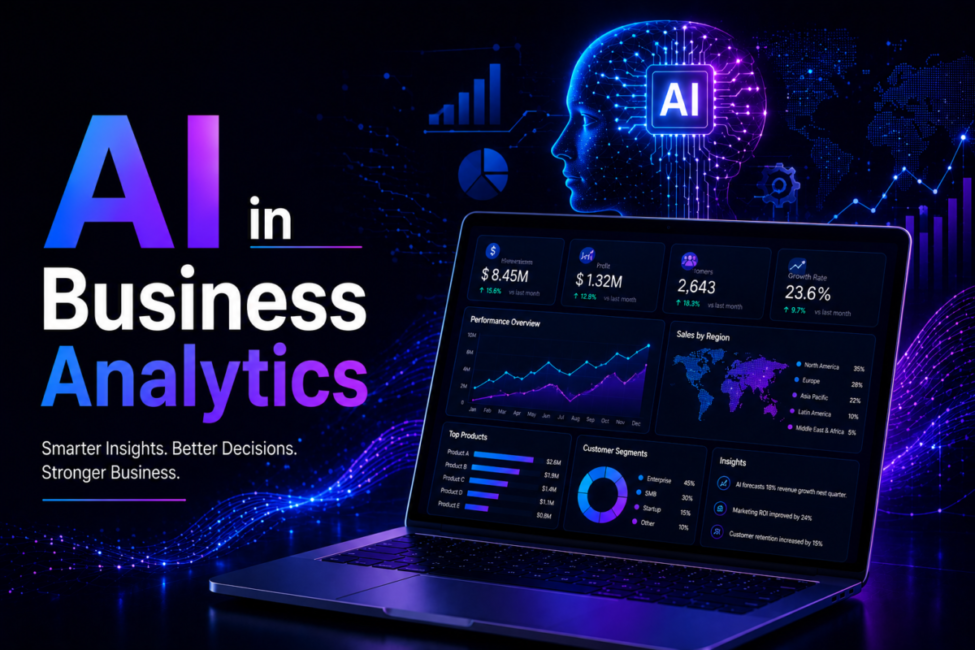
    AI in business analytics
    Share
    Facebook Twitter LinkedIn Pinterest Email

    Transform Business Decision-Making with AI-Powered Analytics

    Table of Contents

    1. Introduction: The AI Revolution in Business Analytics
    2. How AI Transforms Business Analytics
      1. AI Analytics Technology Landscape
        1. Business Analytics Use Cases
          1. Implementation Strategy
            1. Building Analytics Capabilities
              1. Measuring AI Analytics Value
                1. Future of AI Business Analytics
                  1. FAQs
                    1. Conclusion
                    2. How do I get started with AI analytics?
                    3. What skills do I need for AI analytics?
                    4. How do I measure AI analytics ROI?
                    5. What are the risks of AI analytics?
                    6. How long does AI analytics implementation take?
                  2. 10. Conclusion

                  1. Introduction: The AI Revolution in Business Analytics

                  Business analytics has entered a transformative era where artificial intelligence fundamentally reshapes how organizations understand their operations, serve customers, and compete in markets. This transformation extends far beyond incremental improvements to existing analytical practices—AI introduces capabilities that redefine what business analytics can accomplish and who can benefit from analytical insights.

                  For decades, business analytics followed a predictable evolution from basic reporting to dashboards to more sophisticated statistical analysis and business intelligence. Each advancement expanded analytical capability, but the fundamental paradigm remained constant: analysts formulated questions, designed analyses, and interpreted results with technology serving as computational infrastructure. Business users consumed outputs but rarely participated directly in analytical exploration.

                  AI disrupts this paradigm completely. Natural language interfaces enable anyone to explore data conversationally, regardless of technical background. Machine learning algorithms identify patterns and predictions that no human analyst could discover manually. Automated insight generation surfaces opportunities and risks without requiring someone to know what questions to ask. Intelligent automation handles routine analytical tasks, freeing human attention for higher-value interpretation and decision-making.

                  This comprehensive guide explores how AI is transforming business analytics across every dimension—from the technology platforms that enable new capabilities to the organizational structures and skills required for success. We examine specific use cases that deliver measurable business value, implementation strategies that maximize return on investment, and the future direction of AI-powered business analytics. Whether you are an analytics leader planning capability investments, a business executive seeking competitive advantage, or a professional developing your analytical skills, this guide provides the framework you need to navigate the AI transformation of business analytics.

                  📊 Global AI market projected to reach $512 billion by 2027, with business analytics representing the largest enterprise application category — Gartner AI Market Forecast

                  📊 Organizations using AI-augmented analytics are 2.6 times more likely to significantly outperform peers on profitability metrics — McKinsey Global Institute

                  📊 AI-powered analytics enables 40% faster decision-making with 20-30% improvement in decision quality — Deloitte AI Institute

                  📊 78% of organizations now use AI in at least one business function, up from 50% in 2022 — McKinsey State of AI Survey

                  These statistics underscore both the scale of the transformation underway and the competitive implications for organizations that fail to embrace AI-augmented analytics. The performance advantages are not temporary phenomena but reflect fundamental improvements in decision-making capability that compound over time as organizations develop expertise and AI systems learn from experience.

                  💡 Pro Tip: The organizations that benefit most from AI analytics are not necessarily those with the most sophisticated technology. They are organizations that thoughtfully integrate AI capabilities with human expertise, organizational processes, and business strategy to create value that neither humans nor AI could achieve alone.

                  2. How AI Transforms Business Analytics

                  Understanding the specific ways AI transforms analytical capabilities helps organizations identify high-value opportunities and develop effective implementation strategies.

                  2.1 From Reactive to Predictive Analytics

                  Traditional business analytics largely operates reactively—analyzing what happened and why. AI enables a fundamental shift toward predictive and prescriptive analytics that anticipates future outcomes and recommends optimal actions.

                  Descriptive Analytics (What Happened)

                  • Traditional approach: Reports and dashboards summarizing historical performance across metrics and dimensions.
                  • AI enhancement: Automated anomaly detection surfaces important changes without requiring manual monitoring. AI-generated narratives explain trends and patterns in plain language.

                  Diagnostic Analytics (Why It Happened)

                  • Traditional approach: Analyst-driven investigation to identify root causes of observed outcomes.
                  • AI enhancement: Automated root cause analysis identifies contributing factors. Key driver analysis reveals which variables most influence outcomes.

                  Predictive Analytics (What Will Happen)

                  • Traditional approach: Statistical forecasting by trained analysts using specialized tools.
                  • AI enhancement: Machine learning enables predictions across any outcome with available data. AutoML makes predictive modeling accessible without data science expertise.

                  Prescriptive Analytics (What Should We Do)

                  • Traditional approach: Limited to simple optimization scenarios with manual analysis.
                  • AI enhancement: Optimization algorithms recommend actions considering multiple objectives and constraints. Simulation enables what-if analysis of potential decisions.

                  📊 Organizations with mature predictive analytics capabilities achieve 73% higher revenue growth than peers relying primarily on descriptive analytics — MIT Sloan Management Review

                  2.2 Democratizing Analytics Access

                  AI transforms who can participate in analytical exploration, expanding access far beyond technical specialists.

                  Natural Language Interfaces

                  • Conversational querying: Business users ask questions in plain English and receive instant visualizations and answers without SQL or technical training.
                  • Context retention: Systems maintain conversation context for iterative exploration without repeating background.
                  • Terminology learning: AI learns organizational vocabulary and business terms for improved accuracy.

                  Automated Insight Generation

                  • Proactive discovery: AI surfaces patterns, anomalies, and trends without requiring specific questions.
                  • Contextual relevance: Insights filtered and prioritized based on user role and interests.
                  • Plain language explanation: Findings communicated in accessible language with appropriate context.

                  Self-Service Analytics Enhancement

                  • Smart recommendations: AI suggests relevant metrics, dimensions, and visualizations based on analytical context.
                  • Data preparation automation: AI handles data cleaning, transformation, and integration that previously required technical skills.
                  • Quality assurance: AI validates analytical approaches and warns of potential issues.

                  2.3 Scaling Analytical Capacity

                  AI enables organizations to analyze more data, answer more questions, and serve more users without proportional increases in analytical staff.

                  Automation of Routine Work

                  • Report generation: Scheduled reports produced automatically with AI-generated narratives.
                  • Data monitoring: Continuous surveillance of key metrics with automated alerting.
                  • Data preparation: AI handles 70-80% of data cleaning and transformation tasks.

                  Parallel Analysis

                  • Simultaneous exploration: AI can investigate thousands of potential patterns and relationships simultaneously.
                  • Comprehensive testing: All hypotheses can be evaluated rather than only those analysts think to test.
                  • Continuous processing: Analysis runs 24/7 without human attention for time-sensitive applications.

                  Knowledge Leverage

                  • Pattern reuse: Successful analytical approaches can be replicated across similar problems.
                  • Institutional learning: AI systems improve over time as they learn from organizational data and feedback.
                  • Best practice encoding: Expert knowledge captured in analytical templates and automation.

                  💡 Pro Tip: The greatest value of AI analytics often comes not from replacing analysts but from enabling them to focus on higher-value interpretation, communication, and decision support while AI handles routine processing.

                  3. AI Analytics Technology Landscape

                  Understanding the technology options for AI-powered business analytics helps organizations make informed platform and vendor decisions.

                  3.1 Enterprise BI Platforms with AI

                  Major BI platforms have integrated sophisticated AI capabilities that transform traditional business intelligence.

                  Microsoft Power BI with Copilot

                  🏆 MARKET LEADER — Best Microsoft Integration

                  • Copilot integration: Natural language report creation, Q&A exploration, and AI-generated insights powered by GPT-4.
                  • Quick Insights: Automated pattern discovery across selected data.
                  • Key Influencers: AI identifies drivers of business outcomes for root cause analysis.
                  • Smart Narratives: AI-generated explanations of visualizations updating automatically with data.
                  • Pricing: Pro $10/user/month, Premium Per User $20/user/month, Copilot requires M365 Copilot license.

                  🔗 powerbi.microsoft.com

                  Tableau with Einstein

                  📊 BEST VISUALIZATION — Industry Standard

                  • Ask Data: Natural language for instant visualizations.
                  • Explain Data: AI explains factors contributing to any data point.
                  • Einstein Discovery: Point-and-click predictive modeling.
                  • Tableau Pulse: AI-driven personalized metrics delivery.
                  • Pricing: Creator $75/user/month, Explorer $42/user/month, Viewer $15/user/month.

                  🔗 tableau.com

                  ThoughtSpot

                  ⚡ MOST AI-NATIVE — Best Self-Service

                  • SearchIQ: Google-like search for business data.
                  • SpotIQ: Automated AI insight discovery.
                  • ThoughtSpot Sage: GPT-powered conversational analytics.
                  • Pricing: Free for 5 users, Pro $95/user/month, Enterprise custom.

                  🔗 thoughtspot.com

                  3.2 Conversational AI for Analytics

                  General-purpose conversational AI enables ad-hoc analysis outside structured BI workflows.

                  ChatGPT Code Interpreter

                  • File analysis: Upload data files and explore through conversation.
                  • Automatic code: AI writes and executes Python for analysis.
                  • Visualization: Generate charts through natural language.
                  • Pricing: Plus $20/month, Team $25/user/month, Enterprise custom.

                  🔗 openai.com/chatgpt

                  Claude

                  • Extended reasoning: Systematic analysis of complex business problems.
                  • Document analysis: Process and analyze lengthy business documents.
                  • Writing quality: Superior analytical reports and communications.
                  • Pricing: Pro $20/month, Team $25/user/month.

                  🔗 claude.ai

                  3.3 Specialized Analytics AI

                  Purpose-built AI tools optimize for specific analytical workflows.

                  • Julius AI: Designed specifically for data analysis with intuitive interface and automatic visualization.
                  • Hex: Notebook-based collaborative analytics with AI assistance.
                  • Mode: SQL-centric analytics with AI query assistance.
                  • Databricks AI/BI: Enterprise-scale analytics on lakehouse architecture.

                  3.4 Embedded AI Analytics

                  AI analytics embedded within operational applications brings insights to point of decision.

                  • CRM analytics: AI insights embedded in Salesforce, HubSpot, and other CRM platforms.
                  • ERP analytics: AI capabilities within SAP, Oracle, and Microsoft Dynamics.
                  • Marketing analytics: AI-powered insights in marketing automation platforms.
                  • Custom applications: Embedded analytics APIs for building AI into proprietary applications.

                  4. Business Analytics Use Cases

                  Proven use cases demonstrate how AI transforms specific business functions and delivers measurable value.

                  4.1 Sales Analytics

                  Pipeline and Forecasting

                  • Traditional approach: Sales managers review opportunities manually and apply judgment-based adjustments.
                  • AI enhancement: ML models predict deal outcomes with 80-90% accuracy, automatically adjusting forecasts based on deal characteristics and sales behavior.
                  • Value delivered: 15-25% improvement in forecast accuracy, better resource allocation, earlier intervention on at-risk deals.

                  Lead Scoring and Prioritization

                  • Traditional approach: Rule-based scoring on demographic and firmographic criteria.
                  • AI enhancement: ML models score leads based on behavioral signals and patterns from historical conversions.
                  • Value delivered: 20-40% improvement in conversion rates, more efficient sales rep time allocation.

                  Sales Performance Analytics

                  • Traditional approach: Retrospective reporting on quota attainment and activity metrics.
                  • AI enhancement: Predictive models identify performance issues early; AI identifies coaching opportunities and best practices.
                  • Value delivered: 10-20% improvement in quota attainment, reduced ramp time for new reps.

                  4.2 Marketing Analytics

                  Campaign Optimization

                  • Traditional approach: Manual A/B testing with limited variables and slow iteration.
                  • AI enhancement: Multi-armed bandit algorithms continuously optimize across many variables simultaneously.
                  • Value delivered: 20-40% improvement in campaign performance, faster optimization cycles.

                  Attribution Modeling

                  • Traditional approach: Rules-based attribution (first touch, last touch, linear) that oversimplify customer journeys.
                  • AI enhancement: Data-driven attribution using ML to understand true contribution of each touchpoint.
                  • Value delivered: More accurate ROI measurement, better budget allocation across channels.

                  Customer Segmentation

                  • Traditional approach: Demographic-based segments with limited behavioral consideration.
                  • AI enhancement: Behavioral clustering identifies natural segments based on actual behavior patterns.
                  • Value delivered: More relevant targeting, improved campaign response rates, better personalization.

                  4.3 Financial Analytics

                  Forecasting and Planning

                  • Traditional approach: Spreadsheet-based models with manual assumption adjustments.
                  • AI enhancement: ML models incorporate more variables and adapt to changing patterns automatically.
                  • Value delivered: 20-40% improvement in forecast accuracy, scenario modeling at scale.

                  Expense Analytics

                  • Traditional approach: Periodic review of expense reports and budget variances.
                  • AI enhancement: Continuous monitoring with anomaly detection for unusual spending patterns.
                  • Value delivered: Early identification of policy violations, improved cost control, reduced fraud.

                  Cash Flow Optimization

                  • Traditional approach: Historical patterns with manual adjustments for known events.
                  • AI enhancement: ML predicts cash flows incorporating multiple data sources and external factors.
                  • Value delivered: Better working capital management, reduced financing costs, improved investment returns.

                  4.4 Operations Analytics

                  Demand Forecasting

                  • Traditional approach: Statistical time series methods applied by trained analysts.
                  • AI enhancement: ML models capture complex patterns including seasonality, promotions, and external factors.
                  • Value delivered: 20-50% improvement in forecast accuracy, reduced inventory costs, improved service levels.

                  Quality Analytics

                  • Traditional approach: Statistical process control with manual review of exceptions.
                  • AI enhancement: ML models detect subtle quality patterns; computer vision enables automated inspection.
                  • Value delivered: Earlier defect detection, reduced waste, improved product quality.

                  Resource Optimization

                  • Traditional approach: Rules-based scheduling with limited optimization capability.
                  • AI enhancement: Optimization algorithms balance multiple objectives across complex constraints.
                  • Value delivered: 10-25% improvement in resource utilization, reduced costs, better service delivery.

                  📊 Companies with advanced marketing analytics capabilities achieve 15-20% improvement in marketing ROI compared to peers — Harvard Business Review Marketing Research

                  5. Implementation Strategy

                  Successful AI analytics implementation requires systematic approach that aligns technology investments with business value and organizational readiness.

                  5.1 Readiness Assessment

                  Data Readiness

                  • Data availability: Do you have the data needed for priority use cases? Consider both internal and external sources.
                  • Data quality: Is data accurate, complete, consistent, and timely enough for AI applications?
                  • Data infrastructure: Can systems handle the processing requirements of AI analytics?
                  • Data governance: Are policies and processes in place for managing data access, quality, and privacy?

                  Organizational Readiness

                  • Skills: Do you have or can you develop the analytical and technical skills required?
                  • Culture: Is the organization willing to change decisions and processes based on AI insights?
                  • Leadership: Do executives understand AI capabilities and limitations well enough to sponsor effectively?
                  • Change capacity: Can the organization absorb changes while maintaining operational effectiveness?

                  Technology Readiness

                  • Current platforms: What existing BI and analytics platforms can serve as foundation?
                  • Integration requirements: What systems must connect with AI analytics capabilities?
                  • Cloud vs on-premises: What deployment model fits organizational requirements?

                  5.2 Use Case Prioritization

                  Focusing on the right use cases maximizes value and builds momentum for broader adoption.

                  Evaluation Criteria

                  • Business impact: Quantify value from improved decisions or automated processes. Focus on measurable ROI.
                  • Feasibility: Assess data availability, technical complexity, and organizational change required.
                  • Strategic alignment: Prioritize use cases supporting strategic priorities and building future capabilities.
                  • Risk profile: Balance ambition with pragmatism—early failures undermine broader adoption.

                  Common Starting Points

                  • Demand forecasting: Clear value, typically available data, proven approaches.
                  • Customer churn prediction: High impact, relatively straightforward implementation.
                  • Sales pipeline forecasting: Immediate visibility for sales leadership, demonstrable accuracy improvement.
                  • Report automation: Quick wins freeing analyst time for higher-value work.

                  5.3 Phased Implementation

                  Phase 1: Foundation (Months 1-6)

                  • Focus: Quick wins demonstrating value while building foundation.
                  • Activities: Implement initial use cases, establish data foundation, develop skills.
                  • Outcomes: Demonstrated value, organizational learning, platform foundation.

                  Phase 2: Expansion (Months 6-18)

                  • Focus: Scaling AI analytics across additional use cases and users.
                  • Activities: Expand use cases, develop self-service capabilities, mature governance.
                  • Outcomes: Multiple use cases in production, growing user adoption, maturing processes.

                  Phase 3: Optimization (Months 18+)

                  • Focus: Embedding AI analytics into operations and continuously improving.
                  • Activities: Operational integration, advanced use cases, continuous improvement.
                  • Outcomes: AI analytics embedded in decisions, measurable business impact, competitive advantage.

                  💡 Pro Tip: Start with use cases where you have data, clear business value, and organizational willingness to act on insights. Early wins build credibility for more ambitious initiatives.

                  6. Building Analytics Capabilities

                  Sustainable AI analytics success requires developing organizational capabilities across people, process, and technology dimensions.

                  6.1 Team Structure and Roles

                  Analytics Team Composition

                  • Business Analysts: Translate business needs, interpret insights, drive adoption. Key for business relevance.
                  • Data Analysts: Explore data, create visualizations, support decision-making. Bridge between data and business.
                  • Data Scientists: Build ML models, conduct advanced analysis. Technical depth for complex use cases.
                  • Data Engineers: Build data infrastructure, ensure data availability and quality. Foundation for everything else.
                  • Analytics Engineers: Transform data for analysis, maintain semantic models. Enable self-service.

                  Operating Models

                  • Centralized: Single team serving organization. Good for consistency; risk of business disconnect.
                  • Embedded: Analysts within business units. Good for business alignment; risk of inconsistency.
                  • Hub-and-spoke: Central platform with embedded specialists. Balances consistency and responsiveness.
                  • Federated: Distributed ownership with central standards. Good for large, mature organizations.

                  6.2 Skill Development

                  Technical Skills

                  • Data literacy: Understanding data concepts, quality issues, and analytical approaches.
                  • Tool proficiency: Deep expertise in selected BI and analytics platforms.
                  • AI/ML literacy: Understanding AI capabilities, limitations, and appropriate applications.
                  • Programming: Python, SQL, and R for advanced analysis and automation.

                  Business Skills

                  • Domain knowledge: Deep understanding of business processes, metrics, and decisions.
                  • Problem framing: Translating business challenges into analytical questions.
                  • Communication: Presenting insights effectively to diverse audiences.
                  • Stakeholder management: Building relationships and driving adoption.

                  Development Approaches

                  • Formal training: Courses, certifications, and structured learning programs.
                  • Hands-on projects: Real work on business problems develops practical skills.
                  • Mentorship: Pairing with experienced practitioners accelerates development.
                  • Community: Professional communities provide exposure to diverse approaches.

                  6.3 Governance Framework

                  Data Governance

                  • Data quality standards: Definitions and thresholds for data fitness for use.
                  • Access management: Controls ensuring appropriate data access while enabling analysis.
                  • Privacy compliance: Policies and processes for handling personal and sensitive data.
                  • Metadata management: Documentation enabling discovery and understanding.

                  Analytics Governance

                  • Model standards: Requirements for model development, validation, and documentation.
                  • Deployment approval: Processes for reviewing and approving production analytics.
                  • Monitoring requirements: Ongoing tracking of analytical accuracy and business impact.
                  • Change management: Processes for updating analytics as requirements and data evolve.

                  7. Measuring AI Analytics Value

                  Demonstrating value is essential for sustaining investment and expanding AI analytics capabilities.

                  7.1 Value Framework

                  Efficiency Metrics

                  • Time savings: Reduction in time required for analytical tasks.
                  • Productivity improvement: Increase in analytical output per analyst.
                  • Cost reduction: Lower costs through automation and improved processes.
                  • Resource optimization: Better utilization of analytical and business resources.

                  Effectiveness Metrics

                  • Decision quality: Improvement in outcomes from AI-informed decisions.
                  • Prediction accuracy: Improvement in forecast and prediction accuracy.
                  • Business outcomes: Revenue, margin, customer, and operational improvements.
                  • Competitive advantage: Market position improvements attributable to analytics.

                  Adoption Metrics

                  • User engagement: Number of active users engaging with AI analytics.
                  • Query volume: Volume of questions answered through AI-powered interfaces.
                  • Self-service adoption: Shift from analyst-produced to self-service analytics.
                  • User satisfaction: Feedback on analytics usefulness and usability.

                  7.2 ROI Calculation

                  • Baseline establishment: Document current state before AI implementation.
                  • Benefit quantification: Translate improvements into monetary value.
                  • Cost accounting: Include technology, personnel, training, and ongoing operations.
                  • Attribution methodology: Isolate AI contribution from other factors.
                  • Time horizon: Consider appropriate period for evaluating returns.

                  7.3 Value Communication

                  • Executive dashboards: Clear visualization of AI analytics impact on key metrics.
                  • Case studies: Documented examples of value delivered by specific use cases.
                  • Regular reporting: Scheduled communication of progress and value to stakeholders.
                  • Story telling: Narrative communication of how AI analytics transforms decisions.

                  📊 Organizations with formal analytics value measurement achieve 50% higher satisfaction with analytics investments — Gartner Analytics Survey

                  8. Future of AI Business Analytics

                  Understanding emerging trends helps organizations prepare for continuing evolution of AI analytics capabilities.

                  8.1 Emerging Capabilities

                  • Autonomous analytics: AI systems that independently identify questions, conduct analyses, and generate recommendations.
                  • Multimodal analysis: AI analyzing combinations of text, images, audio, and structured data together.
                  • Real-time AI: Instant AI-powered analysis operating at transaction speed for operational decisions.
                  • Generative analytics: AI creating analytical content including reports, presentations, and recommendations.
                  • Conversational BI: Natural dialogue-based interaction replacing traditional dashboard interfaces.

                  8.2 Organizational Implications

                  • Role evolution: Analysts shift from execution to strategy, oversight, and complex interpretation.
                  • Decision processes: More decisions made with AI assistance, requiring new governance approaches.
                  • Skill requirements: Increasing emphasis on AI literacy, judgment, and human-AI collaboration.
                  • Competitive dynamics: AI analytics capability increasingly important for market position.

                  8.3 Preparing for the Future

                  • Continuous learning: Maintain awareness of AI developments and business implications.
                  • Experimentation culture: Build capability for rapid testing of new AI capabilities.
                  • Flexible architecture: Design technology systems for incorporating emerging AI capabilities.
                  • Talent development: Invest in developing AI skills across the organization.

                  9. FAQs

                  What is the difference between business analytics and AI analytics?

                  Traditional business analytics involves humans formulating questions, designing analyses, and interpreting results. AI analytics introduces capabilities like automated insight discovery, natural language interaction, and predictive modeling that expand what analytics can accomplish without requiring human direction for every step.

                  How do I get started with AI analytics?

                  Assess your data readiness and identify high-value use cases with clear business impact. Select appropriate tools based on your existing infrastructure and requirements. Start with achievable wins that demonstrate value and build organizational momentum.

                  What skills do I need for AI analytics?

                  Effective AI analytics requires combination of technical skills (data analysis, tool proficiency, AI/ML literacy) and business skills (domain knowledge, problem framing, communication). Specific mix depends on role and organizational context.

                  How do I measure AI analytics ROI?

                  Establish baselines before implementation. Quantify efficiency gains and effectiveness improvements. Account for all costs including technology, personnel, and ongoing operations. Consider both direct project returns and platform value enabling multiple use cases.

                  What are the risks of AI analytics?

                  Key risks include bias in AI outputs affecting decisions unfairly, over-reliance on AI without appropriate human oversight, data privacy and security concerns, and organizational resistance to AI-driven change. Thoughtful governance addresses these risks.

                  How long does AI analytics implementation take?

                  Initial use cases can reach production in 3-6 months. Building comprehensive organizational capability typically requires 18-36 months. Timeline depends on data readiness, use case complexity, and change capacity.

                  10. Conclusion

                  AI is fundamentally transforming business analytics from a specialized technical discipline to a pervasive organizational capability that enables better decisions at every level. This transformation is not incremental improvement but paradigm shift—AI introduces capabilities that redefine what analytics can accomplish and democratizes access so that anyone can benefit from analytical insights.

                  Organizations that effectively embrace AI analytics gain significant competitive advantages. The 2.6x profitability advantage and 40% faster decision-making are not temporary phenomena but reflect fundamental improvements in organizational intelligence that compound over time as AI systems learn and organizations develop expertise.

                  Success requires thoughtful strategy that aligns AI investments with business priorities, builds on existing analytical foundations, develops appropriate skills and governance, and measures value systematically. The organizations that benefit most are those that integrate AI capabilities with human expertise rather than viewing AI as replacement for human judgment.

                  The future of business analytics is AI-augmented. The question for organizations is not whether to embrace this transformation but how to do so effectively. This guide provides the framework and practical guidance to navigate that journey successfully.

                  📊 AI Market: Projected $512B by 2027

                  🏆 Performance: 2.6x profitability advantage

                  ⚡ Speed: 40% faster decision-making

                  📈 Adoption: 78% of enterprises using AI

                  For tool recommendations, see our AI Tools for Data Analysis Guide.

                  For career guidance, see our Data Analyst AI Career Guide.

                  Share. Facebook Twitter Pinterest LinkedIn Tumblr Email
                  Previous ArticleAI and Analytics: Complete Guide to Intelligent Data Analysis 2026
                  Next Article AI Sentiment Analysis: Complete Guide 2026
                  TechieHub

                    Related Posts

                    20 Best AI Tools for YouTube Automation 2026: Complete Implementation Guide

                    February 28, 2026

                    15 Best Agentic AI Tools & Platforms for Building Autonomous Agents [2026]

                    February 25, 2026

                    What is Claude: Complete Guide 2026

                    February 24, 2026
                    View 1 Comment

                    1 Comment

                    1. Pingback: AI Sentiment Analysis: Complete Guide 2026 - Techiehub

                    Leave A Reply Cancel Reply

                    Editors Picks

                    20 Best AI Tools for YouTube Automation 2026: Complete Implementation Guide

                    February 28, 2026

                    15 Best Open Source AI Models 2026: Complete Implementation Guide

                    February 26, 2026

                    Building Agentic AI Applications with a Problem-First Approach [2026]

                    February 25, 2026

                    15 Best Agentic AI Tools & Platforms for Building Autonomous Agents [2026]

                    February 25, 2026
                    Techiehub
                    • Home
                    • Featured
                    • Latest Posts
                    • Latest in Tech
                    • Privacy Policy
                    • Terms and Conditions
                    Copyright © 2026 Tchiehub. All Right Reserved.

                    Type above and press Enter to search. Press Esc to cancel.

                    We use cookies to ensure that we give you the best experience on our website. If you continue to use this site we will assume that you are happy with it.