


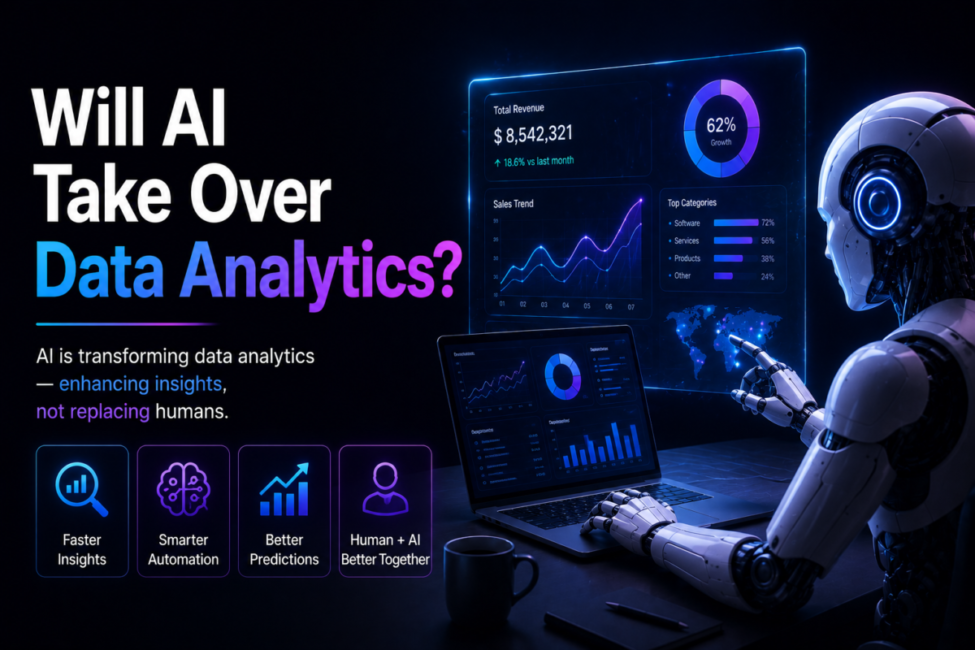
Every analytics team has now sat through the same demo: someone types a plain-English question, and half a minute later there is a cleaned dataset, a query, a chart and a written summary. It is fair to wonder whether the job survives that. Data analytics is the discipline of collecting, cleaning, modelling and interpreting data to answer business questions and drive decisions — and only some of those verbs are things a language model does well.

| Quick answer: No — AI will not take over data analytics as a discipline, but it has already taken over much of the work inside it. AI now automates data cleaning, SQL generation, dashboard building and first-draft insights. Choosing which questions matter, judging ambiguous results and driving decisions stay human. The job shifts from executing analysis to directing and verifying it. |
Table of Contents
Will AI take over data analytics, or only the work inside it?
The honest 2026 answer is that AI is taking over analytics tasks, not the analytics discipline. That distinction is not a hedge — it is measurable. The mechanical layer of the job (pulling data, reshaping it, writing the query, formatting the deck) is being absorbed quickly because it is high-volume, well-specified and easy to verify. The judgment layer (deciding what is worth measuring, noticing what the dataset is missing, persuading a sceptical executive) is being absorbed slowly, because none of those tasks have a ground truth a model can check itself against.
A useful test: if your work this quarter could be written as a repeatable ticket, expect automation pressure. If it required you to argue with the brief, expect leverage instead. Analysts whose role was almost entirely recurring report generation are feeling genuine displacement; analysts doing investigative, stakeholder-facing work report the opposite. Our pillar guide to AI tools for data analysis maps which categories of tooling attack which layer.
What parts of the analytics workflow has AI already automated?
Four stages already automated
Four stages have moved decisively. Data preparation — profiling, deduplication, type coercion, join-key reconciliation — is now largely machine-drafted and human-approved. Query generation is close to solved for well-modelled warehouses; text-to-SQL against a documented semantic layer is reliable enough that many teams no longer write routine SQL by hand. Reporting is automated end-to-end for recurring artefacts. And first-pass insight generation — anomaly flags, cohort splits, correlation candidates — is now a default feature rather than a differentiator.
Why 2026 felt different
Model quality is the reason the last two years felt like a step change rather than a slope. When Anthropic released Claude Opus 5 on 24 July 2026, enterprise partner Box measured an 11% improvement on data analysis workflows over the previous flagship at unchanged pricing. Opus 5.5 has since replaced it as Anthropic’s main Opus model at a lower API price, $4 and $20 per million tokens against $5 and $25, so the direction has not reversed. Gains of that size compound: a model that holds context across a twenty-step analysis without drifting can be trusted with the whole pipeline, not just one cell of it. That is the practical difference described in our walkthrough of using AI for data analysis day to day.
What is agentic analytics, and how does it differ from an AI assistant?
What agentic analytics means
Agentic analytics is the use of AI systems that autonomously plan, execute and verify a multi-step analytical workflow, rather than assisting with one step at a time. You no longer ask for a formula; you assign an outcome — “find out why Northeast margin fell in Q2” — and the agent decides which tables to touch, runs the extraction, tests explanations and reports back with its own working.

| Dimension | AI assistant (2024 model) | Agentic analytics (2026 model) |
| Unit of work | A single step you request | An outcome you delegate |
| Who plans | The analyst | The agent, reviewed by the analyst |
| Data access | Whatever you paste in | Connected warehouses and applications |
| Verification | Manual, after the fact | Self-checking, plus human sign-off |
| Main risk | A wrong answer you can see | A confident answer nobody audited |
| Skill it rewards | Prompting | Specification and review |
Adoption in practice
Adoption is real but earlier than the marketing suggests. Gartner’s 2026 data and analytics predictions forecast that by 2028, 60% of self-service analytics users will reach for general-purpose large language models for ad hoc and exploratory work, while production-grade reporting stays inside governed BI platforms. The same research warns that half of AI-agent deployment failures will trace back to inadequate governance and interoperability — which is a polite way of saying most agentic analytics projects fail on plumbing and permissions, not intelligence.
What can AI still not do in data analysis?
Choosing the question
AI can answer questions; it cannot decide which questions deserve asking. The highest-value analysis usually starts outside the dataset — a hunch from a sales call, an odd pattern in a support queue, a suspicion that the metric everyone reports is the wrong metric. An agent optimises within the frame it is handed. Asked to improve conversion, it will diligently tune the funnel it was pointed at; it will not spontaneously conclude that the company is targeting the wrong segment.
Ambiguity, accountability and cost
Three other limits matter in practice. Ambiguity: when results are genuinely inconclusive, models tend to produce a confident narrative anyway. Accountability: someone has to sign the number that goes into a board pack, and that signature carries consequences a model cannot bear. Ethical and regulatory judgment: deciding whether a segmentation is legitimate targeting or unlawful discrimination is a human call, increasingly a documented one. This is exactly where the durable career value sits, and why the toolchains covered in our guide to AI tools for business analysts emphasise traceability over raw autonomy.
Are data analyst jobs disappearing or changing?
The labour data does not support a collapse. The US Bureau of Labor Statistics projects data scientist employment to grow 34% between 2024 and 2034 — from roughly 245,900 to 328,300 jobs — making it the fourth fastest-growing occupation in the economy. The World Economic Forum’s Future of Jobs Report 2025 ranks big data specialists as the single fastest-growing role worldwide through 2030, with AI and machine learning specialists close behind.
What changes is the shape of the work. Routine reporting headcount shrinks; specification, governance, semantic modelling and decision support expand. The role that emerges looks less like a query writer and more like an editor of machine output — a shift we unpack in detail in our profile of the data analyst AI role. Analysts who can define a question precisely, evaluate an agent’s reasoning and defend a conclusion under pressure are becoming scarcer relative to demand, not more abundant.
Real-world use case: one demand analyst’s rebuilt week
Augusta Lindberg, a composite, is a senior demand analyst at a 140-store home-goods retailer. Her recurring task was a weekly stockout-risk forecast: pull point-of-sale and inventory extracts, reconcile SKU mappings across three systems, fit a simple forecast, and brief the merchandising leads every Tuesday. It reliably consumed two full days.
In March 2026 she moved the mechanical stages onto an agent connected to the warehouse. The agent now handles extraction, SKU reconciliation and the baseline forecast overnight, and drafts a summary with flagged exceptions. Augusta’s Tuesday is now roughly three hours: reviewing the agent’s assumptions, killing the explanations that do not survive scrutiny, and preparing the argument for the merchandising call.
The instructive part is what the agent missed. In its second week it reported a dramatic demand collapse in outdoor furniture — statistically clean, entirely wrong. A supplier had silently re-issued SKUs, so the historical series no longer matched the current catalogue. The agent had no way to know that; Augusta did, because she had spoken to the supplier. Her forecast is now faster and more accurate than before, and the reason it is accurate is that a human still owns the context the data does not contain.
How we compare AI analytics claims
We separate three tiers of evidence: measured benchmarks from model developers or named enterprise partners, labour-market projections from statistical agencies, and analyst-firm forecasts, which we treat as directional rather than factual. Vendor productivity claims with no stated methodology are excluded. Where a widely repeated figure cannot be traced to a primary source — the perennial “analysts spend 80% of their time cleaning data” being the clearest example — we leave it out.
Affiliate disclosure: TechieHub may earn a commission if you purchase through links on this site, at no additional cost to you. This never influences which tools we recommend or how we assess them.
What does the data analyst role actually become?
Direct answer: the mechanical middle of the job disappears and the ends grow. Writing queries, cleaning files and assembling recurring reports compress from hours to minutes. Choosing which question matters, knowing that “revenue” is booked net of refunds in this particular system, and being accountable for a number that drives a decision — none of that automates, and all of it becomes a larger share of the work.
Which analyst skills gain value
Three rise sharply. Metric definition, because an AI answering ad-hoc questions will silently apply a different definition each time unless a governed semantic layer says otherwise — and someone has to build that. Verification instinct, since a confidently wrong result looks identical to a correct one, and the analysts who catch it are the ones who check a headline number against something they already know. Translation, because output volume is no longer the constraint; deciding what a result means for a decision is.
Which skills lose value
Query-writing speed, memorised syntax and manual data preparation. These were genuine differentiators five years ago and are now the part a model does first and best. Analysts who defined their value by those skills feel the change hardest; those who treated them as plumbing barely notice. The honest framing is that AI replaces analyst keystrokes, not analyst accountability — and the accountability is where the job actually lives. For the practical side of this, see our guide to using AI for data analysis.
Frequently Asked Questions
Will AI replace data analysts by 2030?
No. AI is replacing analytics tasks rather than analyst roles. The US Bureau of Labor Statistics projects 34% growth in data scientist employment from 2024 to 2034, and the World Economic Forum ranks big data specialists as the fastest-growing job worldwide through 2030. Routine reporting work shrinks; specification and governance work expands.
What is agentic analytics in simple terms?
Agentic analytics means giving an AI system an outcome instead of an instruction. Rather than asking it to write one query, you assign a goal such as diagnosing a revenue drop. The agent plans the steps, runs the extraction and transformation, tests explanations, and returns findings with its reasoning for a human to verify.
Which analytics tasks are safest from automation?
Tasks requiring context that lives outside the dataset are safest: framing which business question matters, interpreting genuinely ambiguous results, judging whether an analysis is ethically and legally sound, and persuading decision-makers to act. Bespoke investigative work resists automation far better than recurring, well-specified reporting does.
Can AI be trusted to run analysis without review?
Not yet, and review is the point. Agents produce confident output even when their inputs are broken, so errors arrive well-formatted rather than obviously wrong. Gartner attributes half of AI-agent deployment failures to inadequate governance and interoperability. Traceable pipelines and human sign-off on consequential numbers remain standard practice in 2026.
What skills should data analysts learn now?
Four compound fastest: precise problem specification, semantic and data modelling so agents query trustworthy definitions, evaluation skills for auditing machine reasoning, and stakeholder communication. Domain depth matters more than tool fluency, because context is the input AI cannot generate. Learning to direct agents beats competing with them on execution speed.
Do AI agents replace BI dashboards?
They complement them. Gartner expects production-grade reporting to remain in governed BI platforms while 60% of self-service users turn to general-purpose language models for exploratory analysis by 2028. Dashboards keep serving recurring, audited metrics; agents handle ad hoc investigation and continuous anomaly monitoring across connected systems.
How is AI used in data analytics?
Across four stages, with very different maturity at each. Preparation is the most automated: models now write the cleaning and reshaping code reliably enough that analysts review rather than author it. Querying is close behind, with natural-language-to-SQL working well against documented schemas and poorly against undocumented ones. Visualisation and dashboard assembly is largely solved for standard chart types. Interpretation is where automation thins out — a model can describe what changed in a metric, but attributing it to a cause and deciding what to do about it still requires context the data does not contain.
What is the difference between AI analytics and traditional analytics?
Traditional analytics is pre-modelled: someone defines metrics, builds a dashboard, and users read it. AI analytics is conversational: the question comes first and the analysis is generated to answer it, including questions nobody anticipated. The trade-off is governance. A dashboard gives everyone the same definition of “active user”; an AI answering ad-hoc questions can silently apply a different one each time. Mature teams run both — governed dashboards for numbers that drive decisions, conversational analysis for exploration ahead of them.
Should data analysts learn AI tools in 2026?
Yes, but the useful skill is narrower than the hype suggests. It is not prompt engineering as a discipline; it is knowing which parts of your workflow are safe to hand over and which are not, and being able to spot a plausible-looking wrong answer quickly. Analysts who develop that judgement ship substantially more work. Analysts who either refuse the tools or trust them without verification both end up worse off, for opposite reasons.
Conclusion
AI has already taken over a large share of the keystrokes and almost none of the accountability. The 2026 picture is an inversion of the old workday: machines now handle extraction, cleaning, querying and drafting, while analysts spend their time on question design, verification and persuasion — the parts that were always the job’s actual value, previously crowded out by mechanical work.
The line is not humans against AI, but analysts who delegate execution and reinvest the time in judgment against those who spend 2027 hand-writing SQL an agent would have drafted before breakfast. Pick the tooling that keeps its reasoning auditable, keep a human signature on every number that leaves the team, and the discipline gets stronger rather than smaller.

10 Comments
Pingback: Data Analyst AI: Complete Career Guide 2026 - Techiehub
Pingback: AI Tools for Data Analysis: Complete Guide 2026 - Techiehub
I appreciate the emphasis on career adaptation in this article. It’s clear that upskilling and embracing AI tools is crucial for staying relevant in the field. It’s all about blending human expertise with AI-powered insights.
Thank you for taking the time to share your thoughts! We truly appreciate the support and are glad you found value here. Stay connected—there’s more helpful content coming your way.
Pingback: Generative Engine Optimization (GEO): Complete Guide 2026
Pingback: Best AI Tools for Business 2026: Complete Guide
Pingback: AI and Analytics: The Complete Guide to AI Data
Pingback: AI in Business Analytics Is Changing How Leaders Decide
Pingback: Best AI Sales Forecasting Tools to Predict Revenue
Pingback: Data Analyst AI – Smarter Decisions Without the Guesswork