

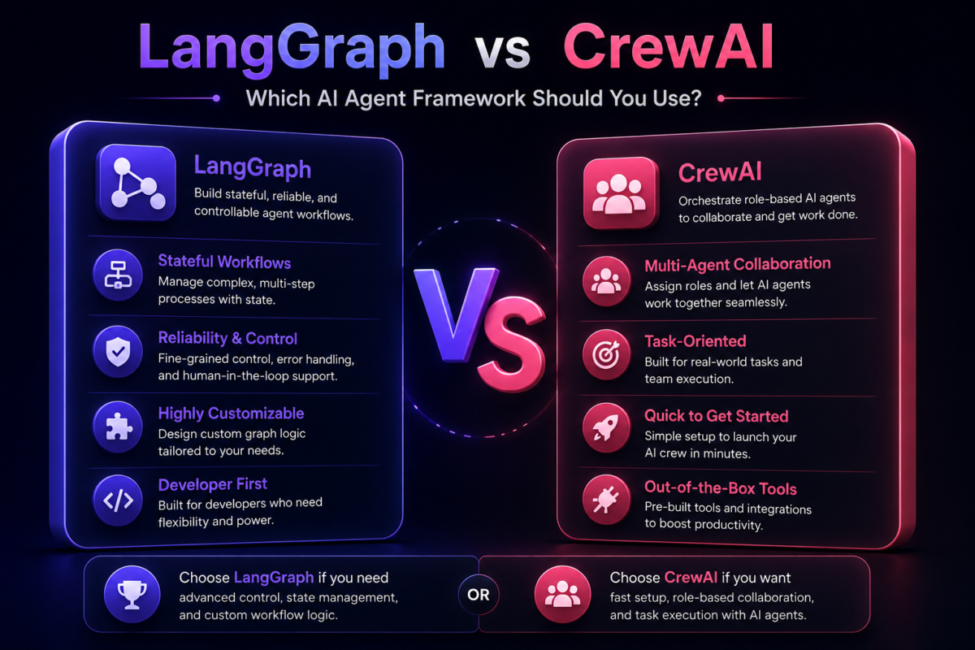
| Quick answer: Choose LangGraph when you need stateful, auditable production agents with checkpointing, retries and human approval, and choose CrewAI when work splits into roles and you want a working multi-agent prototype in hours. LangGraph wins on control and durability; CrewAI wins on speed and simplicity. |
In one sentence: LangGraph models an agent system as a directed graph of nodes sharing state, while CrewAI models it as a crew of role-playing specialist agents that collaborate on tasks.
How we compare: we build the same multi-step agent task in each framework, read the official docs and changelogs, and cross-check public benchmarks and adoption data before drawing conclusions — no vendor pays for placement.
Affiliate disclosure: some outbound links may be affiliate links. If you sign up through them we may earn a small commission at no extra cost to you, and it never changes our verdict.

Table of Contents
LangGraph vs CrewAI: the core architectural difference
These are the two most widely deployed open-source AI agent frameworks for building autonomous systems, and they take opposite routes to the same goal. The split reduces to one idea: LangGraph thinks in graphs, CrewAI thinks in roles. LangGraph, part of the LangChain ecosystem, represents a workflow as a directed graph where a shared state object flows between nodes. CrewAI, built by CrewAI Inc., represents it as a crew of specialists — each with a role, goal and backstory — coordinating on tasks.
That single decision cascades into everything else: how much control you get, how fast you ship, how gracefully the system handles failure, and whether it fits a regulated production environment or a weekend prototype. If the underlying paradigm is new to you, our primer on what agentic AI actually means sets the foundation this comparison builds on.
What is LangGraph, and when does its graph model pay off?
LangGraph represents an agent workflow as an explicit state graph: you define nodes (steps or agents) and edges (transitions, including conditional ones), and a shared state object flows through them. That makes loops, branching, retries and parallel execution first-class — exactly the patterns real agent behavior needs. Its standout production features are checkpointing (durable execution that survives restarts), streaming, and human-in-the-loop primitives that let an agent pause for approval and resume later. The official LangGraph documentation details the persistence and HITL model, and the framework reached its 1.0 milestone in 2026, with point releases past 1.2 through mid-year hardening both.
The trade-off: a steeper learning curve
The trade-off is a steeper learning curve — debugging graph-state transitions means understanding the execution model, a real investment for engineers new to it. But that control is why LangGraph has become a production default: public benchmarks put it near 62% success on complex, multi-step tasks versus roughly 54% for CrewAI, because its graph state machine handles failed nodes gracefully. It is model-agnostic, so you can wire different LLM providers into different nodes, and it pairs with LangSmith for full-trace observability. For agents that touch customer data or financial operations — where a failed action must be explained and reversed — that auditability is decisive.
A concrete example
A concrete example makes it click. Picture a loan-processing agent: a node validates the application, a conditional edge routes high-value cases to a human-approval node, and a checkpoint saves state so that if the run pauses for two days awaiting sign-off, it resumes exactly where it left off rather than restarting. If a downstream credit-check API times out, LangGraph can retry that node or roll back without corrupting the rest of the run. That deterministic, inspectable flow is precisely what compliance teams need.
What is CrewAI, and why do teams prototype with it first?
CrewAI flips the mental model. Instead of graphs and state machines you think in roles: define agents with a specific job (researcher, writer, reviewer), give each a goal and backstory, group them into a crew, assign tasks, and let the framework run the coordination loop. If you have ever managed a team of specialists, you already understand CrewAI — which is why it has the lowest barrier to entry of any dedicated agent framework and the fastest path from idea to working prototype, often in two to four hours.
That accessibility shows up in the numbers. CrewAI passed 54,000 GitHub stars by mid-2026, shipped past version 1.15, and reports roughly two billion agent executions over the trailing year. It added native support for MCP (Model Context Protocol) and A2A (Agent-to-Agent) communication — making it more interoperable than LangGraph on open standards — and a visual workflow editor with an AI copilot. MCP itself is documented at modelcontextprotocol.io. The honest limitation: when an agent fails mid-crew, recovery is less mature than LangGraph’s checkpoint system — fine for most SaaS workloads, not yet as battle-tested for long-running flows. To see where crews fit among broader tooling, browse our roundup of real-world agentic AI applications across industries.

How do LangGraph and CrewAI compare head-to-head?
The two frameworks diverge across the dimensions that matter most in production.
| Dimension | LangGraph | CrewAI |
| Orchestration model | Directed graph + shared state | Role-based crews |
| Learning curve | Steeper (state graphs) | Gentle (team metaphor) |
| Time to prototype | Slower (more setup) | Fast (2–4 hours) |
| State & recovery | Checkpointing, durable, rollback | Newer, less mature |
| Human-in-the-loop | First-class primitives | Supported, simpler |
| MCP / A2A protocols | Via community integrations | Native support |
| Complex-task benchmark | ~62% success | ~54% success |
The pattern is consistent: LangGraph trades setup time for control and durability, while CrewAI trades fine-grained control for speed and clarity. On simple tasks the gap is narrow (both clear roughly 80–88%), but on complex, multi-step workflows requiring planning and backtracking, LangGraph’s explicit state handling pulls ahead. Conversely, for linear business-process automation that maps cleanly to roles, CrewAI delivers a working system far faster. Research also suggests the orchestration scaffold can move agent benchmark performance by up to 30 percentage points on identical models — so framework choice is a primary lever, not a footnote.
What does the difference look like in code?
The architectures diverge in the first ten lines. LangGraph asks you to declare the flow — nodes, edges and the conditions that route between them — so the control flow is an object you can inspect, checkpoint and resume:
from langgraph.graph import StateGraph, END

builder = StateGraph(AgentState)
builder.add_node("research", research_node)
builder.add_node("review", review_node)
builder.add_edge("research", "review")

# The loop is explicit: review can send work back
builder.add_conditional_edges(
    "review", needs_rework, {True: "research", False: END}
)

graph = builder.compile(checkpointer=checkpointer)
CrewAI asks you to describe the team and lets the framework work out the sequencing:
from crewai import Agent, Task, Crew

researcher = Agent(role="Researcher", goal="Gather primary sources")
writer = Agent(role="Writer", goal="Draft the brief")

crew = Crew(
    agents=[researcher, writer],
    tasks=[research_task, write_task],
)
result = crew.kickoff()
Two things follow from that contrast, and they are the whole decision. The CrewAI version is shorter because the orchestration is implicit — which is exactly why it prototypes in an afternoon, and exactly why it is harder to reason about when step four fails at 3am. The LangGraph version carries a checkpointer, and that single argument is what makes a run resumable after a crash and inspectable after a bad decision. If your workflow never needs to answer “why did it do that?”, the extra setup is overhead. If it does, no amount of role description substitutes for it.
What do LangGraph and CrewAI cost in 2026?
Both cores are free and open source, so license fees rarely decide it — the ecosystem does. LangGraph is MIT-licensed; the paid layer is the managed LangGraph Platform plus LangSmith for observability, and the tiers changed in 2026: LangChain’s pricing page, read on 10 October 2026, lists Developer at $0 for one seat with 5,000 traces a month, Plus at $39 per seat with 10,000 traces, and Enterprise quoted, with deployment compute metered on top. The roughly $99 Professional tier older comparisons quote is no longer listed. That depth — LangSmith tracing, LangServe, the broader LangChain library — is a major reason production teams standardize on it, though LangChain’s history of API-breaking changes is fair to weigh.
CrewAI is likewise open source, with a free tier covering roughly 50 workflow executions per month, and a paid plan from about $25 per month that includes 100 executions with additional runs around $0.50 each, plus a CrewAI Enterprise tier adding managed deployment, scheduling, SOC 2 compliance and SSO. Because limits change frequently, confirm current figures on each vendor’s site before budgeting. For most teams the real cost is engineering time: CrewAI saves it up front, LangGraph saves it later when production complexity hits.
Agent orchestration in practice: a fintech team’s choice
Consider Clara Moreau, a staff engineer at a mid-size lending startup, in an illustrative case: she is asked to ship an agent that triages loan applications. Her team starts in CrewAI: in an afternoon she defines a document-analyst agent, a risk-assessor agent and a compliance-reviewer agent, wires them into a crew, and demos a working pipeline to stakeholders the same week. The role metaphor lets a product manager read and tweak the agents without touching graph code.
When the prototype gets greenlit for regulated production, the requirements shift: every decision must be auditable, high-value cases must pause for a human underwriter, and a mid-run API failure must never corrupt an application’s state. Clara rebuilds the validated logic in LangGraph, mapping each former agent to a node, adding a conditional edge to a human-approval node and a checkpoint that lets a paused application resume days later. The illustrative outcome: the team keeps CrewAI’s fast iteration for experiments while running the compliance-critical flow on LangGraph’s durable execution — the “prototype then harden” path many practitioners recommend. Understanding where an agent ends and a simpler tool begins helps too; our explainer on the difference between an AI agent and an AI assistant clarifies when this orchestration is even warranted.
Which framework should you choose?
Decide by your primary constraint, not by which framework tops a single benchmark. Choose LangGraph when you are building production systems that need explicit state management, rollback, human-in-the-loop approval, compliance audit trails, or long-running workflows that must survive restarts — anything touching customer data or money. Choose CrewAI when work splits naturally into specialist roles, you want a working prototype quickly, you value an intuitive model, or you need native MCP and A2A interoperability out of the box.
- Don’t over-engineer: if you need zero-to-working in an afternoon, LangGraph’s graph abstraction will slow you down until complexity justifies it.
- Don’t under-engineer: shipping a compliance-critical, multi-step agent on CrewAI’s lighter recovery model invites failure modes you can’t easily explain or reverse.
- Invest past the framework: the gap between a good agent system and a bad one is rarely the framework — it is the evaluation pipeline, observability and failure-recovery logic. If you are starting from scratch rather than choosing between these two, our walkthrough on how to build an AI agent covers that groundwork first.
Frequently Asked Questions
What is the main difference between LangGraph and CrewAI?
LangGraph models an agent system as a directed graph with shared state flowing between nodes, giving precise control over branching, retries and human-in-the-loop steps. CrewAI models it as a crew of role-playing agents that the framework coordinates. LangGraph targets stateful production control; CrewAI targets fast, intuitive prototyping.
Is LangGraph or CrewAI better for production?
LangGraph is usually the stronger choice for complex, stateful workflows. Its checkpointing gives durable execution that survives restarts, it offers first-class human-in-the-loop and rollback, and it pairs with LangSmith for deep observability. CrewAI is production-capable for many SaaS workloads but has less mature failure recovery.
Which is easier to learn, LangGraph or CrewAI?
CrewAI is significantly easier. Its role-based metaphor — agents with roles, goals and backstories grouped into crews — is intuitive for anyone who has managed a team, and a working prototype takes two to four hours. LangGraph has a steeper curve because you must understand its state-graph execution model.
Do LangGraph and CrewAI support MCP and A2A protocols?
CrewAI ships native support for both MCP (Model Context Protocol) and A2A (Agent-to-Agent) communication, making it more interoperable on open standards out of the box. LangGraph does not natively support either as of 2026, though community integrations exist. For open-protocol interoperability, CrewAI has the edge.
Are LangGraph and CrewAI free?
Yes — both cores are free and open source. LangGraph is MIT-licensed, with paid LangGraph Platform and LangSmith layers. CrewAI is open source with a free tier of roughly 50 executions per month, a paid plan from about $25 per month, and a CrewAI Enterprise tier. LangChain’s figures were confirmed on 10 October 2026; CrewAI’s pricing page did not load that day, so its numbers are the last it published. Confirm both before you budget.
Can I use LangGraph and CrewAI together?
Most teams use them sequentially, not simultaneously: prototype the logic quickly in CrewAI, then rebuild the production version in LangGraph once it needs cycles, retries, approval steps or audit trails. Both are model-agnostic with first-class tool calling, so models and tools carry over between them.
Conclusion
LangGraph and CrewAI solve the same problem from opposite directions. LangGraph’s graph-and-state model delivers the control, durability and auditability regulated production demands, at the cost of a steeper curve. CrewAI’s role-based crews deliver speed, clarity and native protocol support, at the cost of less mature recovery. Pick by your primary constraint — control and compliance point to LangGraph, speed and roles point to CrewAI — then put your real effort into evaluation, observability and recovery logic, because that is what turns an impressive demo into a system you can trust.
