


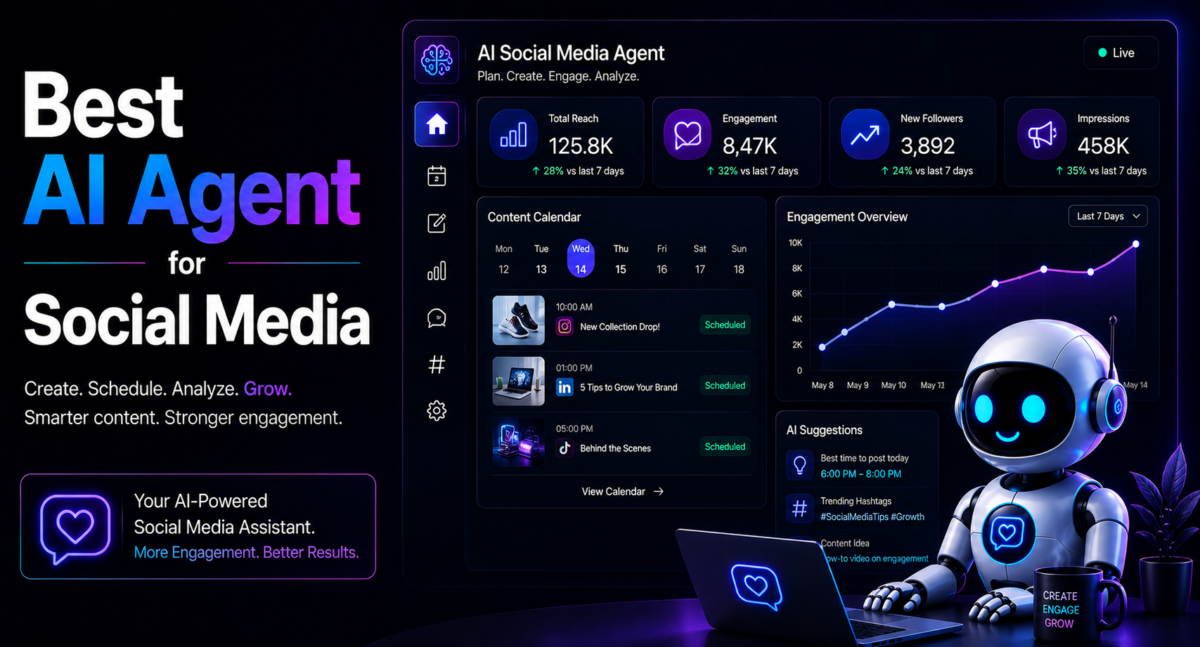
| Quick answer: The best AI agent for social media in 2026 is Sprout Social for all-in-one, enterprise-grade work thanks to its Trellis AI agent; Hootsuite for large multi-platform teams; and Buffer for the best value. AI-first tools like SocialBee and Predis.ai generate complete posts. Choose by your biggest bottleneck. |
An AI social media agent is software that plans, creates, schedules, publishes and analyzes social content — and, at its most advanced, decides what to post — with limited human oversight. In practice, the category spans a spectrum from schedulers that bolt AI on top to genuinely agentic systems that reason over your data.

Table of Contents
What does an AI social media agent actually do?
Two years ago, “AI for social” mostly meant a caption generator. That is no longer a differentiator — caption drafting is now baseline. According to Salesforce’s State of Marketing 2026, 87% of marketers now use generative AI in at least one workflow, up from 51% in 2024, and among social media professionals nearly 90% use AI at least several times a week. Marketers who deploy true AI agents report reclaiming roughly eight hours per week.
What a modern agent covers
The modern social agent touches the entire workflow: it generates and adapts posts per platform, schedules them at predicted high-engagement windows, monitors comments and DMs, listens for sentiment and emerging trends, and turns that data into reports. Where a tool sits on the autonomy spectrum — assistant versus agent — is the real question, a distinction we unpack in AI agent vs AI assistant. If you want the underlying concept, our primer on what is agentic AI explains why “agentic” is more than marketing language.
The four layers of the work
It helps to think of the work in four layers. Content is drafting and design — captions, hashtags, images, carousels and short video. Distribution is scheduling and cross-posting, ideally with timing tuned to each network’s audience. Engagement is the inbox: replies, DMs, comment moderation and sentiment triage. Intelligence is listening and analytics — spotting trends, tracking share of voice, and reporting on what actually moved the needle. Most tools are strong in one or two layers; the platforms that earn the “agent” label are the ones stitching all four together and starting to act across them, not just report on them.
The tools worth knowing in 2026
Each leader below earns its place by removing a specific bottleneck rather than by feature count.
| Tool | Type | Best for | Price (2026) |
|---|---|---|---|
| Sprout Social | Platform + Trellis agent | Enterprise analytics, listening and governance | Trellis Plus ~$35/user/mo on top of core seats |
| Hootsuite | Scheduler with AI | Large teams across many networks | $99 Pro / $249 Team / $739 Business |
| Buffer | Scheduler with AI | Creators and small teams — best value | Free for 3 channels; ~$5/channel/mo |
| SocialBee | AI-first | Category-based strategy plus image generation | ~$29/mo |
| Predis.ai | AI-first (generative) | Complete posts, carousels and reels from one prompt | Free tier; Core $32; Rise $79 |
| Vista Social | Scheduler with AI | Newer networks — Threads, Bluesky | Low-cost tiers |
| Later | Visual planner | Instagram-first visual brands | Paid tiers |
Sprout Social — best overall and closest to agentic
Sprout is the most complete platform and the nearest thing to a true agent. In May 2026 it expanded Trellis, its proprietary AI agent, from listening into a conversational intelligence layer spanning Publishing, Smart Inbox, Listening and Reporting. Trellis Plus runs about $35 per user per month (roughly $29 annually) with a monthly credit allowance, layered on top of Sprout’s core seats. It is expensive, but unmatched for analytics, sentiment and enterprise governance.
Hootsuite — broadest feature set at scale
Hootsuite is built for teams juggling many networks. OwlyWriter AI drafts platform-optimized captions, repurposes top posts and powers an AI content calendar that suggests schedules from engagement patterns, with social listening woven in. Pricing starts at $99/month (Professional, one user), $249/month (Team) and $739/month (Business) — governance and approval chains are its strength.
Buffer — best value for creators and small teams
Buffer’s AI Assistant is included on every tier and, crucially, takes one idea and reshapes format, length and tone for Instagram, LinkedIn, X, TikTok, Threads and more. It stays free forever for three channels, with paid plans around $5 per channel per month. Analytics and listening are lighter than Sprout, but the price-to-capability ratio is hard to beat.
SocialBee and Predis.ai — the AI-first content leaders
SocialBee’s AI Copilot bundles image generation, 1,000+ prompts and strategy-based categorization at around $29/month, blurring the scheduler-versus-agent line. Predis.ai is genuinely AI-native: from a single prompt it produces complete posts, carousels and reels with copy and visuals, on a free tier plus Core ($32/month) and Rise ($79/month) plans. These are the closest tools to “describe it and publish it.”

Beyond the headliners, Vista Social offers broad features at a low price with strong support for newer networks like Threads and Bluesky; FeedHive leans into automation; and Later remains the visual-planning favorite for Instagram-first brands. These wider automation patterns echo the broader agentic AI applications reshaping day-to-day marketing work.
Scheduler with AI vs. AI-first agent: what’s the real difference?
The most useful distinction in this category is between a scheduler with AI layered on and a genuine AI-first agent. Buffer and Hootsuite are management platforms with AI features added — helpful, but not autonomous. An AI-first tool goes further: it helps decide what to post, creates it, and often schedules and publishes it. Predis.ai and SocialBee sit near that end, while Sprout’s Trellis adds agentic intelligence on top of a full suite.

Why is the fully autonomous social agent still rare? Social media is unforgiving of mistakes. A tone-deaf post during a sensitive news cycle, or a reply that misreads context, can damage a brand publicly and instantly in a way a misfired internal email never would. That real-time, public risk is exactly why leading platforms keep a human approval step even as their models grow more capable — and why agentic features are framed as intelligence that assists decisions, not a bot left to run an account unsupervised.
Best AI agent for social media in practice: a creator’s workflow
Consider Maya, a solo founder running a five-person SaaS startup’s social presence with no dedicated social manager. Her bottleneck is content volume, not budget. She uses Buffer’s AI Assistant to turn each blog post or product note into platform-native drafts for LinkedIn, X and Instagram in a single pass, then leans on Buffer’s optimal-timing to schedule them across the week. For richer visuals — carousels and short reels — she drafts in Predis.ai from a one-line prompt, then reviews and edits before anything goes live.
The truthful outcome: Maya stops spending her Sunday evenings hand-writing captions and instead reviews a full week of AI-drafted, on-brand posts in about an hour, keeping final judgment and community replies to herself. The lesson generalizes — the right agent removes the specific task that consumes your time, while you keep strategy, voice and the publish button.
How do you choose the right one?
Choose by your primary bottleneck, not the longest feature list.
- Content creation is the constraint: pick an AI-first tool — Predis.ai or SocialBee — for the most complete posts from a prompt.
- Scheduling and value matter most: Buffer or Vista Social deliver the best price-to-capability.
- Analytics and engagement drive decisions: Sprout Social leads on listening, sentiment and customer intelligence.
- Team workflows and governance are essential: Hootsuite or Sprout offer the most mature approvals and audit trails.
Also weigh team size and budget: solo creators are well served by Buffer’s per-channel pricing or an affordable AI-first tool, while high-growth teams outgrow lighter apps and need Sprout or Hootsuite. Start on free tiers, test with real content, and commit to whichever tool actually removes your bottleneck. If you want to assemble a custom workflow across these platforms, our pillar on the best AI agent tools shows how the pieces fit together.
What are the best practices for working with a social AI agent?
A few principles keep AI social work effective rather than risky. First, use AI for production and keep humans on strategy. The tools excel at drafting, scheduling, hashtag research and first-pass reporting, but brand voice, creative concepts and genuine community engagement still benefit from a person. Only 13% of marketers say they fully trust AI insights without human checks, and that caution is warranted on a public channel.
Lean on optimal-time scheduling
Second, lean hardest on optimal-time scheduling, since timing analysis delivers the clearest, most measurable engagement lift of any single feature. Third, adapt content per platform instead of cross-posting identically — the best tools generate network-specific versions automatically, and platform-native posts reliably outperform one-size-fits-all copy. Fourth, review before you publish, especially with tools that can post autonomously, and train the AI on your voice where the tool supports it. Finally, treat “AI video” claims with care: in most social tools that means kinetic or short-form output, not polished production, so pair them with dedicated video tools when quality matters. Used this way, an AI agent handles the repetitive volume while you supply the judgment.
How we compare: TechieHub independently reviews AI tools by testing free tiers where available, cross-checking pricing and features against each vendor’s official pages, and citing verified third-party research. We update this guide as plans change — always confirm current pricing on the vendor’s site before buying.
Affiliate disclosure: some links on this page may be affiliate links. If you sign up through them we may earn a commission at no extra cost to you. This never influences our rankings, which are based on independent testing and research.
Frequently Asked Questions
What is the best AI agent for social media?
It depends on your bottleneck. Sprout Social is the best overall thanks to its agentic Trellis intelligence and deep analytics; Hootsuite has the broadest features for multi-platform teams; and Buffer is the best value for creators. For AI-first content, SocialBee and Predis.ai lead. Choose by need, not feature count.
What’s the difference between a scheduler with AI and an AI-first agent?
A scheduler with AI, like Buffer or Hootsuite, is a management platform with AI features layered on — useful but not autonomous. An AI-first agent helps decide what to post, creates the content, and often schedules and publishes it. Predis.ai, SocialBee and Sprout’s Trellis sit closest to that end.
Can AI fully run my social media accounts?
Not reliably on its own yet. AI handles scheduling, caption drafting, hashtag research and reporting well, and done-for-you services will publish for you. But brand voice, creative judgment and authentic engagement still need people, and autonomous posting risks off-brand content reaching your whole audience instantly. Keep a human on final review.
How much do AI social media tools cost?
Pricing sorts into tiers: free to about $20 per month for Buffer and value tools, roughly $29–$79 for SocialBee and Predis.ai, and $99 or more for Hootsuite, up to $739 for its Business plan. Sprout’s Trellis AI adds around $35 per user. Start on a free tier and upgrade by need.
What’s the best free AI social media tool?
Buffer offers the best free tier for core scheduling and AI caption drafting across three channels, and Predis.ai’s free plan includes 15 AI-generated posts a month. These are genuinely capable for solo creators and small businesses. Paid plans unlock more accounts, analytics, listening and team collaboration as you grow.
How much can AI improve social media results?
Optimal posting-time analysis can lift engagement roughly 25–40% versus fixed scheduling by posting during predicted high-engagement windows, and marketers using AI agents report reclaiming about eight hours a week. The timing optimization is often the single highest-leverage feature, so enable it early and let the tool learn your audience’s patterns.
Does AI-generated content get penalised by social media algorithms?
Not for being AI-generated as such — the platforms rank on engagement signals, not on how a post was written. There is no reliable public evidence of a detector that demotes AI text on the major networks. What does get demoted is what weak AI output looks like: generic phrasing, low dwell time, few saves or shares. The algorithm never has to identify the tool; it just measures that nobody stopped scrolling.
Two caveats do matter. Several platforms now require disclosure labels on synthetic or manipulated media — AI-generated images, video and voice — and applying that label is a policy obligation rather than a ranking choice, though undisclosed synthetic media that gets caught is a far bigger problem than a label. And posting near-identical AI copy across accounts can trip spam and authenticity rules, which are enforced. The practical rule is unchanged: let the agent draft and schedule, keep a human deciding what is worth saying, and never publish the same generated post to five accounts unedited.
Conclusion
The honest split in this category is between schedulers that added AI and tools built AI-first, and they solve opposite bottlenecks. If your problem is that posting is disorganised across six networks, Hootsuite or Buffer fixes it and the AI is a bonus. If your problem is a blank page every Monday, Predis.ai or SocialBee will do more for you than any amount of scheduling polish. Buying the wrong side of that line is the most common mistake here.
So name the bottleneck first, then match the budget to it. Buffer stays free for three channels and is the right starting point for most creators; SocialBee around $29/month is the value pick once content generation is the constraint; Sprout Social with Trellis only earns its premium when analytics, listening and governance are the actual requirement, which for a small team they rarely are. Whichever you pick, keep a human on the publish decision — an agent that drafts well still has no idea when your brand should stay quiet. For the writing layer see our roundups of generative AI tools for content creation and AI caption generators for video.
