


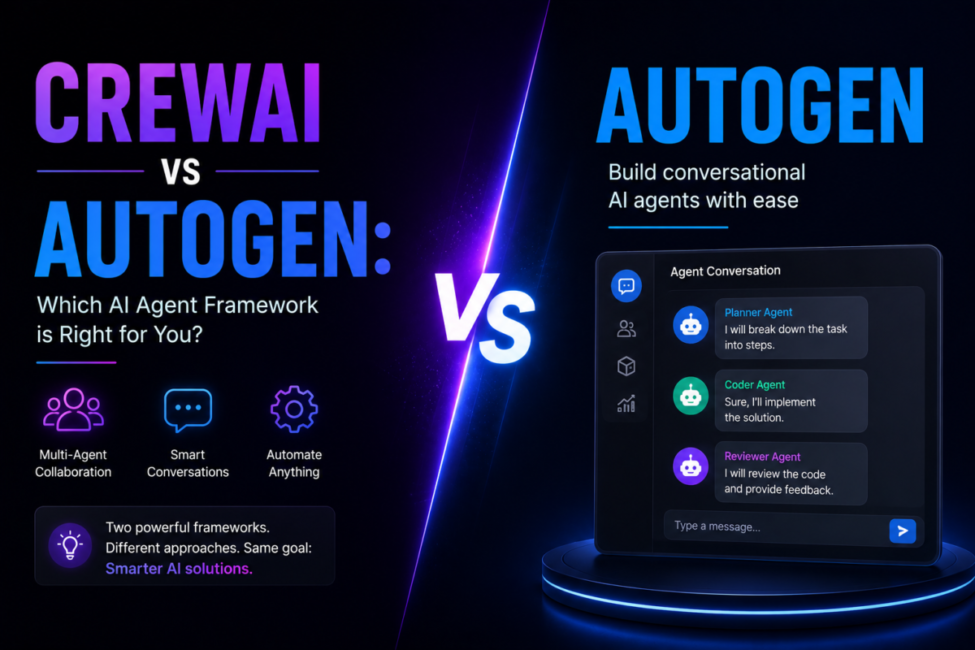
How we compare: we read each framework’s official docs, release notes and public GitHub activity, then map the trade-offs against the real jobs teams hire these tools to do — not a feature checklist in the abstract.
Disclosure: some outbound links may be affiliate or partner links. They never change our verdict, and every product named here has a free, open-source tier.

Table of Contents
CrewAI vs AutoGen: which multi-agent framework fits your workflow?
| Quick answer: CrewAI orchestrates agents as role-based crews — each with a role, goal and backstory executing tasks top-down — which suits predictable business automation. AutoGen orchestrates agents through open-ended conversation, ideal for dynamic problems and code execution. The 2026 twist: Microsoft put AutoGen in maintenance mode; the community fork AG2 carries it forward. |
A multi-agent framework is software that coordinates several LLM-powered agents so they can divide a task, pass work between each other, and reach an outcome no single prompt would reliably produce. CrewAI and AutoGen are two of the best known, and they take opposite design bets: CrewAI thinks in roles; AutoGen thinks in conversations. If you are new to the wider category, our primer on what agentic AI actually is explains why the orchestration layer, not the model, is where most projects live or die.
What is CrewAI and how does it work?
CrewAI uses structured, role-based workflows. You define each agent by giving it a Role, a Goal and a Backstory, then assign tasks that flow top-down through either a Sequential or a Hierarchical process. The mental model is a human team: a researcher gathers information, a writer drafts, a reviewer checks — each a specialist playing its part. It is the most intuitive abstraction of any major framework, with the gentlest learning curve; you can stand up a working crew in roughly 20 lines. That accessibility shows in adoption — CrewAI’s PyPI package has crossed 27 million total downloads with around 5 million in a single recent month, and the project reports powering roughly two billion agentic executions over the prior year.
The trade-off: limited fine-grained control
The trade-off is limited fine-grained control. CrewAI prioritises simplicity over precision: agent-to-agent communication is mediated through task outputs rather than direct messaging, and error handling is coarse. It has matured, though. The open-source CrewAI 1.0 release hardened the core and expanded Flows, an event-driven mode that connects roles into observable, deterministic chains for more predictable workloads. The reason CrewAI resonates is simple: most business problems genuinely do map onto teams of specialists.
When your problem looks like an org chart
When your problem already looks like an org chart — a content pipeline, a market-research routine, a tiered support flow — CrewAI lets you encode it almost literally, and the code reads like a description of the work. That readability is an underrated production virtue: when a non-engineer can look at a crew definition and understand what the system does, debugging and iteration get dramatically faster, and that shorter feedback loop is a large part of why CrewAI’s adoption has climbed so quickly. Its enterprise traction reflects this too, with the framework reporting adoption across a wide slice of large organisations that value shipping working automation over squeezing out every last unit of control. You can explore it at crewai.com, and see where role-based crews fit in the broader map of real agentic AI applications.
What is AutoGen — and what changed in 2026?
AutoGen pioneered conversational, event-driven multi-agent systems. Its agents interact through multi-turn dialogue, with GroupChat as the primary coordination pattern: several agents share a conversation and a selector decides who speaks next, letting them debate, refine and converge. That makes AutoGen strong where the solution path is not known upfront — multi-party reasoning, consensus building, and especially code execution and human-in-the-loop workflows, where one agent writes code, another critiques it, a third runs it and reports errors, and the loop iterates until the tests pass. The weakness is the mirror image of that strength: structured outputs are hard to enforce and dialogues can loop without the transition control a graph framework provides, so production systems that must guarantee a workflow terminates in a defined state often need circuit-breaker logic added by hand. Where AutoGen genuinely shines is in tasks that benefit from emergence — letting several agents argue toward a better answer than any single prompt would produce — which is exactly why it built a devoted following among researchers tackling problems whose right sequence of steps cannot be planned in advance.
The bigger story is organisational. On February 19, 2026, Microsoft placed AutoGen into maintenance mode — bug fixes and security patches only — and merged its multi-agent patterns with Semantic Kernel into the new Microsoft Agent Framework (MAF), which reached 1.0 general availability on April 3, 2026. Meanwhile the original contributors forked the project as AG2, an MIT-licensed, community-driven continuation that preserves the familiar AutoGen API while shipping a production-focused async rewrite. So “AutoGen” no longer names one thing. You can still find the original at github.com/microsoft/autogen and the fork at ag2.ai.
How do CrewAI and AutoGen compare head-to-head?
The two frameworks diverge across the dimensions that actually decide a project. CrewAI is structured, top-down and easy to reason about; AutoGen (and its successors) are open-ended, emergent and code-execution-friendly. Both are model-agnostic, and both have moved toward open interoperability protocols like MCP and A2A.

| Dimension | CrewAI | AutoGen / AG2 |
| Orchestration | Role-based crews | Conversational GroupChat |
| Workflow style | Structured, top-down | Open-ended, emergent |
| Learning curve | Lowest (role DSL, ~20 lines) | Moderate |
| Best at | Predictable pipelines | Debate and code execution |
| Development status | Active (CrewAI 1.x) | AutoGen in maintenance; AG2 active |
| Structured outputs | Easier to enforce | Harder; can loop |
The clean rule: choose CrewAI for predictable business automation with a defined structure; choose AutoGen/AG2 for complex, dynamic problem-solving where the solution path isn’t known upfront — especially when agents must write and execute code or argue toward an answer. These are not interchangeable. A research-automation routine that suits CrewAI’s role abstractions would be a poor fit for AutoGen’s free-form conversation, and vice versa. It also helps to be clear on the category boundary itself — both are true multi-agent systems, not single helpers, a distinction we unpack in AI agent vs AI assistant.
AutoGen, AG2, or the Microsoft Agent Framework?
This is the part most comparisons get wrong, because they predate the split. Here is the practical guidance grounded in the current status of each path:
- Already on AutoGen 0.2: AG2 is your near zero-friction upgrade path — it keeps the familiar API and is actively developed (v0.12.x shipped in mid-2026, with a v1.0 roadmap).
- Starting fresh in a Microsoft ecosystem: evaluate the Microsoft Agent Framework, which folds AutoGen’s patterns into enterprise-grade session management, type safety, telemetry and MCP/A2A interoperability.
- Want an independent open-source route: AG2 is MIT-licensed and community-governed.
- The one path to avoid: building a brand-new project on the deprioritised original AutoGen expecting active feature development. Teams on its older async stack should plan migration before infrastructure changes land later in 2026.
CrewAI and AutoGen in practice
Consider Heidi Brandt, a solo automation consultant building a lead-research pipeline for a B2B agency. Her task is well defined: for each inbound company, pull public data, summarise it, draft a tailored outreach email, and have a second pass check tone and factual claims. Because the workflow already looks like a team — researcher, writer, editor — she reaches for CrewAI, encodes three roles with clear goals and backstories, wires them as a Sequential process, and has a demo running the same afternoon. Her client, a non-engineer, can read the crew definition and understand exactly what it does, which makes iteration fast and reviews painless.
Two weeks later a different need appears: a research assistant that writes and runs Python to validate data-cleaning logic against messy CSVs, where the right sequence of steps genuinely isn’t known ahead of time. That is a conversational, code-execution problem, so Heidi prototypes it with AG2, letting a writer agent, a critic and a code-executor iterate until the script passes. Same consultant, same week — two frameworks, chosen by the shape of the problem rather than by brand loyalty. Truthfully, neither project needed to “win”; matching the tool to the workflow is the whole game, and it is how experienced builders approach the wider best AI agent tooling landscape.
This example is a composite of the framework evaluations we see most often, not a single client account; the figures are typical rather than measured from one engagement.
Which should you choose?

Match the framework to the shape of your problem. Choose CrewAI when your task decomposes into specialist roles, you want to prototype quickly, non-engineers need to understand the architecture, and you value readability over fine-grained control — content pipelines, market research and multi-role support are sweet spots. Choose AG2 or the Microsoft Agent Framework when agents must write and execute code, the workflow centres on multi-turn debate, you need humans in the loop, or the solution path is genuinely open-ended.
Two caveats sharpen the decision. If you need durable, strictly terminating, stateful production workflows, neither is the strongest option — a graph framework often leads there, which is why teams frequently prototype in CrewAI and harden elsewhere. And in a Microsoft-centric enterprise, MAF’s session management, telemetry and type safety may outweigh AG2’s independence. Whatever you pick, verify the project’s current status on its official site first — this space is moving in months, not years.
Frequently Asked Questions
What is the difference between CrewAI and AutoGen?
CrewAI uses structured, role-based workflows where agents with a role, goal and backstory execute tasks top-down, ideal for predictable business automation. AutoGen uses conversational workflows where agents negotiate through multi-turn GroupChat dialogue, ideal for dynamic problems where the solution path isn’t known upfront.
Is AutoGen discontinued?
Not discontinued, but deprioritised. On February 19, 2026, Microsoft placed AutoGen in maintenance mode — fixes only, no new features — and merged it into the Microsoft Agent Framework. The community fork AG2 continues active development, so existing projects work but should plan a migration path.
What is AG2?
AG2 is the MIT-licensed community fork of AutoGen, maintained by original contributors after Microsoft moved AutoGen to maintenance mode. It preserves the familiar AutoGen API so existing users can upgrade with little code change, while independently shipping a production-focused, event-driven async architecture.
Which is easier to learn, CrewAI or AutoGen?
CrewAI is easier. Its role-based DSL is the gentlest learning curve of any major framework — you can define agents with roles, goals and backstories and run a working crew in around 20 lines. AutoGen’s conversational model is powerful but needs more effort to constrain to structured outputs.
Should I start a new project on AutoGen in 2026?
Generally no — not on the original Microsoft AutoGen, which is in maintenance mode. Use AG2 (the active community fork) or the Microsoft Agent Framework (the official successor) for conversational patterns. For structured business automation, CrewAI is a better starting point. Choose by workflow shape, not brand name.
Can CrewAI and AutoGen execute code?
AutoGen and AG2 are particularly strong at code execution — agents write and run code, debate results, and iterate. CrewAI can use code-execution tools too, but its design centres on role-based task delegation. If your core workflow is agents writing and running code collaboratively, AG2 or the Agent Framework fits better.
Conclusion
These two frameworks take opposite design bets, and the right answer follows from your problem shape rather than from any benchmark. CrewAI thinks in roles: agents with a job, a goal and tasks executed top-down, which fits predictable business automation you can draw as a flowchart. AutoGen thinks in conversations: agents talking until they converge, which fits open-ended problems and code execution where the path is not knowable up front.
Two practical notes decide it more often than architecture. If your process is already a defined sequence, forcing it through conversational agents adds cost and non-determinism for nothing. And factor in the 2026 governance change: Microsoft moved AutoGen to maintenance mode, with the community fork AG2 carrying it forward and the Microsoft Agent Framework as the official successor path — so an AutoGen choice today is really a choice about which of those you follow. For the wider field see best AI agent frameworks.
