


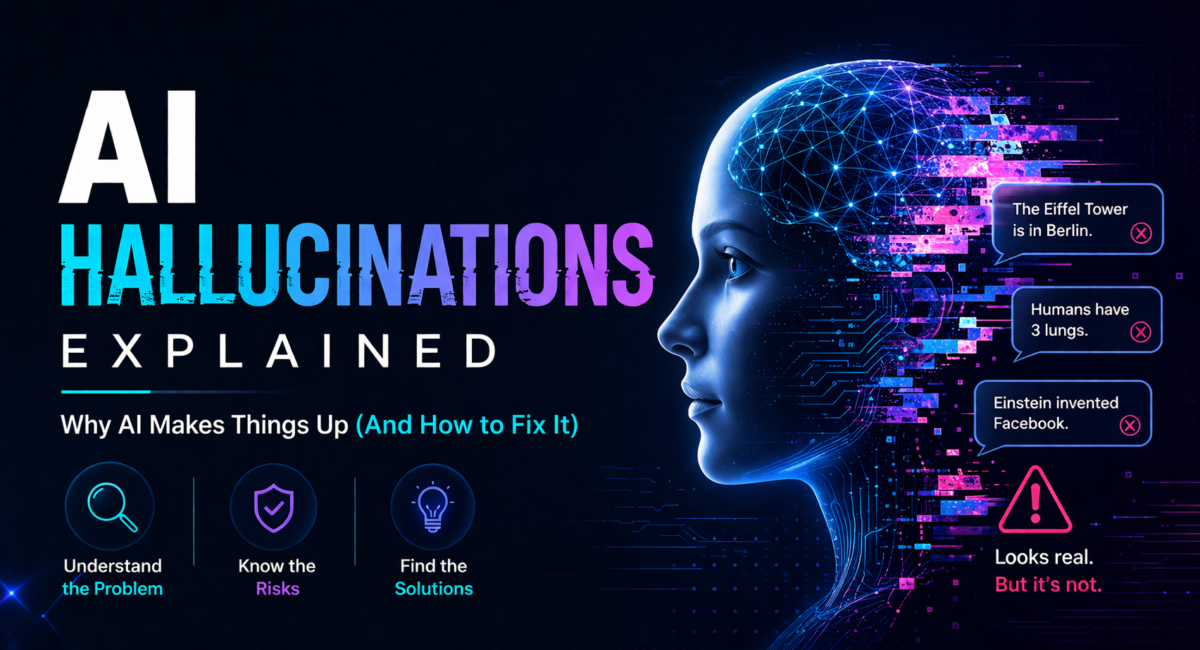
Ask a language model for a case citation, a benchmark number or a product spec and you will usually get something useful. Occasionally you get something fluent, specific, correctly formatted — and completely invented. In 2026 that failure mode is no longer a curiosity: courts have sanctioned lawyers over it, standards bodies have written it into risk frameworks, and frontier labs now publish it as a headline metric next to accuracy. This guide covers why it is structural, what the measured rates look like this year, and which mitigations move the number.
Related: our Claude AI review looks at how one leading model family handles factual accuracy.
| Quick answer: AI hallucinations are confident, plausible-sounding outputs from a generative AI model that are factually false or unsupported by any real source. They happen because language models are trained to predict likely text, not to verify truth. Retrieval grounding, abstention prompting and human verification reduce them substantially, but no known method eliminates them. |

Table of Contents
What Is an AI Hallucination, Exactly?
An AI hallucination is output from a generative model that is fluent, confident and formatted like a fact, but is false, fabricated or unsupported by any real source.
The word is imprecise, and standards bodies avoid it. The US National Institute of Standards and Technology uses confabulation, listing it as one of twelve generative-AI risk categories in its Generative AI Profile (NIST AI 600-1). The label matters less than the property underneath: the model is not merely wrong, it is wrong without any signal that it is wrong. A fabricated citation is formatted identically to a genuine one. Fluency is not evidence.
That reframes the problem. Hallucination is a verification challenge before it is an accuracy challenge, which is why it sits alongside how a large language model actually generates text and what explainable AI techniques expose about a model’s reasoning. A system right 95% of the time that gives you no way to tell which 5% is wrong is harder to operate than one right 85% of the time that flags its own uncertainty.
What do AI hallucinations look like in practice?
Direct answer: hallucinations rarely look like nonsense. They look like the most plausible possible answer, delivered in the same confident register as a correct one — which is exactly why they get past review. Five patterns account for most real-world cases.
| Pattern | What it looks like | Where it bites |
|---|---|---|
| Fabricated citations | A correctly formatted reference — plausible authors, real-sounding journal, valid-looking DOI — to a paper that does not exist | Legal filings, academic work, research summaries |
| Invented API surface | A function, parameter or config flag that fits the library’s naming conventions perfectly but was never implemented | Code generation, technical documentation |
| Confident numerical drift | A statistic close to the real figure but wrong, or attributed to the wrong year or source | Financial summaries, market research, reporting |
| Phantom product features | Describing a capability a tool does not have, usually one a competitor does have | Product comparisons, support answers, buying guides |
| Misattributed quotes | A real quotation assigned to the wrong person, or a plausible quote nobody said | Content writing, journalism, briefing documents |
The citation case is the best documented
The citation case is best documented: Stanford RegLab’s evaluation of leading AI legal research tools — including systems marketed as hallucination-free — found fabricated or misgrounded output at rates high enough to matter professionally, which is why courts now sanction filings containing invented case law. The more a domain relies on precise references, the more expensive its hallucinations are.
What unites every example
What unites all five: each output is structurally correct — the citation formatted properly, the API call syntactically valid, the statistic in a believable range. Models optimise for plausibility, and plausibility is what defeats a skim-read. That is why detection has to be mechanical rather than intuitive.
Why Do Language Models Invent Facts?
The strongest current explanation comes from OpenAI’s research paper Why Language Models Hallucinate, which locates the cause in two layers, not one.
The first layer is pretraining. A model learns the statistical distribution of its training text; it has no separate store of verified facts to check against. Errors are therefore not a defect but a consequence of density — facts appearing rarely in training data are the ones the model must approximate, and approximating a specific name, number or citation produces something that looks right and is not.
The second layer is post-training incentives, and it is the more actionable one. Most benchmarks score accuracy alone. Under that scoring, saying “I don’t know” earns zero while a confident guess has some chance of scoring, so the optimal strategy is to always answer — the logic a student applies to a multiple-choice exam with no penalty for wrong answers. Models are trained into overconfidence by how we grade them. The proposed fix is to change the grading: penalise confident errors more heavily than admitted uncertainty.
Three factors compound both layers: knowledge cutoffs mean anything recent is guessed rather than known, ambiguous prompts widen the space of plausible continuations, and noisy retrieved context buries the correct passage among distractors.
How Often Do Models Get Facts Wrong in 2026?
There is no single hallucination rate for any model, and any article quoting one number without naming the task and dataset is simplifying to the point of being wrong. Rates swing by more than an order of magnitude with what you ask.
The clearest public measurement is Vectara’s hallucination leaderboard, which tests one narrow task: summarise a supplied document using only that document. Scored with the HHEM-2.3 model across more than 7,700 articles, the best entry in the 22 September 2026 update sits at roughly 1.8%, held by antgroup/finix_s1_32b. That corrects a recycled figure — older write-ups still quote sub-1% rates such as 0.7%, which came from an earlier scoring model and are not comparable.
Closed-book factual recall, where the model has no document to lean on, is a different universe; rates there run well into double digits for every frontier model. Nor does grounding automatically rescue you. A preregistered Stanford RegLab study, Hallucination-Free? Assessing the Reliability of Leading AI Legal Research Tools, found purpose-built retrieval-augmented legal products hallucinated on 17% to 33% of queries, despite marketing promising hallucination-free citations.
Hallucination rate is therefore a property of a task, not a model. Grounded summarisation over clean documents is close to solved; open-ended recall about obscure entities is not.
Do Smarter Models Hallucinate Less?
Not automatically, and 2026 produced an unusually clear demonstration. Anthropic’s Claude Opus 5 system card, published with its release on 24 July 2026, reports that Opus 5 is more accurate than its predecessor on a closed-book factual benchmark while showing a higher hallucination rate. The cause is willingness: the model answers more often when uncertain, producing both more correct claims and more confident false ones.
That breaks a common assumption. Capability and calibration are separate axes — a model can know more, reason further and still be worse at recognising the edge of its own knowledge. When evaluating models for factual work, accuracy alone is the wrong metric; pair it with the rate of confidently wrong answers, as NIST’s confabulation guidance recommends.
What Real Damage Do Fabricated Outputs Cause?
Law is where the damage is best documented, because filings are public. The AI Hallucination Cases database maintained by Damien Charlotin at HEC Paris tracks court decisions involving AI-fabricated citations; it had catalogued roughly 1,600 cases by mid-2026, up from around 200 a year earlier — the database did not respond when we re-checked on 3 October 2026, so treat 1,600 as a mid-2026 floor rather than the current total, because the count only moves one way. Penalties escalated from token fines to five-figure sanctions per attorney and the first bar suspensions tied to AI filings.
The pattern generalises. In healthcare a fabricated detail in a discharge summary is a safety event; in finance an invented figure in a client memo is a compliance exposure. The mechanism is identical each time: a confident output entered a workflow with no verification step, because the previous hundred outputs had been fine.
That asymmetry — many quiet wins, one loud public failure — is the governance argument. Teams that treat hallucination management as a launch requirement keep the productivity gains; teams that discover it after a filing goes wrong lose trust in tools that worked everywhere else.
How do you detect AI hallucinations?
Direct answer: you verify against a source rather than reading for plausibility, because plausibility is the thing the model optimised for. Three checks catch the overwhelming majority, and all three are mechanical.
Check every reference actually resolves
Do not read a citation and judge whether it looks real — open it. A fabricated reference fails instantly against the source database while surviving any amount of careful reading. The same applies to API calls, quotes and statistics: check the source states it. This one habit catches the most damaging category outright.
Ask the same question twice, in separate sessions
Genuine knowledge is stable across runs; fabrication tends not to be. If a model gives one confident specific in one session and a different one in a fresh session, the detail was generated rather than recalled. A rough test, not a proof — but it costs seconds and flags the fluent specifics reviewers wave through.
Require the model to cite from supplied context only
In a retrieval setup, instruct the model to answer only from the provided passages and to say when they do not contain the answer — then check the cited passage says what the answer claims. This turns hallucination from an invisible failure into a visible one. Automated graders comparing output against retrieved text work the same way and scale better than manual review.
What does not work is asking the model if it is confident. Self-reported confidence correlates poorly with accuracy, and a model that fabricated a citation will defend it. Trust the source check, not the self-assessment. Our guide to fine-tuning vs RAG covers the retrieval architecture that makes this checkable in the first place.
How Do You Reduce AI Hallucinations?
No single control solves this. Reliable systems stack several layers, each catching a different class of failure.
How we compare: the table below ranks mitigations by published, reproducible evidence — preregistered studies and leaderboards with disclosed scoring models — not vendor claims. Where a technique has been marketed as eliminating hallucinations, we note the measurement that contradicts it.
| Mitigation layer | What the evidence supports | Where it still fails |
| Retrieval-augmented generation | The largest single reduction available; grounded tasks score best. | Stanford RegLab measured 17–33% in RAG legal tools; stale sources still fabricate. |
| Abstention prompting | Letting the model say it does not know offsets the incentive to guess. | Trades hallucinations for refusals; needs tuning per task. |
| Mandatory citation | Forces every claim to a checkable anchor, making fabrication visible. | A model can cite a real source that does not support the claim. |
| Claim-level verification | Checks each sentence against retrieved evidence and flags unsupported spans. | Adds latency and cost; the verifier is itself a model. |
| Model and route selection | Rates differ by an order of magnitude between models on one task. | The most capable model is not reliably the best calibrated. |
| Human review gate | The only control that catches genuinely novel failures. | Degrades exactly as volume rises and reviewer trust grows. |
The two design decisions that matter most
Two design decisions matter most. Retrieval quality dominates retrieval presence — RAG over a stale corpus underperforms a smaller, well-governed one, the central trade-off in our guide to choosing between fine-tuning and RAG. And the system needs a defined behaviour for “not in the retrieved context,” because a model with no permitted failure mode will invent one.

Case Study: Stopping Fabricated Citations at a Fintech
Consider someone running regulatory monitoring at a 40-person UK fintech, turning regulator publications into internal memos that tell product teams what changed. An assistant is adopted to draft them and, within two months, two memos are caught citing a consultation paper reference that does not exist. Both had already been read by engineers. (This example is a composite of AI review workflows we have examined, illustrating the control pattern rather than one company’s metrics.)
The fix was structural, not a better prompt. The team stopped letting the model answer from memory: the assistant retrieves only from a curated store of regulator PDFs, and returns “not found in source” when retrieval comes back empty. Every factual sentence must carry a document reference and page number, and a reviewer spot-checks three before circulation. The outcome was not a smarter model but a workflow where a fabrication cannot travel past one reviewer.
Disclosure: TechieHub may earn a commission from links to tools mentioned on this site. This never influences our testing, rankings or conclusions.
Frequently Asked Questions
What are AI hallucinations?
AI hallucinations are outputs from a generative AI model that sound confident and plausible but are factually false, fabricated or unsupported by any real source. Typical examples include invented statistics, citations to studies that do not exist, and descriptions of product features that were never built.
Why do AI models hallucinate even when they seem confident?
Because confidence and correctness are produced by the same mechanism. A language model predicts statistically likely text, so a fabricated answer is generated with the same fluency as a true one. OpenAI’s research also shows that accuracy-only benchmarks reward guessing over admitting uncertainty, training models toward overconfidence.
What is a normal AI hallucination rate in 2026?
There is no single rate. On Vectara’s grounded summarisation leaderboard, the best model scored roughly 1.8% in its 22 September 2026 update. On open-ended closed-book recall, rates are far higher, and Stanford RegLab measured 17–33% in retrieval-augmented legal research tools. Task and dataset determine the number.
Does RAG eliminate AI hallucinations?
No. Retrieval-augmented generation is the single most effective mitigation because it grounds answers in real documents, but Stanford RegLab found purpose-built RAG legal tools still hallucinated on 17–33% of queries. RAG on stale, conflicting or ungoverned data fabricates, so grounding requires data governance alongside it.
Do newer AI models hallucinate less than older ones?
Not reliably. Anthropic’s Claude Opus 5 system card, published on 24 July 2026, reports higher factual accuracy than its predecessor alongside a higher hallucination rate, because the model answers more often when uncertain. Capability and calibration improve independently, so newer does not automatically mean safer.
How do I stop an AI from making up sources?
Require citations to documents you supplied rather than to the model’s memory, tell it explicitly to reply that the answer is not in the source when retrieval fails, and verify that each cited source exists and supports the claim. Never accept a reference without opening it.
What are some examples of AI hallucinations?
The most common AI hallucination examples are a citation to a court case or research paper that does not exist, a code function or config flag the library never implemented, a statistic that is close to the real figure but wrong, a product feature the tool does not have, and a real quotation credited to the wrong person. Each looks correctly formatted, which is why fake case citations have led courts to sanction lawyers who filed them without checking.
What should you do when an AI gives a fact you think is wrong?
Treat it as a likely hallucination. Check the claim against a reliable primary source, such as the original document, an official record or a reputable reference, before you use it. Re-asking the same question or trusting the confident tone does not verify anything, because models can repeat or change an error without knowing it is wrong.
Conclusion
AI hallucinations are not a defect awaiting a patch. They follow from how language models are trained to predict text and from how the industry has graded them, which is why they persist in the most capable systems shipped this year. The 2026 picture is encouraging on grounded tasks and unsolved on open-ended recall — and that gap is the most useful thing to know when deciding where to deploy a model.
The practical position is neither blanket trust nor avoidance. Ground the model in sources you control, give it a sanctioned way to say it does not know, require citations you can open, and keep a human accountable for anything published. Do that and the failure mode becomes a managed cost rather than a latent liability.

8 Comments
Pingback: AI and Analytics: The Complete Guide to AI Data
Pingback: Best AI Agent – Top Picks Tested & Compared
Pingback: Best AI Models 2026: GPT-5.5 vs Claude vs Gemini vs DeepSeek
Pingback: What is Prompt Engineering? A Complete Beginner Guide
Pingback: Fine-Tuning vs RAG: Which AI Approach Wins in 2026?
Pingback: Generative AI for Content Creation That Saves Hours
Pingback: Best AI Tools for Business to Scale Without Extra Staff
Pingback: How Does Generative AI Work – Simply Explained