


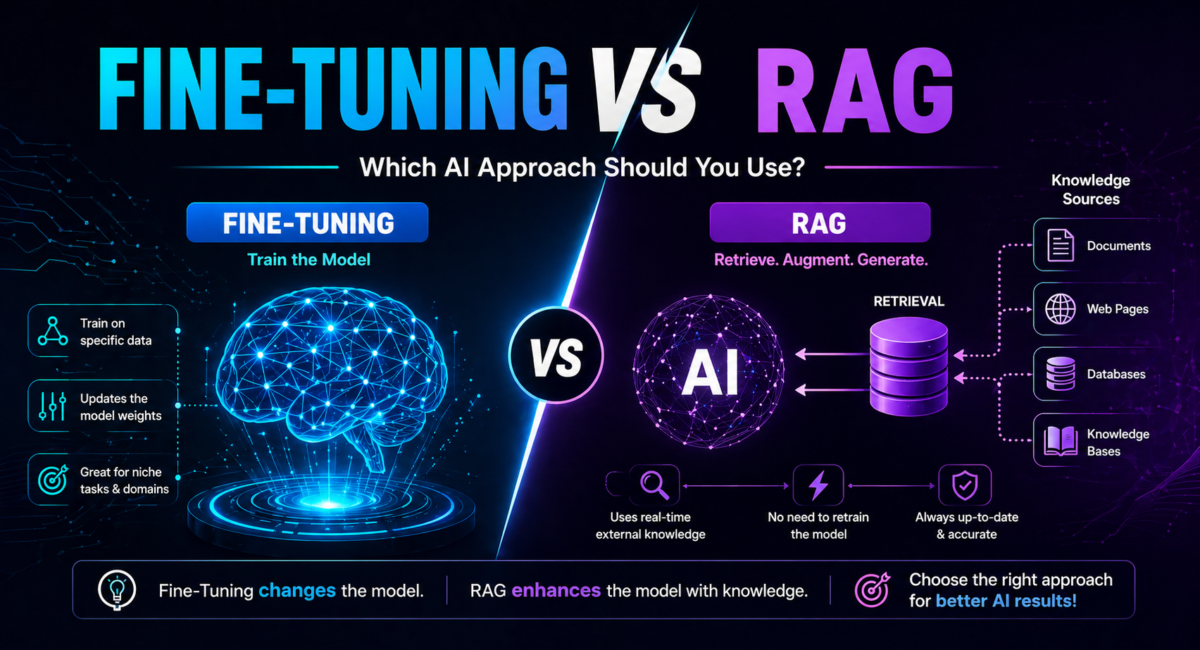
| Quick answer: RAG (retrieval-augmented generation) connects a large language model to an external knowledge base so it looks up facts at query time, staying current without retraining. Fine-tuning retrains the model’s weights to lock in a consistent style, format, and behavior. RAG keeps you truthful; fine-tuning keeps you consistent. In 2026, most production systems blend both. |
Definition: Fine-tuning vs RAG is the choice between changing what a model knows how to do (its weights) and changing what a model can see (its retrieved context) when it answers.
How we compare: This guide weighs the two approaches on the factors teams actually feel in production – freshness of knowledge, upfront and per-query cost, transparency, engineering effort, and failure modes – using published enterprise adoption data, vendor pricing, and peer-reviewed research rather than vendor marketing. Affiliate disclosure: some outbound links may be affiliate or partner links; they never change our editorial verdict or what we recommend.
Table of Contents
Fine-tuning vs RAG: what actually changes inside the model?
Out of the box, a large language model knows a great deal in general and almost nothing about your specific business, documents, or rules. The two dominant ways to close that gap are RAG and fine-tuning, and they are constantly framed as rivals. They are not. They change different parts of the system. Fine-tuning edits the model’s parameters so a behavior becomes second nature. RAG leaves the parameters untouched and instead controls the evidence placed in front of the model at the moment it answers.
The cleanest mental model: RAG is an open-book exam, and fine-tuning is studying until the material is automatic. If your system gives wrong answers because it lacks current or proprietary facts, that is a retrieval problem. If it gives correctly informed answers in the wrong tone, format, or structure, that is a behavior problem. Naming the failure mode first is the single most useful judgment when building with AI – and it usually settles the RAG-versus-fine-tuning debate before it starts.
What is RAG, and why do enterprises default to it?
Retrieval-augmented generation connects an LLM to an external source – your documents, a vector database, or a live API – so that when a query arrives, the system first retrieves the most relevant passages and then generates an answer grounded in them. Nothing about the model’s weights changes; you govern what sits in the knowledge base.
Two properties make RAG the practical default: freshness and traceability. Because it reads from a live source, RAG stays current without retraining, and because answers are built from specific passages, the system can cite exactly which sources it used. That grounding is also the strongest lever against hallucination. A 2025 review of hallucination mitigation for retrieval-augmented LLMs found grounding in retrieved evidence meaningfully cuts fabrication, and independent 2026 benchmarks put RAG’s hallucination reduction in the range of roughly 40-90% depending on task and retrieval quality (see the Hallucination Mitigation for Retrieval-Augmented LLMs review). The catch: RAG is only as good as its retrieval and its data. Well-tuned pipelines reach 85-90% answer accuracy, while naive implementations can languish at 10-40%.
Adoption reflects this. In Menlo Ventures’ State of Generative AI in the Enterprise, 51% of enterprise deployments used RAG in production versus just 9% relying primarily on fine-tuning – a gap that has only widened as tooling matured.
What does fine-tuning actually do to a model?
Fine-tuning takes a pre-trained model and trains it further on your curated dataset, adjusting its weights so it internalizes your terminology, tone, formats, and decision patterns. Where RAG adds knowledge at query time, fine-tuning encodes behavior into the model itself, so you no longer have to spell out those instructions on every call.
Fine-tuning shines at consistency: reliable structure, stable voice, sharp classification, and strict adherence to a policy or schema. For narrow, high-volume tasks it can also be cheaper per query once the training cost is amortized, because a smaller fine-tuned model can replace a larger prompted one. The trade-offs are real – it demands ML expertise and compute, every knowledge change forces a retrain, and it risks “catastrophic forgetting” of general ability. A useful boundary: fine-tune the how, retrieve the what. This is also why a compact, tuned model can outperform a giant general one on a bounded job, a theme we explore in what a small language model is.
What is LoRA, and why did it change the cost equation?
Full fine-tuning updates every weight in the model, which is what makes the six-figure estimates in the table above realistic. Parameter-efficient fine-tuning (PEFT) avoids that by freezing the original weights and training a small set of new ones alongside them. LoRA (Low-Rank Adaptation) is the dominant method: it trains compact adapter matrices that sit beside each layer, typically touching well under 1% of the parameters. QLoRA adds quantisation on top, bringing the memory requirement down far enough that adapting a mid-size open-weight model becomes a single-GPU job rather than a cluster one.
This matters for the comparison in two ways. It collapses the cost gap — a LoRA adapter trained on a few hundred well-chosen examples costs orders of magnitude less than a full fine-tune, which is why “fine-tuning is too expensive” is a weaker objection in 2026 than it was two years ago. And it makes adapters disposable: because the base model is untouched, you can keep several task-specific adapters, swap them per workload, and discard one that stops earning its place without retraining anything. The caveat is unchanged — LoRA lowers the price of encoding behaviour, not the wisdom of encoding facts. Cheap retraining is still retraining, and knowledge that changes weekly still belongs in retrieval. Our guide to open source AI models covers which base models are practical to adapt this way.
How do fine-tuning and RAG compare head-to-head?
The table below lines up the two approaches on the dimensions that decide real projects.
| Factor | RAG | Fine-tuning |
| Best for | Fresh, changing facts | Consistent style, format, behavior |
| How it works | Looks up external data at query time | Retrains the model’s weights |
| Freshness | Always current – update the data | Stale until retrained |
| Time to deploy | Roughly 1-2 weeks | Roughly 2-6 months |
| Cost profile | Lower upfront (~$500-$5k/mo typical) | High upfront ($50k-$500k+); cheaper per query at scale |
| Transparency | Can cite sources | Opaque – behavior is baked in |
| Main risk | Poor retrieval or bad data | Forgetting, privacy, rigidity |
The pattern is consistent: RAG wins on knowledge, freshness, transparency, and agility; fine-tuning wins on consistent behavior and, for bounded high-volume tasks, efficiency at scale. They target different failure modes, which is precisely why the mature answer is rarely “pick one.”
What changed in 2026?

Two shifts reshaped the calculus this year. First, the economics of standalone fine-tuning tightened. OpenAI began winding down its self-serve fine-tuning API in May 2026, steering teams toward prompt caching plus smaller, cheaper base models that now match fine-tuned economics for most workloads. When the cheapest path to consistency is a good prompt against a small model, the bar for fine-tuning rises.
Second, the hybrid frontier matured. The RAFT (Retrieval-Augmented Fine-Tuning) paper from UC Berkeley showed you can fine-tune a model specifically to reason over retrieved documents – teaching it to lean on the right passages and ignore distractors. In benchmarks across models and domains, combining fine-tuning with RAG outperformed either technique alone. The takeaway for 2026 is not that fine-tuning is dead; it is that fine-tuning increasingly earns its place inside a retrieval system rather than as a replacement for one.
Where the cheapest option still wins
Before either approach, try strong prompt engineering, and – if your knowledge base is small – simply place it in context with prompt caching. Many “we need to fine-tune” problems are solved by a better prompt at a fraction of the cost and time. Escalate only when the simpler methods genuinely fall short.
Fine-tuning and RAG in practice
Consider Saskia, a data platform lead at a mid-size fintech building an internal analytics copilot. Her analysts ask questions like “which merchant categories drove chargebacks last quarter?” The facts – transaction tables, fraud rules, this week’s dashboards – change daily, so Saskia puts them behind a RAG layer that queries governed data sources at request time. That keeps answers current and lets the copilot cite the exact table or report it drew from, which her compliance team requires.
But the way the copilot answers – always returning a short summary, then a SQL snippet, then caveats about data freshness – has to be identical every time. Rather than pay for full fine-tuning, Saskia first encodes that structure in a reusable prompt template against a small model; when a few edge cases keep drifting, she fine-tunes that small model on a few hundred vetted examples. The result mirrors what teams building serious LLM-driven data analysis workflows report: retrieval handles volatile facts, a lightly tuned model handles stable behavior, and each layer improves without disturbing the other. It is the same separation of concerns that makes hybrid setups so durable for coding assistants too, as covered in our look at the best AI model for coding.
This example is a composite of the tuning-versus-retrieval decisions we see most often, not a single client account; the figures are typical rather than measured from one engagement.
How should you choose?
Three factors drive the decision:
- Knowledge volatility – how often your information changes. Fast-changing knowledge points to RAG.
- Query scale and task shape – stable, high-volume, narrow tasks can justify the upfront cost of fine-tuning.
- Team capability – hybrid needs both ML and data-engineering maturity; without ML expertise, RAG is the safer, faster path.
A sequence that works for most teams
A sequence that works for most teams: start with prompt engineering; add RAG when you need current or proprietary facts; layer fine-tuning on top only if behavior or format inconsistencies remain; and build a full hybrid only when the payoff clearly justifies the extra points of failure. Avoid the classic mistake – fine-tuning to add knowledge that changes, which freezes facts into weights and forces endless retraining. Whatever you choose, measure continuously. Both approaches are means to the same end: making capable models genuinely useful for your specific problem.
Where the market is heading
It also helps to think about the direction the market is moving. As base models get cheaper and their context windows grow, more problems that once demanded fine-tuning collapse into a good prompt over a small, fast model – which is exactly why OpenAI nudged customers toward prompt caching in 2026. Meanwhile, retrieval keeps getting stronger: better embeddings, re-rankers, and hybrid keyword-plus-vector search have pushed well-built RAG pipelines from novelty to reliable infrastructure. Fine-tuning has not disappeared; it has moved up the stack, from a blunt tool for stuffing in knowledge to a precision tool for shaping behavior and, via techniques like RAFT, for making a model a better reader of its own retrieved context. The teams that win in 2026 are not the ones loyal to a single method – they are the ones who can name a failure mode in one sentence and reach for the smallest, cheapest fix that resolves it.
Frequently Asked Questions
What is the difference between fine-tuning and RAG?
RAG connects an LLM to an external knowledge base so it retrieves relevant facts at query time without changing the model. Fine-tuning retrains the model’s weights on your data, encoding behavior into the model itself. RAG suits fresh, changing knowledge; fine-tuning suits consistent style, format, and behavior.
Is RAG better than fine-tuning?
Neither is universally better – they solve different problems. RAG wins for fresh facts, transparency, and agility, and is the more common production choice at around 51% of enterprise deployments. Fine-tuning wins for consistent behavior and narrow high-volume tasks. In 2026, hybrid systems combining both are the practical default.
When should I use RAG instead of fine-tuning?
Use RAG when your problem is missing or stale facts. RAG lets you update knowledge instantly by changing the documents, keeps answers current, cites sources, and reduces hallucinations. It is also lower-cost and easier to maintain than fine-tuning whenever your underlying information changes frequently.
When should I fine-tune a model?
Fine-tune when your failure mode is behavior inconsistency – wrong format, unstable tone, weak classification, or poor policy adherence – and the desired behavior is stable. It is also efficient for narrow high-volume tasks once training cost is amortized. Avoid it for fast-changing knowledge, which forces constant retraining.
Can I use fine-tuning and RAG together?
Yes, and in 2026 hybrid systems are the practical default for production quality. UC Berkeley’s RAFT technique even fine-tunes a model specifically to reason over retrieved documents. Use retrieval for facts and fine-tuning for style, policy, and decision behavior; the trade-off is added complexity best suited to mature teams.
Which is cheaper, RAG or fine-tuning?
RAG usually has lower upfront and ongoing costs for changing knowledge, often $500-$5,000 monthly, since you avoid training runs. Fine-tuning can start in the tens of thousands upfront but may be cheaper per query for high-volume narrow tasks once amortized. For most teams starting out, RAG is more cost-effective.
Conclusion
Name the failure mode before you pick a technique. If the system is confidently wrong about facts, that is retrieval — reach for RAG. If it is correct but inconsistent in tone, structure or policy adherence, that is behaviour — reach for fine-tuning, and reach for LoRA before a full run. If it is both, you want a hybrid, and you should still build the retrieval layer first because it is the half that fails loudly rather than quietly.
The sequencing advice holds regardless of budget: prompt engineering, then retrieval, then a light adapter, then a full hybrid — stopping at the first step that actually resolves the problem. The expensive mistakes in this space are almost never choosing the wrong technique; they are skipping straight to the most complex one, and encoding knowledge into weights that will be stale by the next quarter.

4 Comments
Pingback: What Are AI Hallucinations? Complete Guide 2026 | TechieHub
Thanks for writing this — CV Builder Free at has been useful for similar workflows. CV Builder Free
Pingback: Best AI Models 2026: GPT-5.5 vs Claude vs Gemini vs DeepSeek
Pingback: What is Prompt Engineering? A Complete Beginner Guide