Close Menu

    Subscribe to Updates

    Get the latest creative news from FooBar about art, design and business.

    What's Hot

    20 Best AI Tools for YouTube Automation 2026: Complete Implementation Guide

    February 28, 2026

    15 Best Open Source AI Models 2026: Complete Implementation Guide

    February 26, 2026

    Building Agentic AI Applications with a Problem-First Approach [2026]

    February 25, 2026
    Facebook X (Twitter) Instagram
    Facebook X (Twitter) Instagram
    TechiehubTechiehub
    • Home
    • Featured
    • Latest Posts
    • Latest in Tech
    TechiehubTechiehub
    Home - Featured - Best AI Agents for Security Questionnaires: Complete Guide [2026]
    Featured

    Best AI Agents for Security Questionnaires: Complete Guide [2026]

    TechieHubBy TechieHubUpdated:March 3, 20261 Comment30 Mins Read
    Facebook Twitter Pinterest LinkedIn Tumblr Email
    best ai agents for security questionnaires
    Share
    Facebook Twitter LinkedIn Pinterest Email

    The Ultimate Resource for Security Teams, GRC Professionals, and Sales Operations Seeking AI-Powered Solutions to Automate Vendor Assessments, Compliance Questionnaires, and Security Reviews

    📌 KEY TAKEAWAYS

    • Companies using AI for security questionnaires report 75% reduction in response time, 40% reduction in security team workload, and 60-80% of questions answered automatically with 90%+ accuracy
    • Best Overall: Vanta (compliance + questionnaire automation) | Best Trust Center: SafeBase | Best Questionnaire-Focused: Conveyor | Best Vendor Risk Management: Prevalent | Best Budget: SecurityScorecard ($5K/year)
    • AI security questionnaire tools have evolved beyond simple automation—they now maintain living knowledge bases, connect responses to real-time compliance evidence, and enable proactive security disclosure through Trust Centers
    • Key differentiator: Modern tools integrate continuous compliance monitoring with questionnaire automation, ensuring responses reflect current security posture rather than outdated documentation
    • Selection framework: Match tool to your primary direction (inbound customer questionnaires vs outbound vendor assessments), evaluate knowledge base capabilities, verify standard questionnaire format support, and assess integration with existing GRC systems

    ✍️ ABOUT THE AUTHOR

    This comprehensive guide was written by TechieHub Security & Compliance Research Team, comprising certified information security professionals (CISSP, CISM), GRC specialists, and enterprise software analysts who evaluate security automation platforms across real-world compliance scenarios. Our team tests tools for questionnaire accuracy, knowledge base capabilities, integration depth, and measurable time savings. We update this guide regularly as platforms evolve and new solutions emerge.

    Table of Contents

    1. The Security Questionnaire Challenge
      1. How AI Transforms Questionnaire Management
        1. Evaluation Framework for AI Questionnaire Tools
          1. Best Overall: Vanta
            1. Best Trust Center: SafeBase
              1. Best Questionnaire-Focused: Conveyor
                1. Best for Vendor Risk Management: Prevalent
                2. More Top AI Security Questionnaire Tools
                  1. Comprehensive Comparison Matrix
                    1. Inbound vs Outbound: Choosing Your Direction
                      1. Implementation Best Practices
                        1. Frequently Asked Questions
                          1. Conclusion

                          1. The Security Questionnaire Challenge

                          Finding the best AI agent for security questionnaires depends on your specific role in the security assessment ecosystem. Organizations responding to customer security inquiries have different needs than those assessing vendor risk. A company pursuing SOC 2 certification needs different capabilities than one managing hundreds of third-party relationships. Understanding the full scope of the security questionnaire challenge helps you evaluate solutions effectively.

                          Security questionnaires assess an organization’s security posture through detailed questions about policies, controls, certifications, and practices. They’re essential for vendor risk management, customer due diligence, and regulatory compliance—but they create significant administrative burden. Enterprise organizations send and receive thousands of questionnaires annually, with each requiring hours of careful, accurate response.

                          The challenge compounds because questionnaires come in countless formats. Standard frameworks like SIG (Standardized Information Gathering), CAIQ (Consensus Assessments Initiative Questionnaire), and VSA (Vendor Security Alliance) help somewhat, but many organizations create custom questionnaires reflecting their specific concerns. Each format requires translation, mapping, and careful response even when the underlying security controls being assessed are identical.

                          Manual questionnaire response is unsustainable at scale. Security teams spend 20-40 hours per complex questionnaire, answering similar questions repeatedly across different formats. This creates bottlenecks in sales cycles, delays vendor onboarding, and diverts security professionals from higher-value work. The repetitive nature—answering the same questions about encryption practices, access controls, and incident response hundreds of times—makes automation not just helpful but necessary.

                          📊 Companies using AI for security questionnaires report 75% reduction in response time and 40% reduction in security team workload — Gartner Security Operations Survey

                          📊 Enterprise organizations handle an average of 200-500 security questionnaires annually, with each requiring 10-40 hours of effort — ISSA Security Survey

                          1.1 Types of Security Questionnaires

                          Understanding questionnaire categories helps identify which AI tools will provide the most value for your specific situation. The security questionnaire landscape divides into several distinct categories, each with different requirements and appropriate solutions.

                          Vendor security assessments evaluate third-party risk before onboarding new vendors or during periodic reviews. These are outbound questionnaires—you’re sending them to assess others. Organizations managing hundreds of vendor relationships need tools that streamline sending, tracking, and analyzing incoming responses. Prevalent and OneTrust Vendorpedia excel in this category.

                          Customer security questionnaires represent inbound assessments—potential customers evaluating your security before purchasing. These questionnaires directly impact revenue, making response speed and quality critical for sales cycles. SafeBase, Conveyor, and Vanta’s questionnaire features address this category, helping organizations respond quickly and consistently.

                          Compliance questionnaires verify adherence to specific regulatory or certification requirements. SOC 2, ISO 27001, HIPAA, and similar frameworks each have associated questionnaire requirements. Compliance-focused tools like Vanta and Drata connect questionnaire responses directly to compliance evidence, ensuring accuracy and providing audit trails.

                          • Vendor Assessments (Outbound): Evaluating third-party security before and during vendor relationships
                          • Customer Questionnaires (Inbound): Responding to security due diligence from potential customers
                          • Compliance Questionnaires: Verifying regulatory and certification adherence
                          • RFP Security Sections: Addressing security requirements in procurement processes
                          • Cyber Insurance Applications: Completing underwriter questionnaires for coverage
                          • Internal Assessments: Evaluating internal departments or business units

                          1.2 Why Manual Processes Fail

                          Manual security questionnaire processes create cascading problems that compound over time. Inconsistency emerges first—different team members answer similar questions differently, creating conflicting representations of security practices. This inconsistency can raise red flags with sophisticated evaluators who notice discrepancies.

                          Currency becomes impossible to maintain manually. Security practices evolve constantly—new controls are implemented, certifications are obtained, policies are updated. Keeping track of current accurate answers across hundreds of potential questions exceeds human capacity. AI tools connected to continuous compliance monitoring solve this by ensuring responses reflect current state.

                          Scale breaks manual processes entirely. When questionnaire volume exceeds what the security team can handle, responses slow down or quality suffers. Sales deals stall waiting for security reviews. Vendor onboarding delays while assessments queue. The administrative burden crowds out strategic security work that would actually improve organizational security posture.

                          Knowledge loss occurs when experienced team members leave. The institutional knowledge about how to answer specific questions, what evidence to provide, and how to handle edge cases walks out the door. AI knowledge bases capture and preserve this expertise, making it available regardless of team changes.

                          💡 Pro Tip: Before evaluating AI questionnaire tools, audit your current process: How many questionnaires do you handle annually? What’s your average response time? How many hours does each questionnaire require? These metrics help quantify the value AI automation can provide and justify investment.

                          2. How AI Transforms Questionnaire Management

                          AI has fundamentally transformed security questionnaire management from a manual, repetitive burden into a largely automated workflow. Understanding how AI applies to questionnaires helps you evaluate tools effectively and set realistic expectations for what automation can achieve.

                          2.1 Knowledge Base and Learning

                          The foundation of AI questionnaire automation is a comprehensive knowledge base containing your organization’s security information. This knowledge base includes policies, procedures, control descriptions, certification details, and historical questionnaire responses. AI tools use this information to generate accurate responses to new questions.

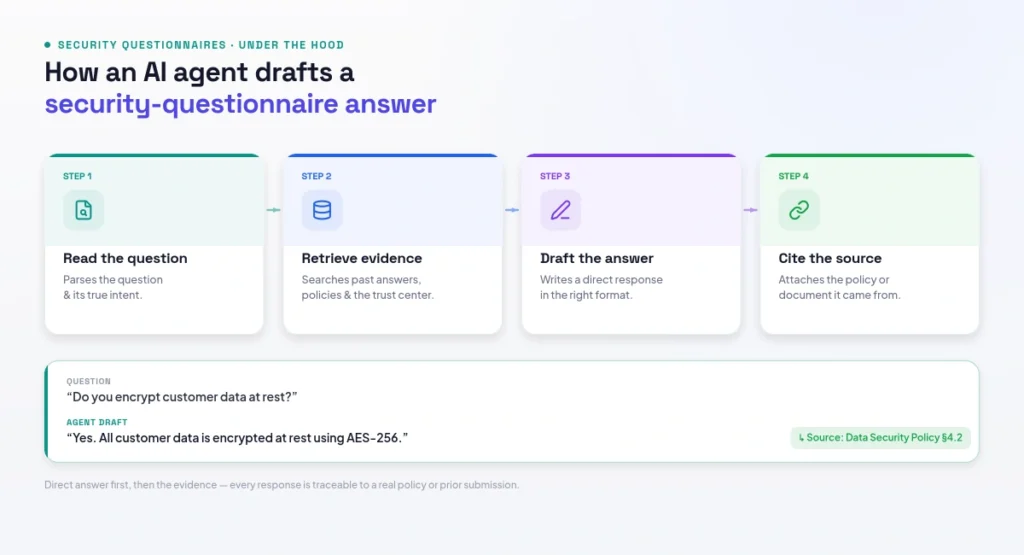
                          Modern AI doesn’t just pattern-match—it understands security concepts and can map questions to relevant information even when wording differs significantly. A question about ‘cryptographic controls for data at rest’ maps to your storage encryption practices regardless of whether your documentation uses that exact terminology. This semantic understanding enables AI to handle the format variation that makes questionnaires challenging.

                          Machine learning improves accuracy over time. As you review and edit AI-generated responses, the system learns your preferences and organization-specific nuances. Accuracy typically improves from 70-80% initially to 90%+ after several months of use and refinement. The best tools make this learning explicit and controllable.

                          2.2 Automated Response Generation

                          AI questionnaire tools automate the response process at multiple levels. Basic automation suggests likely answers from historical responses—useful but limited. Advanced tools understand questions semantically, map them to relevant controls, and generate responses that accurately represent your current security posture.

                          The best tools connect responses to underlying evidence. Rather than generating answers from static text, they pull from live compliance data—the actual configurations, policies, and certifications currently in place. This evidence connection ensures accuracy and provides audit trails showing why specific responses were given.

                          Multi-format handling is essential because questionnaires arrive in Excel spreadsheets, Word documents, PDFs, web forms, and proprietary formats. AI tools parse these various formats, extract questions, and present a unified response interface. Responses export back to the original format, maintaining the questionnaire structure the requester expects.

                          📊 AI-powered questionnaire tools achieve 90%+ accuracy on standard security questions when trained on comprehensive knowledge bases — Forrester GRC Wave Report

                          2.3 Trust Centers and Proactive Disclosure

                          Trust Centers represent a paradigm shift from reactive questionnaire response to proactive security disclosure. Rather than waiting for customers to request security information, organizations publish comprehensive security profiles publicly or to authenticated viewers. Many security reviews conclude satisfied after reviewing the Trust Center, eliminating questionnaire exchanges entirely.

                          Effective Trust Centers include security certifications with downloadable audit reports, detailed control descriptions organized by security domain, compliance attestation documents, penetration test summaries, and answers to frequently asked security questions. Some include self-service NDA signing for accessing more sensitive documentation.

                          The efficiency gains are substantial. Instead of answering the same questions repeatedly across hundreds of questionnaires, organizations answer once comprehensively and direct inquiries to that authoritative source. SafeBase, Whistic, and similar tools specialize in Trust Center creation and management with AI-assisted content generation.

                          💡 Pro Tip: Publish a Trust Center even before implementing full questionnaire automation. It immediately reduces inbound questionnaire volume by satisfying many security reviews proactively. Start with certifications, SOC 2 summary, and top 50 FAQ answers.

                          3. Evaluation Framework for AI Questionnaire Tools

                          Before comparing specific tools, understand the criteria that matter most for security questionnaire automation. The best tool for your organization will excel in areas most relevant to your questionnaire workflow while meeting baseline requirements for accuracy, security, and integration.

                          3.1 Key Evaluation Criteria

                          Response accuracy is paramount—inaccurate security representations create legal liability and erode customer trust. Evaluate accuracy on your actual questionnaires, not vendor demos. Request a pilot where you submit real questionnaires and review AI-generated responses against your ground truth.

                          Knowledge base capabilities determine how well the tool learns and maintains your security information. Can it import existing documentation? How does it handle updates as your security posture evolves? Does it connect to live compliance data or rely on static information? The knowledge base is the brain of the system—evaluate it carefully.

                          Format support matters because questionnaires arrive in diverse formats. Verify the tool handles your commonly received formats: Excel, Word, PDF, web forms, and any industry-specific standards like SIG or CAIQ. Some tools excel at structured standards but struggle with custom formats.

                          • Response Accuracy: Correctness of AI-generated answers against ground truth
                          • Knowledge Base: Comprehensiveness, update mechanisms, and evidence integration
                          • Format Support: Handling of Excel, Word, PDF, web forms, and standard frameworks
                          • Direction: Inbound (customer questionnaires) vs outbound (vendor assessments)
                          • Integration: Connections with existing GRC, CRM, and compliance systems
                          • Security: The tool’s own security posture, certifications, and data handling
                          • Scalability: Performance at your questionnaire volume with growth capacity
                          • Workflow: Review and approval processes, collaboration features

                          3.2 Questions to Ask Before Choosing

                          What’s your primary questionnaire direction? Organizations primarily responding to customer questionnaires need different capabilities than those assessing vendor risk. Some tools handle both directions; others specialize. Match tool focus to your primary use case.

                          What’s your questionnaire volume? Tools are priced and designed for different scales. A startup handling 20 questionnaires annually has different needs than an enterprise managing 500+. Ensure the tool scales to your current volume with headroom for growth.

                          What compliance frameworks matter to you? If you’re pursuing or maintaining SOC 2, ISO 27001, or similar certifications, tools that integrate compliance monitoring with questionnaire automation provide significant value. The same evidence that proves compliance becomes the source for questionnaire responses.

                          What integrations are essential? If questionnaires are part of your sales process, CRM integration matters. If you have existing GRC platforms, verify compatibility. Integration gaps create manual work that undermines automation benefits.

                          3.3 Security Considerations

                          Irony alert: you’re sharing sensitive security information with a tool to help manage security questionnaires. Evaluate the vendor’s security as rigorously as they’ll help you respond to questionnaires. Look for SOC 2 Type II certification, clear data handling policies, encryption practices, and access controls.

                          Consider data residency requirements if you operate in regulated industries or jurisdictions with data localization requirements. Some tools offer regional hosting options; others process all data in specific locations regardless of customer preferences.

                          📊 Organizations report 60-80% reduction in time spent on security questionnaires after implementing AI automation — IDC Security Automation Study

                          4. Best Overall: Vanta

                          For organizations seeking comprehensive compliance automation with integrated questionnaire capabilities, Vanta delivers the best combination of continuous monitoring, evidence collection, and AI-powered questionnaire response. If you’re pursuing SOC 2, ISO 27001, HIPAA, or similar certifications, Vanta provides unified compliance and questionnaire automation.

                          Website: vanta.com

                          Vanta’s fundamental value is connecting questionnaire responses to real compliance evidence. Rather than generating answers from static documentation, Vanta’s AI draws from live monitoring data—actual configurations, real policies, current certifications. When you respond that you encrypt data at rest, Vanta can point to the specific controls proving it.

                          The continuous compliance monitoring transforms questionnaire accuracy. Traditional approaches rely on point-in-time documentation that may not reflect current state. Vanta monitors your actual security controls continuously, ensuring AI-generated responses represent your current posture, not last quarter’s snapshot.

                          The questionnaire experience builds on this foundation. Upload an incoming questionnaire in Excel, Word, or PDF format. Vanta’s AI parses questions, maps them to relevant controls, and generates responses citing specific evidence. Security teams review and refine rather than starting from scratch. Response time drops from days to hours.

                          The platform includes a Trust Center for proactive disclosure, reducing inbound questionnaire volume by satisfying many security reviews before they generate questionnaires. Customers access certifications, control descriptions, and FAQ answers without requiring your team’s time.

                          • Pricing: From $10,000/year | Enterprise tiers for larger organizations
                          • Best For: Organizations pursuing compliance certifications who also handle many questionnaires
                          • Key Strength: Continuous compliance monitoring integrated with questionnaire automation ensures response accuracy
                          • Limitations: Higher cost than questionnaire-only tools, compliance focus may be overkill if certifications aren’t needed

                          📊 Vanta customers report completing security questionnaires 70% faster with AI-assisted responses connected to live compliance evidence — Vanta Customer Data

                          4.1 Why Vanta Leads Overall

                          Vanta’s leadership stems from the integration between compliance monitoring and questionnaire automation. Competitors often treat these as separate problems; Vanta recognizes they’re the same problem viewed differently. The controls you implement for compliance are what questionnaires ask about. The evidence you collect for audits answers questionnaire questions.

                          This integration creates compounding value. Set up compliance monitoring once, and you’ve also built your questionnaire knowledge base. Maintain compliance continuously, and your questionnaire responses stay current automatically. Pass your SOC 2 audit, and you have authoritative answers for every questionnaire asking about those controls.

                          4.2 Vanta Limitations

                          Vanta’s comprehensive approach may be more than needed for organizations without compliance certification goals. If you just need to respond to questionnaires without pursuing SOC 2 or similar certifications, questionnaire-focused tools like Conveyor provide similar questionnaire automation at lower cost.

                          The price point reflects enterprise positioning. Starting at $10,000/year, Vanta targets organizations with significant compliance and questionnaire needs. Smaller companies with modest questionnaire volumes may find better value in more focused tools.

                          5. Best Trust Center: SafeBase

                          For organizations prioritizing proactive security disclosure and self-service security information, SafeBase provides the best Trust Center capabilities combined with effective questionnaire automation. If reducing inbound questionnaire volume through proactive disclosure is your primary goal, SafeBase excels.

                          Website: safebase.io

                          SafeBase’s Trust Center approach fundamentally changes security review dynamics. Instead of waiting for customers to request security information through questionnaires, you publish comprehensive security profiles that satisfy most inquiries proactively. Customers access certifications, control documentation, and security FAQs through a professional portal—often concluding their security review without ever submitting a questionnaire.

                          The Trust Center includes sophisticated access controls. Make some information public, gate other content behind NDA acceptance, and restrict sensitive documentation to authenticated and approved viewers. This tiered disclosure provides appropriate information to different audiences without oversharing sensitive security details.

                          For questionnaires that do arrive, SafeBase’s AI learns from your Trust Center content and previous responses to auto-complete new questionnaires accurately. The machine learning improves continuously as you refine responses, achieving high accuracy rates on standard questions while flagging unusual ones for human attention.

                          The sales integration is strong—SafeBase understands that security questionnaires are often sales cycle bottlenecks. Integration with Salesforce and other CRMs connects questionnaire status to deal progress. Sales teams gain visibility into security review status without bothering security teams for updates.

                          • Pricing: From $12,000/year | Enterprise tiers available
                          • Best For: Organizations prioritizing proactive security disclosure and sales-facing security reviews
                          • Key Strength: Best-in-class Trust Center with tiered access controls and AI questionnaire response
                          • Limitations: Trust Center focus may be more than needed if you only need questionnaire response

                          📊 SafeBase customers report completing questionnaires 80% faster and reducing inbound questionnaire volume by 50% through Trust Center adoption — SafeBase

                          5.1 Trust Center Best Practices

                          Effective Trust Centers include several key elements. Certifications and audit reports (SOC 2, ISO 27001, etc.) provide third-party validation. Detailed control descriptions organized by security domain answer specific questions. Penetration test summaries demonstrate ongoing security validation. FAQs address the questions that appear on most questionnaires.

                          Tiered access maximizes value while protecting sensitive information. Public content includes certifications and general security posture. NDA-gated content provides detailed control descriptions and configuration information. Authenticated access offers the most sensitive documentation to verified evaluators with legitimate need.

                          💡 Pro Tip: When launching a Trust Center, announce it to active prospects and existing customers. Many will appreciate the proactive disclosure and may revise their questionnaire requirements based on Trust Center availability.

                          6. Best Questionnaire-Focused: Conveyor

                          For organizations seeking focused questionnaire automation without broader compliance platform features, Conveyor provides the most streamlined solution. If your primary need is responding to incoming questionnaires efficiently, Conveyor’s singular focus delivers exactly that.

                          Website: conveyor.com

                          Conveyor specializes in security questionnaire automation—it’s their entire product focus. This specialization means every feature addresses questionnaire challenges directly. There’s no compliance monitoring to configure if you don’t need it, no vendor management if you’re not doing outbound assessments. Just efficient questionnaire response.

                          The AI engine excels at question mapping. Upload a questionnaire in any format—SIG, CAIQ, custom Excel, PDF—and Conveyor parses questions, identifies what’s being asked, and maps to your existing answers. The semantic understanding handles the variation in how different organizations phrase similar questions.

                          Response generation draws from your knowledge base and previous questionnaire responses. Conveyor learns your organization’s voice and preferred answer structures, generating responses that sound like your team wrote them rather than generic AI output. Review and refinement further improves future responses.

                          The usage-based pricing model makes Conveyor accessible to organizations with varying questionnaire volumes. You’re not committing to enterprise annual contracts before proving value. Start small, expand as you validate ROI, and scale costs with actual usage.

                          • Pricing: Usage-based pricing accessible to various company sizes
                          • Best For: Organizations needing focused questionnaire automation without compliance platform overhead
                          • Key Strength: Singular focus on questionnaire automation with strong AI mapping and generation
                          • Limitations: No compliance monitoring, no vendor assessment features, narrower than platform solutions

                          6.1 When Conveyor Fits Best

                          Conveyor fits organizations that already have compliance covered through other means—perhaps you’re using a different compliance platform, or compliance certifications aren’t a current priority. You need questionnaire automation specifically, not a comprehensive GRC solution.

                          The usage-based model also suits organizations with variable questionnaire volume. If you go through busy seasons (perhaps tied to your customers’ procurement cycles) and quieter periods, usage-based pricing aligns cost with actual value rather than fixed commitments that may exceed need.

                          7. Best for Vendor Risk Management: Prevalent

                          For organizations managing vendor security through outbound questionnaires, Prevalent provides comprehensive third-party risk management with AI-assisted assessment capabilities. If you’re assessing vendor security rather than responding to assessments, Prevalent and similar tools address that direction specifically.

                          Website: prevalent.net

                          Prevalent’s focus is managing the vendors you rely on rather than managing how customers assess you. The platform streamlines sending assessments to vendors, tracking response status, analyzing results, and maintaining ongoing vendor risk visibility. AI assists throughout—suggesting risk indicators, analyzing responses, and identifying concerns.

                          The vendor management workflow handles the full lifecycle. Onboard new vendors with appropriate assessment depth based on risk tier. Monitor ongoing vendor posture through periodic reassessment. Track remediation when concerns are identified. Maintain audit trails of due diligence for regulatory and customer requirements.

                          Risk intelligence enhances questionnaire-based assessment. External data about vendor security incidents, regulatory actions, and security ratings complement questionnaire responses. This multi-source approach provides more complete vendor risk visibility than questionnaires alone.

                          For enterprises managing hundreds or thousands of vendor relationships, the automation and workflow capabilities prevent vendor risk management from becoming unmanageable. Without automation, keeping vendor assessments current across a large portfolio is essentially impossible.

                          • Pricing: Enterprise pricing based on vendor portfolio size
                          • Best For: Organizations managing substantial vendor portfolios requiring systematic risk assessment
                          • Key Strength: Complete third-party risk management with questionnaire automation and risk intelligence
                          • Limitations: Enterprise focus may be overkill for smaller vendor portfolios, not designed for inbound questionnaires

                          📊 Organizations with automated vendor risk management complete third-party assessments 65% faster and maintain 3x more current assessment coverage — Prevalent TPRM Report

                          8. More Top AI Security Questionnaire Tools

                          8.1 Drata

                          Website: drata.com

                          Drata offers compliance automation with strong questionnaire support, similar to Vanta’s approach of connecting questionnaire responses to continuous compliance monitoring. For organizations evaluating both, Drata provides comparable capabilities with some differences in specific features and pricing structures.

                          Drata’s questionnaire automation leverages the same evidence collection powering compliance. Responses cite actual controls, policies, and configurations rather than static documentation. The continuous monitoring ensures questionnaire answers reflect current security posture.

                          • Pricing: From $10,000/year | Enterprise tiers available
                          • Best For: Compliance-focused organizations seeking integrated questionnaire automation
                          • Key Strength: Evidence-based responses from continuous compliance monitoring

                          8.2 Whistic

                          Website: whistic.com

                          Whistic provides a network-based approach where organizations share security profiles proactively within a trusted network. Rather than exchanging questionnaires, network participants access each other’s validated security profiles. This eliminates redundant assessments when both parties are network members.

                          The network effect grows more valuable as more organizations participate. If your customers and vendors are already Whistic network members, the shared profile approach can virtually eliminate traditional questionnaire exchanges. AI assists in creating comprehensive profiles and responding to requests from non-network parties.

                          • Pricing: From $15,000/year | Enterprise tiers available
                          • Best For: Organizations whose customers and vendors participate in security profile networks
                          • Key Strength: Network approach eliminates redundant assessments between participating organizations

                          8.3 Panorays

                          Website: panorays.com

                          Panorays combines automated external security assessment with questionnaire management. Rather than relying solely on questionnaire responses, Panorays evaluates vendor security posture through external scanning and analysis, complementing questionnaire-based assessment with objective data.

                          • Pricing: Enterprise pricing
                          • Best For: Organizations wanting external security assessment alongside questionnaires
                          • Key Strength: Combined automated assessment and questionnaire management

                          8.4 SecurityScorecard

                          Website: securityscorecard.com

                          SecurityScorecard provides security ratings based on external observation, complemented by questionnaire capabilities. The ratings offer continuous visibility into vendor security posture without requiring questionnaire responses—useful for ongoing monitoring between formal assessments.

                          For organizations seeking budget-friendly entry into security assessment automation, SecurityScorecard’s rating-first approach provides value at accessible price points. Add questionnaire capabilities as needs grow and budgets allow.

                          • Pricing: From $5,000/year | Accessible entry point
                          • Best For: Organizations seeking continuous security ratings with optional questionnaire enhancement
                          • Key Strength: Affordable entry with external ratings and questionnaire capabilities

                          8.5 OneTrust Vendorpedia

                          Website: onetrust.com

                          OneTrust’s Vendorpedia provides enterprise-scale vendor risk management within the broader OneTrust GRC platform. For large organizations already using OneTrust for privacy, GRC, or other capabilities, Vendorpedia adds questionnaire management within the unified platform.

                          • Pricing: Enterprise pricing as part of OneTrust platform
                          • Best For: Existing OneTrust customers, large enterprises with broad GRC needs
                          • Key Strength: Integrated with comprehensive OneTrust GRC platform

                          8.6 Hyperproof

                          Website: hyperproof.io

                          Hyperproof provides compliance operations software with AI-assisted questionnaire handling. It connects questionnaire responses to underlying evidence, ensuring accuracy and providing audit trails. For organizations with significant compliance programs, Hyperproof integrates questionnaires into broader compliance workflows.

                          • Pricing: From $15,000/year
                          • Best For: Organizations with mature compliance programs seeking integrated questionnaire automation
                          • Key Strength: Direct linkage between questionnaire responses and compliance evidence

                          For broader AI automation tools, explore our best AI agents guide.

                          9. Comprehensive Comparison Matrix

                          9.1 By Primary Use Case

                          • Best Overall: Vanta — continuous compliance with integrated questionnaire automation
                          • Best Trust Center: SafeBase — proactive security disclosure with questionnaire response
                          • Best Questionnaire-Focused: Conveyor — singular focus on efficient questionnaire response
                          • Best Vendor Risk: Prevalent — comprehensive third-party risk management
                          • Best Network Approach: Whistic — shared security profiles eliminate redundant assessments
                          • Best External Ratings: SecurityScorecard — continuous ratings with questionnaire capabilities
                          • Best for Enterprise GRC: OneTrust Vendorpedia — integrated with comprehensive platform
                          • Best Budget Entry: SecurityScorecard — accessible pricing from $5K/year

                          9.2 By Direction (Inbound vs Outbound)

                          • Inbound Specialists (Customer Questionnaires): SafeBase, Conveyor, Vanta, Drata
                          • Outbound Specialists (Vendor Assessments): Prevalent, OneTrust Vendorpedia, Panorays
                          • Both Directions: SecurityScorecard, Whistic, Hyperproof

                          9.3 By Organization Size

                          • Startups/SMB: Conveyor (usage-based), SecurityScorecard (affordable entry)
                          • Mid-Market: Vanta, SafeBase, Drata — full featured with appropriate pricing
                          • Enterprise: OneTrust, Prevalent, Hyperproof — scale and integration for large organizations

                          9.4 By Pricing Tier

                          • Entry ($5K-10K/year): SecurityScorecard, Conveyor (usage-based)
                          • Standard ($10K-15K/year): Vanta, SafeBase, Drata
                          • Enterprise ($15K+/year): Whistic, Hyperproof, Prevalent, OneTrust
                          • Custom Enterprise: OneTrust, Prevalent (large-scale deployments)

                          💡 Pro Tip: When evaluating tools, request customer references in your industry and of similar size. Questionnaire tools perform differently across contexts—validation with similar organizations provides the most accurate expectation setting.

                          10. Inbound vs Outbound: Choosing Your Direction

                          10.1 Inbound Solutions (Responding to Questionnaires)

                          If your primary challenge is responding to security questionnaires from customers, prospects, or partners, prioritize tools designed for inbound response. Vanta, SafeBase, Conveyor, and Drata all specialize in this direction, though with different approaches and strengths.

                          Inbound solutions emphasize response speed (accelerating sales cycles), accuracy (protecting against misrepresentation), consistency (ensuring similar questions get similar answers), and efficiency (reducing security team burden). Trust Center capabilities reduce volume by satisfying reviews proactively.

                          Evaluate based on questionnaire format support (can it handle your common incoming formats?), knowledge base capabilities (how easily can you capture your security information?), response accuracy (test on your actual questionnaires), and review workflow (how does your team refine AI suggestions?).

                          10.2 Outbound Solutions (Assessing Vendors)

                          If your primary challenge is assessing vendor security through questionnaires you send, prioritize tools designed for outbound assessment. Prevalent, OneTrust Vendorpedia, and Panorays specialize in vendor risk management, treating questionnaires as part of broader third-party risk programs.

                          Outbound solutions emphasize vendor onboarding efficiency, ongoing monitoring, risk identification and remediation tracking, and portfolio-wide visibility. External security ratings complement questionnaire responses with objective observation.

                          Evaluate based on vendor workflow (does it match your assessment process?), risk analytics (how does it identify and prioritize concerns?), remediation tracking (can you manage identified issues?), and integration (does it connect with procurement and vendor management systems?).

                          10.3 Bi-directional Needs

                          Some organizations need both directions—responding to customer questionnaires while also assessing vendor security. Platform solutions like OneTrust or combining specialized tools can address both needs. The choice depends on volume in each direction and integration requirements.

                          Evaluate whether a single platform addressing both directions provides better value than specialized tools for each. Integration between separate tools may create gaps; single platforms may sacrifice depth for breadth. Test both approaches if your needs are genuinely bi-directional.

                          Consider your team structure when evaluating bi-directional needs. If the same team handles both inbound responses and outbound assessments, unified platforms reduce context switching. If different teams own each direction, specialized tools may better serve each team’s specific workflow.

                          10.4 Measuring Success

                          Track key metrics to measure questionnaire automation success. Response time measures how quickly you complete questionnaires—target 70-80% reduction from baseline. Accuracy rate tracks how often AI suggestions are accepted without modification—target 85%+ for mature implementations.

                          Volume capacity measures how many questionnaires your team can handle—should increase 2-3x with automation. Team satisfaction matters too—security professionals generally prefer strategic work over repetitive questionnaire completion. Survey your team periodically.

                          For sales-facing questionnaires, track deal cycle impact. Are deals closing faster with quicker security reviews? Are fewer deals stalling on security requirements? These business metrics demonstrate value beyond efficiency.

                          11. Implementation Best Practices

                          11.1 Build a Comprehensive Knowledge Base

                          AI questionnaire tools are only as good as the information they draw from. Invest time upfront building a comprehensive knowledge base covering all aspects of your security program: policies, procedures, controls, configurations, certifications, and organizational information.

                          Structure information by security domain—access control, encryption, incident response, vendor management, etc.—to enable accurate mapping regardless of how questions are phrased. Include both narrative descriptions and specific technical details for comprehensive coverage.

                          11.2 Maintain Answer Currency

                          Security practices evolve constantly—new controls are implemented, policies are updated, certifications are renewed. Establish processes to keep your knowledge base current. Compliance-connected tools like Vanta and Drata help by pulling from live monitoring data, but static knowledge bases require regular review.

                          Schedule quarterly knowledge base reviews to catch drift. When significant security changes occur, update the knowledge base immediately. Stale information generates inaccurate responses, undermining trust with customers and creating compliance risk.

                          11.3 Establish Review Workflows

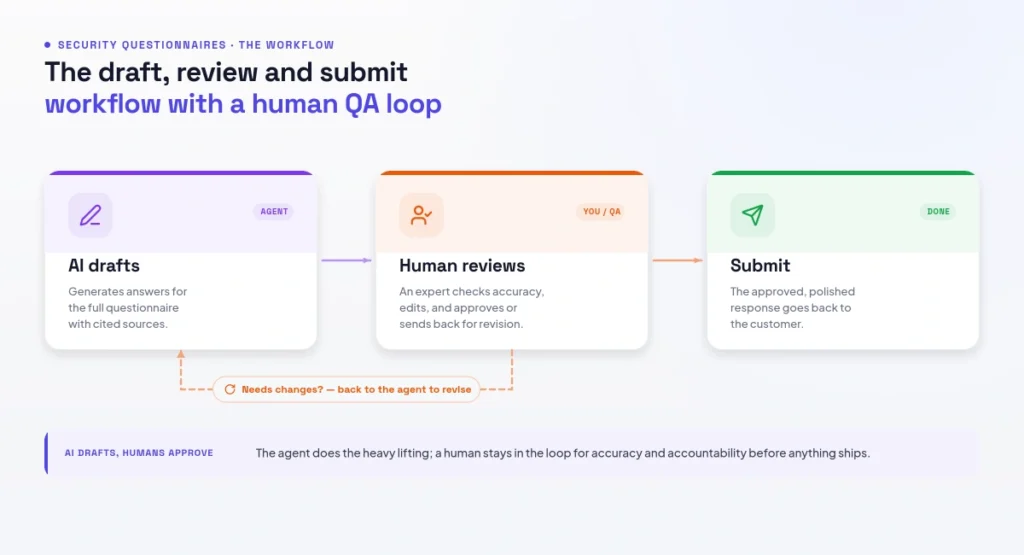
                          AI handles routine questions well but requires human oversight for accuracy assurance. Establish clear workflows for reviewing AI-generated responses before submission. Define escalation paths for unusual questions or sensitive topics requiring expert attention.

                          Track AI accuracy over time. Most tools surface confidence levels—review low-confidence answers more carefully. As you correct AI mistakes, the system learns and accuracy improves. Initial months require more review; mature implementations need less.

                          11.4 Create Response Templates

                          Develop templates for common question types: encryption practices, access controls, incident response, vendor management. Templates speed AI processing by providing structured starting points and ensure consistent messaging across questionnaires.

                          Include appropriate detail levels for different audiences. Technical evaluators want specifics; executive summaries need high-level assurance. Templates for different detail levels enable efficient response matching to questionnaire complexity.

                          11.5 Integrate with Sales Workflow

                          Security questionnaires often gate deal progress. Integrate questionnaire tools with CRM to provide sales visibility into security review status. When sales knows a deal is waiting on security review, they can expedite or communicate timelines to prospects.

                          Define SLAs for questionnaire response times—perhaps 5 business days for standard questionnaires, faster for strategic deals. Track performance against SLAs to identify bottlenecks and improvement opportunities. Share SLA performance with sales leadership to maintain accountability.

                          11.6 Train Your Team Effectively

                          Successful implementation requires team adoption. Train security team members on tool usage, review workflows, and knowledge base maintenance. Different roles may need different training—some focus on response review, others on knowledge base curation.

                          Create documentation for your specific workflows and customizations. Generic vendor training covers tool features; internal documentation addresses how your organization uses the tool specifically. This documentation helps onboard new team members and maintains consistency.

                          Designate knowledge base owners responsible for maintaining accuracy and completeness. Without clear ownership, knowledge bases drift out of date. Regular review cadences and assigned responsibility prevent this degradation.

                          11.7 Continuous Improvement

                          Treat implementation as ongoing rather than a one-time project. Review AI accuracy monthly and adjust knowledge base content where errors occur. Gather feedback from team members using the tool daily—they’ll identify improvement opportunities.

                          Stay current with tool updates and new features. Vendors continuously improve AI capabilities; new features may address pain points you’ve accepted as limitations. Quarterly vendor check-ins help identify valuable updates.

                          💡 Pro Tip: Create a 90-day implementation plan: Month 1 for knowledge base building and tool configuration. Month 2 for pilot use on real questionnaires with careful review. Month 3 for workflow optimization and scaling. This phased approach validates accuracy before full production use.

                          12. Frequently Asked Questions

                          Can AI fully automate security questionnaire responses?

                          AI typically handles 60-80% of questionnaire questions automatically with high accuracy. Complex, unusual, or organization-specific questions require human input. All AI responses should be reviewed before submission—the goal is efficiency, not blind automation. Human oversight ensures accuracy and catches AI errors.

                          How accurate are AI-generated security questionnaire responses?

                          Accuracy depends heavily on knowledge base quality and question complexity. Leading tools achieve 90%+ accuracy on standard security questions when trained on comprehensive source material. Complex or unusual questions have lower accuracy. Initial accuracy is typically 70-80%, improving to 90%+ after several months of use and refinement.

                          Which tool is best for responding to customer questionnaires?

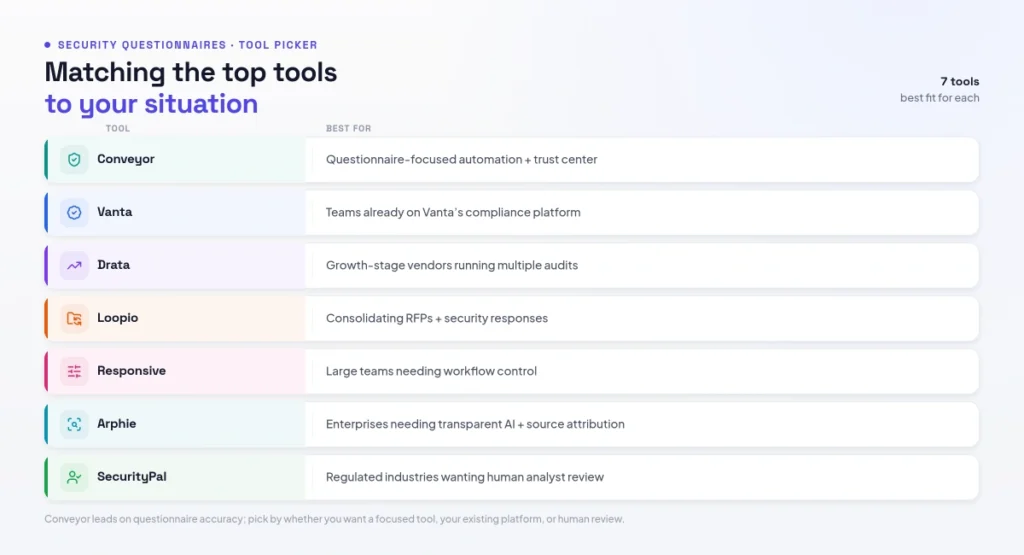
                          Vanta, SafeBase, and Conveyor excel at inbound questionnaire responses. Vanta is strongest if you also need compliance certification support—the same evidence powers both. SafeBase offers the best Trust Center for proactive disclosure. Conveyor provides focused questionnaire automation without compliance overhead.

                          Which tool is best for vendor risk management?

                          Prevalent and OneTrust Vendorpedia are purpose-built for outbound vendor assessments. Prevalent offers comprehensive third-party risk management. OneTrust integrates questionnaires into broader GRC platform. SecurityScorecard adds continuous external ratings to questionnaire-based assessment for ongoing visibility.

                          How long does implementation take?

                          Basic setup takes 2-4 weeks including tool configuration and initial training. Building a comprehensive knowledge base that enables high AI accuracy typically requires 1-3 months of effort. Full optimization with refined workflows and high accuracy usually takes 3-6 months. Start simple and iterate.

                          What questionnaire formats do AI tools support?

                          Leading tools support major standards (SIG, CAIQ, VSA) plus custom questionnaires in Excel, Word, and PDF formats. AI semantic understanding handles format variation—questions phrased differently still map to the right answers. Verify specific format support for any proprietary questionnaire types you commonly receive.

                          How do these tools handle sensitive security information?

                          Enterprise tools include role-based access controls, encryption at rest and in transit, and comprehensive audit logging. Most leading tools maintain SOC 2 Type II certification themselves. Evaluate the vendor’s security as rigorously as they’ll help you respond to questionnaires—you’re trusting them with sensitive information.

                          What’s the typical ROI for security questionnaire automation?

                          Organizations report 60-80% reduction in time spent on questionnaires. For teams handling 50+ questionnaires annually at 10-20 hours each, that’s 300-800 hours saved yearly. At $100/hour loaded cost for security professionals, that’s $30,000-80,000 in annual value—typically exceeding tool costs in the first year.

                          Can small companies afford these tools?

                          Yes, though pricing varies significantly. Conveyor’s usage-based model and SecurityScorecard’s $5K/year entry point provide accessible options. Vanta, Drata, and SafeBase offer tiers for different company sizes starting around $10K/year. Evaluate total cost against hours saved to calculate value at your scale.

                          Can these tools integrate with existing GRC systems?

                          Most offer integrations with major GRC platforms. OneTrust and Hyperproof provide questionnaire capabilities within broader GRC suites. Standalone tools typically offer APIs and pre-built integrations with common platforms. Verify specific integrations for your environment before committing.

                          13. Conclusion

                          AI agents have transformed security questionnaire management from a painful manual process to a largely automated workflow. Tools like Vanta and Drata connect questionnaire responses to continuous compliance evidence, ensuring accuracy while dramatically reducing effort. SafeBase’s Trust Center approach shifts from reactive response to proactive disclosure. Prevalent and SecurityScorecard streamline vendor risk assessment.

                          The productivity gains are substantial and documented: 75% reduction in response time, 60-80% of questions answered automatically, security teams freed for higher-value work. For organizations handling significant questionnaire volume, these tools pay for themselves quickly through time savings and faster deal cycles.

                          Choose based on your primary direction and use case: Vanta or Drata for compliance-focused organizations needing integrated questionnaire automation, SafeBase or Conveyor for sales-driven questionnaire responses, Prevalent or OneTrust for vendor risk management. Start with a pilot on real questionnaires to validate accuracy before full deployment.

                          As security assessment requirements continue growing across industries, AI-powered questionnaire automation becomes increasingly essential. Organizations that implement these tools gain competitive advantage through faster response times, consistent quality, and freed security resources. The technology is mature and proven; the question is how quickly you’ll capture these benefits.

                          🏆 Best Overall: Vanta (compliance + questionnaire automation)

                          🔒 Best Trust Center: SafeBase (proactive security disclosure)

                          📝 Best Questionnaire-Focused: Conveyor (usage-based, efficient)

                          🏢 Best Vendor Risk: Prevalent (third-party risk management)

                          💰 Best Budget: SecurityScorecard ($5K/year entry)

                          📈 ROI: 60-80% reduction in questionnaire time, first-year payback typical

                          Explore more AI tools in our Best AI Agents Guide.

                          Learn about compliance automation in our Best AI Tools Guide.

                          For career guidance, see our Data Analyst AI Career Guide.

                          For industry outlook, see our Will AI Take Over Data Analytics.

                          Share. Facebook Twitter Pinterest LinkedIn Tumblr Email
                          Previous ArticleBest AI Phone Call Agents for Business Communication [2026]
                          Next Article Best AI Agents for Cross-Border Loan Servicing [2026]
                          TechieHub

                            Related Posts

                            20 Best AI Tools for YouTube Automation 2026: Complete Implementation Guide

                            February 28, 2026

                            15 Best Open Source AI Models 2026: Complete Implementation Guide

                            February 26, 2026

                            Building Agentic AI Applications with a Problem-First Approach [2026]

                            February 25, 2026
                            View 1 Comment

                            1 Comment

                            1. Pingback: 15 Best Agentic AI Tools & Platforms for Autonomous Agents 2026

                            Leave A Reply Cancel Reply

                            Editors Picks

                            20 Best AI Tools for YouTube Automation 2026: Complete Implementation Guide

                            February 28, 2026

                            15 Best Open Source AI Models 2026: Complete Implementation Guide

                            February 26, 2026

                            Building Agentic AI Applications with a Problem-First Approach [2026]

                            February 25, 2026

                            15 Best Agentic AI Tools & Platforms for Building Autonomous Agents [2026]

                            February 25, 2026
                            Techiehub
                            • Home
                            • Featured
                            • Latest Posts
                            • Latest in Tech
                            • Privacy Policy
                            • Terms and Conditions
                            Copyright © 2026 Tchiehub. All Right Reserved.

                            Type above and press Enter to search. Press Esc to cancel.

                            We use cookies to ensure that we give you the best experience on our website. If you continue to use this site we will assume that you are happy with it.