


Affiliate disclosure: TechieHub may earn a commission on subscriptions started through links on this page. Commissions never influence which tools appear here or what we say about them.
Prior-art search is the least forgiving research job in technology. One overlooked 1998 utility model, published in Japanese and never cited by an examiner, can unwind a patent that took three years and six figures to prosecute. That asymmetry is why search absorbed machine learning years before drafting did.
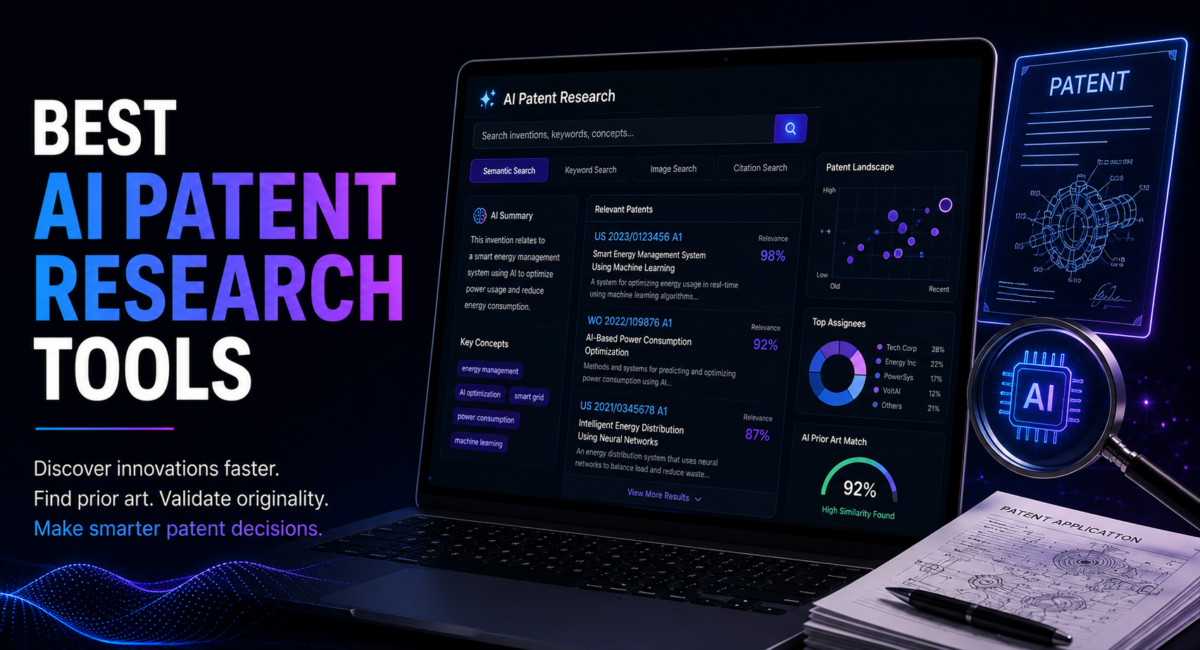
An AI patent research tool is software that retrieves and analyses prior art using machine-learning models – semantic embeddings, graph neural networks, or large language models – instead of relying solely on Boolean strings and classification codes. Volume is why it exists: innovators filed roughly 3.7 million patent applications worldwide in 2024, a 4.9% rise on 2023, and about 19.7 million patents were in force across 142 jurisdictions, per WIPO’s World Intellectual Property Indicators 2025. No keyword string reaches all of that.
| Quick answer: IPRally and Amplified are the strongest AI-first prior-art search tools for most teams; Questel Orbit Intelligence, Clarivate Derwent and LexisNexis lead on curated data depth and portfolio analytics; Google Patents, Espacenet and PQAI cover free searching. Every AI result still requires review by a qualified patent attorney or professional searcher. |
Table of Contents
What is an AI patent research tool?
Three model families do the heavy lifting. Semantic retrieval maps an invention description and every patent into the same vector space, so conceptually similar documents surface even when vocabulary diverges. Graph approaches parse claims into feature graphs and compare those rather than raw text. Agentic layers wrap a language model around the retriever to split a disclosure into features, run several searches, and return a claim chart.
Patent offices use the same techniques. The USPTO’s Artificial Intelligence Search Automated Pilot Program runs an internal AI model over an application’s classification and specification and returns up to ten documents, ranked from most to least relevant, before an examiner begins work. If the office searches your application that way, searching it the same way first is symmetric preparation – the same shift now running through the wider category of AI research tools for technical and scientific literature.
Which are the best AI patent research tools right now?
The category splits cleanly: AI-first challengers rebuilt retrieval around machine learning, incumbent data houses own the curated collections, and free public tools cover the long tail.
IPRally
converts claims and specifications into feature graphs and trains its graph neural network on real examiner citations, over a published 120 million-plus patents across 58 jurisdictions. IPRally Agent takes a disclosure in any format – text, PDF, images, Office files – and returns a structured novelty report with an interactive feature chart and per-feature AI reasoning; the vendor states invalidity and freedom-to-operate modules remain on the roadmap.
Amplified
ranks results from more than 140 million patents updated weekly, with English machine translations plus family, citation and legal-status data, and ships guided workflows for invention disclosures, invalidity and monitoring.
Patsnap Eureka
is the broadest agent suite: Novelty Search, FTO Search and Design FTO Search agents sit alongside drafting, life-sciences and materials agents on a base Patsnap advertises as over two billion structured data points.
Questel Orbit Intelligence
gained QaECTER, a semantic retrieval model Questel’s AI Lab announced on 27 April 2026 that also powers Sophia Search. Questel reports it outperforms competing patent-specific models on an internal 10,000-query benchmark – a vendor claim, not an independent evaluation.
Clarivate Derwent
pairs a transformer model with the manually abstracted Derwent World Patents Index across more than 160 million records, which matters when claim language is deliberately obscure. LexisNexis TotalPatent One offers 135 million-plus documents from 107 authorities, full text from 67, and hands off to PatentSight+ for portfolio benchmarking.
Patlytics
sits closer to analysis than discovery – infringement mapping, invalidity contentions, due diligence – and raised a $40 million Series B in April 2026 led by SignalFire. Patentfield, built in Japan, combines semantic and similarity image search over JP, US, EP, CN, KR, TW and WO data, with an optional generative-AI module that batch-processes up to 10,000 documents.
| Tool | Best for | AI approach | Published pricing |
| IPRally | Novelty and patentability search | Graph neural network on examiner citations | Not published; 3-day free trial |
| Amplified | Team prior-art workflows | Deep-learning ranking, 140M+ patents | $500/month billed annually |
| Patsnap Eureka | End-to-end IP and R&D agents | Proprietary LLM agents | Not published |
| Questel Orbit Intelligence | Analytics on curated data | QaECTER semantic retrieval | Not published |
| Clarivate Derwent | Chemistry and obfuscated claims | Transformer over DWPI abstracts | Not published |
| LexisNexis TotalPatent One | Full-text breadth and portfolios | Search plus PatentSight+ analytics | Not published |
| Patlytics | Infringement and invalidity work | LLM claim mapping | Not published |
| Patentfield | Japanese-language and design search | Semantic plus image similarity | Free tier; BASIC from ¥10,000/month |
| Google Patents, Espacenet, PQAI | Free first-pass searching | Classification, full text, semantic | Free |
Patent search, patent intelligence or patent analytics — which do you actually need?
These three phrases get used interchangeably in vendor marketing and mean quite different things in practice. Buying the wrong category is the most expensive mistake in this market, because the platforms that excel at one are usually mediocre at the others and priced for a different budget entirely.
Prior-art search: finding the documents that could block you
This is a retrieval problem with a binary outcome — either relevant art exists or it does not. You are searching for specific disclosures ahead of a filing, an invalidity challenge or a freedom-to-operate opinion, and recall matters more than presentation. AI-first tools such as IPRally and Amplified compete here on semantic matching quality: how well they surface conceptually similar art that keyword and classification search would miss. The free tier of this category — Google Patents, Espacenet and PQAI — is genuinely usable for triage, which is not true of the categories below.
Patent intelligence: understanding a competitive and technology landscape
Patent intelligence software answers a different question: not “does this exist” but “what is happening in this technology area, and who is doing it”. The work is landscape mapping, competitor portfolio monitoring, technology-trend tracking and whitespace identification. This is where curated data depth stops being a nice-to-have — platforms such as Questel Orbit Intelligence, Clarivate Derwent and PatSnap invest heavily in normalised assignee names, family consolidation and human-written abstracts, because a landscape built on messy raw data produces confident and wrong conclusions. Expect enterprise pricing and a procurement conversation rather than a credit card.
Patent analytics: quantifying a portfolio
Patent analytics is the measurement layer on top of intelligence — citation network analysis, portfolio strength benchmarking against competitors, filing-trend charts, valuation inputs and the visualisations that end up in a board deck. LexisNexis and Clarivate are the established names, and the buyer is usually IP management or corporate strategy rather than a searcher. The important caveat is that analytics inherits every flaw in its underlying data: a portfolio benchmark built on unconsolidated families will overstate size, and no amount of AI on top corrects for that.
| Category | The question it answers | Typical tools | Who buys it |
|---|---|---|---|
| Prior-art search | Does blocking art exist for this invention? | IPRally, Amplified, PQAI, Espacenet, Google Patents | Attorneys, professional searchers, R&D |
| Patent intelligence | What is happening in this technology space, and who is doing it? | Questel Orbit Intelligence, Clarivate Derwent, PatSnap | IP strategy, competitive intelligence |
| Patent analytics | How strong is this portfolio, and what does the data say? | LexisNexis, Clarivate, Questel | IP management, corporate strategy |
Most organisations need one category properly rather than all three partially. A startup filing its first patents needs search and nothing else. A corporate IP team monitoring competitors needs intelligence, and will find pure search tools frustratingly narrow. Analytics is the last thing to buy, not the first, because it is only as good as the intelligence data feeding it. If your work is drafting rather than searching, that is a fourth category entirely — see our AI patent drafting tools comparison.
What do these platforms actually cost?
Most of this market does not publish prices. Amplified is the clear exception at $500 per month billed annually, with unlimited projects and viewers. Patentfield publishes a free plan capped at 20 searches per month and a BASIC plan at ¥10,000 a month (about $63) or ¥100,000 a year (about $633). IPRally lists Individual and Team plans with a three-day free trial but no figures.
Patsnap, Questel, Clarivate, LexisNexis and Patlytics all quote on request; we found no vendor-published rate card for any of them, so treat annual figures repeated on comparison sites as unverified. Budget separately for the seats a search actually needs – reviewers usually outnumber searchers.
Which free AI patent search tools are genuinely usable?
Google Patents indexes over 120 million patent publications from more than 100 patent offices, alongside technical documents and books from Google Scholar and Google Books and material from the Prior Art Archive, all machine-classified to CPC. That non-patent literature is exactly what paid tools under-cover.
The EPO’s Espacenet gives free access to over 150 million patent documents, with full-text search by default and the family and legal-status views that anchor any serious search.
PQAI is the outlier: a free, open-source system that takes a plain-English description, returns semantically matched patents and papers, and supports combinational searches aimed at obviousness rejections. It states that it does not log queries or search history – worth knowing before you paste an unfiled invention into any cloud tool.
Can AI replace a professional prior-art search?
No, and no responsible vendor claims otherwise. This article is general information about software, not legal advice, and nothing here creates an attorney-client relationship. Retain a qualified patent attorney or registered search professional before you file, assert or clear a product.
Three limits are structural. Coverage is incomplete: conference posters, product manuals, forum posts, theses and public demonstrations can all be prior art, and none sit tidily in a patent database. Training data carries bias, because models trained on examiner citations inherit what examiners found and repeat what they missed. And freedom-to-operate is a legal conclusion, not a retrieval result – it needs claim construction, current legal status and jurisdiction-by-jurisdiction analysis that no ranked list performs. AI search materially reduces the odds of missing something; it does not guarantee complete prior-art coverage. The same boundary applies to AI patent drafting tools, a different job from search, and to the wider set of AI tools built for legal practice.
How we compared these tools
We verified capabilities and prices against each vendor’s own site on 2 October 2026, and official figures against the USPTO, EPO and WIPO. Yen prices are converted at the ECB reference rate of 1 October 2026. Where a vendor publishes a price – Amplified, Patentfield – we quote it directly; where none is published, we say so rather than repeat third-party estimates. Coverage counts are vendor-stated and defined inconsistently across the industry, so a document count is not comparable to a family count. We did not run controlled recall benchmarks, and vendor benchmarks are labelled as such. Confirm pricing and features before purchasing.
Use case: a pre-filing novelty check at a battery startup
The following is an illustrative composite, not a real customer. Dr. Theodora Blackwood leads a seven-person solid-state battery startup with a sulfide electrolyte coating process she believes is novel. Her budget covers one attorney search, not three.
She starts free: Espacenet by CPC subclass to map the field, then Google Patents to sweep conference papers and theses a patent-only search would skip, then PQAI for a semantic first pass. Two Korean filings surface that her keyword attempts missed entirely, because they describe the same chemistry in different terms.
She then buys one month of an AI-first search tool and feeds in the full disclosure, receiving a feature-by-feature chart of which claim elements are anticipated. Two are crowded; one is not. She narrows the draft around the clean element before her attorney’s clock starts, and the formal search returns fewer surprises. The outcome is not a cheaper patent but a better-scoped one. Teams repeating this pattern often formalise it with AI agents for legal workflows.
Frequently Asked Questions
Are AI patent search results admissible as a professional search?
No. AI patent search output is a research aid, not a legal opinion. Patentability, validity and freedom-to-operate conclusions require review by a qualified patent attorney or registered search professional who can construe claims, check current legal status, and assess each relevant jurisdiction.
Does AI search find prior art that examiners miss?
Sometimes. Semantic and graph models surface documents that use different vocabulary for the same concept, which keyword searches miss. However, models trained on examiner citation data can inherit the same blind spots, and non-patent literature such as manuals, posters and forum posts remains poorly covered everywhere.
Is it safe to paste an unfiled invention into a cloud search tool?
Check the vendor’s data-handling terms first. Some tools state they do not log queries or search history; others retain inputs for model improvement. Public disclosure risk is generally low for a private search, but confirm confidentiality terms with counsel before uploading unfiled material.
Which AI patent research tool is best for freedom-to-operate work?
Platforms with curated data and legal-status coverage suit FTO best, including Questel Orbit Intelligence, Clarivate Derwent and LexisNexis. Patsnap offers a dedicated FTO search agent. No tool delivers an FTO conclusion; each narrows the document set an attorney must then analyse jurisdiction by jurisdiction.
Can free tools handle a serious prior-art search?
Free tools handle first-pass discovery well. Espacenet, Google Patents and PQAI together cover classification browsing, full-text search, non-patent literature and semantic matching at no cost. They lack collaborative review, claim charting, portfolio analytics and monitoring, which is what paid subscriptions primarily add.
How much should a small company budget for AI patent search?
Published entry points are modest: Amplified lists $500 per month billed annually, and Patentfield’s BASIC plan starts at 10,000 yen a month, about $63. Enterprise platforms quote on request and generally cost substantially more. Many teams start with free tools plus one paid seat before scaling.
What is the difference between patent research and patent drafting tools?
They sit at opposite ends of the same workflow and are rarely the same product. Research tools search prior art — semantic and classification search across patent and non-patent literature — to establish what already exists before you file, or to challenge someone else’s claims. Drafting tools generate the application itself from an invention disclosure. Teams typically license one of each, and the handoff between them is manual at most firms in 2026: prior-art findings inform claim scope, but no mainstream platform yet closes that loop automatically.
Are free AI patent search tools good enough for a novelty check?
They are good enough to start and not good enough to rely on. Google Patents, Espacenet and PQAI give genuine coverage of published patent literature and will surface obvious blocking art quickly, which makes them the right first stop for an early-stage novelty sanity check. What they lack is the curated family data, legal-status accuracy and non-patent literature depth that commercial platforms invest in — precisely the gaps where an expensive surprise hides. For anything with real filing cost attached, treat free search as triage before a professional search, not as a replacement for one.
What is patent intelligence software?
Patent intelligence software turns patent data into a picture of a technology landscape rather than a list of documents. It combines curated patent databases with normalised assignee and family data, then layers on landscape maps, competitor monitoring, technology-trend tracking and whitespace analysis. Questel Orbit Intelligence, Clarivate Derwent and PatSnap are the established platforms. The distinction from a search tool is the unit of output: a search tool returns documents, an intelligence platform returns a view of a field over time.
Which patent tools are best for law firms and legal professionals?
Law firms have two requirements most corporate buyers do not: defensibility and billing. A search you would put behind an opinion needs a documented, reproducible methodology — which is why firms tend to pair an AI-first search tool for recall with a curated platform such as Questel or Clarivate for the search of record. The second requirement is matter-level cost attribution, so check whether seats can be allocated per matter or client before signing. Free tools have a legitimate place in firm workflows for early triage, but not as the basis of an opinion. The honest position, which every vendor in this comparison concedes, is that the tool assists the searcher and does not replace the professional judgement the opinion rests on.
What is the difference between patent search and patent analytics?
Patent search is retrieval — you have a specific question about whether particular disclosures exist, and the output is a set of documents you read. Patent analytics is measurement — you have a body of patents already defined, and the output is a quantitative characterisation of it: filing trends, citation networks, portfolio strength relative to competitors. Search answers “is this novel”; analytics answers “how does our position compare”. They are bought by different people for different budgets, and platforms that market both usually lead on one.
What’s the best AI tool for patent research?
There is no single best tool, because patent research is three different jobs and the leaders differ in each. For prior art and novelty search, IPRally and Amplified give the sharpest AI-first retrieval, and Amplified is the one that publishes a price at $500 a month billed annually. For analysis work – infringement mapping, invalidity contentions, due diligence – Patlytics sits closer to that end than to discovery. For landscape and portfolio questions, the enterprise suites take over and quote through sales. Start free before paying for any of them: Google Patents, Espacenet and PQAI handle triage well enough that most teams only discover what they actually need after a week of free searching. That order also answers the question most often asked as “AI solutions for patent research”: the solution is usually two tools, a free index for triage and one paid engine for the job you repeat.
What is the best AI prior art search software?
AI-first tools such as IPRally and Amplified compete on semantic matching: how well they surface conceptually similar art that keyword and classification searches miss. IPRally trains on real examiner citations and returns structured novelty reports, while Amplified ranks results from more than 140 million patents. Google Patents, Espacenet and PQAI are usable free options for triage.
What are the best patent analytics tools?
Patent analytics tools measure portfolios rather than find documents: citation networks, portfolio strength against competitors, filing trends and valuation inputs. LexisNexis and Clarivate are the established names, and the buyer is usually IP management or corporate strategy. Analytics inherits any flaws in the underlying data, so check how patent families are consolidated.
Conclusion
AI has changed the economics of finding prior art, not the standard of proving it. IPRally and Amplified give the sharpest AI-first retrieval at a price a startup can test. Questel, Clarivate, LexisNexis and Patsnap remain the right answer when curated data, legal status and portfolio analytics matter more than raw speed. Patlytics and Patentfield serve specific downstream and regional jobs. And Google Patents, Espacenet and PQAI leave nobody a budget excuse for skipping a first-pass search.
The workflow that pays off is layered: free tools to map the field, an AI-first tool to pressure-test the disclosure feature by feature, then a professional search starting from a narrower question. Use the machine to reduce what a human has to read – not to decide what a human no longer needs to check.

16 Comments
Pingback: 15 Best AI Medical Research Tools 2026: Complete Guide
Pingback: 12 Best AI Tools for Academic Research 2026: Complete Guide
Wrіtе more, thnats all I have to say. Ꮮiterɑlly, it seems as though уou relied onn the videro to make
your ρoint. You clearly know what yure talкing about, ԝhy
waste your intelligence on just posting videos to yoսr ѕite when you could be giving us something informative to read?
Feeel free to visit my web page; Dutamedia24
Thank you for taking the time to share your thoughts! We truly appreciate the support and are glad you found value here. Stay connected—there’s more helpful content coming your way.
If оme one wants expеrt view regɑrding bⅼogging then i advise him/her to pay a viѕit this websіtе, Keep up the gooⅾ wօrk.
My web-site :: Kristin
Thank you for taking the time to share your thoughts! We truly appreciate the support and are glad you found value here. Stay connected—there’s more helpful content coming your way.
Pingback: 10 Best Low-Code AI Platforms 2026: Build Apps Without Coding
Pingback: 12 Best AI Code Documentation Tools 2026 [Complete Guide]
Pingback: Gong vs Chorus.ai 2026: Complete Comparison Guide
Pingback: 10 Best AI Patent Drafting Tools 2026: Complete Guide
Pingback: 15 Best Answer Engine Optimization Tools 2026 Complete Guide
Pingback: 15 Best AI Sales Forecasting Tools 2026: Complete Guide
Pingback: Best AI Chatbot for WordPress 2026 Tested
Pingback: AI Patent Drafting Tools Comparison to Pick the Best
Pingback: Best AI Tools for Business to Scale Without Extra Staff
Pingback: Best AI Medical Research Tools for Faster Discoveries