Close Menu

    Subscribe to Updates

    Get the latest creative news from FooBar about art, design and business.

    What's Hot

    Best AI Search Monitoring Tools 2026

    May 10, 2026

    Best AI APIs: Complete Developer Guide 2026

    April 29, 2026

    What Are AI Hallucinations? Complete Guide 2026

    April 27, 2026
    Facebook X (Twitter) Instagram
    Facebook X (Twitter) Instagram
    TechiehubTechiehub
    • Home
    • Featured
    • Latest Posts
    • Latest in Tech
    TechiehubTechiehub
    Home - Featured - AI Medical Research Tools: Complete Guide 2026
    Featured

    AI Medical Research Tools: Complete Guide 2026

    TechieHubBy TechieHubUpdated:May 25, 20261 Comment24 Mins Read
    Facebook Twitter Pinterest LinkedIn Tumblr Email
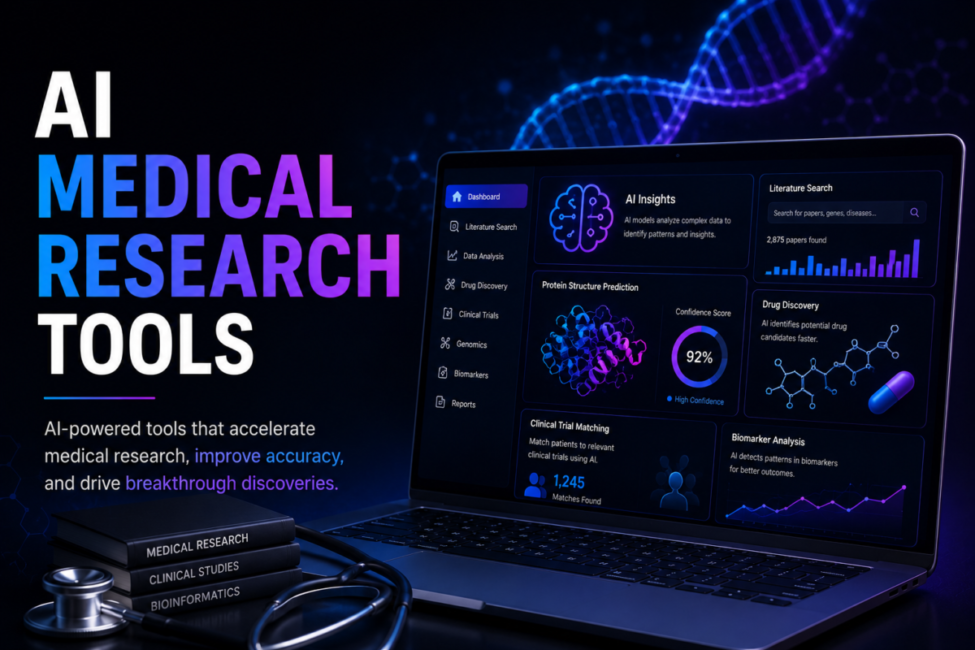
    AI medical research tools
    AI medical research tools
    Share
    Facebook Twitter LinkedIn Pinterest Email

    The definitive 2026 guide to AI medical research tools — covering drug discovery and genomics, literature review, clinical documentation, and clinical decision support, with verified outcomes from leading academic and enterprise healthcare deployments.

    AI Medical Research by the Numbers 2026

    71%Hospitals Using Predictive AI60%Faster Drug Dev (Insilico Med)757K+OpenEvidence Clinician Users150+Health Systems on DAX Copilot200M+Papers in Semantic Scholar

    Table of Contents

    1. What Are AI Medical Research Tools?
    2. The 4 Categories of AI Medical Research Tools
    3. AI Tools for Drug Discovery and Genomics
      1. AlphaFold 3 — Best for Protein Structure Prediction
      2. Insilico Medicine — First AI-Designed Drug in Clinical Trial
      3. TxGemma — Google’s Therapeutics AI
    4. AI Tools for Medical Literature Review
      1. Elicit — Best for Structured Literature Reviews
      2. Consensus — Best for Binary Evidence Questions
      3. Semantic Scholar — Best Free Paper Discovery Engine
      4. scite — Best for Citation Quality Analysis
    5. AI Tools for Clinical Documentation
      1. Nuance DAX Copilot — Best Enterprise Clinical Documentation Tool
      2. Abridge — Best for Clinical Conversation Documentation
      3. Suki AI — Best for Voice-Driven Clinical Documentation
    6. AI Tools for Clinical Decision Support
      1. OpenEvidence — Best Free Clinical Decision Support Platform
      2. UpToDate Expert AI — Best for Deep Clinical Evidence
      3. ChatGPT for Clinicians — Newest Entry, Strongest Underlying Model
    7. Research Tools vs Clinical Decision Support — A Critical Distinction
    8. How to Choose the Right AI Medical Research Tool
    9. Frequently Asked Questions
      1. What are AI medical research tools?
      2. What is the best AI tool for medical literature review?
      3. Is AlphaFold 3 free to use?
      4. Is OpenEvidence safe to use for clinical decisions?
      5. What is the difference between Elicit and Consensus?
      6. Which AI tool is best for clinical documentation?
      7. Can general AI tools like ChatGPT be used for medical research?
    10. Conclusion

    1. What Are AI Medical Research Tools?

    AI medical research tools are specialized software applications that apply artificial intelligence to accelerate, enhance, and automate the research and clinical workflows that underpin modern healthcare and biomedical science. Unlike general-purpose AI tools, the best AI medical research tools are trained on biomedical literature, clinical data, genomic datasets, and drug discovery pipelines — giving them the domain-specific depth and accuracy that healthcare research demands.

    In 2026, AI medical research tools span four distinct categories — drug discovery and genomics, literature review and evidence synthesis, clinical documentation, and clinical decision support. Each category solves a fundamentally different research problem, requires different technical architecture, and operates under different regulatory and safety standards. Understanding which category addresses your specific research challenge is the most important first step in selecting the right tool. Critically, AI research tools and AI clinical decision support tools are different categories that should never be confused at the point of care — a distinction this guide addresses directly in Section 7.

    Pro Tip   AI medical research tools have moved from experimental to essential in 2026. AlphaFold’s protein structure prediction capabilities earned a Nobel Prize in Chemistry. Insilico Medicine’s ISM001-055 became the first AI-designed drug targeting an AI-discovered disease target to show positive Phase IIa results. Microsoft’s Nuance DAX Copilot is now deployed across 150 or more health systems. 71% of non-federal acute-care hospitals use predictive AI integrated into their electronic health records. The adoption curve is steep — and the tools are genuinely delivering outcomes that would have been impossible without AI.

    2. The 4 Categories of AI Medical Research Tools

    Figure 2: AI Medical Research Tools by Category — Four Distinct Categories Solving Different Research Challenges

    The AI medical research tool landscape in 2026 organizes around four core categories, each serving a distinct phase of the medical research and clinical workflow. Choosing a tool from the wrong category for your task — particularly at the clinical decision point — is a patient safety risk, not just a workflow inefficiency.

    CategoryWhat It DoesBest Tools 2026Primary Users
    Drug Discovery and GenomicsProtein structure prediction, drug-target identification, toxicity and efficacy modeling, molecular designAlphaFold 3, Insilico Medicine, TxGemma, BenevolentAI, MolCADrug researchers, pharmaceutical scientists, computational biologists
    Literature Review and Evidence SearchStructured systematic reviews, evidence synthesis, citation analysis, paper discovery across millions of studiesElicit, Consensus, Semantic Scholar, scite, Perplexity ProAcademic researchers, clinicians conducting reviews, medical students, policy analysts
    Clinical DocumentationAmbient note generation from clinician-patient conversations, EHR auto-population, voice-driven chartingNuance DAX Copilot, Abridge, Suki AI, Heidi Health, DeepScribeClinicians, physicians, nurses, hospital systems, ambulatory care teams
    Clinical Decision SupportGuideline-grounded answers at point of care, drug interaction checks, differential diagnosis supportOpenEvidence, UpToDate Expert AI, DoxGPT, iatroX, ChatGPT for CliniciansClinicians, physicians, pharmacists, medical students at bedside or in consultation
    Pro Tip   The most important distinction in AI medical research tools in 2026 is between research tools and clinical decision support tools. Research tools like Elicit and Consensus synthesise the published literature — they answer what the evidence says. Clinical decision support tools like OpenEvidence and UpToDate synthesise guidelines — they answer what you should do for this patient. Using a research tool for point-of-care clinical decisions is a patient safety risk. Using a clinical tool for broad literature review gives you guideline-narrow results where comprehensive evidence was needed. Use each category for its designed purpose.

    3. AI Tools for Drug Discovery and Genomics

    Drug discovery is where AI medical research tools are delivering the most transformative and newsworthy outcomes in 2026. The traditional drug development timeline — from target identification to clinical trial completion — spans 12 to 15 years and costs 1 to 2 billion dollars on average. AI tools applied systematically across the discovery pipeline are compressing the early stages of this timeline by 40 to 60%, with the first AI-discovered drugs now in clinical trial and early FDA approval decisions expected in the coming years.

    3.1 AlphaFold 3 — Best for Protein Structure Prediction

    AlphaFold 3, developed by Google DeepMind, is one of the most consequential scientific tools of the decade and the de facto standard for protein structure prediction in academic and pharmaceutical research in 2026. The original AlphaFold’s protein structure prediction achievements earned a Nobel Prize in Chemistry in 2024. AlphaFold 3 extends these capabilities to predict biomolecular interactions with small molecules, antibodies, and RNA with high atomic-level accuracy — enabling researchers to explore protein-ligand binding, design novel therapeutics, and understand disease mechanisms in silico before committing to expensive laboratory validation. AlphaFold 3 has dramatically shortened drug target validation timelines and is widely available through the AlphaFold Server at no cost for academic research.

    3.2 Insilico Medicine — First AI-Designed Drug in Clinical Trial

    Insilico Medicine represents the most clinically validated example of AI-driven drug design in 2026. Its ISM001-055 compound became the first AI-designed drug targeting an AI-discovered disease target to show positive results in Phase IIa clinical trials — achieving a 60% reduction in time from project initiation to preclinical candidate compared to traditional drug discovery approaches. Insilico Medicine’s Pharma.AI platform combines generative chemistry, target identification, and clinical trial outcome prediction in an integrated pipeline that is now being used by multiple pharmaceutical partners for parallel drug discovery programs. The verified Phase IIa results establish AI-assisted drug discovery as a clinically serious methodology rather than a computational experiment.

    3.3 TxGemma — Google’s Therapeutics AI

    TxGemma is Google’s therapeutics-focused large language model, specialized for toxicity and efficacy prediction in drug development pipelines. Unlike general-purpose LLMs that have broad but shallow biomedical knowledge, TxGemma is fine-tuned on therapeutic data and trained to reason about molecular structure, pharmacological properties, and predicted clinical behavior. It assists drug researchers in rapidly screening compound libraries for toxicity red flags and predicted efficacy signals before committing to laboratory synthesis and testing. TxGemma is accessible through Google’s research programs and is increasingly integrated into pharmaceutical organizations’ computational drug discovery workflows.

    •  BenevolentAI: Knowledge graph-based drug target identification platform that maps biological relationships to surface non-obvious drug candidates. Operates in partnership with major pharmaceutical companies for target discovery programs.

    •  MolCA: Molecular contrastive learning platform from the Chinese Academy of Sciences for chemical space exploration, enabling researchers to identify novel molecular structures with desired therapeutic properties.

    •  DeepDR: AI platform specifically designed for diabetic retinopathy screening and ophthalmic disease research, demonstrating the power of disease-specific AI tools over general-purpose vision models in clinical screening applications.

    Pro Tip   For academic drug discovery researchers, AlphaFold 3 is available free through the AlphaFold Server — no institutional subscription required. For pharmaceutical teams working on proprietary compounds, the AlphaFold API provides programmatic access for high-throughput screening. The combination of AlphaFold 3 for structure prediction and TxGemma for toxicity screening creates a powerful free-to-low-cost computational pre-screening layer that reduces laboratory validation costs by eliminating low-potential candidates before any wet lab work begins.

    4. AI Tools for Medical Literature Review

    The published biomedical literature is vast and growing at a rate no individual researcher can keep pace with manually. Over 2 million new biomedical papers are published annually, and the total indexed literature now exceeds 200 million papers across databases like PubMed and Semantic Scholar. AI literature review tools address this information overload by searching, synthesising, and contextualising the evidence base in minutes rather than weeks — dramatically accelerating the systematic review and evidence synthesis workflows that underpin clinical guideline development, grant applications, and research planning.

    4.1 Elicit — Best for Structured Literature Reviews

    Elicit is the most purpose-built AI tool for systematic literature review in 2026. Its core capability is structured data extraction — you define the columns you need (study design, sample size, intervention, outcome, effect size, follow-up period) and Elicit automatically populates a table across dozens or hundreds of papers simultaneously. This capability — which previously required a research team weeks of manual extraction work — is completed in minutes, transforming the most labor-intensive step of a systematic review into an automated process. Elicit searches PubMed and other academic databases, filters by study type and publication date, and allows export to spreadsheet for further analysis. The free tier is generous for most research workflows, with the Plus plan at 10 dollars per month providing higher usage limits.

    4.2 Consensus — Best for Binary Evidence Questions

    Consensus is specifically designed for the common research scenario where you need a clear, direct answer to a binary question — ‘Does intervention X improve outcome Y in population Z?’ Its Consensus Meter synthesizes the weight of evidence across multiple studies into a visual signal that immediately communicates whether the literature predominantly supports, is mixed about, or contradicts the proposition. This makes Consensus particularly effective for quickly assessing the evidence base during literature searches, grant writing, clinical guideline development, and research planning. The free tier provides substantial access, with the Pro plan at 9.99 dollars per month adding unlimited searches and advanced filtering.

    4.3 Semantic Scholar — Best Free Paper Discovery Engine

    Semantic Scholar is the most comprehensive free biomedical paper discovery tool available in 2026, indexing over 200 million papers across disciplines with AI-generated TLDRs that summarize each paper’s core contribution in 2 to 3 sentences. Its citation graph visualization displays not just how many times a paper was cited but the network of conceptual connections between citing and cited papers — revealing research lineages and intellectual clusters that keyword search alone cannot surface. Semantic Scholar is funded by the Allen Institute for AI, ensuring it remains completely free with no subscription, credit limits, or paywalls. It is the recommended starting point for any comprehensive biomedical literature search before moving to more specialized tools.

    4.4 scite — Best for Citation Quality Analysis

    scite addresses one of the most persistent problems in evidence-based medicine: the misleading signal of citation counts. A paper cited 500 times is not necessarily well-supported — if 100 of those citations explicitly contradict its findings, the citation count vastly overstates the paper’s evidential value. scite classifies every citation as supporting, contradicting, or merely mentioning the citing paper’s findings — transforming citation counts into citation quality signals. For researchers evaluating whether a foundational study is genuinely well-supported or has been significantly challenged in subsequent literature, scite provides the evidence quality layer that standard citation metrics cannot. The free tier provides basic citation quality analysis, with the Pro plan at 20 dollars per month providing full functionality.

    Pro Tip   For the most efficient medical literature review workflow in 2026, use a three-tool sequence: Semantic Scholar for broad initial discovery across 200 million papers, Elicit for structured data extraction from the most relevant subset, and scite to evaluate the evidential quality of the key papers you plan to cite. This combination covers discovery, extraction, and quality validation in a workflow that costs under 30 dollars per month for the paid elements and saves 8 to 12 hours per systematic review compared to fully manual approaches.

    5. AI Tools for Clinical Documentation

    Clinical documentation burden is one of the most serious challenges facing healthcare systems in 2026. Physicians spend 35 to 50% of their working day on documentation — time stolen from patient care, contributing to clinician burnout, and delivering zero clinical value to patients. AI clinical documentation tools — primarily ambient scribing systems that listen to clinician-patient conversations and generate accurate clinical notes automatically — are the most widely adopted AI medical tools in healthcare today, with proven adoption across hundreds of health systems and verified time savings of 2 or more hours per clinician per day.

    5.1 Nuance DAX Copilot — Best Enterprise Clinical Documentation Tool

    Microsoft’s Nuance DAX Copilot is the most widely deployed ambient clinical documentation tool in 2026, operating across 150 or more health systems integrated directly with Epic EHR systems. DAX Copilot uses specialized speech-to-text models trained on clinical conversations — models like Nova-3 Medical achieve 3.44% word error rates on medical terminology, drug names, and anatomical language that general-purpose speech recognition consistently mishandles. The system listens to the clinician-patient encounter, generates a structured clinical note matching the clinician’s specialty and documentation style, and populates the note directly into the EHR workflow for clinician review. The result is a documentation process that takes minutes of clinician review time rather than 30 to 60 minutes of manual dictation and typing after each patient encounter.

    5.2 Abridge — Best for Clinical Conversation Documentation

    Abridge specializes in transforming clinician-patient conversations into accurate, structured clinical documentation across multiple specialties. In 2026 it secured a significant funding round reflecting strong market confidence in its clinical approach. Abridge integrates with healthcare systems to reduce administrative burden at every point of care — inpatient, outpatient, and telehealth — and supports diverse specialties from primary care to oncology and cardiology. Its natural language processing is specifically trained on clinical conversations to capture the nuanced information exchange between clinicians and patients, generating notes that reflect the actual clinical reasoning communicated during the encounter rather than a generic template. Abridge is enterprise-priced and deployed through health system contracts.

    5.3 Suki AI — Best for Voice-Driven Clinical Documentation

    Suki AI provides a voice-enabled clinical assistant that enables dictation, patient information retrieval, and automated note generation through natural speech — keeping clinicians hands-free and eyes-up with patients rather than at a keyboard during encounters. Suki’s 2026 capabilities include real-time note generation from dictation, intelligent surfacing of relevant patient history during encounters, and integration with major EHR platforms for direct note population. The voice-first design makes Suki particularly effective for procedural specialties, emergency medicine, and high-volume outpatient settings where screen time is a clinical constraint. Enterprise pricing is available through Suki’s health system sales channel.

    Pro Tip   The single most evidence-backed ROI from any AI medical tool category is ambient clinical documentation. Studies across multiple health systems show clinicians using ambient scribing tools recover 90 to 120 minutes per day — time returned to direct patient care, administration, or personal recovery from the documentation burden that drives burnout. For health system administrators evaluating where to begin an AI investment, ambient documentation tools offer the most immediate, measurable, and clinically validated return available in the current market.

    6. AI Tools for Clinical Decision Support

    Clinical decision support (CDS) tools assist clinicians at the point of care with evidence-based answers to specific clinical questions — treatment choices, drug interactions, diagnostic criteria, guideline recommendations, and differential diagnosis generation. Unlike research tools that synthesise the broad published literature, CDS tools synthesise curated clinical guidelines and expert-authored content — providing faster, more actionable answers calibrated to the specific clinical context rather than comprehensive evidence overviews.

    6.1 OpenEvidence — Best Free Clinical Decision Support Platform

    OpenEvidence is the most feature-rich free clinical AI platform available to US healthcare professionals in 2026, with over 757,000 verified clinician users. Its retrieval model searches PubMed-indexed peer-reviewed literature exclusively — providing the source quality control that general-purpose AI tools lack for clinical applications. OpenEvidence integrates directly with Epic EHR systems at institutions including Mount Sinai and Sutter Health, and as of March 2026 added Coding Intelligence for automatic ICD-10, E/M, and CPT code suggestions. It was named the best AI tool for medical information by NEJM Journal Watch and is funded through a pharmaceutical advertising model that keeps the platform free for clinicians. It carries a 12 billion dollar valuation reflecting its dominant clinical AI position.

    6.2 UpToDate Expert AI — Best for Deep Clinical Evidence

    UpToDate is the established 30-year incumbent in clinical decision support, with 7,600 or more expert authors producing and maintaining the most comprehensively curated clinical content database available. Its Expert AI feature in 2026 applies generative AI to its curated content layer — allowing clinicians to ask complex clinical questions and receive synthesized answers grounded exclusively in UpToDate’s expert-authored content rather than the general web. The platform integrates with Microsoft Dragon Copilot through a partnership that allows clinicians to access UpToDate’s clinical depth within the documentation workflow. UpToDate is the gold standard for clinical depth and institutional trust, with over 70% enterprise adoption among major health systems. The individual subscription is priced at 500 or more dollars per year, typically covered by hospital or academic institution subscriptions.

    6.3 ChatGPT for Clinicians — Newest Entry, Strongest Underlying Model

    ChatGPT for Clinicians was launched on April 22, 2026 as a free, US-first clinical application of OpenAI’s GPT-5 model. It provides the strongest underlying language model of any clinical AI tool currently available, with the broadest capability across writing, synthesis, reasoning, and analysis. However, it currently lacks the peer-review source control of OpenEvidence, the EHR integration of DAX Copilot and OpenEvidence, and the expert-curated content depth of UpToDate. ChatGPT for Clinicians is best suited for tasks where language model strength matters most — complex clinical writing, literature synthesis, complex case reasoning — rather than as a sole source for routine point-of-care clinical decisions where source-controlled tools provide stronger evidence guarantees.

    7. Research Tools vs Clinical Decision Support — A Critical Distinction

    Figure 3: AI Research Tools vs Clinical Decision Support Tools — The Most Critical Patient Safety Distinction for 2026

    The most important safety guidance in this entire guide is the distinction between AI research tools and AI clinical decision support tools. Using the wrong category of tool for clinical decision-making is a patient safety risk — not merely a workflow inefficiency.

    DimensionAI Research ToolsAI Clinical Decision Support Tools
    ExamplesElicit, Consensus, Semantic Scholar, scite, PerplexityOpenEvidence, UpToDate, iatroX, DoxGPT, ChatGPT for Clinicians
    Designed ForLiterature synthesis and evidence exploration across millions of papersPoint-of-care clinical decisions — prescribing, diagnosis, treatment
    Source MaterialMillions of peer-reviewed papers and preprints — broad literatureCurated clinical guidelines, expert-authored content, approved protocols
    AnswersWhat does the research literature say about this topic?What is the recommended clinical action for this patient?
    Response SpeedMinutes to hours for comprehensive reviewsSeconds for point-of-care clinical questions
    Regulatory StatusNot medical devices — informational research toolsMany have FDA clearance, CE marking, or guideline governance
    Safe ForSystematic reviews, grant applications, evidence grading, research planningPrescribing decisions, treatment planning, clinical diagnosis support
    Not Safe ForMaking real-time clinical decisions for specific patientsReplacing primary literature review for research and publication

    The practical implication of this distinction is straightforward: for bedside clinical decisions in the consulting room or at the patient’s bedside, use a clinical decision support tool like OpenEvidence, UpToDate, or iatroX — not a literature research tool. Research tools search the broad published literature and may surface papers that are contradicted by current guidelines, superseded by later evidence, or inapplicable to your specific patient population. Clinical decision support tools synthesise the guidelines that represent the clinical consensus derived from that literature — giving you the actionable clinical answer rather than the raw evidence landscape.

    Pro Tip   A concrete example of the distinction: you need to know the first-line treatment for newly diagnosed type 2 diabetes in a patient with established cardiovascular disease. A research tool like Elicit will surface the most relevant clinical trial evidence — useful for understanding the evidence base. A clinical tool like UpToDate will give you the current ADA guideline recommendation for this specific clinical scenario — useful for making the prescribing decision safely. Use research tools to understand the evidence. Use clinical tools to act on it at the bedside.

    8. How to Choose the Right AI Medical Research Tool

    Selecting the right AI medical research tool requires clarity about your primary task, your user role, your regulatory context, and whether you need a research tool, a clinical decision support tool, or both. These questions guide the selection process across every major use case in medical research and clinical practice.

    •  Identify your primary task first: Drug discovery and genomics require specialist tools like AlphaFold 3 and Insilico Medicine. Literature review requires Elicit, Consensus, or Semantic Scholar. Clinical documentation requires ambient scribing tools like DAX Copilot or Abridge. Point-of-care clinical decisions require guideline-grounded CDS tools like OpenEvidence or UpToDate. Starting with the wrong category is the most common selection error.

    •  Assess your regulatory requirements: Any AI tool used in clinical decision-making for specific patients should have appropriate regulatory clearance or be explicitly validated for clinical use. Tools used for research and literature review carry lower regulatory burden but should still be evaluated for source quality and potential for hallucination before citing their outputs in published work.

    •  Evaluate source quality transparency: The best AI medical research tools are transparent about their sources. Elicit cites the papers it extracts from. OpenEvidence cites PubMed-indexed literature exclusively. scite classifies citations by sentiment. Tools that generate medical information without explicit source attribution should be used with extreme caution in any healthcare context.

    •  Consider EHR integration for clinical tools: Clinical documentation and decision support tools that integrate directly with your institution’s EHR system deliver dramatically better adoption rates than standalone tools requiring clinicians to context-switch between systems. OpenEvidence’s Epic integration and DAX Copilot’s Epic partnership are the strongest examples of workflow-native clinical AI in 2026.

    •  Start with free tiers across multiple tools: Elicit, Consensus, Semantic Scholar, scite, and OpenEvidence all offer meaningful free tiers. For academic researchers and individual clinicians, these free tools cover a comprehensive AI-assisted research and clinical workflow before any budget commitment is required.

    •  Verify compliance requirements for patient data: Any AI tool that processes patient-identifiable information requires HIPAA compliance documentation and a signed Business Associate Agreement from the vendor. Tools without documented BAA coverage are non-negotiable in any clinical deployment involving real patient data.

    9. Frequently Asked Questions

    What are AI medical research tools?

    AI medical research tools are specialized AI applications designed to accelerate and enhance biomedical and clinical research workflows. They span four categories: drug discovery and genomics tools that predict protein structures and design drug candidates, literature review tools that synthesise evidence across millions of papers, clinical documentation tools that generate clinical notes from patient-clinician conversations, and clinical decision support tools that provide guideline-grounded answers at the point of care. Each category addresses a distinct phase of the research-to-clinical-practice pipeline.

    What is the best AI tool for medical literature review?

    Elicit is the best AI tool for structured systematic literature review — its automated data extraction table capability saves 8 to 12 hours per review compared to manual approaches. Consensus is best for binary evidence questions where you need to quickly assess whether the literature supports a specific proposition. Semantic Scholar is the best free discovery engine for initial paper identification across 200 million indexed papers. scite adds citation quality analysis — classifying citations as supporting, contradicting, or mentioning — that citation counts alone cannot provide. For most researchers, the combination of Semantic Scholar for discovery and Elicit for extraction covers the core systematic review workflow.

    Is AlphaFold 3 free to use?

    AlphaFold 3 is available free for academic and non-commercial research use through the AlphaFold Server, accessible at alphafoldserver.com. Researchers can submit protein, nucleic acid, and small molecule structures for prediction without institutional subscription or payment. Commercial use by pharmaceutical companies and biotechnology organizations requires a commercial license through Google DeepMind. The academic free tier is the recommended entry point for university researchers, postdoctoral researchers, and research institutions exploring AI-assisted structural biology without budget allocation.

    Is OpenEvidence safe to use for clinical decisions?

    OpenEvidence is designed specifically for clinical use by verified healthcare professionals and searches PubMed-indexed peer-reviewed literature exclusively — providing stronger source quality control than general-purpose AI tools. It is named the best AI tool for medical information by NEJM Journal Watch and is used by over 757,000 clinicians. However, no AI clinical tool should be used as the sole basis for clinical decisions without clinician verification against institutional guidelines and clinical judgment. OpenEvidence is a tool that augments clinical reasoning, not one that replaces it. For UK clinicians, iatroX is recommended as it retrieves NICE, CKS, and BNF content specifically relevant to UK clinical practice.

    What is the difference between Elicit and Consensus?

    Elicit is designed for comprehensive structured literature review — defining data extraction columns and automatically populating them across dozens of papers simultaneously. It is best for systematic reviews, meta-analyses, and research tasks requiring detailed extraction of study characteristics from multiple papers. Consensus is designed for quick binary evidence assessment — answering ‘Does the literature support this specific proposition?’ through its Consensus Meter visual signal. It is best for clinical and research scenarios where you need a fast read of whether the evidence base broadly supports or contradicts a specific claim. For most research workflows, the two tools are complementary rather than competitive.

    Which AI tool is best for clinical documentation?

    Nuance DAX Copilot is the best enterprise clinical documentation tool in 2026, deployed across 150 or more health systems with native Epic EHR integration. Abridge is strong for multi-specialty ambulatory and hospital settings. Suki AI is best for voice-first, hands-free documentation workflows in procedural and high-volume outpatient settings. Heidi Health and DeepScribe are recommended for smaller practices and individual clinicians who need clinical documentation AI without enterprise contracts. The consistent outcome across all validated ambient scribing tools is 90 to 120 minutes of documentation time saved per clinician per day.

    Can general AI tools like ChatGPT be used for medical research?

    General AI tools like ChatGPT can support certain medical research tasks — drafting grant applications, writing manuscript sections, summarizing papers you provide directly, brainstorming research questions, and preparing presentations. They are not reliable for clinical decision-making at the point of care because they do not provide source citations for clinical claims, may generate plausible but incorrect medical information, and are not trained exclusively on peer-reviewed literature. For clinical decisions, use source-controlled tools like OpenEvidence, UpToDate, or iatroX. ChatGPT for Clinicians, launched April 22 2026, represents OpenAI’s attempt to add clinical-appropriate guardrails to GPT-5 for healthcare use, but it still lacks the EHR integration and expert-curated content depth of established clinical CDS platforms.

    10. Conclusion

    AI medical research tools have crossed the threshold from experimental capability to clinical and scientific infrastructure in 2026. AlphaFold 3’s protein structure predictions enabled a Nobel Prize-winning advance in structural biology. Insilico Medicine’s AI-designed drug reached Phase IIa clinical trials with a 60% reduction in development time. Microsoft’s DAX Copilot is deployed across 150 or more health systems, saving clinicians 90 to 120 minutes of documentation time per day. OpenEvidence serves 757,000 verified clinicians with evidence-grounded clinical AI. 71% of non-federal acute-care hospitals use predictive AI in their EHR systems. These are not pilot statistics — they are the current state of clinical deployment.

    The most important guidance for any clinician, researcher, or health system administrator navigating this landscape is to use each tool category for its intended purpose. Research tools synthesise the literature. Clinical decision support tools synthesise the guidelines. Drug discovery tools predict and design at the molecular level. Documentation tools free clinicians from administrative burden. The compounding impact of the right tool in the right workflow — at the right phase of the research-to-clinical-practice pipeline — is where AI medical research tools deliver their full potential.

    Share. Facebook Twitter Pinterest LinkedIn Tumblr Email
    Previous ArticleLLMEO Strategies: Complete Guide 2026
    Next Article AI Tools for Academic Research 2026
    TechieHub

      Related Posts

      Best AI Search Monitoring Tools 2026

      May 10, 2026

      Best AI APIs: Complete Developer Guide 2026

      April 29, 2026

      What Are AI Hallucinations? Complete Guide 2026

      April 27, 2026
      View 1 Comment

      1 Comment

      1. Michelle on February 9, 2026 12:52 am

        I was reading the section about BenevolentAI and Exscientia accelerating the clinical candidate selection process, and it’s fascinating how 2026 is becoming a turning point for AI-driven drug discovery. However, as a researcher often working with international data, I’m curious about the bridge between these lab breakthroughs and global patient access. Dr. Denis Slinkin mentions some interesting practical tools for cross-border medication identification in this discussion: https://www.fitday.com/fitness/forums/off-topic/36428-smart-patients-guide-health-resources-dr-denis-slinkin.html. Do any of the enterprise AI platforms listed in your guide, like Owkin or Tempus, currently integrate real-world data regarding global drug naming and availability to help pharmaceutical companies plan for international market distribution during the trial phases?

        Reply
      Leave A Reply Cancel Reply

      Editors Picks

      Best AI Search Monitoring Tools 2026

      May 10, 2026

      Best AI APIs: Complete Developer Guide 2026

      April 29, 2026

      What Are AI Hallucinations? Complete Guide 2026

      April 27, 2026

      What is Prompt Engineering? Complete Guide 2026

      April 27, 2026
      Techiehub
      • Home
      • Featured
      • Latest Posts
      • Latest in Tech
      • Privacy Policy
      • Terms and Conditions
      Copyright © 2026 Tchiehub. All Right Reserved.

      Type above and press Enter to search. Press Esc to cancel.

      We use cookies to ensure that we give you the best experience on our website. If you continue to use this site we will assume that you are happy with it.