


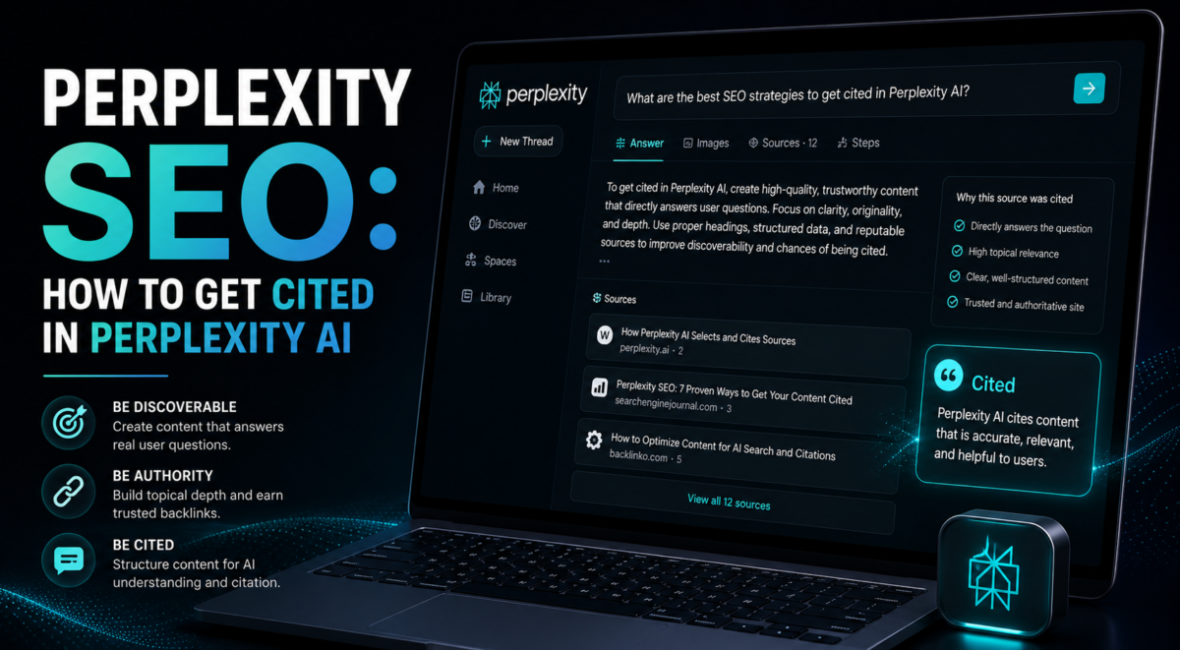
Ask Perplexity a real buying question and you get one synthesised paragraph with a short row of numbered footnotes beside it. Those footnotes are the whole prize. There is no page two, no position six, no long tail of blue links to squeeze into — only the handful of domains the engine judged worth quoting. That scarcity makes optimising for this engine a separate craft from classic search. It is also why Perplexity is the friendliest place to learn AI search: it shows you exactly who it trusted, and in 2026 it started paying some of them.
| Quick answer: Perplexity SEO is the work of getting your page selected as one of the three to five sources Perplexity cites in an answer. You win it by allowing PerplexityBot, answering the question in the opening lines, covering the full intent, publishing original data, and keeping pages current. |
Disclosure: TechieHub is reader-supported. Some links below are affiliate links and we may earn a commission if you subscribe, at no extra cost to you. It never changes a ranking or softens a limitation.
Table of Contents
What is Perplexity SEO, and why is it not ranking?
Perplexity SEO is the practice of getting a page selected as one of the sources an answer engine quotes, rather than one of ten links a results page lists. The unit of success is the citation, not the position. That single swap changes most downstream decisions: you stop writing for a query string and start writing for a prompt, you stop tuning a title tag for click-through and start tuning the first paragraph for extraction, and you stop reporting rank and start reporting your share of cited sources.
The discipline sits inside generative engine optimization and overlaps heavily with answer engine optimization. What makes this platform the best entry point is transparency. ChatGPT and Gemini rarely explain their retrieval; Perplexity numbers its sources inline and links every one, so fifteen minutes of testing tells you precisely who owns a prompt in your category today.
How does Perplexity choose the sources it cites?
Perplexity is a retrieval-augmented system. It interprets the prompt, runs retrieval against a live web index, then writes an answer grounded in the passages it pulled back. Nothing is quoted that was not retrieved first, so selection happens in two stages and your page has to survive both.
Retrieval rewards ordinary things: the page must be crawlable, indexed, topically unambiguous and reachable for the phrasing a human actually types. Synthesis rewards something narrower — passages that state a claim cleanly enough to be lifted without rewriting. A paragraph that hedges for four sentences before committing loses to one that answers in the first line and defends the answer afterwards.
Four properties keep recurring in the pages that win: extractability, intent completeness, originality and freshness. Originality matters most: a model summarising six pages that all say the same thing has no reason to prefer yours. Give it a number, a benchmark or a method that exists nowhere else and you become hard to replace.
Which crawlers have to reach your pages?
PerplexityBot vs Perplexity-User: what each one does
Two, and they behave differently. Perplexity’s crawler documentation describes PerplexityBot, the indexer that surfaces and links pages in Perplexity results, and Perplexity-User, which fetches a page on demand when a live question requires it. PerplexityBot respects robots.txt; Perplexity-User generally does not, because a person requested that specific fetch. Neither, the documentation notes, collects content to train foundation models.
How to allow PerplexityBot correctly
Allow PerplexityBot explicitly instead of relying on a permissive default, verify hits against the IP lists Perplexity publishes rather than trusting the user-agent string, and check that your CDN or bot-mitigation layer is not quietly returning 403s to it. Plenty of sites convinced they are invisible in Perplexity are simply blocked at the edge by a firewall rule nobody has reviewed since installation.
# Allow Perplexity's indexer explicitly
User-agent: PerplexityBot
Allow: /

# Perplexity-User fetches on a person's request and generally
# does not consult robots.txt — allowing it is a courtesy entry
User-agent: Perplexity-User
Allow: /
Then confirm it is working. Check your server logs for real PerplexityBot hits, and validate them against the IP ranges Perplexity publishes rather than trusting the user-agent string, which anyone can spoof.
What changed in 2026 that makes citations pay?
Comet, Perplexity’s browser, came out from behind its paywall and shipped free on desktop and mobile, moving the engine into everyday browsing rather than occasional research. Comet Plus, a $5 subscription bundled into Pro ($20/month) and Max ($200/month), added a compensation model that allocates revenue to publishers across three traffic types — human visits, search citations and agent actions — with the pool distributed to participants minus Perplexity’s compute costs, as Search Engine Journal reported.
The traffic is unusually valuable too. Semrush’s study of AI search traffic found the average AI search visitor is worth roughly 4.4 times a traditional organic visit on conversion rate, because people arrive having already compared their options inside the assistant.
| Traditional SEO | Perplexity SEO |
| Goal: rank inside the top ten | Goal: be one of three to five cited sources |
| Targets a keyword | Targets a conversational prompt |
| Wins on titles and click-through | Wins on extractable opening paragraphs |
| Page volume helps | Depth and original data help |
| Measured by position and impressions | Measured by citation share and referrals |
| Refresh when rankings slip | Refresh on a calendar, before facts age |
How do you build a page Perplexity can quote?
Start from a prompt list, not a keyword list
Write down twenty to forty questions a buyer would type as full sentences, then keep the ones where being cited could plausibly lead to a trial, a demo or a purchase.
Build each page in the order a model reads it
Lead with a direct answer in the first forty to sixty words, in plain declarative sentences with no throat-clearing. Define the entity, explain the process, show a worked example, then give the caveats and the next step. Put comparisons in real tables rather than prose, because tabular facts survive extraction intact. Attach dates and name your sources.
How we compare: we buy or trial every tool we rank, run one identical prompt set across each engine we cover, re-run it monthly on the same date, and publish the prompt list so anyone can reproduce the result.
Cluster your coverage and refresh on a schedule
Cluster your coverage so the whole theme lives on your domain instead of in one thin article, and refresh on a schedule rather than on panic. The same moves lift how to rank in ChatGPT and the wider LLMEO playbook, which is why this work compounds instead of fragmenting.
How do you measure Perplexity visibility?
Three instruments, in ascending order of cost. First, GA4: filter sessions whose source contains perplexity.ai and read the trend monthly rather than the absolute number. Second, a manual prompt panel — the same twenty prompts, run on the same day each month, logging which domains were cited and whether your brand surfaced in the synthesised text. It takes an hour and it is the only way to see who is beating you. Third, server logs, which tell you whether PerplexityBot is arriving at all.
Dedicated trackers fill the gap once the panel grows too large to run by hand. Entry-level monitoring starts near $29 a month, mid-market platforms sit in the €75 (about $85) to €169 (about $191) range, and enterprise suites covering ten engines quote custom pricing. Buy one only after the manual panel has shown you which prompts actually matter.
How did one content lead win back a category prompt?
Bethan Morris runs content for a mid-market payroll-automation platform. (The account is a composite of engagements we have run; the pattern is the ordinary one.) Her task was blunt. The company’s category page sat fourth on Google for “best payroll automation software” yet had never once been cited when she asked Perplexity the same question in plain English. Competitors with thinner backlink profiles were.
Diagnosis took an afternoon. The page opened with three paragraphs of brand narrative before naming a single product, the feature comparison lived in styled divs instead of a table, and pricing had last been verified fourteen months earlier. Nothing was technically broken. The page was simply unquotable.
The rebuild was equally blunt: a forty-word answer at the top naming the three leading tools and who each one suits, the comparison moved into a real HTML table carrying prices and a verification date, a short methodology block explaining how the tools were tested, and a ninety-day refresh reminder.
Six weeks later the page was appearing in Perplexity answers for four of her eight tracked prompts, and perplexity.ai referrals — previously a rounding error — became her third-largest assisted-conversion source. Her backlink profile had not changed at all.
Frequently Asked Questions
What exactly is Perplexity SEO?
It is the practice of optimising content so Perplexity selects it as one of the three to five sources cited in a generated answer. The target is source selection rather than a ranking position, which changes how you write openings, structure comparisons and measure success.
Do I need to allow PerplexityBot in robots.txt?
Yes, if you want to appear in Perplexity results. PerplexityBot respects robots.txt, so a disallow directive removes you from its index. Perplexity-User, which fetches pages on demand for a live question, generally ignores robots.txt because a person requested that specific page.
Does a Perplexity citation actually send traffic?
Yes, though less volume than a top Google position. Citations are clickable, so researchers wanting detail click through. Semrush found AI search visitors convert at roughly 4.4 times the rate of traditional organic visits, so the sessions are fewer but considerably more valuable each.
How is optimising for Perplexity different from ChatGPT?
Perplexity retrieves from the live web on nearly every query and numbers its sources inline, so freshness and crawlability matter immediately and wins are easy to audit. ChatGPT blends memorised knowledge with retrieval and cites less consistently, which makes attribution harder and feedback slower.
Can publishers get paid for citations?
Through Comet Plus, yes. The $5 subscription, included with Pro and Max, allocates revenue to participating publishers across human visits, search citations and agent actions, with Perplexity retaining a portion for compute costs. Participation happens by application rather than automatically for every site.
How long before optimisation shows up?
Faster than traditional SEO, because retrieval happens live rather than waiting on a slow index refresh. Teams commonly see cited-source changes within four to eight weeks of restructuring a page, assuming it is already crawlable and the topic is one Perplexity covers well.
Why is my site not showing up in Perplexity?
The most common cause is not content — it is a block you did not set deliberately. Check three things in order. First, whether your CDN or bot-mitigation layer is returning 403s to PerplexityBot, which is the single most frequent cause and often a firewall rule nobody has reviewed since installation. Second, whether robots.txt allows PerplexityBot explicitly rather than by permissive default. Third, whether the answer actually exists on the page as a short, quotable passage. Plenty of sites convinced they have a content problem are simply blocked at the edge.
How do I verify that PerplexityBot is really PerplexityBot?
Match the request IP against Perplexity’s published ranges, not the user-agent string. User agents are trivially spoofed, and scrapers routinely impersonate AI crawlers to bypass rate limits. Perplexity publishes its IP lists in its crawler documentation; validate log hits against those before concluding you are being crawled — or before blocking something you think is abuse.
Does schema markup help you get cited in Perplexity?
Indirectly, and less than most guides claim. Perplexity selects passages it can quote, so clear structure, a direct answer near the top and real tables do more than markup. Schema helps by making entities and dates machine-readable, which supports the freshness and attribution signals — but no amount of markup rescues a page whose answer is buried in paragraph nine. Structure first, schema second.
Conclusion
Perplexity is the one AI surface that shows its working, which makes it the cheapest place to learn what answer engines reward. The mechanics are unglamorous: let the crawlers in, answer in the first forty words, cover the whole intent, publish something only you could publish, put comparisons in tables, and refresh before the facts rot. Then measure with a prompt panel and a GA4 filter rather than a hunch. Do that and the same pages start earning citations across every other engine, which is the real argument for treating this as a branch of generative engine optimization rather than a one-platform trick. Start with your five highest-intent prompts and rebuild the page each one deserves.

7 Comments
Pingback: 15 Best AI Medical Research Tools 2026: Complete Guide
Pingback: 12 Best AI Tools for Academic Research 2026: Complete Guide
Pingback: 12 Best AI Code Documentation Tools 2026 [Complete Guide]
Pingback: Gong vs Chorus.ai 2026: Complete Comparison Guide
Pingback: 15 Best AI Sales Forecasting Tools 2026: Complete Guide
This content perfectly captures what makes your platform 🌈 so special and unique
Thank you for taking the time to share your thoughts! We truly appreciate the support and are glad you found value here. Stay connected—there’s more helpful content coming your way.