



| Quick answer |
|---|
| The best AI evaluation tools for production in 2026 are Langfuse at $29 a month for open-source teams, Braintrust at $249 for eval-first workflows, and LangSmith at $39 per seat for LangChain stacks. Arize AX starts at $50; Phoenix is free self-hosted. Choose on the billing unit, not the headline price. |
How we compare: prices below were re-read from each vendor’s own pricing page in September 2026. Tools are judged on entry price, what the free tier allows, the unit you are billed for, and retention. Every price was re-checked against the vendor’s own pricing page in September 2026, and figures available only from third-party trackers are marked as reported. We have not run a head-to-head benchmark and do not claim one.
Table of Contents
What makes an evaluation tool a production tool?
Almost every framework can score a model in a notebook. Production is a different problem: the inputs are real user traffic, the failures are rare and expensive, and someone has to be told before a release ships. A production-grade tool has to do four things — capture traces from live traffic, hold a frozen evaluation dataset, run scorers automatically on every change, and fail a build when quality regresses.
That is why LLM evaluation and AI observability collapsed into one category: you cannot score what you did not capture, and a trace you never score is an expensive log line. The tools below sit on both sides of that line and differ mostly in how they charge for it.
LLM evaluation is the practice of scoring model output against a fixed dataset and a written rubric, automatically, on every change. Observability is the capture layer underneath it — traces and spans from live traffic. A production tool does both; a notebook benchmark does neither.

Best AI evaluation tools for production compared
| Tool | Entry price | Free tier | What you are billed for | Best for |
|---|---|---|---|---|
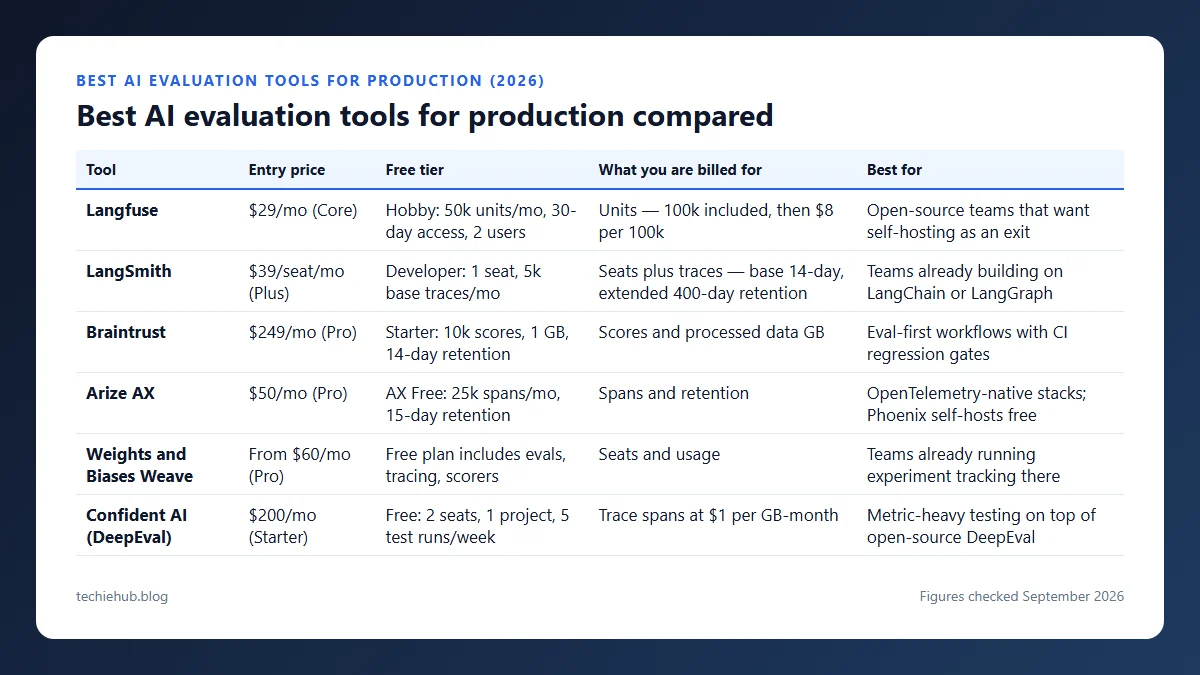
| Langfuse | $29/mo (Core) | Hobby: 50k units/mo, 30-day access, 2 users | Units — 100k included, then $8 per 100k | Open-source teams that want self-hosting as an exit |
| LangSmith | $39/seat/mo (Plus) | Developer: 1 seat, 5k base traces/mo | Seats plus traces — base 14-day, extended 400-day retention | Teams already building on LangChain or LangGraph |
| Braintrust | $249/mo (Pro) | Starter: 10k scores, 1 GB, 14-day retention | Scores and processed data GB | Eval-first workflows with CI regression gates |
| Arize AX | $50/mo (Pro) | AX Free: 25k spans/mo, 15-day retention | Spans and retention | OpenTelemetry-native stacks; Phoenix self-hosts free |
| Weights and Biases Weave | From $60/mo (Pro) | Free plan includes evals, tracing, scorers | Seats and usage | Teams already running experiment tracking there |
| Confident AI (DeepEval) | $200/mo (Starter) | Free: 2 seats, 1 project, 5 test runs/week | Trace spans at $1 per GB-month | Metric-heavy testing on top of open-source DeepEval |
The billing unit is the real decision
These six products charge for six different things, and that — not the entry price — decides your bill at production volume. Langfuse counts units. LangSmith counts traces and seats. Braintrust counts scores and gigabytes of processed data. Arize counts spans. Confident AI counts trace storage in GB-months.
- Retention is a price multiplier, not a setting. LangSmith separates base traces (14-day) from extended traces (400-day) and charges an upgrade fee for the longer window — the same trace costs more because you kept it. As of September 2026 the per-1k rates are no longer itemised on the pricing page, so get them in writing before you model a bill.
- Scoring multiplies your unit count. On a scores-based plan like Braintrust’s, running four scorers on every trace very nearly quadruples the line item.
- Free tiers are sized for evaluation, not production. 25k spans or 5k traces a month is a fortnight of a modest live agent.
- Two of these have a genuine zero-cost path. Phoenix and DeepEval are open source; Langfuse can be self-hosted. That is leverage in a renewal conversation.
The tools in detail
Langfuse
Open-source LLM observability and evaluation platform. Cloud Core is $29 a month with 100k units included and 90 days of data access; the Hobby tier is free with 50k units and 30 days. Pro is $199 for three-year retention, and Enterprise $2,499. Overage is graduated rather than flat — $8 per 100k units, falling to $7 above 1M, $6.50 above 10M and $6 above 50M — and a billable unit is any tracing data point, including the evaluation scores you write. Self-hosting is the exit route.
LangSmith
LangChain’s own tracing and evaluation product. Plus is $39 per seat per month with 10k base traces; the free Developer plan covers one seat and 5k. Overage is per trace, and retention changes the rate.
Braintrust
Evaluation-first platform built around versioned datasets, human and automated scoring, and CI regression gates. Pro is $249 a month with 50k scores, 5 GB processed data, 30-day retention and $100 of model credits; Starter is free with 10k scores, 1 GB and 14-day retention. Past the allowance you pay $1.50 to $2.50 per 1,000 scores and $3 to $4 per GB, which is why a four-scorer setup reprices the plan rather than nudging it.
Arize AX and Phoenix
Arize AX is the managed product at $50 a month for 50k spans and 30-day retention, with a free tier at 25k spans. Phoenix is the open-source, self-hosted sibling built on OpenTelemetry spans.
Weights and Biases Weave
Evaluation and tracing bolted onto the experiment-tracking suite many ML teams already run. The free plan includes evaluations, tracing and scorers; Pro starts at $60 a month, for teams under 50 employees.
Confident AI and DeepEval
The hosted platform for the open-source DeepEval metric library. The free tier allows 2 seats, 1 project and 5 test runs a week; Starter is $200 a month, with trace storage at $1 per GB-month.
A production eval method you can copy
No vendor publishes the method, only the dashboard. This is the shape that works regardless of which product you buy, and you can run it on the free tier of any of them before you commit.
- Freeze a golden set. Pull 50 real production inputs, including the ugly ones — empty fields, wrong language, prompt injection attempts. Version it. Never edit it silently.
- Write four scorers, not fourteen. Groundedness (is every claim supported by retrieved context), instruction-following, refusal correctness, and format validity. Four scorers you trust beat a dashboard of twenty you ignore.
- Run the judge with a rubric, not a vibe. A usable judge prompt reads: “Given the context and the answer, list each factual claim in the answer, mark it supported or unsupported by the context, then return a score of 0-1 as the fraction supported.” Scores you can audit survive arguments; a bare 1-5 rating does not.
- Calibrate on 20 human labels. Have a person grade 20 outputs, then check the judge agrees. If it does not, the judge is the thing that needs fixing.
- Gate the build. Any prompt, model or retrieval change reruns the golden set. A drop past your threshold fails CI. This is the step that turns LLM tracing into an actual safety net.
What these tools will not do
None of them evaluates an agent the way you need it evaluated. Scoring a single response is solved; scoring a trajectory — did the agent pick the right tool, in the right order, and stop when it should have — still comes down to scorers you write against your own span structure. Budget for that if you are shipping agents rather than a single-turn assistant. None of them tells you what “good” means for your product either — you still write the rubric. None fixes a retrieval pipeline returning the wrong documents, the root cause behind many failures people label as AI hallucinations. And none decides whether your quality problem is a prompt problem or an architecture problem; our comparison of fine-tuning versus RAG covers that trade-off, and the AI agent frameworks guide covers what you are instrumenting.
Frequently Asked Questions
What are the best AI evaluation tools for production?
Langfuse at $29 a month, Braintrust at $249 and LangSmith at $39 per seat are the three strongest production choices in 2026. Arize AX starts at $50 with a free 25k-span tier, Weave starts at $60, and Phoenix and DeepEval are free and open source if you self-host.
What does evaluation tooling cost at production volume for production LLM teams?
Cost at volume is decided by the billing unit, not the plan name. Langfuse bills units, at $8 per 100k above the included allowance and less at high volume. LangSmith bills seats plus traces, with a surcharge for 400-day retention over the 14-day default. Braintrust bills scores and processed data, and publishes its overage: $3 to $4 per GB and $1.50 to $2.50 per 1,000 scores. Model the unit you generate most, then compare.
Do you need a dedicated eval tool for production LLM teams if you already log traces?
Logs tell you what happened; evaluation tells you whether it was any good. If you already ship traces, the gap you are filling is scoring and regression detection: a frozen dataset, scorers that run automatically, and a gate that fails the build when quality drops. Some teams get there with Phoenix on existing OpenTelemetry infrastructure and never buy a separate product.
How do you evaluate LLM output without ground-truth labels for production LLM teams?
Use reference-free scorers. Three work in production: LLM-as-judge against a written rubric, groundedness checks that verify every claim traces to retrieved context, and pairwise comparison of the new output against the previous version. Add a small human-labelled sample to calibrate the judge, otherwise you are trusting a score nobody has ever checked.
How much do AI evaluation tools for production cost?
Published entry prices in September 2026: Langfuse Core $29 a month, LangSmith Plus $39 per seat, Arize AX Pro $50, Weave Pro from $60, Confident AI Starter $200, Braintrust Pro $249. Above those sit Langfuse Pro at $199, Confident AI Team at $2,000 and Langfuse Enterprise at $2,499. Phoenix and DeepEval are free to self-host. Everything above the included allowance is billed per unit, so the entry price is a floor.
Conclusion
Start on the free tier of whichever tool matches your stack, run the golden-set method above for two weeks, then look at the price list — by then you will know how many units, traces, spans or scores you actually generate, which is the number that decides the bill.
For most teams in 2026 that lands on Langfuse: $29 a month plus a self-hosting escape hatch is hard to argue with. Buy Braintrust when evaluation is the workflow rather than a feature, LangSmith when you are already deep in LangChain, and Phoenix when you would rather own the infrastructure than rent it.
