



| Quick answer |
|---|
| Label Studio is the best data annotation tool for most teams: the community edition is open source and free, and HumanSignal’s hosted Starter Cloud is $99 a month plus $49 per extra user. Roboflow is the vision specialist, free to start and $39 a month on Core. |
| How we compare |
|---|
| Ranking is based on published vendor documentation and pricing pages re-read on 20 November 2026: which data types each tool covers, what its AI assistance actually automates, and whether a genuine self-hosted path exists. We ran no head-to-head labeling benchmark and no lab test of our own. Every price was re-checked against the vendor’s own pricing page on 20 November 2026, and figures available only from third-party trackers are marked as reported. No vendor paid for placement or saw this page before publication. |
Table of Contents
What the AI in these tools actually does
The AI in a modern data annotation tool is not labeling your data for you — it is reducing the number of clicks per label. That distinction sets expectations correctly, because the marketing implies the first and the product delivers the second. Four mechanisms carry most of the value. For analysing interviews and open-ended feedback, see our guide to AI qualitative research tools.

- Pre-labeling. An existing model proposes labels and the human corrects them. This is the largest single time saving and it scales with how good your current model already is — which means it helps least at the start of a project.
- Model-assisted segmentation. Click an object, get a mask. On dense visual data — the imagery that trains physical AI systems — this is the difference between a viable project and an impossible one.
- Interpolation across frames. Label two keyframes in a video and let the tool fill the gap. CVAT built its reputation on this.
- LLM-as-a-judge and bulk labeling for text, now packaged into HumanSignal’s enterprise tier — useful for triage, unreliable as a final answer without a human-labeled calibration set.
What is data annotation?
Data annotation is the work of adding labels to raw data, such as boxes on images, tags on text or timestamps on audio, so a machine learning model can learn from it. An annotation tool speeds this up with pre-labels and shortcuts, but a person still decides what each label means.
Best data annotation tools compared
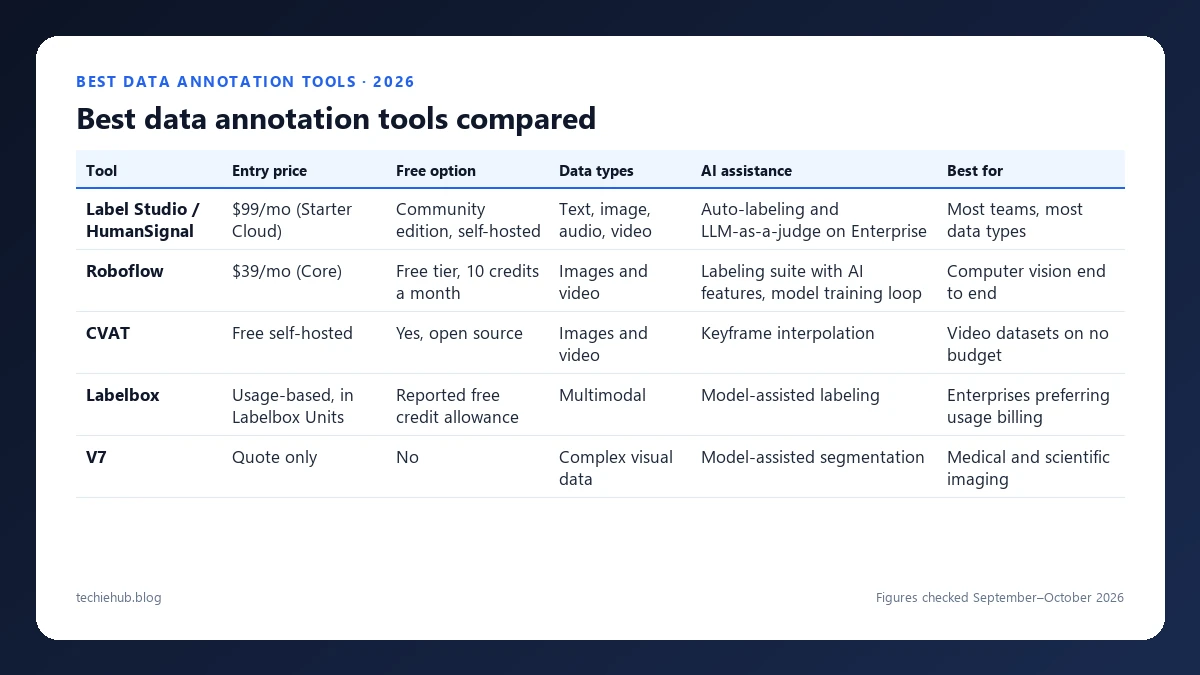
| Tool | Entry price | Free option | Data types | AI assistance | Best for |
|---|---|---|---|---|---|
| Label Studio / HumanSignal | $99/mo (Starter Cloud) | Community edition, self-hosted | Text, image, audio, video | Auto-labeling and LLM-as-a-judge on Enterprise | Most teams, most data types |
| Roboflow | $39/mo (Core) | Free tier, 10 credits a month | Images and video | Labeling suite with AI features, model training loop | Computer vision end to end |
| CVAT | Free self-hosted; Online from $23/user/mo (yearly) | Yes, open source | Images and video | Keyframe interpolation | Video datasets on no budget |
| Labelbox | Usage-based, in Labelbox Units | Reported free credit allowance | Multimodal | Model-assisted labeling | Enterprises preferring usage billing |
| V7 | Quote only | No | Complex visual data | Model-assisted segmentation | Medical and scientific imaging |
The tools in detail
Label Studio and HumanSignal
The default open-source choice, covering text, image, audio and video in one interface. The community edition is free to self-host; the hosted Starter Cloud is $99 a month plus $49 for each additional user up to twelve. Enterprise adds single sign-on, auto-labeling, bulk labeling and LLM-as-a-judge.
Roboflow
Computer vision specialist that runs labeling, training and deployment in one loop. Its pricing page, read on 11 October 2026, lists a free tier with 10 credits a month and a Core plan at $39 a month billed monthly, which adds another 10 credits; larger credit packs run from $89 for 35 credits. Workspaces are listed as private on both. That is a change from September, when the free Public plan required open data and Core was $79 to $99.
CVAT
Open-source annotation for images and video with interpolation between keyframes, which removes a large share of manual work on video datasets. Free to self-host with no seat limits; CVAT Online, the hosted version, has a free plan (one project, three tasks) and Team seats at $33 per user a month, or $23 billed yearly, for 2 to 50 seats (pricing page read on 20 November 2026).
Labelbox
Enterprise platform billed on usage rather than seats, priced in Labelbox Units. Its published pricing page did not load when checked in August, September or November 2026; third-party trackers report a free tier with a monthly LBU credit allowance and paid plans from a few hundred dollars per user per month. Confirm directly before budgeting.
V7
Quote-only platform aimed at teams labeling complex visual data, particularly medical and scientific imagery where model-assisted segmentation saves the most time. Expect a sales process rather than a signup form, and ask for pricing per labeled item as well as per seat.
Other platforms on 2026 shortlists: SuperAnnotate and Encord
Two more names appear on most 2026 shortlists, including G2’s data-labeling grid. Neither publishes a dollar price, so budget for a sales call.
| Platform | Plans listed | Data types (vendor pricing page) | Price |
|---|---|---|---|
| SuperAnnotate | Starter, Pro, Enterprise | Image, video, text and audio editors on every plan, plus a customizable multimodal editor | Not published; demo or sales |
| Encord | Quote-based | Images, video, audio, documents, DICOM and NIfTI medical files; LiDAR, 3D and LLM evaluation as add-ons | Not published; sales |
Seats, credits and units
The three billing models in this category behave very differently as a project grows. HumanSignal charges per seat, so cost scales with how many annotators you have. Roboflow charges credits, so cost scales with how much you process. Labelbox charges usage units, which is the same idea with a different name.
- Seat pricing punishes short bursts. Six annotators for two weeks costs a full month each on a per-seat plan. HumanSignal’s extra users at $49 add up quickly against a $99 base.
- Credit pricing punishes reprocessing. Re-running a dataset after fixing your guidelines consumes the credits twice.
- Self-hosting removes both problems and adds an operational one. Label Studio and CVAT are genuinely free, but somebody now owns the upgrades, the storage and the backups.
- Check the data terms on the free tier. Roboflow’s pricing page, read on 11 October 2026, lists free workspaces as private to your team, a change from the old Public plan that made data and models open. It also says free-tier data may be used to improve its products unless you opt out, so opt out before loading client work.
The seat-cost curve, worked out
Vendors quote a headline price, not a cost per annotator, so we worked one out from HumanSignal’s two published Starter Cloud figures: $99 a month for the plan and $49 a month for each additional user, capped at twelve users. Monthly bill = $99 + ($49 x extra users); cost per annotator = bill / annotators. Re-run it with your own headcount.
| Annotators | Monthly bill (arithmetic) | Cost per annotator | 12-month total |
|---|---|---|---|
| 1 | $99 | $99.00 | $1,188 |
| 3 | $99 + (2 x $49) = $197 | $65.67 | $2,364 |
| 6 | $99 + (5 x $49) = $344 | $57.33 | $4,128 |
| 12 | $99 + (11 x $49) = $638 | $53.17 | $7,656 |
The per-seat figure nearly halves between one annotator and twelve, so the plan gets cheaper per head exactly as the project scales. The number that matters is the right-hand column: $7,656 a year at twelve seats is the sum a self-hosted Label Studio or CVAT deployment has to beat with engineer time spent on upgrades, storage and backups. Below about six annotators, hosting is usually the cheaper problem to buy your way out of.

Guidelines beat tooling
The most common failure in a data labeling project for machine learning is not the software, it is two annotators disagreeing about an edge case for three weeks before anyone notices. Write the guideline document before the first label, include worked examples of the ambiguous cases, and measure inter-annotator agreement early. NIST’s AI Risk Management Framework puts the same point in governance language: measuring and documenting your data is part of the system, not paperwork around it. No amount of pre-labeling rescues a dataset whose definition of the label changed halfway through. Our guides to fine-tuning versus RAG, open source LLMs and AI tools for data analysis cover what happens to the dataset afterwards.
Frequently Asked Questions
What are the best AI tech for data annotation tools?
Label Studio is the best default: open source and free to self-host, with HumanSignal’s hosted Starter Cloud at $99 a month plus $49 per extra user. Roboflow is the computer vision pick, free to start and $39 a month on Core. CVAT is free for video work, while Labelbox and V7 sit at the enterprise end.
What does data annotation cost at production volume?
The software is rarely the expensive part. Platform pricing runs from free self-hosted through $23 to $99 a month for a small team, up to a few hundred dollars per user at enterprise level. The dominant cost at volume is the human labeling itself — annotator time, adjudication of disagreements, and the review pass that catches drift in the guidelines. Model the labeled items per month first; the subscription is a rounding error beside it.
Do you need an annotation tool if you already log model outputs?
Logs are not labels. Traces tell you what your system produced; an annotation tool is how those traces become a scored dataset with human judgement attached. If you already log, the missing pieces are a labeling interface, a guideline document, and an adjudication step for the cases where two reviewers disagree. That gap is small enough that a free self-hosted Label Studio instance often closes it.
How do you evaluate LLM output without ground-truth labels for data annotation?
Use scorers that need no reference answer, then anchor them with a little human labeling. Pairwise comparison against the previous version, a rubric-driven model judge, and consistency checks across repeated runs all work without labels. HumanSignal’s enterprise tier packages LLM-as-a-judge directly. The catch is that an unanchored judge drifts, for the same reasons a model hallucinates, so a small labeled sample remains the calibration you cannot skip.
How much do AI data annotation tools cost?
Published prices on 20 November 2026: Label Studio community edition is free to self-host and HumanSignal Starter Cloud is $99 a month with additional users at $49. Roboflow has a free tier with 10 credits a month, then Core at $39 a month billed monthly (re-read on 11 October 2026; it was listed at $79 to $99 in September). CVAT is free and open source. Labelbox bills on usage in Labelbox Units, and V7 is quote-only.
Is Label Studio really free?
The community edition is, but running it is not. Label Studio’s open-source edition costs nothing to self-host, with no seat limits, while HumanSignal’s hosted Starter Cloud is $99 a month plus $49 per extra user, up to 12 users. The trade-off is operational: self-hosting means someone owns upgrades, storage and backups, which is the cost the hosted plan removes.
Which data annotation tool is best for medical images?
Encord and V7 both target medical imaging, and Encord lists DICOM and NIfTI files as core data types. Both are quote-only. CVAT is a free self-hosted starting point for teams that can run their own infrastructure, though it is not built for clinical workflows.
Conclusion
Start with the free community edition of Label Studio, label 200 items by hand, and write the guideline document as you go. That exercise tells you your real throughput, your disagreement rate and the data types you actually need — three numbers no vendor comparison can give you.
Then buy on the constraint you found. Choose HumanSignal Starter Cloud at $99 if hosting is the problem, Roboflow at $39 if it is a vision pipeline you want end to end, and CVAT if the work is video and the budget is zero. Leave Labelbox and V7 for when scale or compliance forces the conversation. What you label for is the next decision — our comparison of the leading AI models covers which ones you will be evaluating against.
