


Disclosure: TechieHub is reader-supported. Some links are affiliate links and we may earn a commission, which never changes our verdict or your price.
A workflow automation platform is software that connects separate applications so an event in one system automatically triggers actions in the others, with no person in the loop. n8n and Zapier dominate that category in 2026, and they are far less interchangeable than the shared label implies. One is a fully managed, cloud-only service with the largest connector catalogue on the market; the other is a source-available engine you run on your own server and extend with real code. Choosing wrongly costs money in both directions: you overpay for convenience you never needed, or burn engineering weeks rebuilding what a $30 subscription solves on Tuesday.
The stakes have risen because automation is no longer a back-office nicety. McKinsey’s State of AI research reports that 88% of organisations now use AI regularly in at least one business function, that 23% are actively scaling an agentic AI system, and that another 39% are experimenting. Those agents need somewhere to run and tools to call — precisely the job these two platforms compete for.
| Quick answer: Choose Zapier if you want the fastest setup, the largest app catalogue (9,000+ integrations) and zero servers to manage — ideal for non-technical teams at modest volume. Choose n8n if you are technical and need self-hosting, native AI agents or far lower cost at scale, because n8n bills per whole-workflow execution rather than per individual step. |

How we compare: every figure below was checked against each vendor’s own published pricing and documentation, most recently on 10 October 2026, not against secondhand roundups. Where a claim is contested — app counts, “90% cheaper” headlines — we state the unit of measurement rather than repeat the marketing number.
Table of Contents
What is the actual difference between n8n and Zapier?
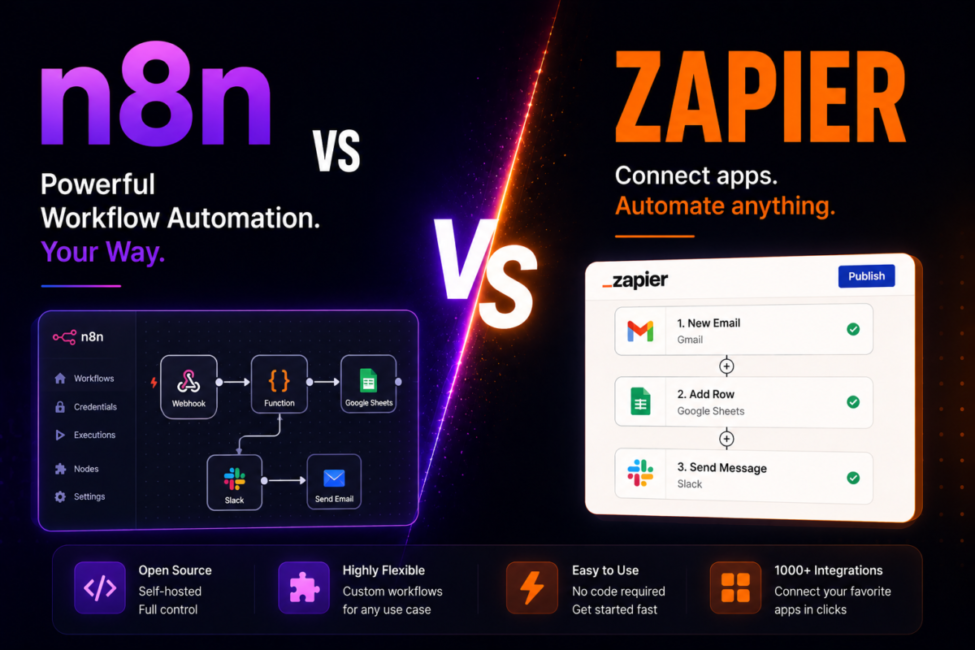
Zapier is a fully managed automation service. You build linear workflows called Zaps in a browser, Zapier maintains every connector, and you never touch a server. Its pricing page lists 9,000+ app integrations — the largest maintained catalogue in the industry — and its MCP server exposes more than 30,000 individual actions to AI clients.
n8n is a source-available automation engine under a fair-code licence. You can pay for n8n Cloud or self-host the Community edition free, indefinitely, on your own infrastructure. Its directory lists close to 2,000 nodes, and the generic HTTP Request node reaches any REST API whether or not a purpose-built node exists — so that number understates real coverage.
The structural difference is where the ceiling sits. Zapier’s ceiling is its connector catalogue and its billing meter; n8n’s ceiling is your team’s willingness to operate infrastructure. Nearly every other difference — cost curves, AI depth, data residency — follows from that split. Our breakdown of the best AI automation tools shows where both sit among the alternatives.
n8n vs Zapier: which platform wins on features?
Neither wins outright, because they optimise for opposite constraints. Zapier wins on breadth, reliability and time-to-first-workflow; n8n wins on control, extensibility and unit economics. The table compares the dimensions that change a buying decision.
| Factor | Zapier | n8n |
| App coverage | 9,000+ maintained integrations | ~2,000 nodes, plus any REST API via HTTP Request |
| Billing unit | Per successful action (task) | Per whole-workflow execution |
| Entry price | Free 100 tasks/mo; Professional from $19.99/mo annual (750 tasks) | Self-host free; Cloud Starter from €20 (about $23)/mo (2,500 executions) |
| Hosting | Cloud only | Cloud or self-hosted on your own servers |
| AI capability | Zapier Agents, Copilot, AI by Zapier, MCP server | Native AI agent nodes, memory, vector stores, RAG, MCP server |
| Extensibility | Code by Zapier steps | JavaScript and Python in-workflow, custom nodes |
| Learning curve | Shallow — usable in an afternoon | Steeper — expressions, nodes, Docker for self-hosting |

Which one gets cheaper as your volume grows?
How each platform defines a billable unit
This is arithmetic, not opinion, and it turns on a single definition. Zapier’s documentation states that a task is any successful action that runs in Zapier. n8n’s pricing page states that an execution is a single run of your entire workflow, no matter how many steps it contains.
The arithmetic on a ten-action workflow
Put a ten-action workflow firing 1,000 times a month through both meters: roughly 10,000 billable tasks on Zapier, 1,000 executions on n8n. Identical output, a tenfold difference in billing units. The gap widens with every step you add — exactly what happens when AI enrichment enters a pipeline.
Two corrections to the folklore
Two corrections to the folklore. First, Zapier is more generous than critics claim about what does not count: triggers, polling, filters, Paths, Formatter, Delay, Looping, Tables and Forms steps are all free, and failed actions are never billed. Second, the “90% cheaper” headline is not universal — it is what per-execution billing plus free self-hosting produces at high step counts and volume. Below a few thousand tasks a month, Zapier’s managed reliability justifies the premium.
The specialist rates that catch AI workflows
Watch the specialist rates too: a Zapier MCP tool call consumes two tasks, so an AI agent looping over tools meters faster than a conventional Zap. If your invoice has crossed roughly $300 a month, run the migration maths — and read our survey of the best Zapier alternatives before assuming n8n is the only exit.
Which platform is better for building AI agents?
n8n — architecturally AI-native
n8n is architecturally AI-native. It ships dedicated agent nodes alongside memory, embeddings, vector stores and retrieval-augmented generation, so an agent can decide at runtime whether to query a database, call an API, run code or reply. It supports multi-agent orchestration, planning agents and deep-research agents, and because you choose the model provider you can wire in Anthropic’s Claude Opus 5.5, OpenAI’s GPT-6 models, Google Gemini, or a local model on your own hardware. That last option is the one no cloud-only platform can match: for regulated data, keeping the engine and the model inside your perimeter is a requirement, not a preference. Our walkthrough on how to use n8n with AI covers the node-by-node build.
Zapier — integration-first
Zapier takes an integration-first approach and is strong on its own terms. Copilot drafts Zaps from plain English, Zapier Agents run assigned jobs across connected apps, and its MCP server publishes those apps to any client speaking the Model Context Protocol, the open standard for connecting AI applications to external tools. What Zapier lacks is a composable agent runtime: no self-hosted models, no vector-store primitives, no multi-agent graph you assemble yourself.
The test: is AI the workflow, or a step inside it?
The useful test is whether AI is the workflow or merely a step inside it. If the model reasons over documents, holds a conversation or routes decisions, n8n’s agent architecture repays its setup cost. If AI is one enrichment step in an ordinary app-to-app flow, Zapier is more than sufficient — a distinction we develop in our guide to the best AI workflow automation tools.
Real-world use case: a 14-person agency cuts its billing units 9x
Take an illustrative example, built from the two billing definitions above rather than from a named customer: Orla Byrne runs operations at a 14-person e-commerce agency. Her core workflow watched for a new client order, enriched it from three APIs, summarised the customer’s support history with an LLM, wrote to the CRM, posted to Slack and filed a record — nine billable actions, roughly 4,000 runs a month.
On Zapier that metered at roughly 36,000 tasks a month and had become the agency’s largest software line item. She did not rip out Zapier. She moved that single high-volume pipeline to self-hosted n8n on a small VPS, where the same 4,000 runs count as 4,000 executions — a ninefold reduction in billing units, with software cost falling to the price of the server.
Three client-facing workflows that touch niche apps with no n8n node stayed on Zapier Professional, because rebuilding those connectors would have cost more in engineering hours than the subscription. The main pipeline took two working days to rebuild, including Docker setup and backups, and now needs about an hour of maintenance a month. The honest lesson: the winning answer was both tools, split by volume and connector availability, not a migration.

This example is a composite of the agency automation switches we see most often, not a single client account; the figures are typical rather than measured from one engagement.
Which one should you choose?
Choose Zapier if…
Choose Zapier if nobody on your team wants to open a terminal, if you need a niche SaaS connector today, if volume sits under a few thousand tasks a month, or if managed uptime matters more than control. For most small businesses this is the right answer, and dismissing it as the unsophisticated choice costs real money in engineering time.
Choose n8n if…
Choose n8n if you have engineering capacity, if you are building AI agents with control over tools, memory and model providers, if compliance requires the engine to stay inside your infrastructure, or if step count has made per-task billing painful. Be honest about the hidden cost: self-hosting’s real price is your attention — server setup, upgrades and the occasional evening working out why a workflow stopped.
The deciding question: which resource are you short of?
The deciding question is not which platform is better, but which resource you are short of. Short of engineering time, buy Zapier. Short of engineering control, run n8n.
Frequently Asked Questions
Is n8n really free?
Yes, with a caveat. The self-hosted Community edition is free indefinitely under n8n’s fair-code licence and carries no execution limits, but you pay for the server and your own maintenance time. n8n Cloud is paid, starting at €20 (about $23) per month for 2,500 executions.
Is n8n open source?
n8n is source-available rather than strictly open source. The code is public and self-hostable under a fair-code Sustainable Use License, which permits internal business use but restricts reselling n8n as a hosted service. For most teams the practical freedoms are identical to open source.
Which is cheaper, n8n or Zapier?
n8n is cheaper at scale because it bills per whole-workflow execution while Zapier bills per successful action. A ten-step workflow running 1,000 times costs 10,000 Zapier tasks but 1,000 n8n executions. Below a few thousand tasks a month, Zapier’s managed service is usually the better value.
Can non-technical people use n8n?
They can, but with more friction. n8n’s canvas is visual and many workflows need no code, yet expressions, data mapping and self-hosting via Docker all assume some technical comfort. A motivated non-technical user can build in n8n Cloud; a whole non-technical team will move faster on Zapier.
Does Zapier support AI agents?
Yes. Zapier offers Zapier Agents, a Copilot that drafts workflows from plain English, AI by Zapier actions, and an MCP server that exposes thousands of apps to external AI clients. What it lacks is a composable agent runtime with self-hosted models, vector stores and multi-agent orchestration.
Can you migrate Zaps to n8n directly?
There is no official one-click importer, so migration means rebuilding workflows node by node. Most teams migrate only their highest-volume pipelines, where the billing saving justifies the effort, and leave low-volume or niche-connector Zaps in place. Budget one to two days per complex workflow.
Conclusion
n8n and Zapier are not competing for the same buyer, and the comparison only clarifies once you stop asking which is better and start asking which constraint binds you. Zapier sells removed friction: 9,000+ maintained connectors, no infrastructure, a workflow live in an afternoon, paid for in per-action billing that grows with your step count. n8n sells removed limits: self-hosting at server cost, a native agent runtime, any API through HTTP Request, and per-execution billing that stays flat as workflows deepen.
Most teams that get this right run both — Zapier for breadth and speed, n8n for the high-volume or AI-heavy pipelines where economics and control both matter. Price your own workflow against both meters before committing: the answer is set by your step count and volume, not by which vendor markets harder.
