


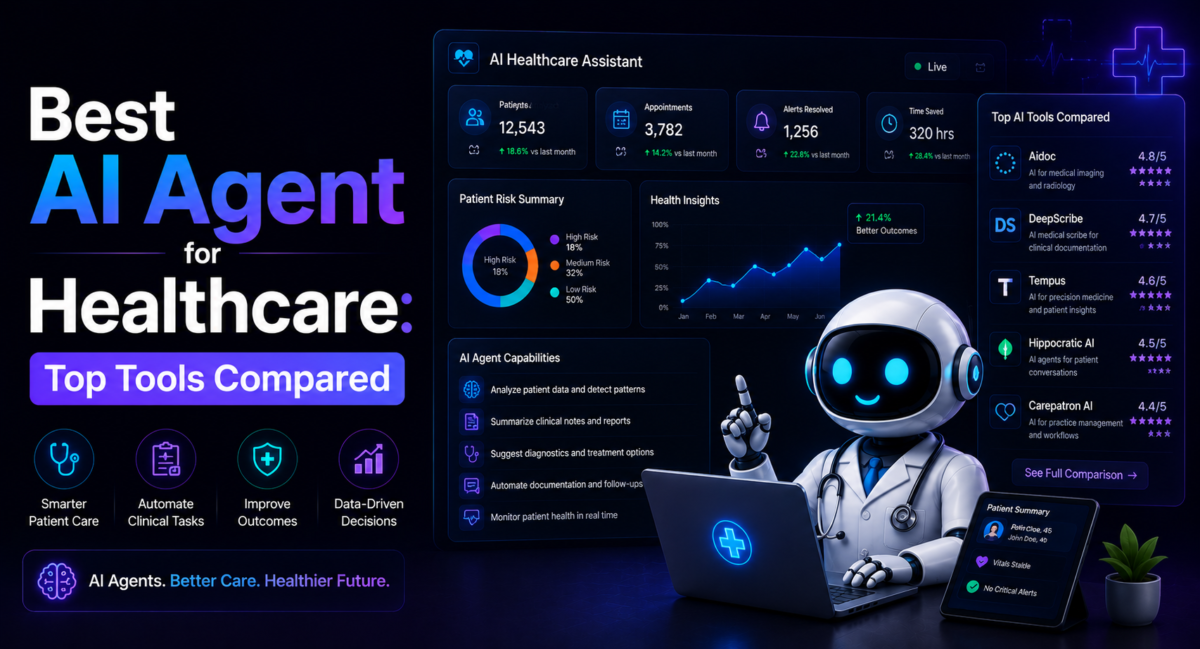
| Quick answer: The best AI agent for healthcare in 2026 is Abridge for enterprise ambient documentation, Dragon Copilot for scale plus dictation, Suki for voice-first individual physicians, and Nabla for evidence-backed multilingual notes. Patient-facing agents like Hippocratic AI handle outreach. Nearly all target administrative burden, not diagnosis, and every one must be HIPAA-compliant with a signed BAA. |
An AI agent for healthcare is software that autonomously completes administrative or operational clinical work — listening to a visit and drafting the note, checking insurance eligibility, or making follow-up calls — so licensed clinicians spend less time on screens and more time on care.
How we compare: we weight independent evidence (peer-reviewed trials, KLAS ratings), real deployment scale at named health systems, EHR integration depth, transparent access for solo versus enterprise buyers, and verifiable HIPAA and SOC 2 posture — not vendor marketing. Affiliate disclosure: some links below may earn TechieHub a commission at no extra cost to you; it never changes our rankings or the facts we report.

Table of Contents
What does an AI agent for healthcare actually do?
The center of gravity is ambient clinical documentation — AI scribes that listen to a patient encounter and generate a structured note with no typing. Around that core sit agents for scheduling and intake, billing and revenue-cycle management, prior authorization, and non-diagnostic patient outreach. The distinction that matters: today’s healthcare AI overwhelmingly automates the paperwork around care, while diagnosis and treatment stay with clinicians. That places these products firmly in the world of real-world agentic AI applications that execute defined, rule-bound tasks rather than exercise medical judgment.
The driver is burnout. Physicians have long spent close to two hours on documentation and desk work for every hour of direct patient care, and the AMA’s 2026 Physician AI Survey found that 81% of physicians now use AI in practice — up from just 38% in 2023 — with 70% seeing it as a way to reduce work-related burnout. Ambient documentation has crossed from pilot to system-wide deployment, which is why choosing the right tool now matters more than ever.
The best AI agent for healthcare: our top picks
No single product wins for everyone; the right choice depends on whether you are an enterprise health system or a solo clinician, and on which burden you want to remove first.

Abridge — the enterprise documentation leader
Abridge is the most widely deployed ambient scribe and Epic’s exclusive documentation partner, rated Best in KLAS for ambient AI in both 2025 and 2026. It runs at scale inside Kaiser Permanente (40 hospitals, roughly 24,600 physicians), Mayo Clinic (2,000+ physicians) and Johns Hopkins (6,700 clinicians), and it emphasizes evidence linking and patient-friendly summaries. The catch: it is enterprise-only, gated behind health-system contracts, so independent clinicians cannot simply sign up.
Dragon Copilot (Nuance / Microsoft) — scale plus dictation
Dragon Copilot has the largest installed base — over 100,000 daily clinicians — and is the leading product that combines ambient documentation with full voice dictation. Backed by Microsoft, it offers the deepest native Epic and Oracle Health (Cerner) integration and is built for the security and infrastructure demands of large hospital groups. Best for enterprises that want documentation and dictation in one mature platform.
Suki AI — the voice-first assistant
Suki is a voice-commanded assistant rather than a passive scribe: clinicians can dictate notes, pull up patient data and generate letters by voice, backed by a Google partnership. It accepts individual physicians and small practices and is notably strong on nursing documentation. Best for providers who want an interactive assistant experience.
Nabla — evidence-backed and multilingual
Nabla generates notes in seconds, supports 35+ languages including bilingual encounters, and is one of the few tools with published randomized-trial evidence — a NEJM AI study showing a statistically significant reduction in documentation time. It accepts individual physicians and adds pre-charting and medical coding. Best for clinicians who want proven, multilingual ambient documentation.
Freed, Heidi and PatientNotes — affordable solo scribes
These lightweight scribes work via clipboard or browser extension across any EHR, sidestepping integration overhead, and start as low as $50–$99/month with free trials. Heidi is strong for international and multilingual practices; Freed is doctor-built for outpatient primary care; PatientNotes suits budget-conscious solo clinics.
Hippocratic AI and OmniMD — patient outreach and operations
Hippocratic AI builds safety-first, strictly non-diagnostic patient-facing voice agents and reports 180+ million clinical interactions validated by 7,500+ U.S.-licensed clinicians, with new AI Front Door and Nurse Co-Pilot products launched in 2026. OmniMD bundles an AI scribe with scheduling, billing and revenue-cycle agents in one HIPAA-compliant, SOC 2-certified platform.

How do these healthcare AI agents compare?
The leaders at a glance, mapped to the buyer they fit best.
| Tool | Category | Best for |
| Abridge | Ambient documentation | Enterprise health systems on Epic |
| Dragon Copilot | Documentation + dictation | Large-scale Epic / Oracle deployments |
| Suki AI | Voice-first assistant | Individual physicians, nursing |
| Nabla | Evidence-backed scribe | Small practices, multilingual care |
| Freed / Heidi | Affordable scribe | Solo and small practices |
| Hippocratic / OmniMD | Outreach and operations | Patient outreach, scheduling, billing |
None publish enterprise pricing publicly, so every large deal starts with a sales conversation. The economics still favor AI heavily: roughly $50–$500/month for an AI scribe versus $3,000–$6,000/month for a human scribe, with comparable accuracy across most outpatient specialties. Because these agents act on defined steps rather than reason about care, it helps to understand the underlying pattern in our primer on what agentic AI is and how it works.
Beyond the scribe: scheduling, billing and outreach agents
Ambient documentation dominates, but the larger opportunity is operational. A true agent completes the next step on its own — checking eligibility, submitting a prior authorization, generating a claim, or working a denial — without a person triggering each action. OmniMD bundles these revenue-cycle agents with documentation, and orchestration platforms like Keragon wire intake systems together to reclaim staff hours.
On the patient side, non-diagnostic voice agents handle appointment reminders, pre-visit intake, follow-up calls and care-gap closure at scale; Hippocratic AI built its entire platform around safe, patient-facing interactions that explicitly avoid diagnosis. These tasks are high-volume, rule-bound and repetitive — exactly where automation is safe and savings are easy to measure, in contrast to clinical decisions where human judgment is irreplaceable. That boundary is the practical version of the difference explained in AI agent versus AI assistant: an assistant drafts and waits, an agent acts.
What do healthcare AI agents look like in practice?
Consider Dr. Leila Mansour, a family-medicine physician running a two-provider independent clinic who was staying late three nights a week to finish charts. Because Abridge is enterprise-gated, she trials Nabla instead — a tool that accepts individual sign-ups and handles her Spanish-speaking patients in-language. During visits she leaves the app listening on her phone; by the time the patient leaves the room, a structured SOAP note is drafted with suggested codes. She reviews and edits each note in the exam room while the encounter is fresh, signing most before the next patient. Independent research points to why this works: an ambient-AI study summarized by the National Library of Medicine found clinicians using these tools spent measurably less time in the EHR and composing notes. For Dr. Nair, the honest, illustrative outcome is not a headline statistic but a behavior change — charts finished before she leaves, and evenings back — which is exactly the burnout lever these agents are built to pull.
How do you choose the right healthcare AI agent?
Three factors decide it. First, practice size and access: enterprise systems on Epic gravitate to Abridge or Dragon Copilot, while independent and small practices need tools that accept individual sign-ups — Suki, Nabla, Freed or Heidi. Second, EHR integration: deep native Epic and Oracle Health integration matters for large systems, while clipboard or browser-extension tools sidestep integration entirely for solo clinics. Third, what you actually need: a pure ambient scribe, a voice-commanded assistant, or operational agents for scheduling and billing.
- Trial in your real workflow — with your actual patient mix and specialty, never a vendor demo.
- Measure editing time, not just draft speed — the time you save is the time you don’t spend correcting.
- Check accent and language handling for your patient population.
- Confirm it captures your common encounter types before you standardize.
What about HIPAA, safety and clinician oversight?
Healthcare is uniquely high-stakes, so a few principles are non-negotiable. Review every AI-generated note for accuracy, completeness and medical-necessity support before signing — AI can omit or misstate clinically important details, and the goal is documentation that preserves the clinician’s reasoning and authorship. Keep AI in administrative lanes: diagnosis, treatment and clinical judgment remain with licensed professionals.
Compliance is equally strict. Not all healthcare AI is HIPAA-compliant by default — verify a signed Business Associate Agreement (BAA), the vendor’s PHI-handling architecture, and SOC 2 (plus HITRUST where relevant) before anything touches patient data. Healthcare-specific vendors are typically built for this; general-purpose AI tools often are not. Diagnostic AI such as imaging or triage is separately regulated and may require FDA clearance. Used responsibly — AI for administration, clinicians for care, with strict compliance — these agents meaningfully cut the documentation load behind burnout. For the wider landscape, see our pillar guide to the best AI agent tools across every category.
The bottom line: the best AI agent for healthcare is the one that gives clinicians their time back while care decisions stay firmly with the professionals. Match it to your practice, keep a clinician reviewing every note, and verify compliance before anything touches patient data.
Frequently Asked Questions
What is the best AI agent for healthcare?
It depends on your setting. For ambient documentation, Abridge leads at enterprise systems on Epic, Dragon Copilot offers the largest scale plus dictation, Suki suits individual physicians wanting a voice assistant, and Nabla offers evidence-backed multilingual notes. Hippocratic AI leads non-diagnostic patient outreach. Choose by practice size, EHR and the burden you want reduced.
Can AI diagnose patients or replace doctors?
No. The healthcare AI agents covered here handle administrative work — documentation, scheduling, billing and non-diagnostic outreach — not diagnosis or treatment, which remain with licensed clinicians. Even clinical-decision-support features aid professional judgment rather than replace it, and diagnostic AI is separately regulated and may need FDA clearance before use.
Are AI medical scribes HIPAA compliant?
Not all of them by default. Healthcare-specific vendors are typically built for HIPAA, but general-purpose AI tools often are not. Before any agent touches patient data, verify a signed Business Associate Agreement, the vendor’s PHI-handling architecture, and SOC 2 certification (plus HITRUST where relevant). Never enter protected health information into a tool lacking these protections.
How much do AI scribes cost versus human scribes?
The economics favor AI heavily. AI scribes typically run $50–$500 per month per provider, compared with $3,000–$6,000 per month for a human scribe, with comparable accuracy in most outpatient specialties. Solo-friendly tools like Freed and PatientNotes start near $50–$99 monthly. Enterprise platforms run higher and require a sales conversation.
Do clinicians still need to review AI-generated notes?
Yes, always. AI scribes speed documentation dramatically, but clinicians must review every note for accuracy, completeness and medical-necessity support before signing, since AI can omit or misstate clinically important details. The best tools preserve the clinician’s reasoning and authorship. When a tool is accurate for your specialty, review becomes a quick verification — but it is never optional.
What is the best AI scribe for a small or solo practice?
Solo practices need tools that accept individual sign-ups, since enterprise scribes like Abridge are contract-gated. Suki and Nabla accept individual physicians, while Freed, Heidi and PatientNotes are affordable, work via clipboard or browser extension across any EHR, and offer free trials from about $50–$99 monthly. Trial it in your real workflow before standardizing.
Do AI scribes integrate with Epic, Cerner and other EHRs?
Most do, but “integrates” covers a wide range and the difference is worth pinning down. At one end the note writes directly into the chart in the right fields, ready for review and signature. At the other, the tool produces a note you copy and paste — which still helps, but gives back noticeably less of the time you bought it for. Ask specifically whether the integration is bidirectional, whether it pulls patient context in as well as pushing the note out, and which of your specialties’ note templates it supports.
Depth varies by vendor and by your own setup. Abridge is Epic’s exclusive documentation partner and embeds natively; Dragon Copilot integrates broadly across major EHRs including Epic and Cerner; the lower-cost solo tools often work standalone by design. Two practical cautions: your organisation’s IT governance may gate the integration regardless of vendor readiness, and integration depth is usually tied to the pricing tier — confirm the tier you are quoting actually includes it.
Conclusion
Your EHR narrows the field before any feature comparison does. An ambient scribe that writes into the chart without a copy-paste step saves a clinician far more time than one with marginally better transcription and no integration — which is why Epic sites gravitate to Abridge and Microsoft-stack organisations to Dragon Copilot. Settle the integration question first, and the shortlist usually reduces to two.
After that it is scale and budget. Enterprise health systems are buying deployment support and EHR depth; a solo clinician paying out of pocket gets most of the benefit from Freed or Heidi at a fraction of the cost. Whatever you choose, pilot it with real clinicians on real encounters rather than a vendor demo — the differences that matter show up in specialty vocabulary, accented speech and messy multi-speaker rooms, not in a scripted walkthrough. See our pillar guide to the best AI agent tools for the wider category, and AI medical research tools if the need is literature and evidence rather than documentation.
