


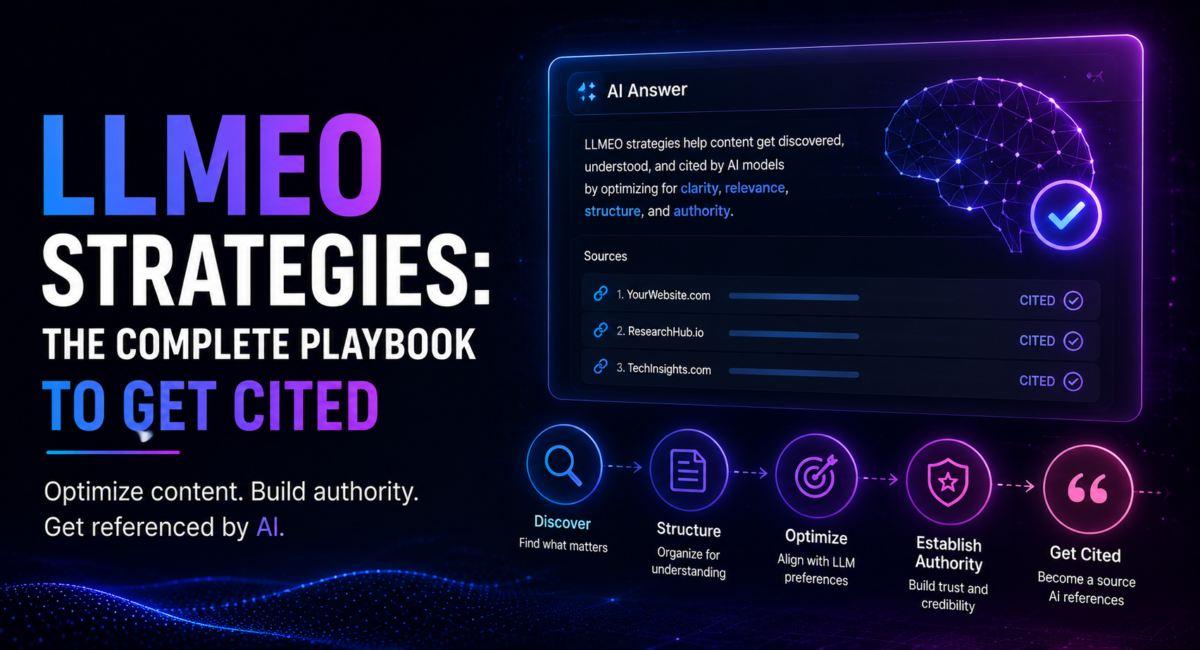
Most teams meet this topic as a list of forty tactics with no instruction on which one to do first. LLMEO, or large language model engine optimization, is the practice of shaping a website so that assistants such as ChatGPT, Claude, Gemini and Perplexity can retrieve a passage from it, trust it, and cite it inside a generated answer. The tactics that matter are few, they are ordered, and several popular ones have been measured and found to do nothing. This page is the execution sequence: what to change, in what order, and how to tell whether it worked.
| Quick answer: Audit crawler access first, because a blocked search bot makes every other change worthless. Then rewrite pages so each passage answers one question and stands alone, add named sources and statistics to every claim, earn accurate mentions on independent sites, and refresh on a fixed cadence. Order matters more than volume. |
Table of Contents
Which LLMEO strategies actually move citations?
Two findings should set your priorities. The first is academic: the KDD 2024 study GEO: Generative Engine Optimization, from researchers at Princeton, Georgia Tech, the Allen Institute for AI and IIT Delhi, tested nine content edits across roughly 10,000 queries. Adding statistics, direct quotations and cited sources lifted visibility in generated answers by up to 40 percent; cosmetic edits such as keyword stuffing did not.
The second is commercial. Ahrefs analysed 863,000 keywords and four million AI Overview URLs and found that only 38 percent of cited pages ranked in Google’s top ten for the same query in March 2026, down from 76 percent in July 2025. Roughly 31 percent of citations now come from pages that rank nowhere in the top 100. A page-one ranking is no longer a proxy for citation, which is why this work is separate from ordinary SEO and sits inside the broader practice of generative engine optimization.
Sequence accordingly: access, then passage structure, then evidence, then off-site corroboration, then maintenance. Each stage is worthless if the one above it is broken. For the underlying mechanics rather than the moves, our companion explainer covers how language models retrieve and choose their sources.
How do you configure crawler access in 2026?
The most common failure is a robots.txt file written before AI search existed. OpenAI and Anthropic now run separate crawlers for training and for search, and the two decisions are independent. Blocking a training crawler does not remove you from that company’s search answers; blocking a search crawler does. Per OpenAI’s crawler documentation, sites that disallow OAI-SearchBot “will not be shown in ChatGPT search answers.” The rule is binary.
Which AI crawlers should you allow?
| User agent | Operator | Purpose | Cost of blocking it |
| GPTBot | OpenAI | Foundation model training | None to ChatGPT search visibility |
| OAI-SearchBot | OpenAI | ChatGPT search results | Removed from ChatGPT search answers |
| ClaudeBot | Anthropic | Model training | None to Claude search visibility |
| Claude-SearchBot | Anthropic | Claude search indexing | Removed from Claude search results |
| PerplexityBot | Perplexity | Search index | Removed from Perplexity citations |
| Google-Extended | Gemini training and grounding | None to Google Search or AI Overviews indexing |

Anthropic documented the same three-bot split in February 2026: ClaudeBot for training, Claude-SearchBot for search indexing, and Claude-User for pages fetched when a person asks Claude a question. Anthropic states that all three honour robots.txt, a stricter commitment than OpenAI and Perplexity make for their user-initiated fetchers.
A working starting point. This allows the three crawlers that decide whether you can be cited, while declining the training crawlers — the split the table above describes. Adjust it to your own position on training, but keep the search agents allowed unless you have decided you do not want the citations.
# AI search crawlers — these decide whether you can be cited
User-agent: OAI-SearchBot
Allow: /

User-agent: Claude-SearchBot
Allow: /

User-agent: PerplexityBot
Allow: /

# Training crawlers — blocking these costs no search visibility
User-agent: GPTBot
Disallow: /

User-agent: ClaudeBot
Disallow: /

User-agent: Google-Extended
Disallow: /
Does JavaScript rendering block AI retrieval?
Yes, often. Serve the answer in server-rendered HTML, because retrieval crawlers do not reliably execute JavaScript and will miss content that only appears after hydration. A passage a model cannot fetch cannot be cited, however well written it is.
Should you publish an llms.txt file?
Not as a first move. Ahrefs crawled 137,210 domains in May 2026 and found 97 percent of existing llms.txt files were never fetched by anything. Google’s guidance on AI features is blunter still, stating that no new machine-readable files, AI text files or special schema.org markup are required to appear in AI Overviews or AI Mode. Fix crawler access and passage structure first; revisit llms.txt only if adoption changes.
How should you write a passage a model can lift?
Retrieval operates on chunks, not documents. A model rarely ingests a whole article; it pulls two or three paragraphs and reasons over them. The unit of optimization is therefore the passage, and a good passage has three properties.
It answers in its first sentence. Put the resolution before the reasoning, then expand. A paragraph that spends three sentences setting up context gives a model nothing quotable in the window it actually retrieved.
It names its own subject. A paragraph beginning with “It”, “This” or “They” becomes meaningless the moment it is separated from its neighbours. Rewriting those openings so each names its subject is the highest-return editing pass available, and it takes an afternoon on a ten-page site.
It carries its own evidence. A claim with a number, a date and an attributed source survives extraction; a claim without them reads as opinion and gets dropped. This is the mechanism behind the Princeton finding, and it is why the same passage performs across engines rather than needing per-platform rewrites. Genuine platform differences are matters of retrieval timing and index freshness rather than writing style, which we cover in our guide to getting cited inside ChatGPT specifically.
Keep entity naming consistent throughout. If your product is “Ledgerly Payroll” in one paragraph and “the platform” in the next, you have halved the number of chunks that tie the capability to the name.
Where does off-site corroboration come from?
On-page work makes you extractable; off-page work makes you safe to quote. Models cross-reference, and a claim about your company that appears identically on five independent sites is treated very differently from one that appears only on your own domain.
The practical moves are unglamorous: get listed accurately in the comparison roundups your category already has, publish original data other writers need to cite, respond to journalist queries with attributable commentary, and correct wrong descriptions of your product wherever they appear. That last one matters more than it sounds, because an inaccurate third-party description propagates into answers as confidently as an accurate one.
Reviews and community discussion count as corroboration, and so does video: the same Ahrefs data shows YouTube supplying 18.2 percent of all AI Overview citations that come from outside the top 100. Coverage across formats beats depth in one. These signals also feed conventional answer engine optimization, so the investment is not stranded if AI referral volume plateaus.
What does a refresh cycle look like?
Freshness is a retrieval signal, and changing a date without changing content does nothing. Set a quarterly review on your twenty most important pages and require that each refresh replace one stale figure, add one newly answered question, and remove one claim that is no longer verifiable. Discontinued products, superseded pricing and statistics that have quietly lost their source are what embarrass you when a model quotes them back at a prospect.

Measure with mention rate rather than rank. Choose thirty prompts a real buyer would type, run them monthly across the assistants your audience uses, and record how often you appear and which URL is cited. Change one variable at a time. A move that lifts appearance from four prompts to eleven is a result; a move that changes nothing after two cycles should be abandoned rather than defended.
How Rosamund turned a payroll blog into a cited source
Rosamund Fairweather runs content at a six-person payroll-software company selling to UK accountancy practices. Her task in February 2026 was awkward: three prospects had told the founder that ChatGPT recommended two competitors and not them.
The audit took ninety minutes. A security plugin had added a blanket disallow for every user agent whose name contained “bot”, silently catching OAI-SearchBot and PerplexityBot. Nothing published in fourteen months had been retrievable by either engine.
Rosamund fixed robots.txt, then spent three weeks on eighteen existing pages rather than writing new ones. Every paragraph opening with a pronoun was rewritten to name its subject. Every unsourced statistic was sourced or deleted. Each page gained a plain-language answer in its opening two sentences, and the company’s name replaced “our platform” throughout.
She tracked thirty buyer prompts monthly. In February the company appeared in two; by the end of May it appeared in fourteen, and the first inbound demo citing an AI recommendation arrived in April. No new articles shipped in that window, which was the point: the content existed and had simply been unreachable and unquotable.
This example is a composite of the optimisation projects we see most often, not a single client account; the figures are typical rather than measured from one engagement.
Frequently Asked Questions
What is the fastest LLMEO win for a site starting from zero?
Audit robots.txt for AI search crawlers. Security plugins and CDN rules frequently block OAI-SearchBot, Claude-SearchBot and PerplexityBot by accident, which removes a site from those engines entirely regardless of content quality. The check takes under an hour and unlocks every subsequent tactic.
In what order should the tactics be executed?
Crawler access first, then passage structure, then evidence and citations, then off-site corroboration, then a maintenance cadence. Each stage depends on the one before it. Rewriting content while a search crawler is blocked produces no measurable change, which is how most teams conclude the discipline does not work.
Do I have to allow AI training on my content to get cited?
No. OpenAI and Anthropic run separate crawlers for training and search. Blocking GPTBot and ClaudeBot stops training data collection while allowing OAI-SearchBot and Claude-SearchBot keeps a site eligible for citation in ChatGPT and Claude search answers. The two decisions are genuinely independent.
How long should a passage be to be lifted cleanly?
Roughly 40 to 80 words, covering exactly one question, with its subject named explicitly and any statistic attributed inline. Longer paragraphs mix multiple claims and get truncated mid-thought. Shorter ones lack enough context for a model to use them without surrounding text.
Does schema markup help a page get cited by AI assistants?
Structured data helps machines parse a page but is not a citation requirement. Google states explicitly that no special schema.org markup is needed to appear in AI Overviews or AI Mode. Article and FAQPage markup remain worthwhile for conventional rich results and cost little to add.
How do I tell whether an LLMEO change worked?
Track mention rate across a fixed prompt set rather than a ranking position. Run the same 30 buyer questions monthly, record how often the brand appears and which URL is cited, and change one variable per cycle. Expect six to twelve weeks before retrieval reflects an edit.
How is LLMEO different from GEO and AEO?
They describe the same goal at different scopes. Answer engine optimization is the oldest and broadest term, covering any engine that returns a direct answer rather than links. Generative engine optimization narrows that to engines which generate prose, and is the term the KDD research uses. LLMEO narrows it further to large language models specifically, and is the most execution-focused of the three. In practice the tactics overlap almost entirely, and the sequence on this page applies whichever label your team prefers.
What does LLMEO stand for?
LLMEO stands for large language model optimization. It describes making your content retrievable and trustworthy enough that assistants such as ChatGPT, Claude, Gemini and Perplexity cite or recommend you inside generated answers, rather than merely ranking your page in a list of blue links.
Do I need an llms.txt file for LLMEO?
Not for visibility. A study of nearly 300,000 domains found no correlation between having the file and being cited, and major AI crawlers request HTML instead. Add one if you like, since it takes an hour, but never in place of genuinely crawlable pages.
How long before LLMEO work shows results?
Expect three to six months. Technical fixes register within weeks once crawlers revisit, evidence-led rewrites take a couple of retrieval cycles, and third-party corroboration is slowest of all. Overnight jumps usually reflect one lucky sample rather than a durable change in mention rate.
Can I pay to appear in AI answers?
Not legitimately. Vendors promising to inject your brand into ChatGPT are selling something they cannot deliver, and models increasingly discount manipulated content. If a tactic would embarrass you in front of a human reader, the model will eventually discount it too.
Does traditional SEO still matter for LLMEO?
Very much. Several assistants browse through conventional search indexes, so pages that are indexed, fast and well structured form the candidate pool retrieval draws from. Strong SEO no longer guarantees citation, but weak SEO reliably prevents it.
Conclusion
The evidence in 2026 points one way: citation is earned by pages that are reachable, self-contained and sourced, and it is no longer inherited from a top-ten ranking. Fix access first, because it is binary and cheap. Rewrite for the passage rather than the page, because retrieval works on chunks. Attach a number, a date and a source to every claim, because that is the edit with measured effect behind it. Then corroborate off-site and maintain on a schedule. Teams that follow that order see movement within a quarter; teams that start by publishing more usually cannot tell whether anything changed at all.
How we compare: every statistic here was re-verified against its primary source, most recently on 2 October 2026, favouring peer-reviewed research, published crawler documentation and first-party platform guidance over vendor blog posts. Claims we could not trace to a named source were removed rather than rounded, and our llms.txt guidance was revised after the May 2026 crawl data superseded earlier estimates.
Disclosure: TechieHub may earn a commission from some links on this site. This does not affect which tools or tactics we recommend, and no vendor reviewed this article before publication.
Related: our AEO tools roundup covers what to use for measurement.

9 Comments
Pingback: 12 Best AI Tools for Academic Research 2026: Complete Guide
Pingback: 15 Best AI Sales Forecasting Tools 2026: Complete Guide
Pingback: 20 Best AI Tools for YouTube Automation 2026
Pingback: 15 Best AI Tools for Generating Images for Designer
Pingback: Answer Engine Optimization to Get Cited by AI First
Pingback: Generative Engine Optimization to Dominate AI Search
Pingback: LLMEO: Large Language Model Optimization Explained - Techiehub
Pingback: Best Answer Engine Optimization Tools That Actually Work
Pingback: Perplexity SEO Guide to Rank in AI Powered Search